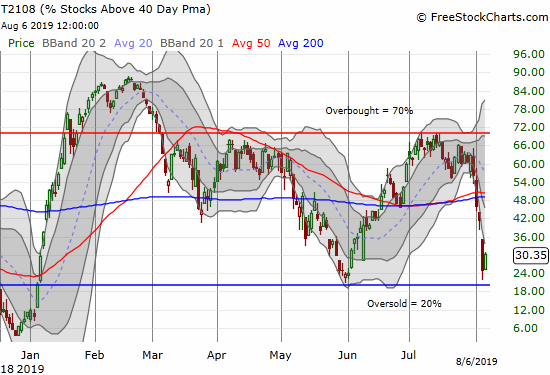
Stock Market Indices Break South On Expanded Border Tensions – Above the 40 (May 31, 2019)

AT40 = 23.8% of stocks are trading above their respective 40-day moving averages (DMAs) (hit a low of 20.7%)AT200 = 36.9% of stocks are trading above their respective 200DMAs (2 1/2 month low)VIX = 18.7Short-term Trading Call: neutral Stock Market Commentary So much for the potential for follow-through on bullish divergence! Perhaps the failure is … Read more

Above the 40 (April 26, 2019) – Stock Market Highs Continue Cradling Bearish Divergence

AT40 = 61.6% of stocks are trading above their respective 40-day moving averages (DMAs)AT200 = 53.9% of stocks are trading above their respective 200DMAsVIX = 12.7Short-term Trading Call: neutral (change from bearish) Stock Market Commentary The week ended with a U.S. GDP report for Q1 2019 that represents well the state of the stock market: … Read more

Above the 40 (April 18, 2019) – Exhausted Buyers and Reluctant Sellers Make A Stock Market Dribble

AT40 = 58.9% of stocks are trading above their respective 40-day moving averages (DMAs)AT200 = 52.5% of stocks are trading above their respective 200DMAsVIX = 12.1Short-term Trading Call: bearish Stock Market Commentary The S&P 500 (SPY) ended the previous week looking ready to lunge for its all-time high. Surprisingly, buyers decided to take a rest, … Read more

Above the 40 (April 9, 2019) – Stock Market Fades from the Edge of Overbought

AT40 = 58.4% of stocks are trading above their respective 40-day moving averages (DMAs)AT200 = 48.4% of stocks are trading above their respective 200DMAsVIX = 14.3Short-term Trading Call: bearish Stock Market Commentary Ever since the last overbought period ended, the stock market has experienced just two clear bearish signals. Each time, the bearishness was well-telegraphed … Read more

Recession Risks Revealed in the “Disindependence” of the Federal Reserve

Major central banks typically cut interest rates in response to economic stresses; they ease when the data force them to do so. Some important exceptions in recent history happened 1) in 2016 when Mark Carney’s Bank of England cut rates as a cushion against the potential downsides of the pro-Brexit vote, and 2) when the … Read more