

Stock Market Analysis Summary
|
Stock Market Commentary
Last week’s trading was a wild affair. Headlines tugged, pulled, and pushed on financial markets. After the dust settled, the prior week’s widening cracks in the stock market progressed and transitioned to cracks wide open. It seems the core issue amid the swirl is a liquidity problem partially related to poor sentiment and contagion from foreign exchange and cryptocurrency. The crypto market buckled under a major liquidity issue after the economic war between the U.S. and China abruptly erupted once again on October 10th. While the stock market quickly returned to melt-up mode in anticipation of Presidents Trump and Xi pretending to be besties once again, Bitcoin (BTC/USD) never recovered. Thanks to permabull Tom Lee, I now realize the significance of the damage. Brian Sullivan from CNBC called his interview with Tom Lee explaining crypto’s problems his most important interview of the year.
Over-leveraged institutional funds got hit by the one-day shock and have been in liquidation mode ever since. The contagion from this selling finally showed up this month after too many Federal Reserve members talked hawkishly about holding off from cutting rates in December. A potential unwind of the Japanese yen carry trade is exacerbating liquidity issues for risk assets. I am not yet convinced that a carry trade unwind is significantly weighing on financial markets because the yen is weakening not strengthening as it normally would during an unwind. Regardless, the accompanying deterioration in market breadth summarizes all these problems.
Add to this churn the growing fears of the bursting of a bubble in AI epitomized by Michael Burry announcing his massive short position against NVDA and Palantir (PLTR). I posted on social media my “funny math” that breaks down these bubble fears. One third of people think there is an AI bubble. Another third think there cannot be a bubble because so many people are talking about an AI bubble. The last third has no idea and are just hoping nothing bad happens soon while assuming they will get out of the way before that bad thing happens. I am wondering how many more bubble skeptics does it take to signal that there is indeed a bubble? Anyway, this fear will linger until the massive spending starts to show material returns.
During Wednesday evening’s earnings announcement, Nvidia CEO Jen-Hsun Huang tried to dispel concerns over an AI bubble. (Surprisingly, the word bubble was only mentioned once.) He referenced three major transformations that require massive and on-going investments. From the transcript of the Q3 earnings conference call:
“…there are 3 massive platform shifts. The transition to accelerated computing is foundational and necessary, essential in a post-Moore’s Law era. The transition to generative AI is transformational and necessary, supercharging existing applications and business models. And the transition to agentic and physical AI will be revolutionary, giving rise to new applications, companies, products and services.
As you consider infrastructure investments, consider these 3 fundamental dynamics, each will contribute to infrastructure growth in the coming years. NVIDIA is chosen because our singular architecture enables all 3 transitions. And thus so, for any form and modality of AI across all industries, across every phase of AI, across all of the diverse computing needs in the cloud and also from cloud to enterprise to robots, one architecture.”
Huang’s reassurances worked temporarily. The stock popped 5% or so after hours and held on for a gap up above the former all-time high. Sellers took over from there. I present more on the aftermath in the review of individual stocks below.
Finally, financial markets finally got some relief on Friday after NY Federal Reserve Governor John Williams hinted that maybe, just maybe, he would be open to a rate cut in December.
“I view monetary policy as being modestly restrictive, although somewhat less so than before our recent actions. Therefore, I still see room for a further adjustment in the near term to the target range for the federal funds rate to move the stance of policy closer to the range of neutral, thereby maintaining the balance between the achievement of our two goals.”
Williams did not even offer specific dates for his rate cut trajectory. Yet, prior sentiment had become so negative and pessimistic that the market snapped to attention and sent the odds of December rate cut soaring from around 30% to as high as 70%, a massive turnaround. Per the FedWatch Tool as of November 23, 2025:
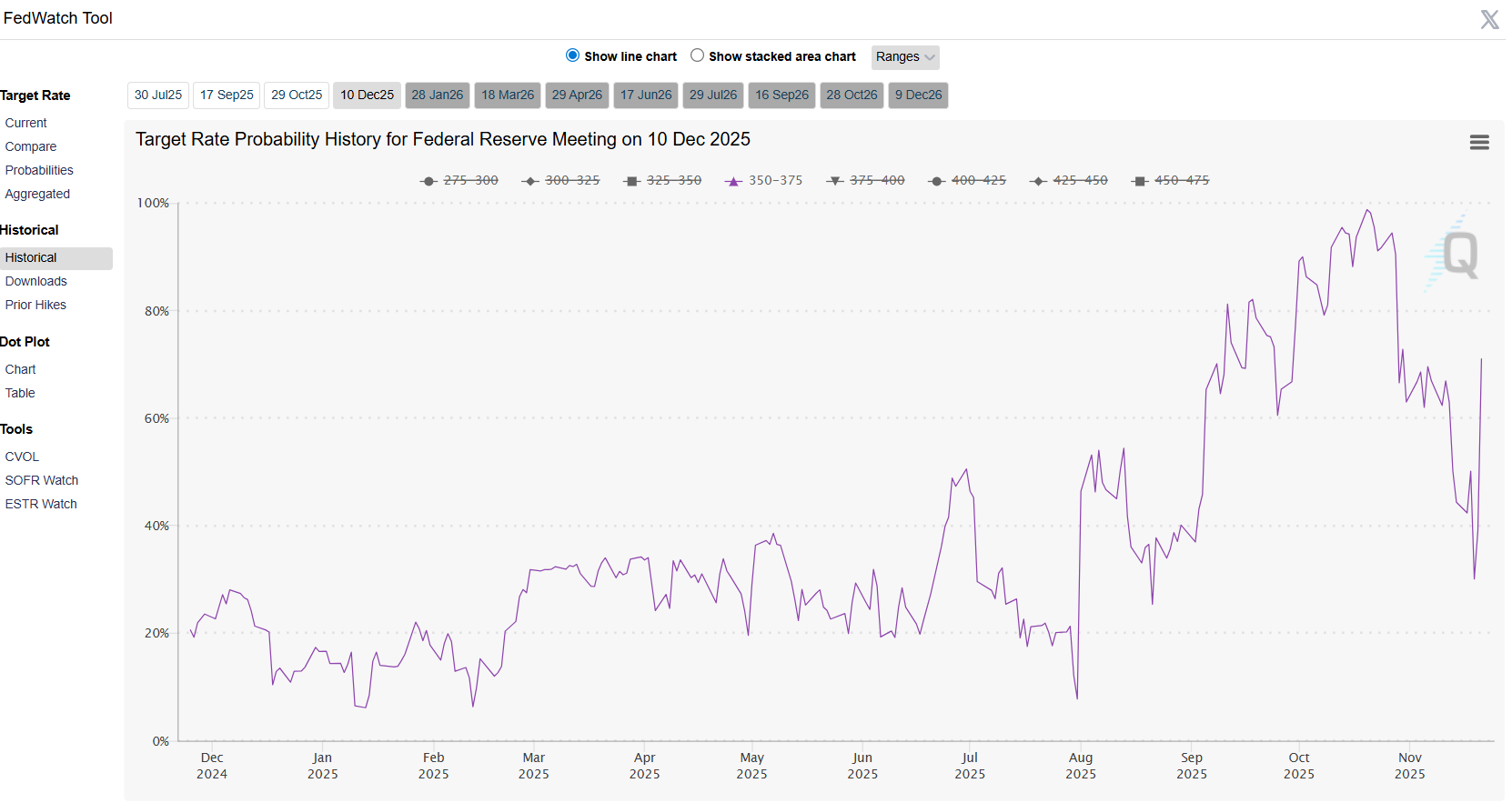
Market sentiment was so bad at the time that Williams’s Fedspeak was enough to ignite rate cut odds and take stocks along for the ride. I used to follow these data closely, but I now appreciate that these odds mean almost nothing given they are subject to so much change. For example, the odds for a rate cut could plunge all over again as the hawkish Fed members reiterate their concerns about inflation.
Regardless, I am calling the Fed’s bluff. I think they will cut in December, and I am trading accordingly. The market could weaken enough to drop into oversold territory and thus “force” the issue with the Fed – nothing like a teetering stock market to bias the Fed toward easing monetary policy.
The Stock Market Indices
S&P 500 (SPY)
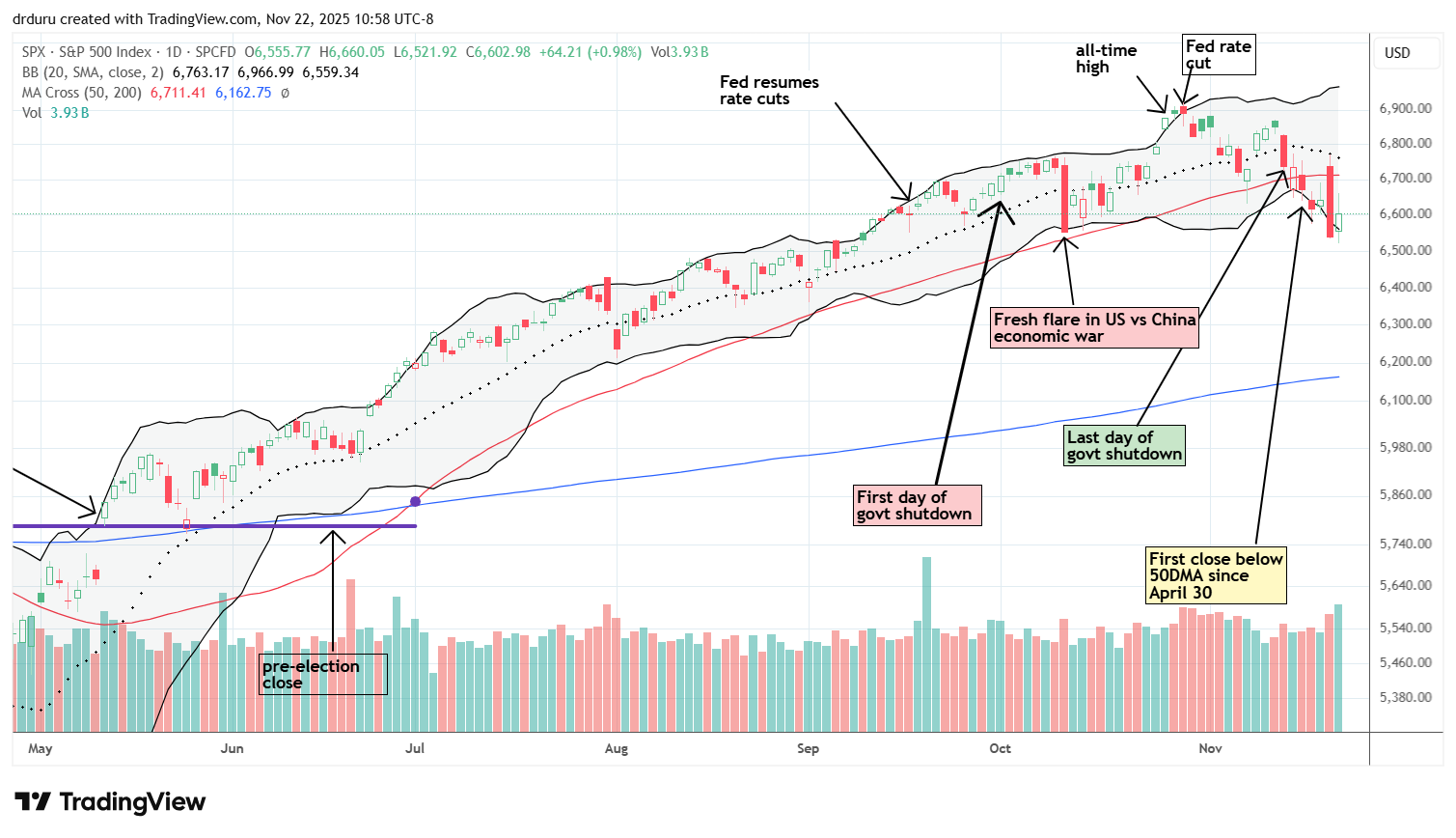
The S&P 500 further confirmed a 50DMA breakdown, a bearish milestone. A week ago sellers delivered the index’s first close below its 50-day moving average (DMA) (the red line) since April 30th (138 trading days). The buyers never looked back after May 1st when the index broke out. For much of this streak, the 20DMA (dashed line) acted as support. If the selloff continues despite Friday’s relief rally, I am targeting 6,200 on the S&P 500 as likely support. That level is 10% below its all-time high, the conventional definition of a correction. The 6200 level coincides with the previous all-time high before the tariff drama, trauma, and noise as well with the 200DMA (blue line). Accordingly, I bought a December 640/620 put spread on SPY as a hedge.
NASDAQ (COMPQX)
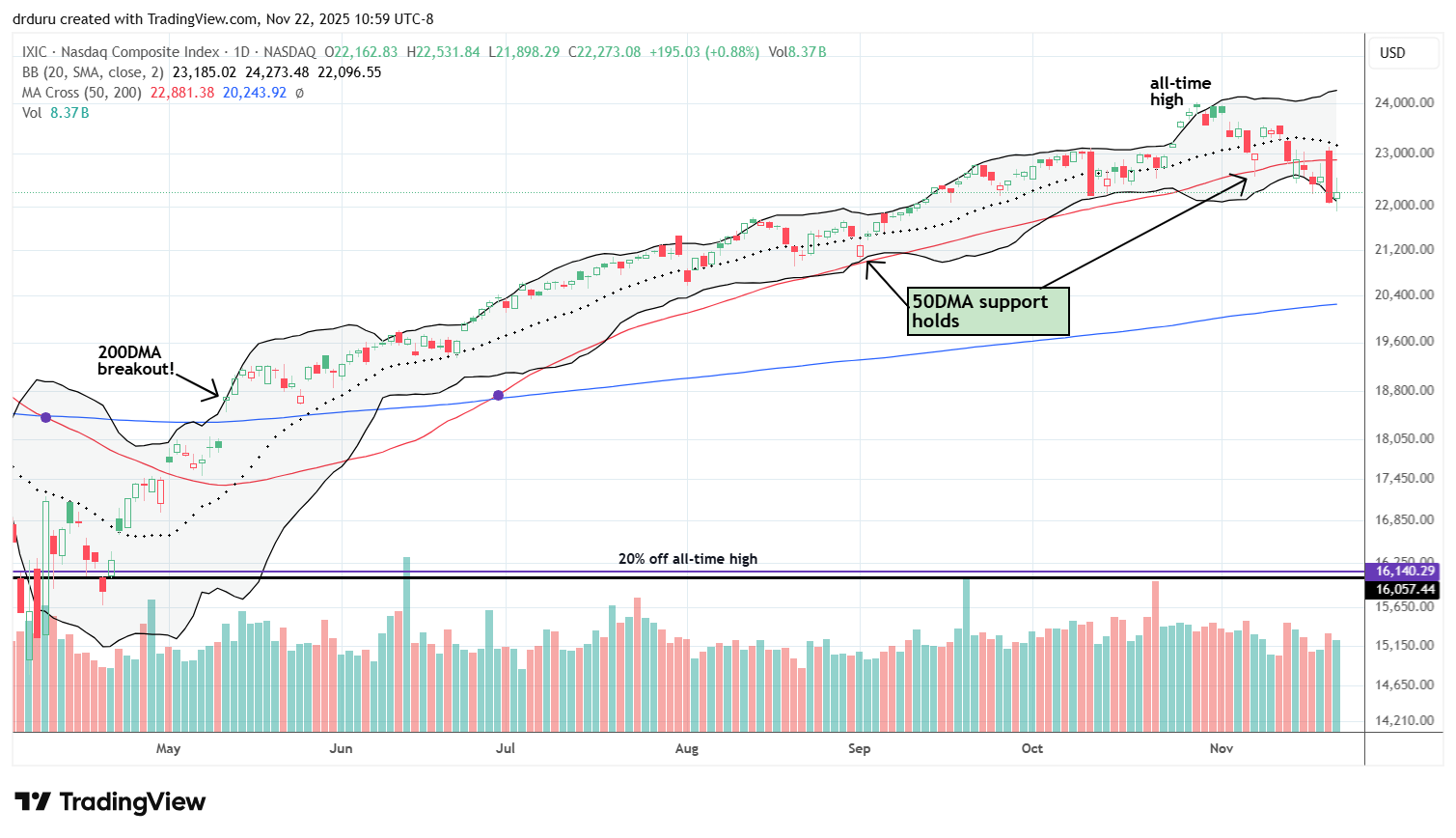
The NASDAQ showed a setup similar to the one for the S&P 500. The tech laden index plunged 2.2% on Thursday and further confirmed its bearish 50DMA breakdown. This breakdown could be even more significant than the breakdown for the S&P 500 given the NASDAQ twice earlier pulled off picture-perfect tests of 50DMA support. The 200DMA now stands as the next logical support around 20,300 if the selloff continues.
iShares Russell 2000 ETF (IWM)
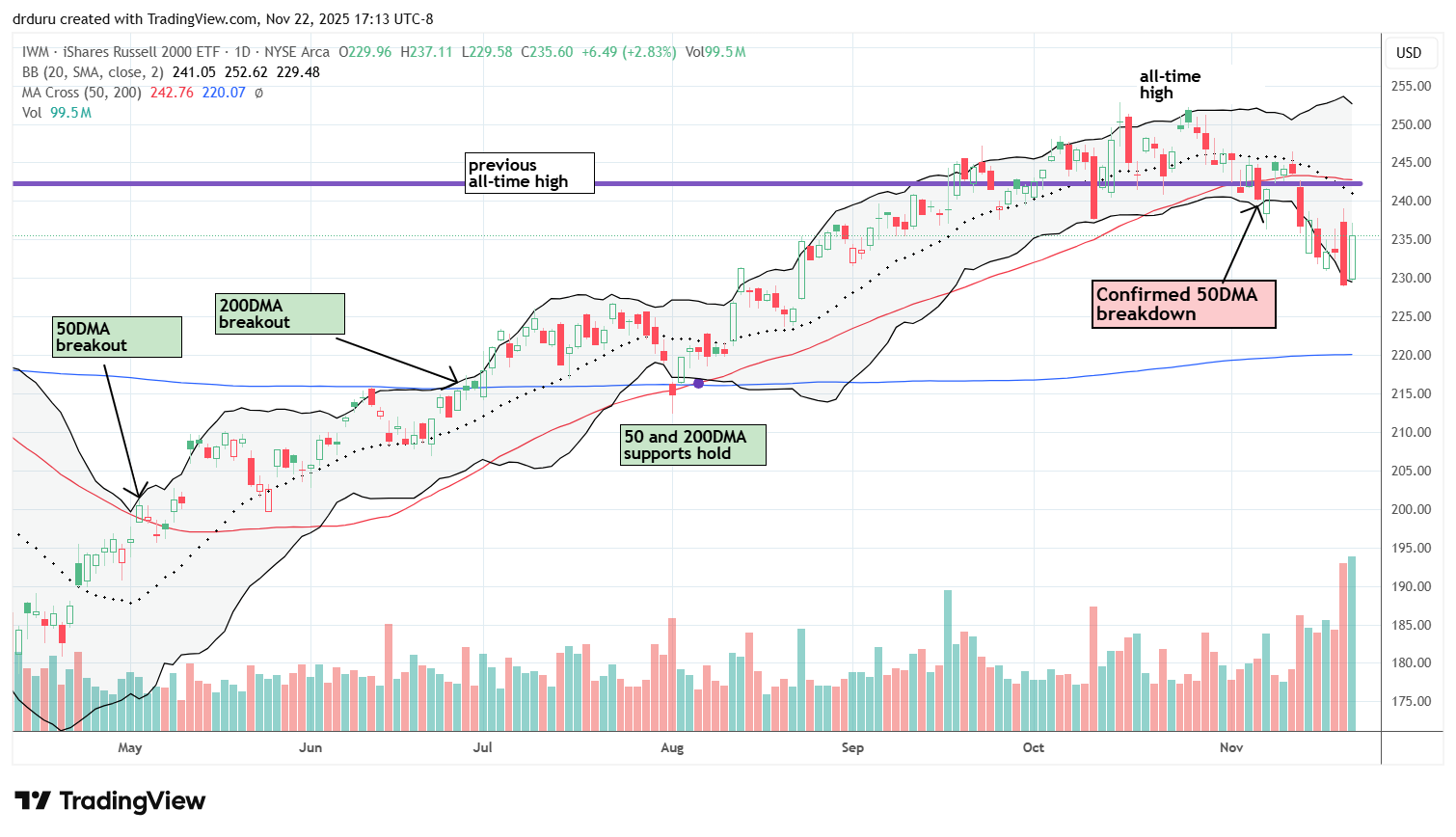
IWM confirmed its bearishness during the prior week. The ETF of small caps is displaying the wild swings characteristic of bearish moves as momentum shifts.
I still traded in anticipation of a rebound as IWM faded on Thursday for a 1.9% loss as a part of my IWM call buying strategy around my core IWM shares. The timing turned out to be fortuitous as IWM rallied 2.8% the next day. I dutifully took profits.
The Short-Term Trading Call With Cracks Wide Open
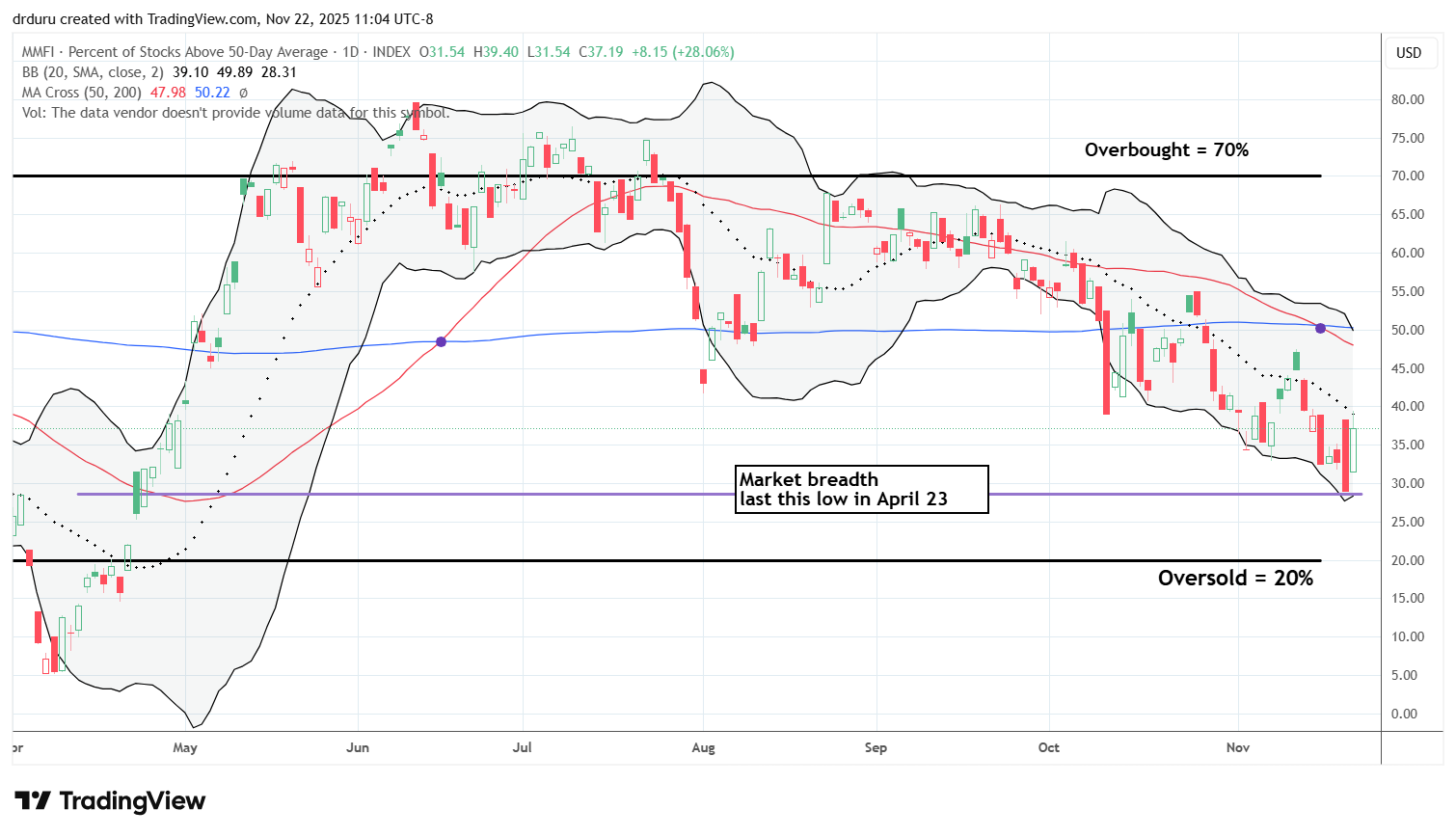
- AT50 (MMFI) = 37.2% of stocks are trading above their respective 50-day moving averages
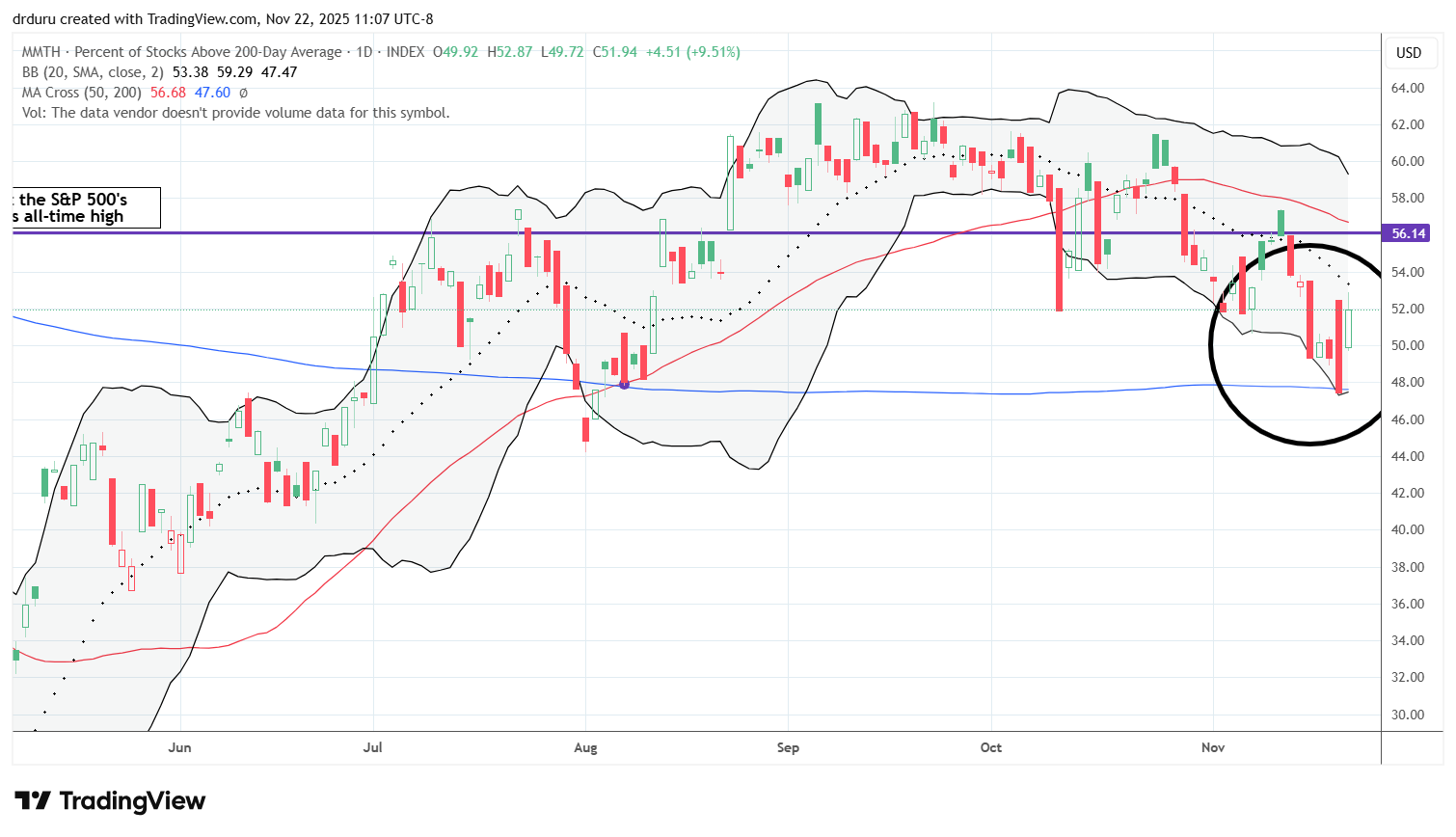
- AT200 (MMTH) = 51.9% of stocks are trading above their respective 200-day moving averages
- Short-term Trading Call: neutral
AT50 (MMFI), the percentage of stocks trading above their respective 50DMAs, closed the week at 37.2%. For weeks and months I have been complaining and worrying about the downtrend in AT50. This negative dynamic finally caught up with the market in November after three months of melt-up trading action preceded this episode of “cracks wide open”. My favorite technical indicator dropped to 29% on Thursday, its lowest level since April 23rd. As promised, I downgraded my short-term trading call to neutral after the S&P 500 closed below its 50DMA. This milestone occurred on Monday. The confirmation of the breakdown is worthy of a further downgrade to cautiously bearish, but AT50 is too close to the 20% oversold threshold for such a move. Below that threshold I flipped bullish per the AT50 trading rules.
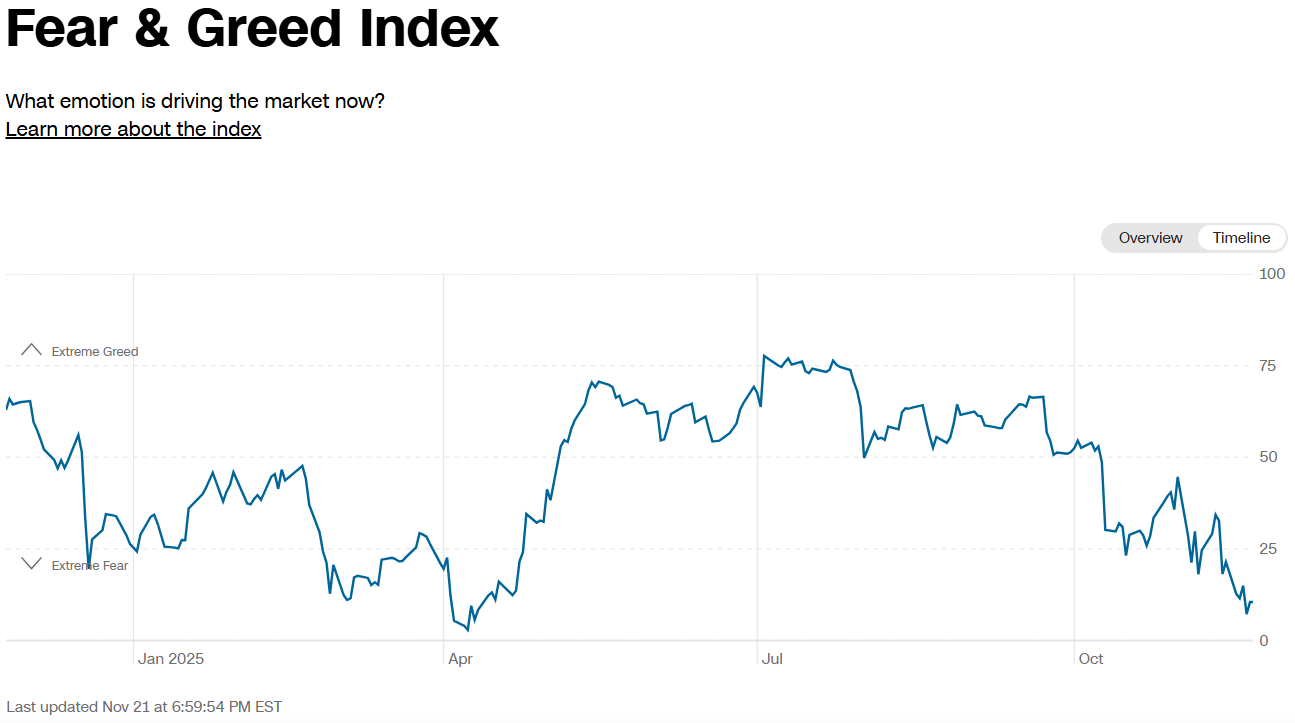
Interestingly, the CNN fear and greed index already has hit extremes last seen at the trough of the tariff panic in April. Given the VIX looks like it still has an upward bias and AT50 is not oversold, I think CNN needs to recalibrate this gauge. I also could not figure out why the gauge dropped to the extremes of fear based on its various components. Regardless, this extreme provides plenty of cause to avoid becoming newly bearish on the stock market at this juncture.
AT200, the percentage of stocks trading above their 200DMAs, closed the week at 51.9%. It also entered a downtrend. Previously I was not very worried about AT200 because it is a longer-term indicator, but now it is in a downtrend as well, confirming the bearishness in market breadth.
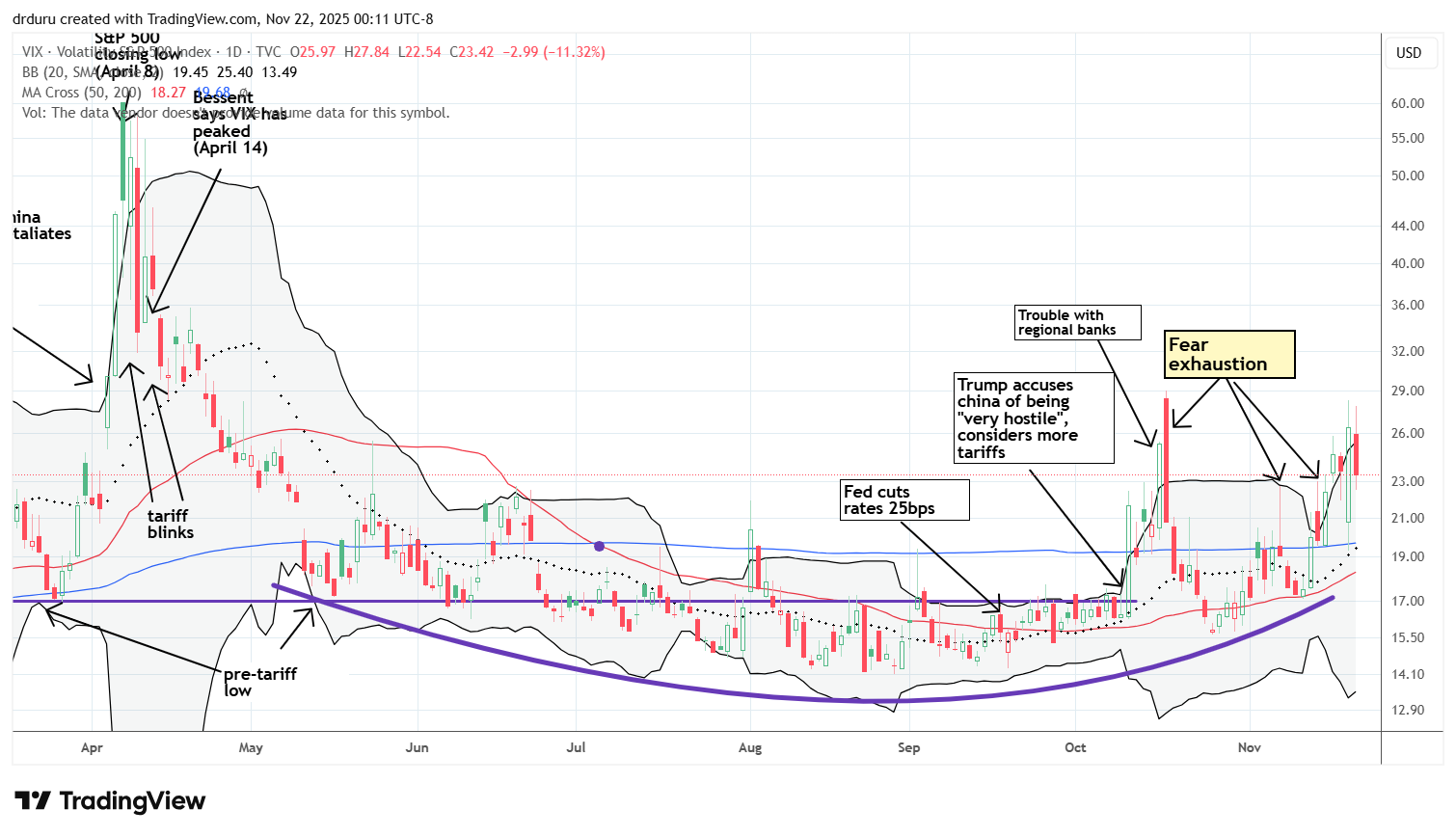
When I flipped to neutral at the beginning of the week, I also purged my portfolio of its weakest stocks. (Recall my claim that individual stocks are rentals, not soulmates). This move serves both as risk management and a way to raise cash to buy stocks on my shopping list when they get cheaper. The cash cushion also reduces my need or desire to sell any core holdings. The on-going upward pressure on the volatility index (VIX) suggests that the market will likely deliver a few more scares on the way to ultimate relief from the Fed announcement on monetary policy on December 10th. (For comparison, see research from Carson Group which suggests that 50DMA breakdowns are shallow after a 100+ day streak above the 50DMA)
The Equities: Cracks Wide Open
Dell Technologies (DELL)
Description: Dell Technologies provides computer systems, servers, data storage products, and related technology solutions.
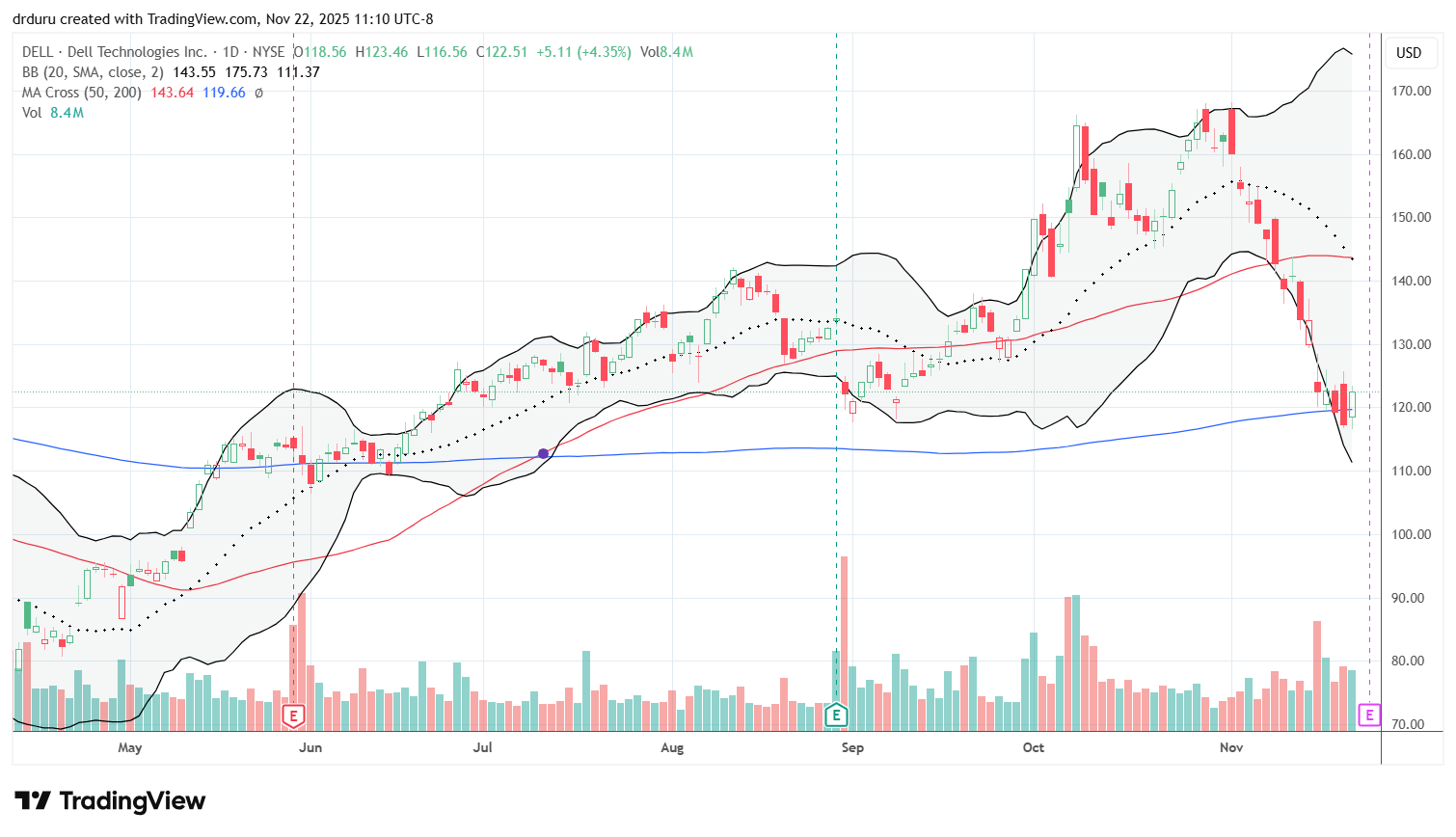
Technical status: Dell Technologies (DELL) traded just above 200DMA support after a month-long decline that placed the stock in a bearish setup ahead of earnings.
Trade commentary: Dell reports earnings next week. I am on the edge of my seat as a shareholder. DELL is barely clinging to its 200DMA support. I almost had to unload my shares because, on Thursday, the stock closed below its 200DMA, but the stock rebounded on Friday. DELL has fallen straight down all month making for a poor setup for earnings. All I can do is wait, since DELL is one of my core AI-related positions. I do not want to have to sell the stock, but if earnings force me to, I have to follow the dictates of the technicals. I cannot stay stubborn about my thematic convictions.
Advanced Micro Devices (AMD)
Description: Advanced Micro Devices designs and produces processors, graphics chips, and related semiconductor products.
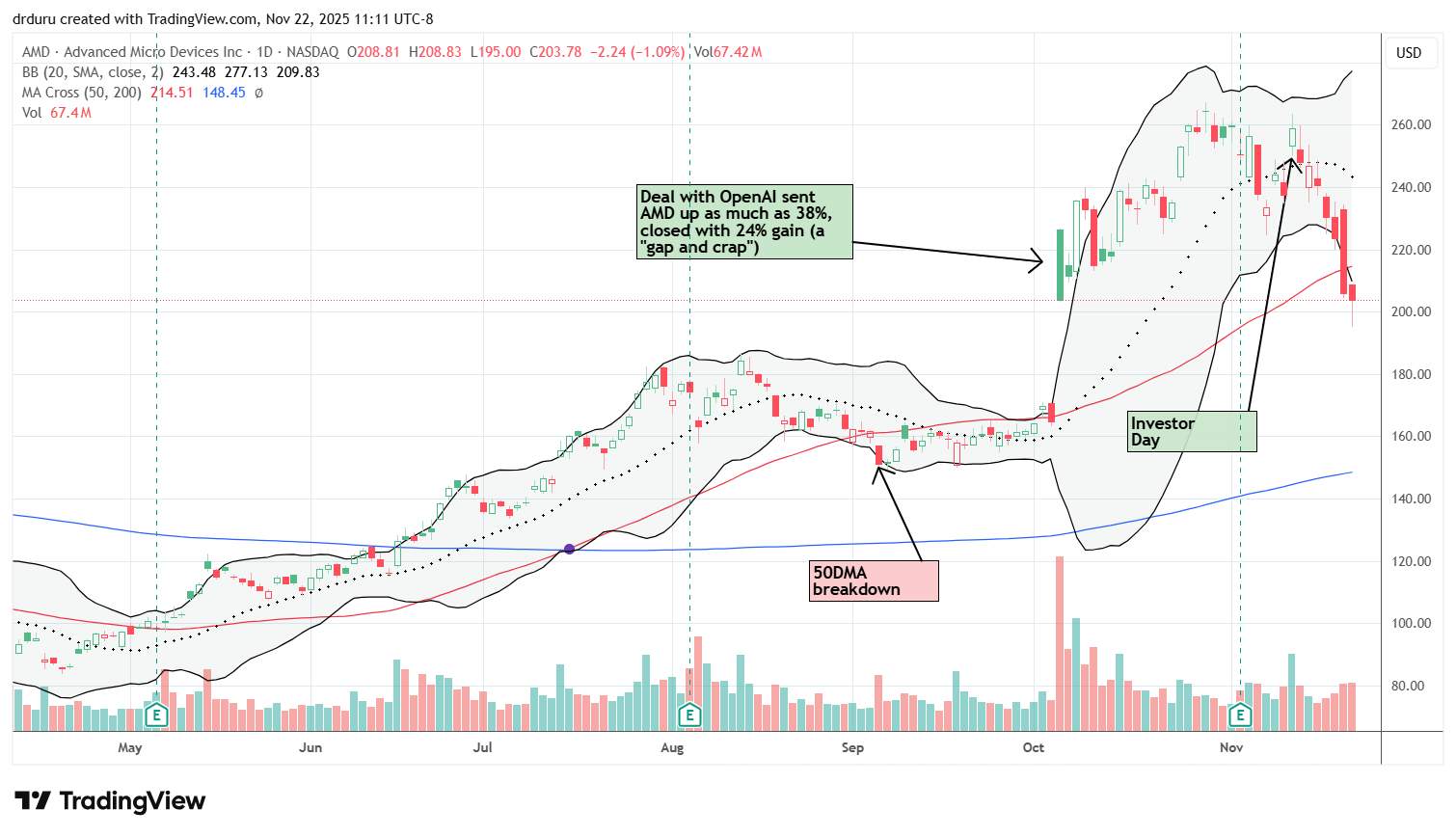
Technical status: Advanced Micro Devices (AMD) confirmed a 50DMA breakdown and traded lower into its post-gap support zone. I reluctantly stopped out to preserve remaining profits.
Trade commentary: I was able to sit in DELL, but I unfortunately had to let go of AMD. The stock confirmed a 50DMA breakdown with two lower closes below the 50DMA. At the lows on Friday, AMD started to eat into the gap up from the OpenAI news. Just over a month ago I assessed the case for holding AMD and decided to conditionally hold the stock. Starting to lose the gains from the OpenAI news was a major setback; the confirmed 50DMA breakdown underlined the negative.
Again, I cannot be stubborn about my thematic convictions. I need to follow the technicals of the price action. Still, I definitely want to get back into AMD. I will buy if the entire gap closes. I will also buy on a test of 200DMA support because I am long-term bullish. On the upside, if AMD quickly turns around, I will buy a small amount of shares as a no regret purchase on a breakout above $235/share. At that point, I will assume bullish momentum has returned.
Oracle Corporation (ORCL)
Description: Oracle Corporation provides enterprise software, cloud services, and database technology.
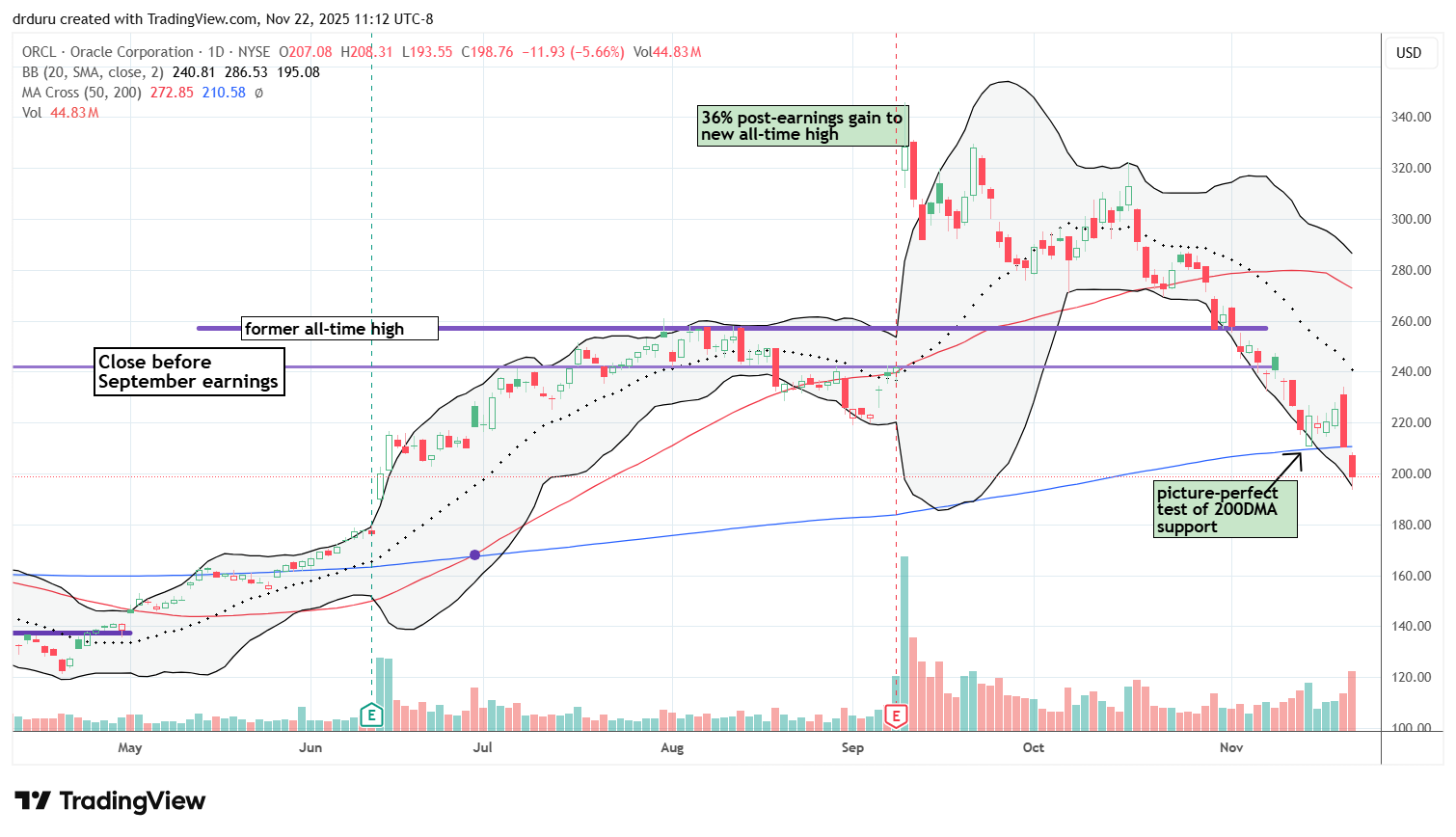
Technical status: Oracle Corporation (ORCL) broke down below its 200DMA and reached five-month lows as its continued post-earnings deterioration is waving a red flag over the AI trade and tech in general.
Trade commentary: ORCL has been one of the bigger victims of the AI fears. The company made large spending commitments and is now cash flow negative. After the stock’s big 36.6% post-earnings gain, ORCL has not been the same.
On Friday, ORCL became even more bearish with a 200DMA breakdown. I made another trade in a put spread as a partial hedge against the growing AI fears. I am bearish on the short-term price action, not necessarily on Oracle the company.
ARM Holdings (ARM)
Description: ARM Holdings designs semiconductor architectures and licenses processor designs to manufacturers.
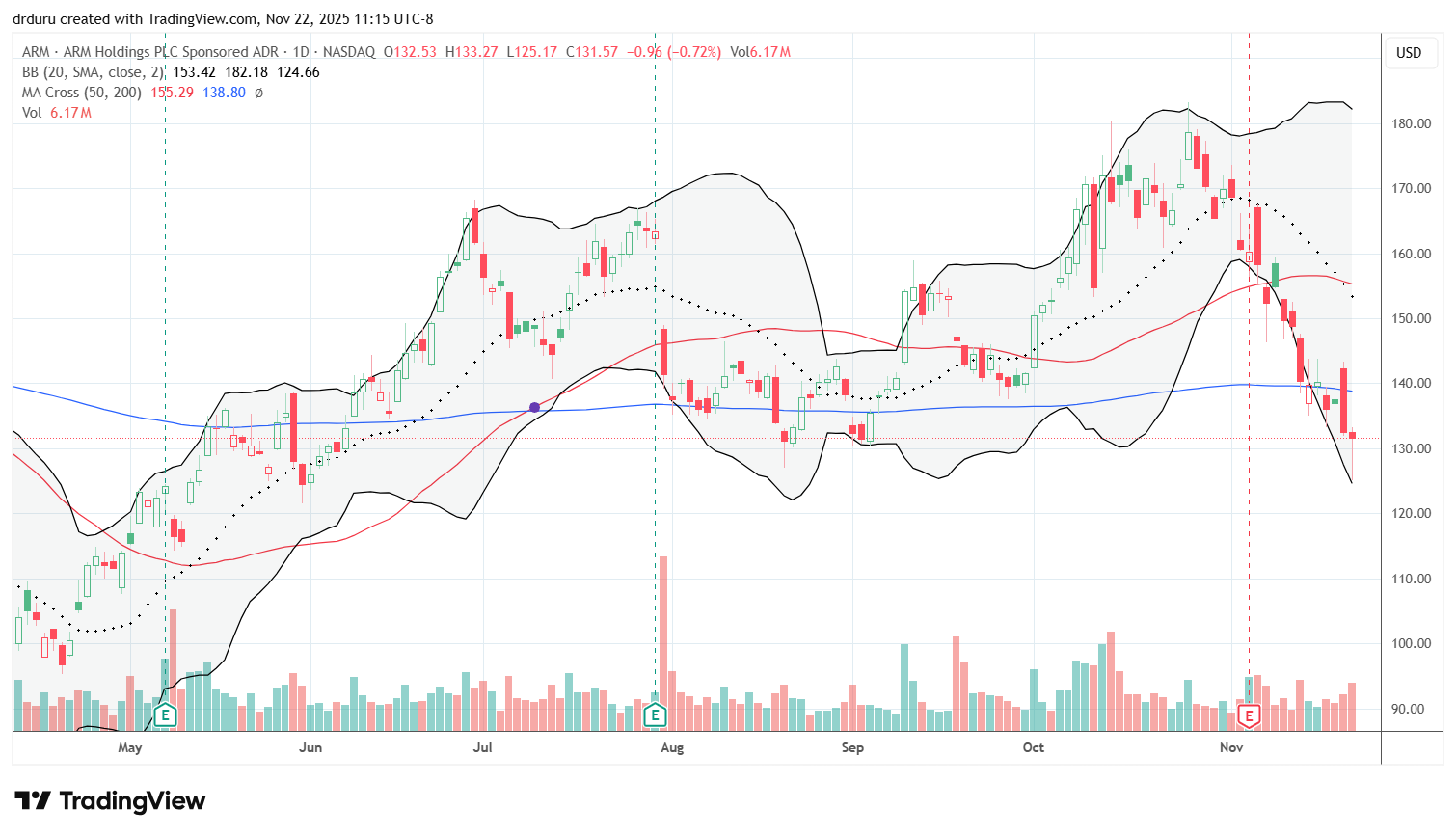
Technical status: ARM Holdings (ARM) confirmed a 200DMA breakdown, but it remains stuck within an extended and stagnant post-IPO range.
Trade commentary: ARM traded below its 200DMA. Overall the stock has gone nowhere since the surge after the IPO. ARM is working toward a one-year trading range if this languishing continues. While the breakdown below the 200DMA is bearish, ARM remains dead money. I am uninterested in a trade at current levels.
Micron Technology (MU)
Description: Micron Technology produces memory and storage semiconductor products.
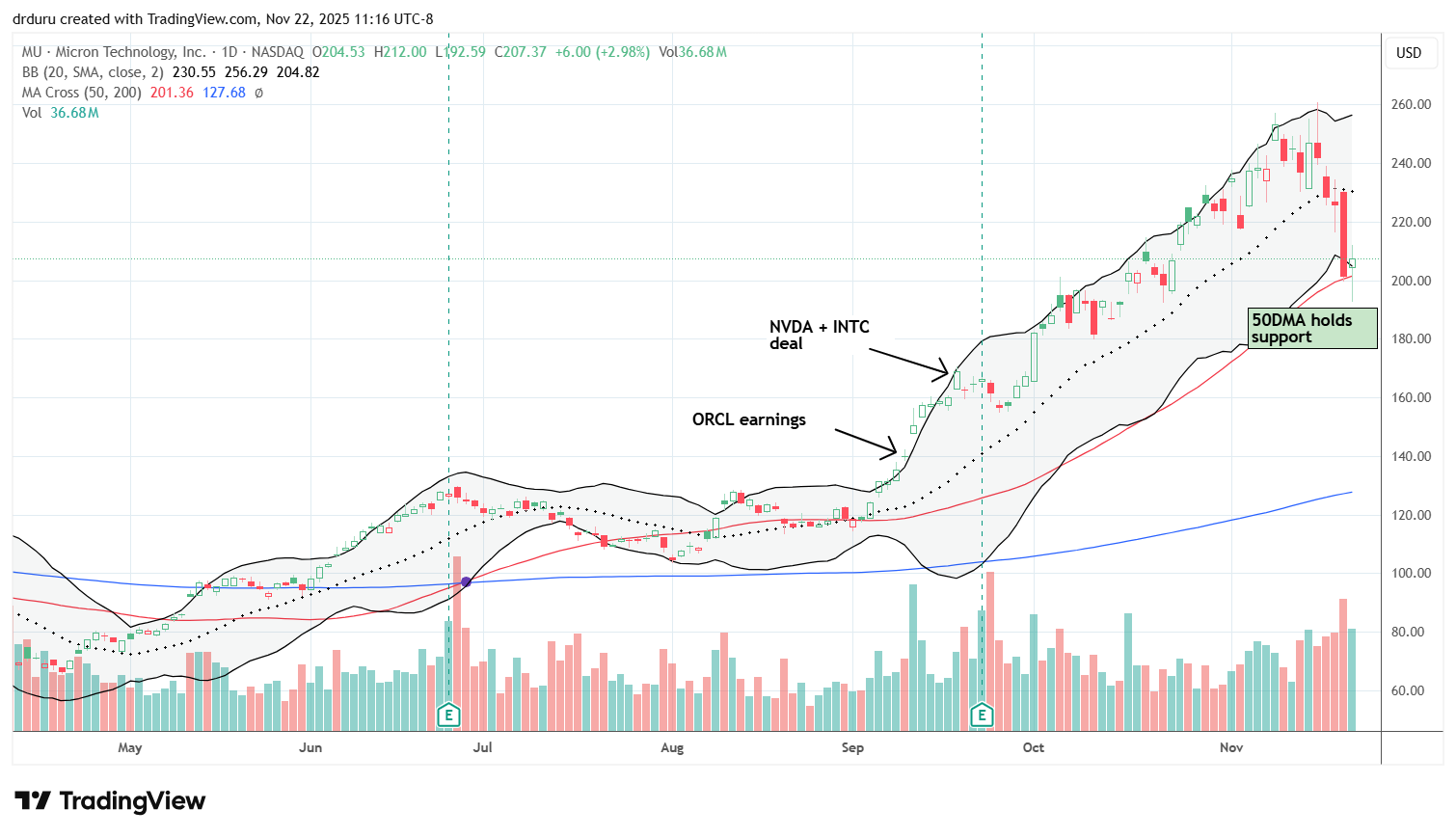
Technical status: Micron Technology (MU) rebounded sharply from a 50DMA breakdown after an 11% decline the day the cracks opened wide in the stock market.
Trade commentary: MU has been very bullish for many months. The stock maintained momentum after Oracle earnings and benefited from the Nvidia-Intel deal. The momentum came to a screeching halt last week with a 20DMA breakdown followed by a plunge to and through 50DMA support. MU suffered mightily from the cracks wide open in the stock market after plunging 11% in sympathy with the NVDA fade. After buyers stepped in and took MU back above its 50DMA, I dared to open a new bullish trade with a January 230/250 call spread.
Nvidia (NVDA)
Description: Nvidia designs graphics processing units, AI processors, and related hardware and software solutions.
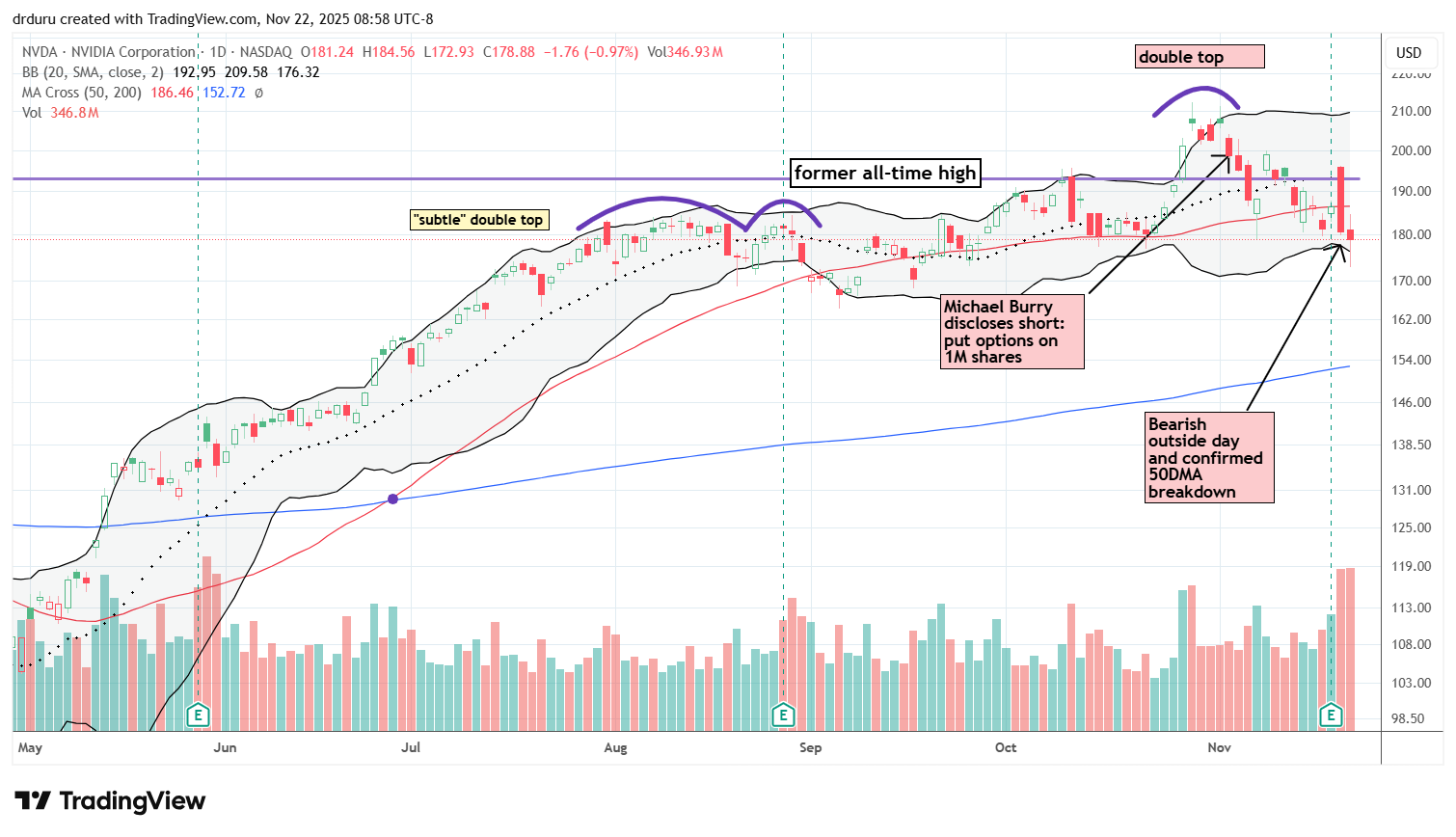
Technical status: Nvidia (NVDA) reversed a gap to all-time highs into a bearish outside day and continued lower toward potential 200DMA support.
Trade commentary: NVDA’s post-earnings fade finally blew the cracks wide open in the stock market. After NVDA gapped higher, bullish momentum looked set to restart and reinvigorate a wobbly stock market because the stock traded above its previous all-time high. Instead, sellers descended on the stock and took profits. The selling was swift enough to close NVDA for the day with a 3.2% loss and a bearish “outside day“. NVDA did not even participate in Friday’s relief rally and fell another 1.0%.
Earlier in November NVDA showed another bearish topping pattern. Nvidia likes to put on a show with bearish topping patterns only to invalidate them, so I am not pounding the table to make a bearish call on NVDA. Still, the twin fades at all-time highs look ominous. If Nvidia continues to sell off beyond the September low, the 200DMA is the next potential support.
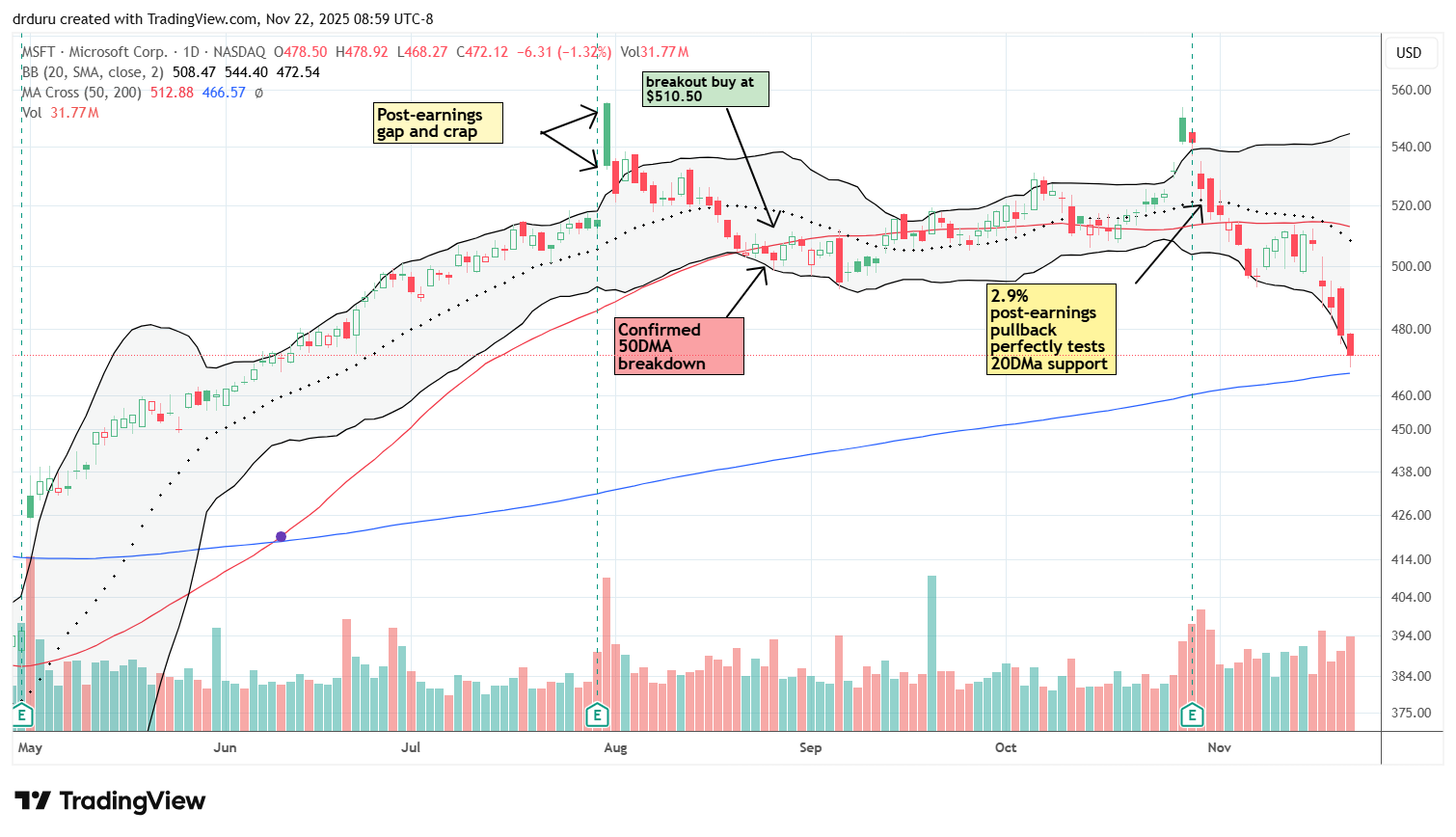
Microsoft (MSFT)
Description: Microsoft develops software, cloud services, operating systems, and hardware devices.
Technical status: Microsoft (MSFT) approached 200DMA support after forming a potential double top with two gap-and-crap patterns.
Trade commentary: I am afraid MSFT is working on a double top. The stock had a post-earnings gap and crap in July and then another gap and crap before its latest earnings. MSFT is another big cap tech wrangling with its 200DMA support. I added to my position on the bounce. I am a little bolder because of my hedge on ORCL.
Meta Platforms (META)
Description: Meta Platforms operates social networking and digital advertising services across Facebook, Instagram, WhatsApp, and related platforms.
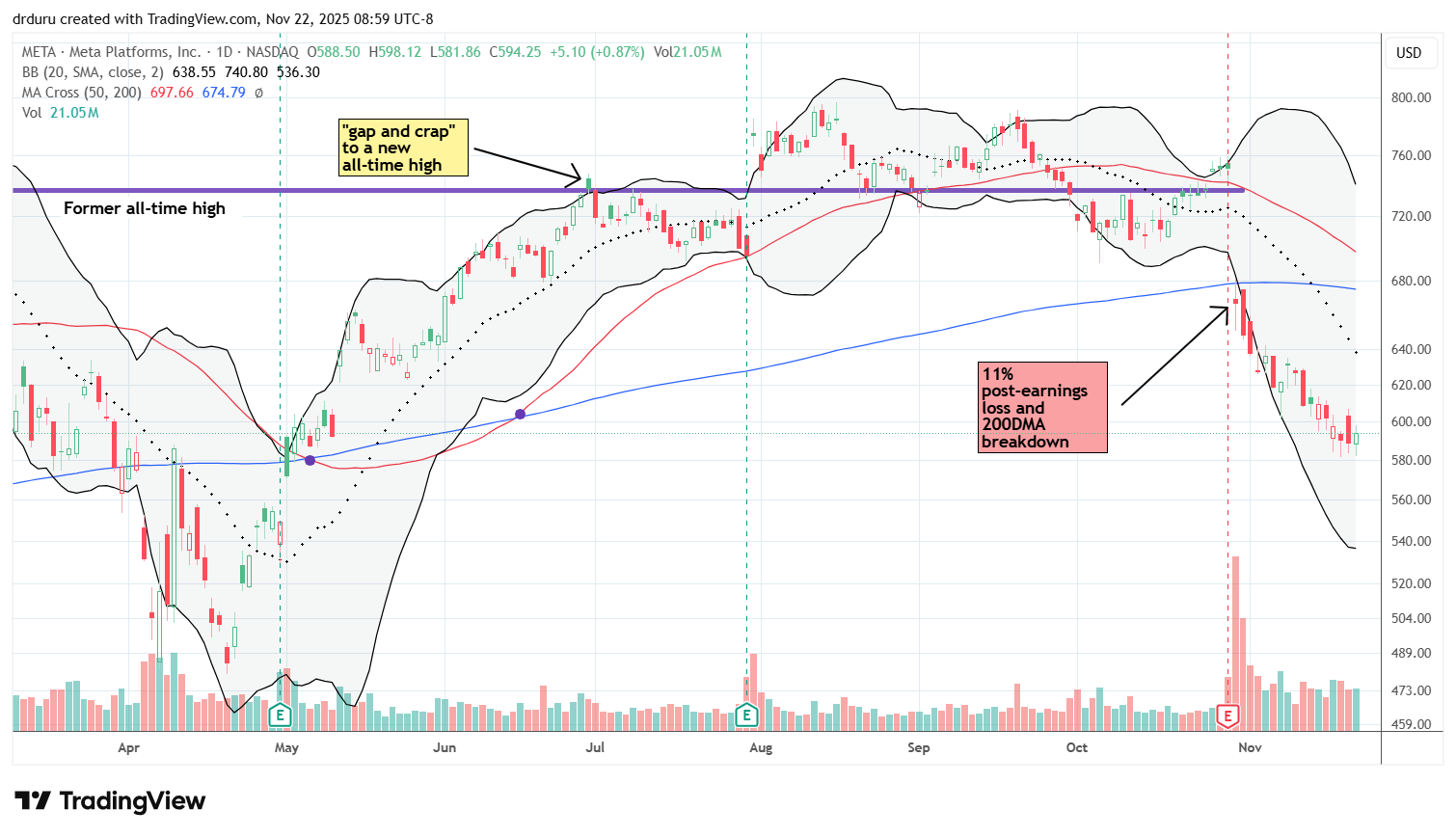
Technical status: Meta Platforms (META) traded below multiple declining moving averages and maintained a persistent bearish trend after its post-earnings gap down.
Trade commentary: META has been in bearish territory all month since the stock gapped down 11% post earnings and has yet to recover. The stock now has a series of resistance levels looming that will likely hold: the 20DMA, the 200DMA, and the 50DMA given investor displeasure over Meta’s ramped-up spending on AI. Overall, META still has a long-term uptrend, but the arc of momentum is bending downward.
Alphabet / Google (GOOG)
Description: Alphabet provides internet search, digital advertising, cloud services, and related technology products.
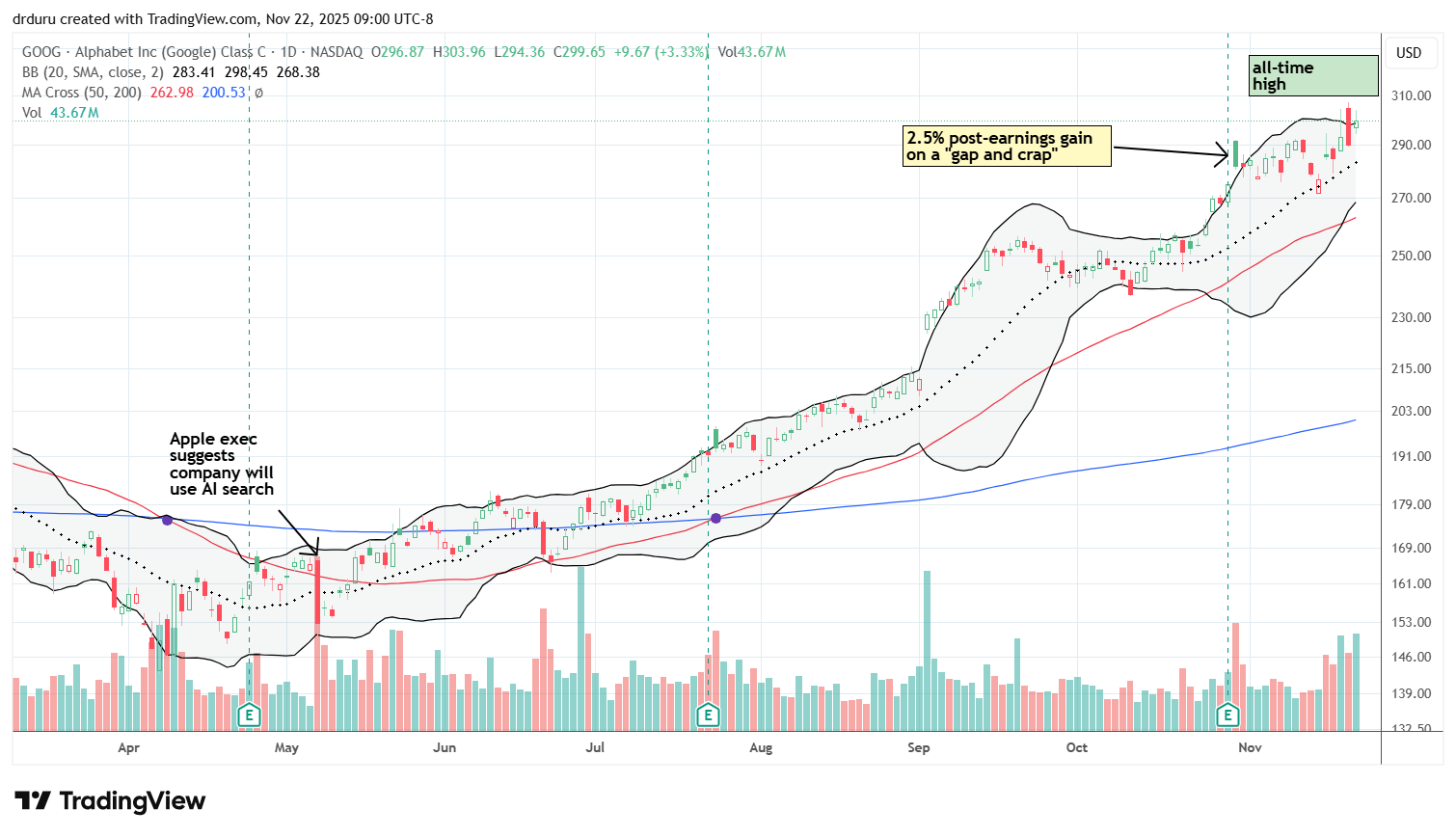
Technical status: Alphabet (GOOG) held firm after its post-earnings dip and continued to all-time highs with strong relative strength.
Trade commentary: GOOG has been impressive; I underestimated the stock. I thought I would have time to get back in with a substantial position, but the runup has been persistent and resilient. Like other big cap tech stocks this cycle, GOOG printed a post-earnings gap and crap. However, unlike other big cap tech stocks, GOOG did not weaken significantly. The stock held its ground and even hit an all-time high this week. GOOG fell in sympathy with Nvidia by 1%, and then gapped up 3.3% on Friday. GOOG is making a bid to be the last (big cap tech) stock standing.
iShares Expanded Tech-Software ETF (IGV)
Description: The iShares Expanded Tech-Software ETF tracks a basket of software-focused technology companies.
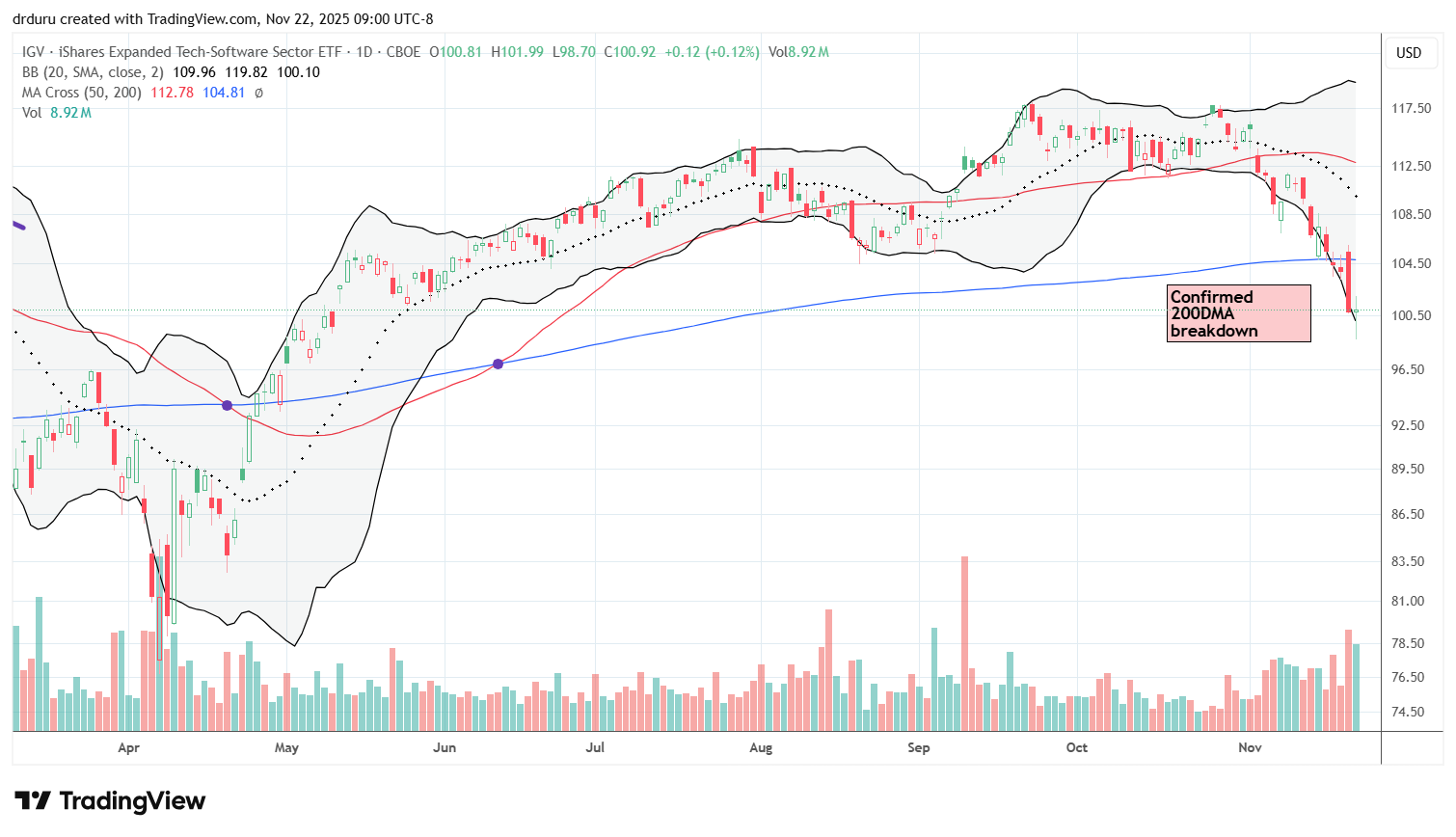
Technical status: The iShares Expanded Tech-Software ETF (IGV) failed a 200DMA recovery and traded back into bearish territory below its 200DMA.
Trade commentary: IGV fooled me. I bought shares right after the ETF peeked above its 200DMA. However, IGV quickly faded with the reversal in sentiment on NVDA and lost 3%. If IGV heads lower from here, I will have to stop out and wait for a breakout above the 200DMA before getting back in.
iShares U.S. Home Construction ETF (ITB)
Description: The iShares U.S. Home Construction ETF tracks homebuilding and construction-related companies.
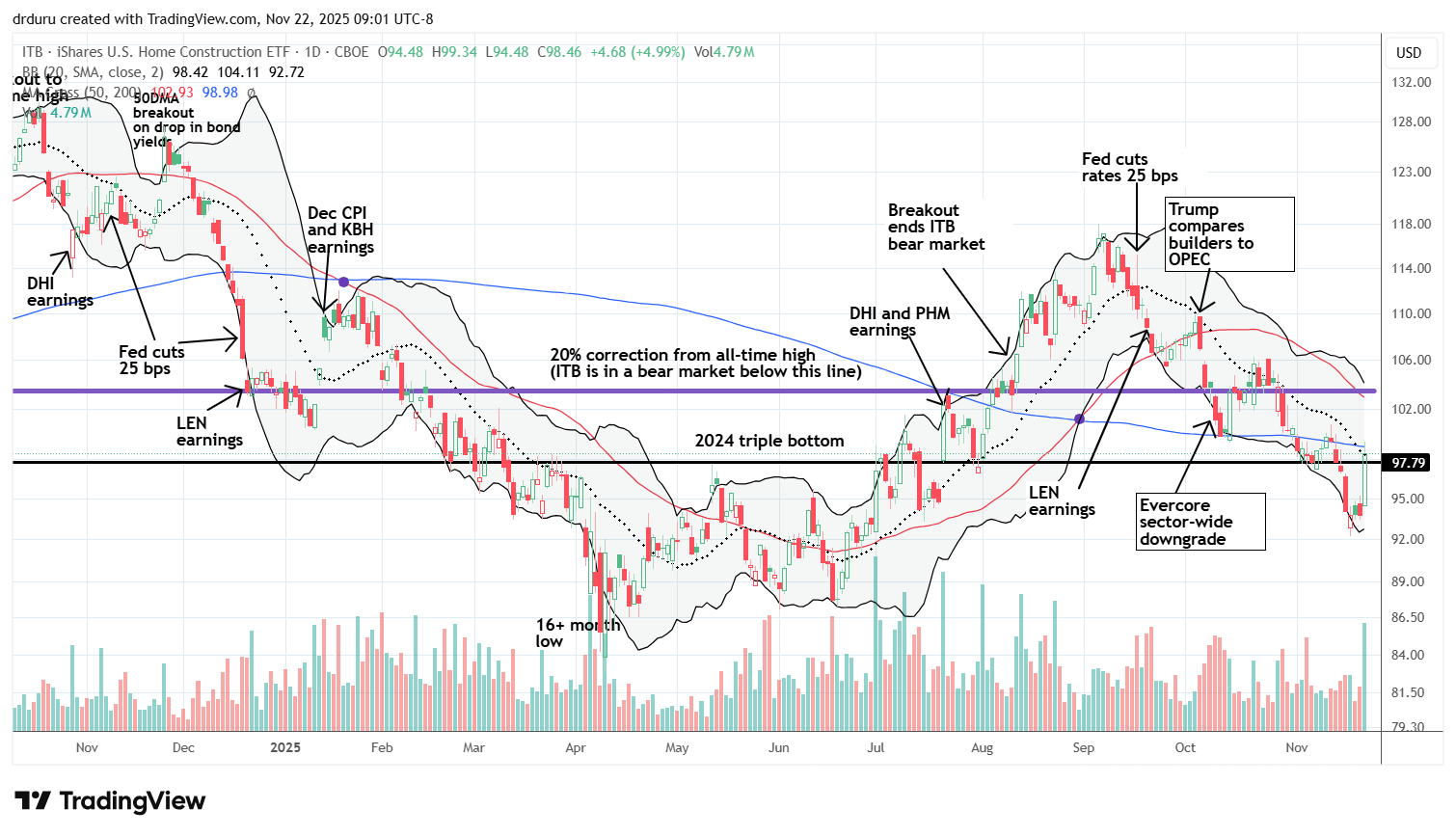
Technical status: The iShares U.S. Home Construction ETF (ITB) bounced sharply on Friday with a 5.0% gain but remained in bearish territory below its 200DMA and key resistance.
Trade commentary: The relief rally was all about consumer-facing and interest-rate-sensitive stocks like ITB rallying thanks to optimism on a December rate cut. I have heavy exposure to individual builder stocks as well as ITB thanks to the seasonal trade on homebuilders. However, ITB is still bearish because it sits below the 200DMA, below the 2024 triple bottom line, and below the bear-market correction line. I will not be comfortable in seasonal trades until ITB exits its bear market.
Brinker International (EAT)
Description: Brinker International operates restaurant brands including Chili’s Grill & Bar and Maggiano’s Little Italy.
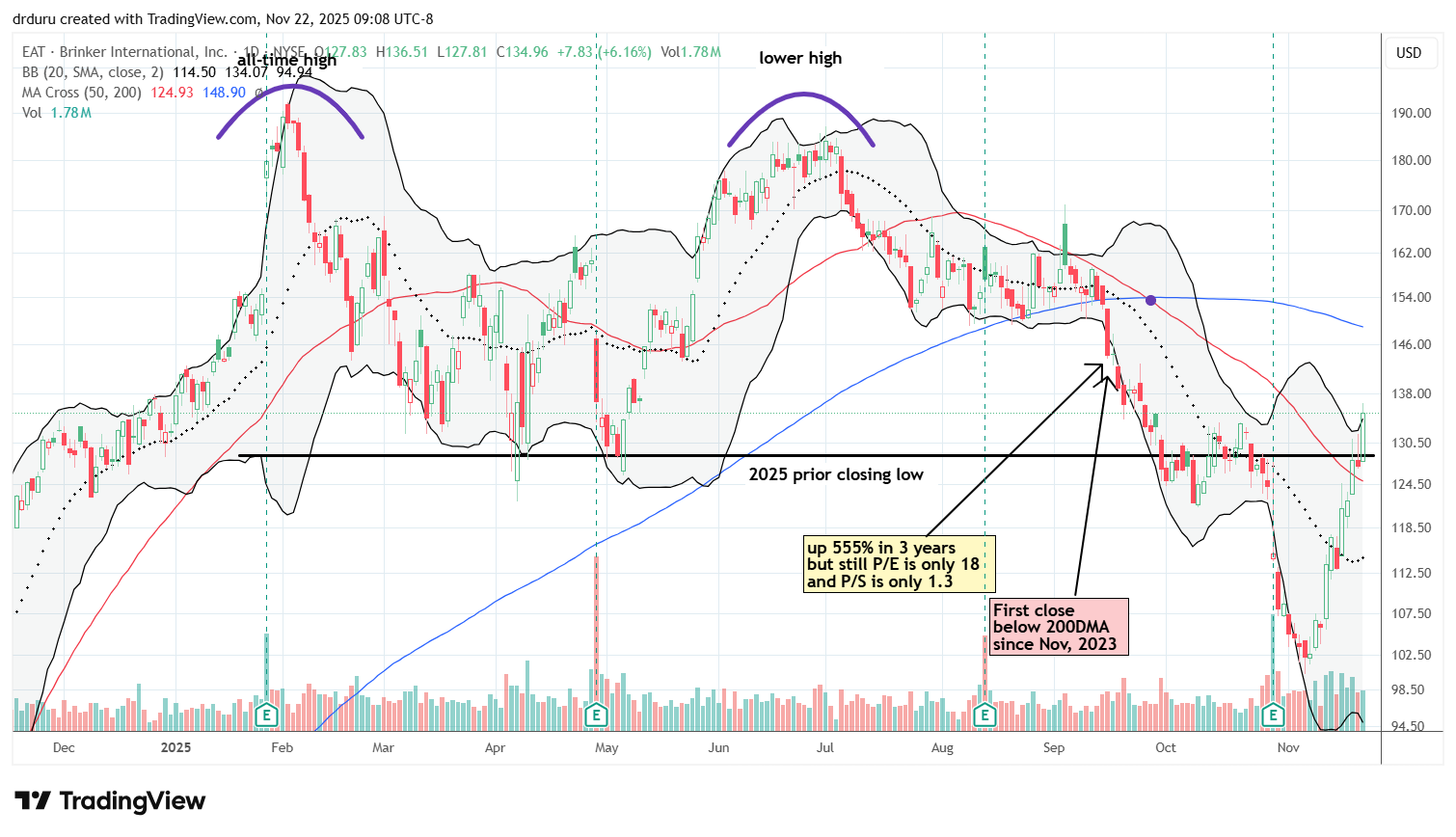
Technical status: Brinker International (EAT) surged into a V-shaped recovery and traded above its 50DMA toward declining 200DMA resistance.
Trade commentary: Restaurants have been weak given the increasing pressures on the average American consumer. I should have paid more attention to the setup in EAT. The stock made a V-shaped move off the recent bottom. I shorted it below the 50DMA, and it shot up again. I am close to stopping out given the 50DMA breakout; I am waiting to see how other long trades in consumer-facing stocks shake out, and I doubt EAT can push through its 200DMA resistance.
Dine Brands Global (DIN)
Description: Dine Brands Global operates restaurant brands including Applebee’s and IHOP.
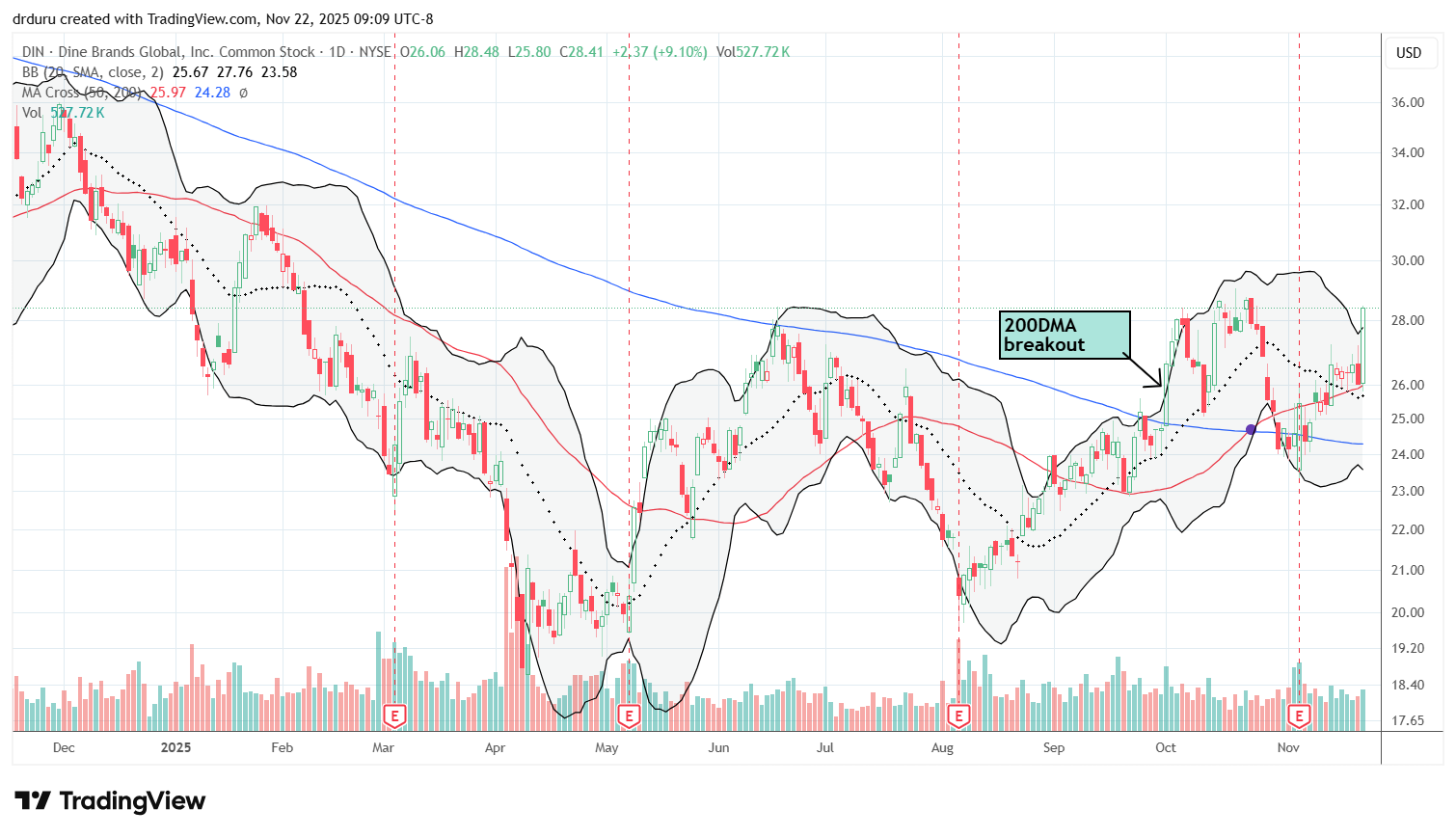
Technical status: Dine Brands Global (DIN) rebounded strongly from 200DMA support and extended its post-earnings recovery.
Trade commentary: DIN has made a wide-ranging roundtrip since I made a pandemic-era case for buying the stock in March, 2020. I made my latest case for DIN last month. I bought in and took profits quickly on that surge. Unfortunately, I was too slow to notice the next setup after DIN held firm after a post-earnings close above the 200DMA. On Friday, DIN surged 9.1%. The stock is a breakout away from becoming a buy on the dips.
SPDR S&P Retail ETF (XRT)
Description: The SPDR S&P Retail ETF tracks a broad basket of retail companies.
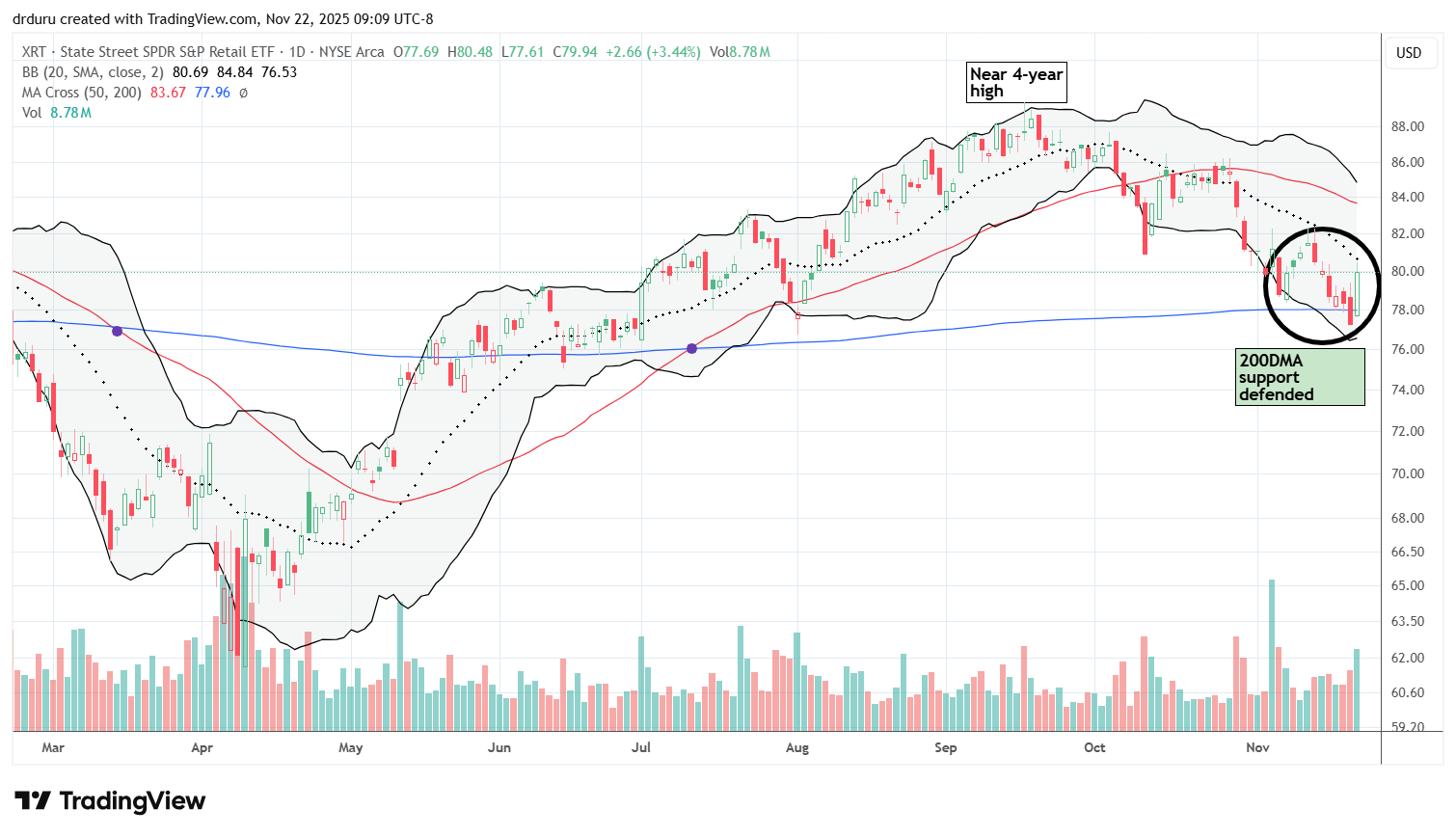
Technical status: The SPDR S&P Retail ETF (XRT) reclaimed its 200DMA as support but remained in a broader downtrend below a declining 20DMA.
Trade commentary: XRT had a big move of 3.4% on Friday thanks to the relief about a December rate cut. While XRT recovered from its 200DMA breakdown, it is still in a downtrend. XRT faded directly from 20DMA resistance and is bearish until proven otherwise.
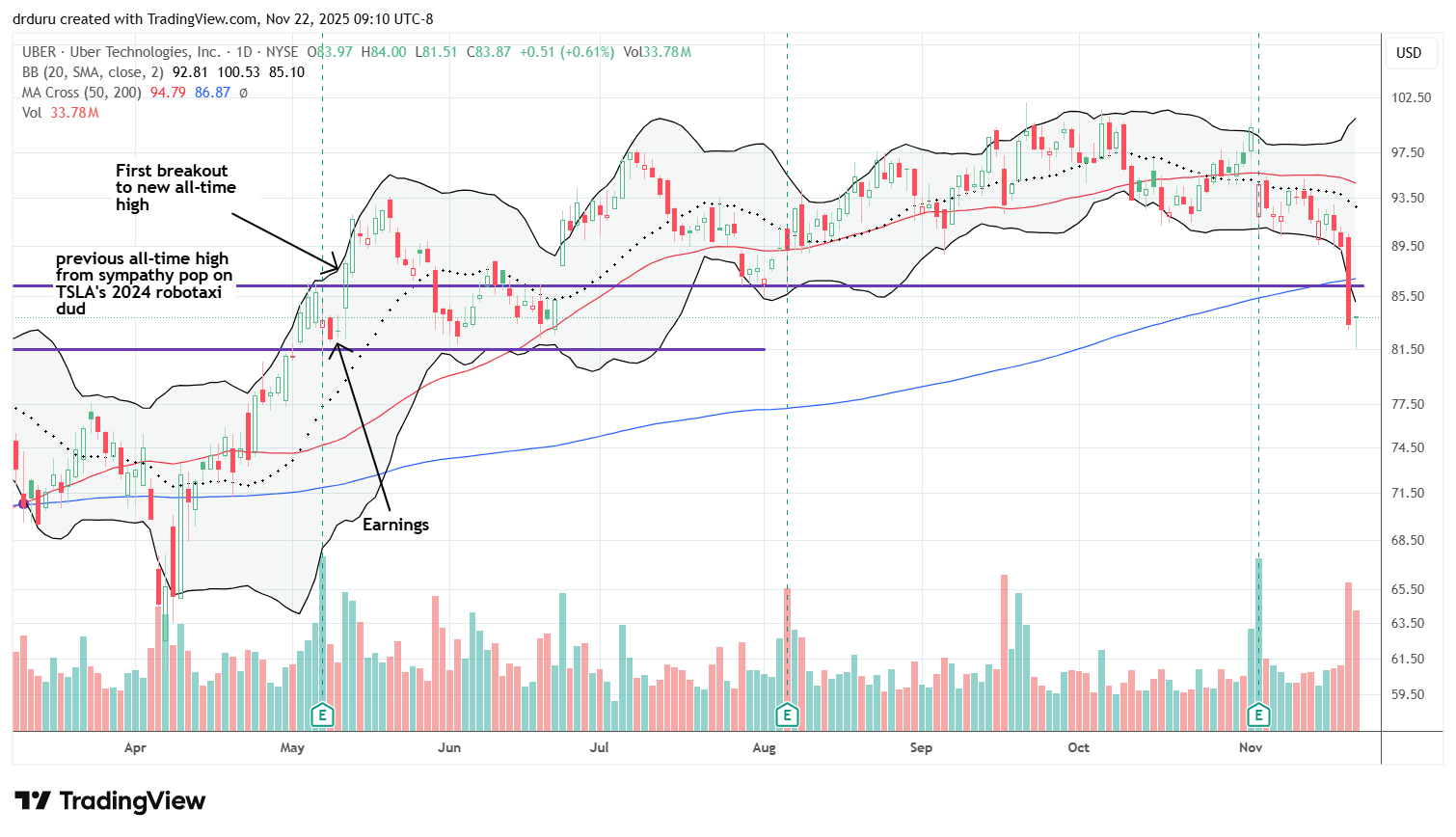
Uber Technologies (UBER)
Description: Uber Technologies provides ride-hailing, delivery, and related mobility services.
Technical status: Uber Technologies (UBER) broke below its 200DMA and traded in bearish territory while forming a hammer candlestick.
Trade commentary: I was disappointed by UBER’s 200DMA breakdown into bearish territory. I like the hammer pattern on Friday, but UBER still under-performed the market. I am committed to UBER for the long-term, so I am giving the stock some latitude before considering stopping out (say below $81.50).
Robinhood Markets (HOOD)
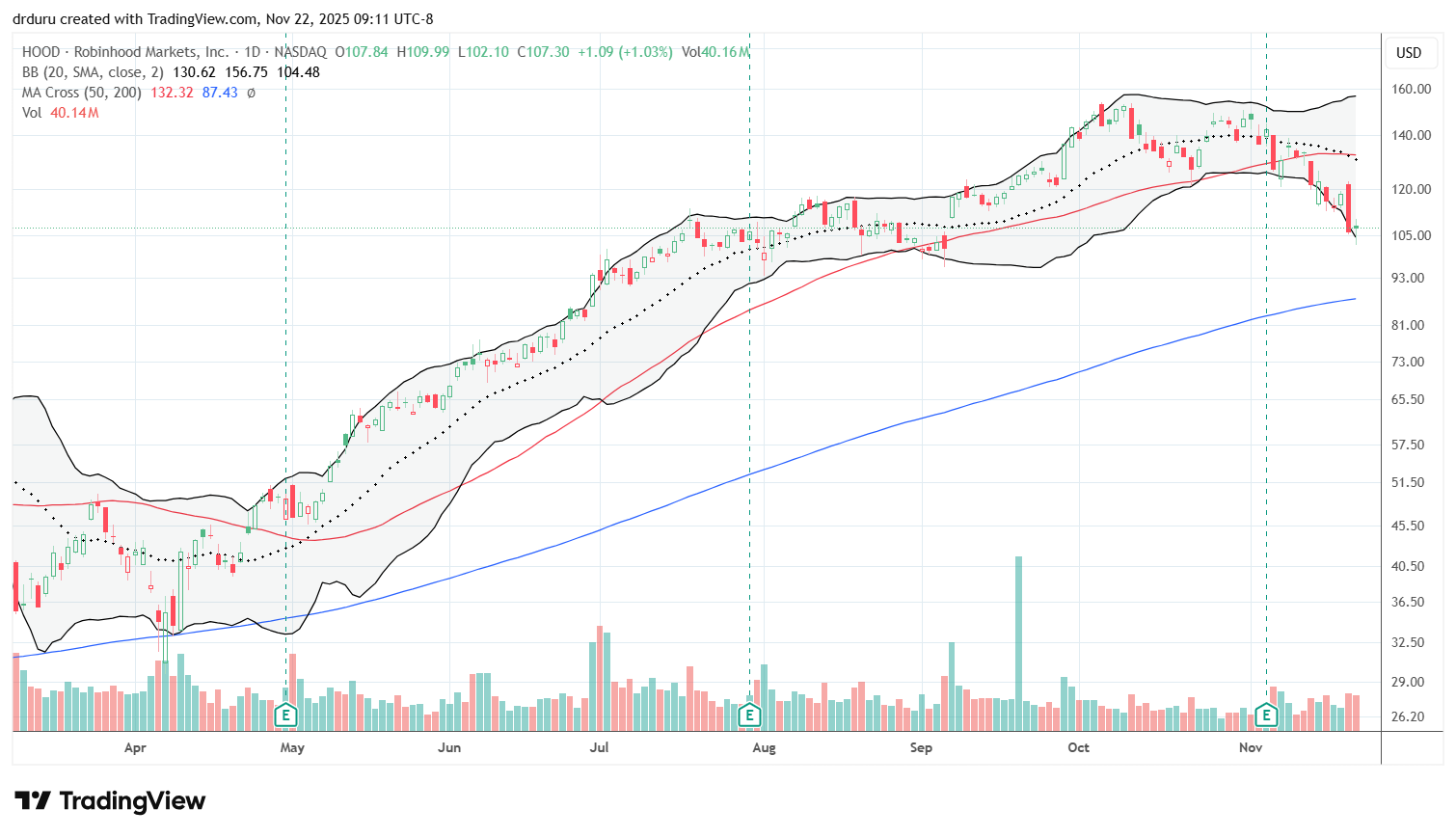
Description: Robinhood Markets offers a trading platform for stocks, options, and cryptocurrencies.
Technical status: Robinhood Markets (HOOD) confirmed a 50DMA breakdown and traded lower toward potential 200DMA support.
Trade commentary: I have been bullish on HOOD for a long while, so I am salivating at the prospect of buying this dip. I will buy greedily at a test of 200DMA support.
Cloudflare (NET)
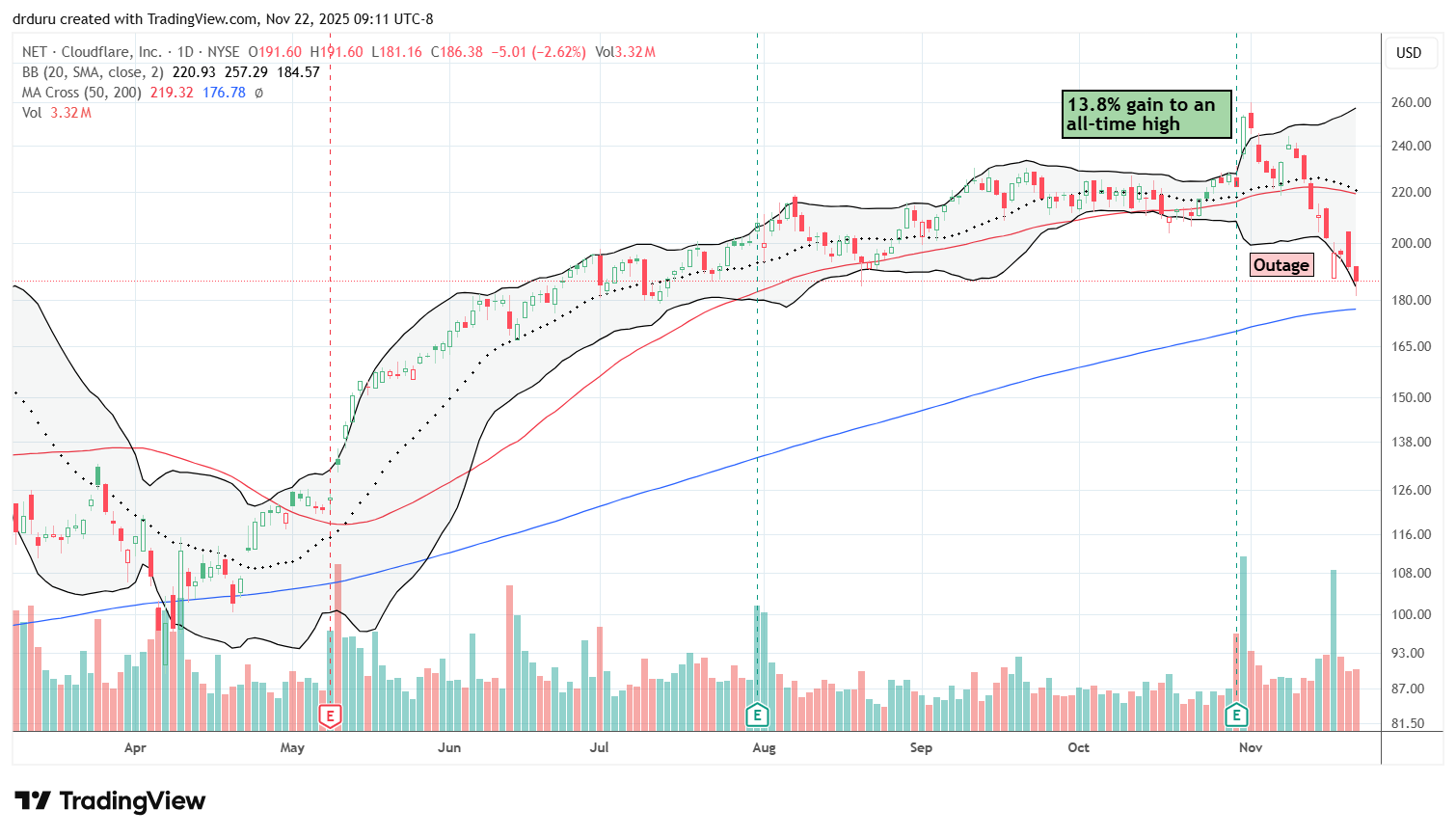
Description: Cloudflare provides internet security, performance, and edge-networking services.
Technical status: Cloudflare (NET) sold off after an outage and is continuing to sell off toward potential 200DMA support.
Trade commentary: NET lost 2.8% on the company’s big outage. Now the big post-earnings surge looks like a potential blow-off top. Still, I will consider a fresh trade on a test of 200DMA support.
Celsius Holdings (CELH)
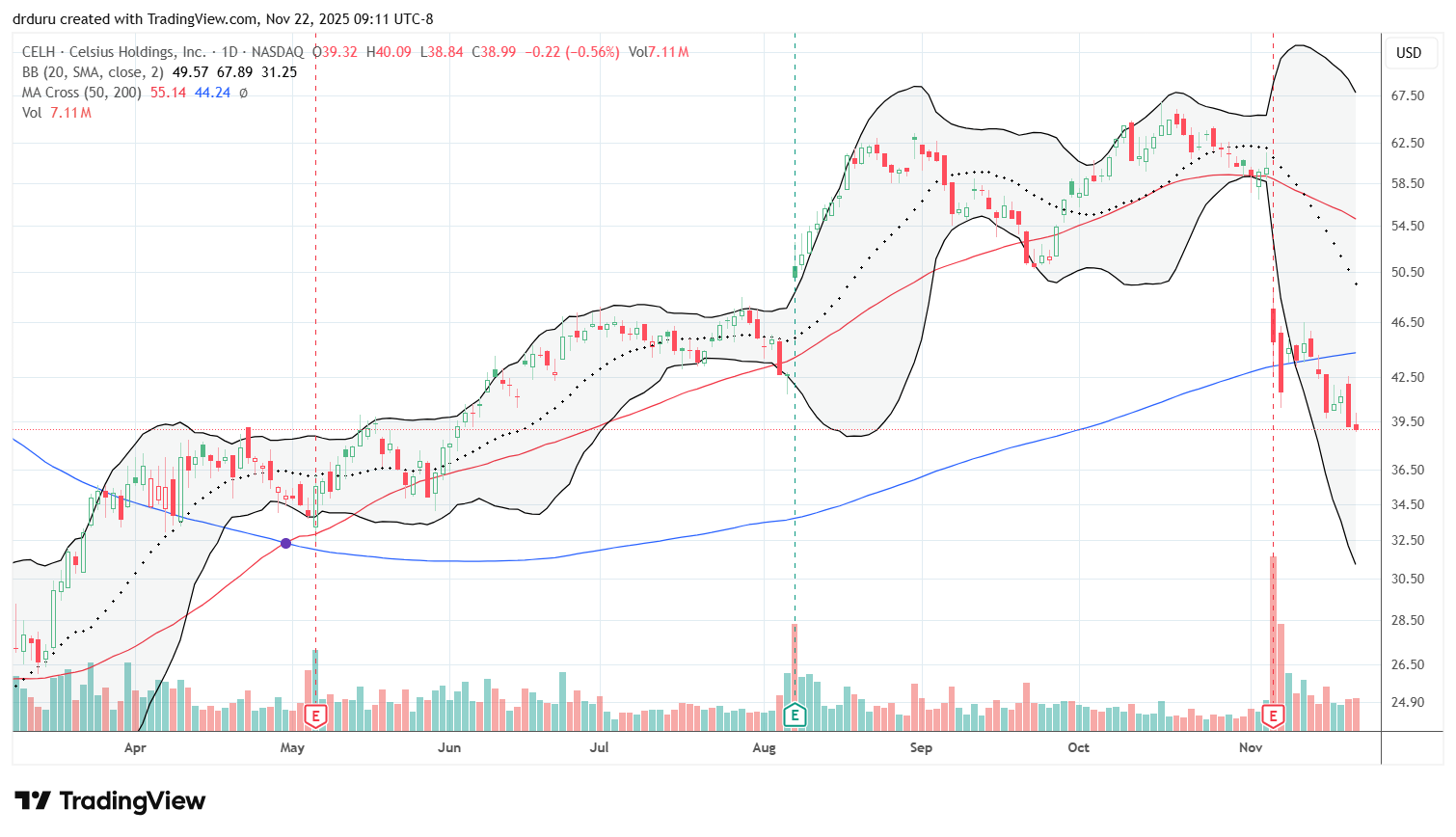
Description: Celsius Holdings produces branded energy drinks and beverage products.
Technical status: Celsius Holdings (CELH) remained in bearish territory after a steep post-earnings collapse below its 200DMA.
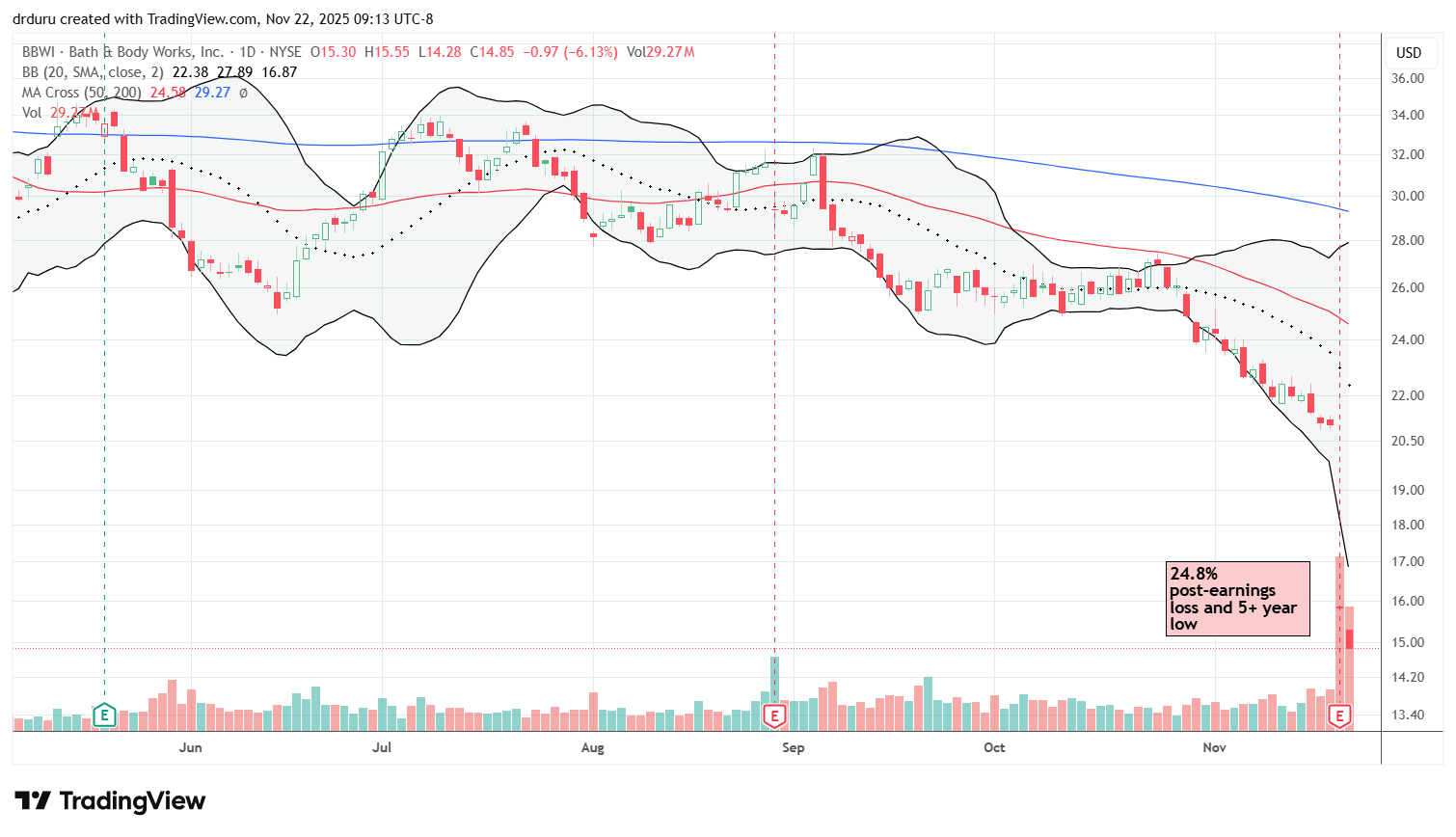
Trade commentary: CELH abruptly flipped bearish with a 24.8% post-earnings plunge. Sellers soon followed through with a 200DMA breakdown. I am assuming CELH has topped out for quite some time since the last high fell far short of the all-time high. Thus, the stock is a fade on rallies until/unless it pulls off a 200DMA breakout.
Bath & Body Works (BBWI)
Description: Bath & Body Works sells personal care, fragrance, and home fragrance products.
Technical status: Bath & Body Works (BBWI) plunged to multiyear lows after a sharp 24.8% post-earnings selloff.
Trade commentary: BBWI is yet one more consumer facing stock that is down for the count after a big post-earnings plunge of 25%. The stock has not been this low since the early 2020s. Specialty retailers are fairing poorly in this environment.
Williams-Sonoma (WSM)
Description: Williams-Sonoma sells home goods, kitchenware, and furnishings through retail and e-commerce.
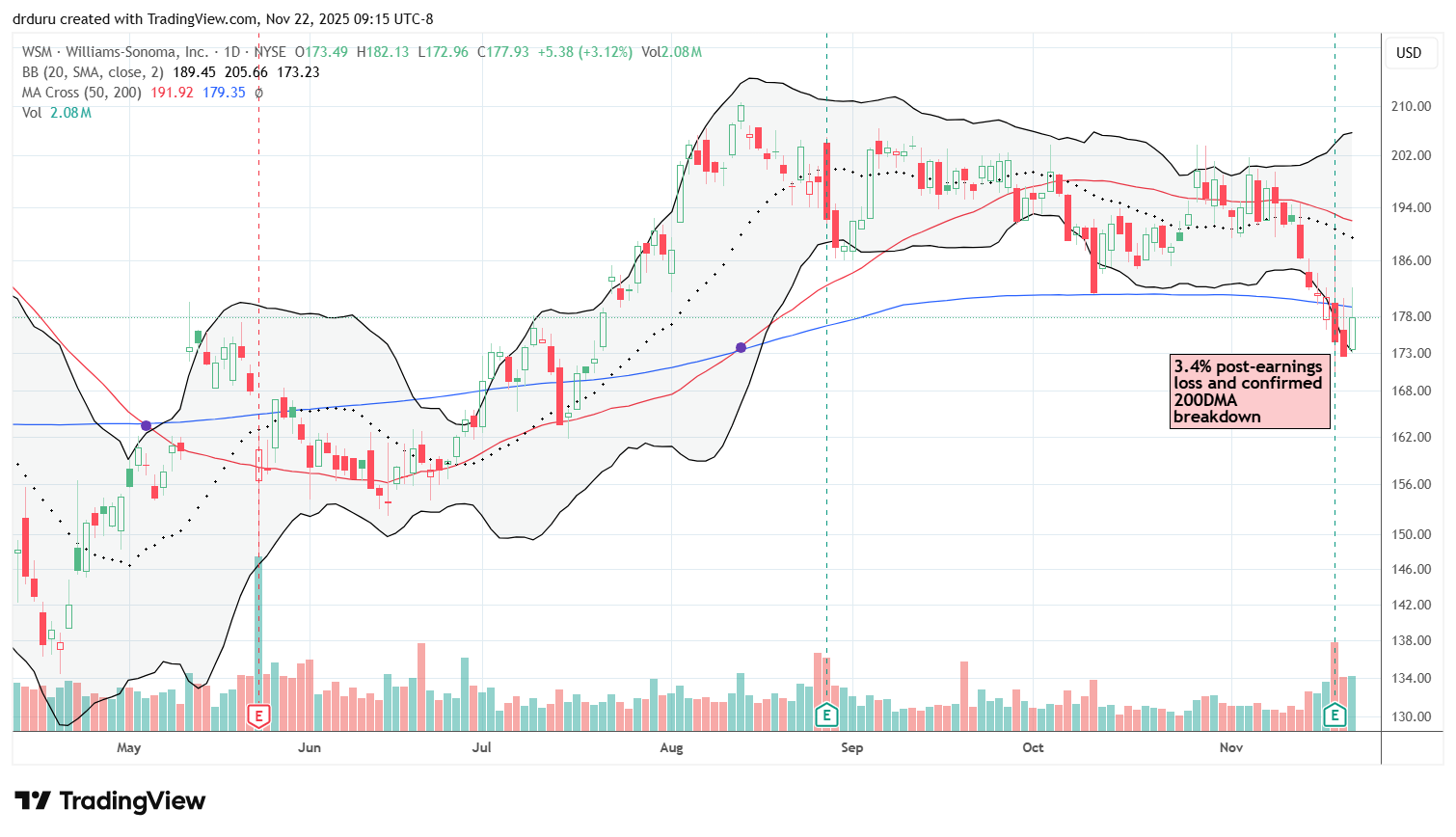
Technical status: Williams-Sonoma (WSM) traded below its declining 200DMA and maintained a bearish setup after volatile post-earnings action.
Trade commentary: Speaking of specialty retailers, WSM may finally be topping out. The stock’s last rally stopped far short of the all-time high set in February, so the post-earnings 200DMA breakdown makes the stock particularly bearish. Even if WSM recovers, I expect 50DMA resistance to hold firm. The stock traded wildly intraday which I interpret as a sign of sentiment in transition for the worse.
Netflix (NFLX)
Description: Netflix provides streaming video entertainment services.
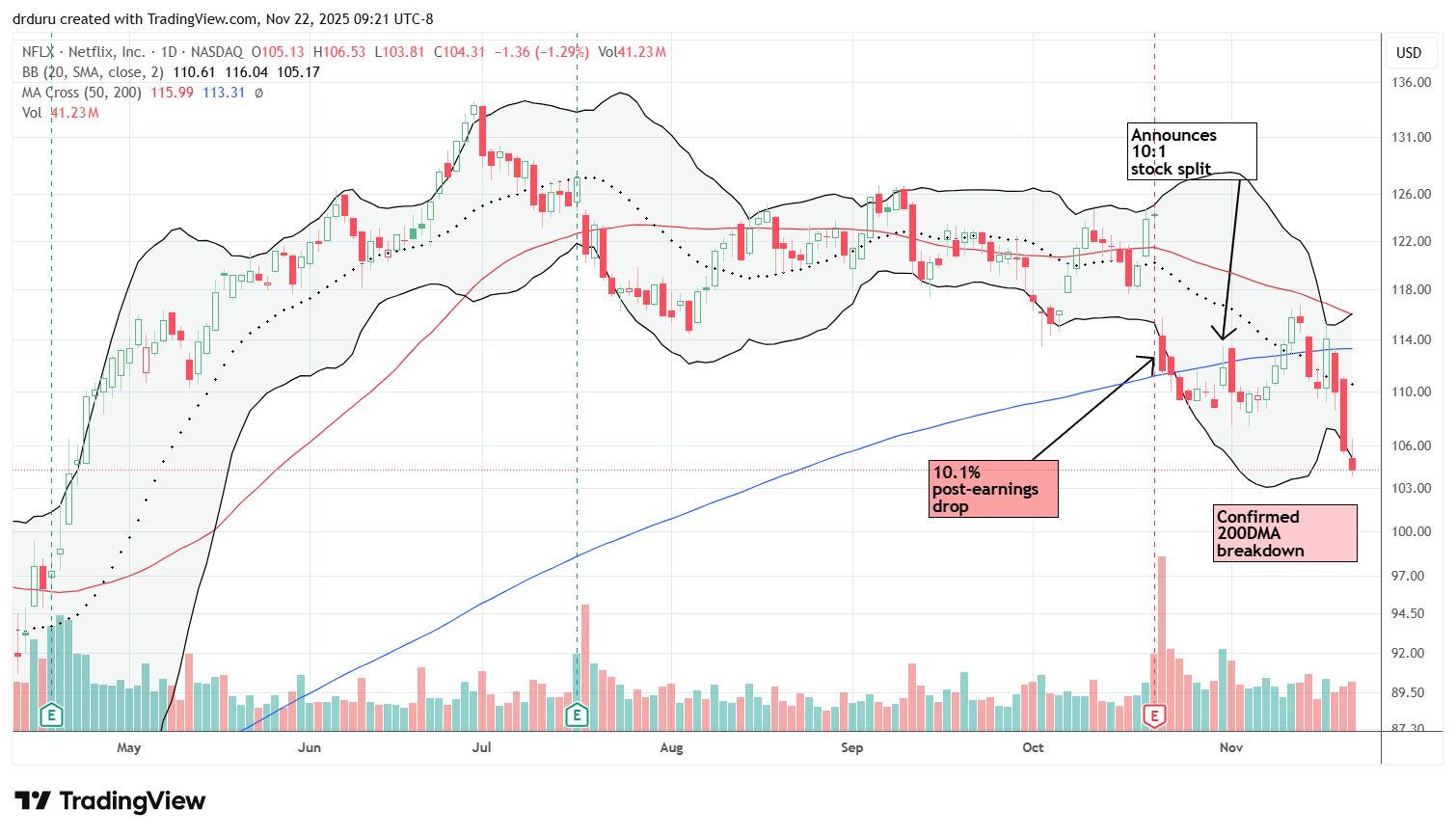
Technical status: Netflix (NFLX) traded below its 200DMA for the first time in years and confirmed a bearish trend after prior post-earnings weakness.
Trade commentary: NFLX is bearish with a confirmed 200DMA breakdown. I shorted the stock after sellers faded the stock the day after news of a 10:1 stock split. I stopped out after the stock broke out above its 200DMA again, but in retrospect I know I should have waited to see whether the stock could push beyond downtrending 50DMA resistance. NFLX did not even challenge that resistance before resuming its sell-off. A potential bid to buy Warner Brothers may be weighing on the stock.
Wix.com (WIX)
Description: Wix.com provides cloud-based website creation and hosting services.
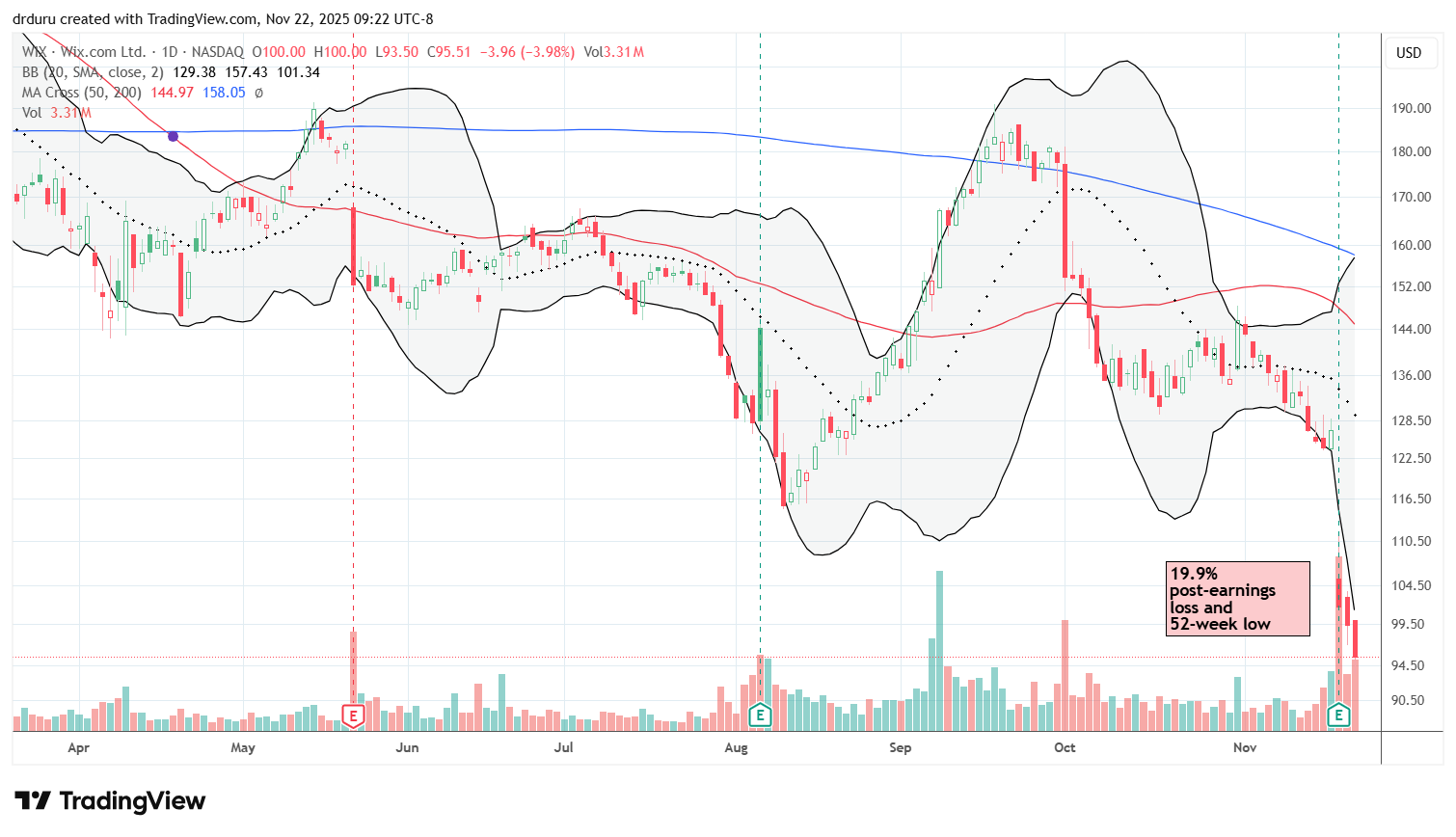
Technical status: Wix.com (WIX) traded to 52-week lows after a steep 19.9% post-earnings collapse and extended its decline below its lower Bollinger Band (BB).
Trade commentary: WIX crashed 20% percent post earnings. The stock has not been this low in a year. The selling pressure continued after earnings with two more closes below the lower Bollinger Band. The near inevitable relief rally should be sharp given the ferocity of the selling. However, rebounds should be sold all else being equal.
Duolingo (DUOL)
Description: Duolingo provides language-learning applications and educational software.
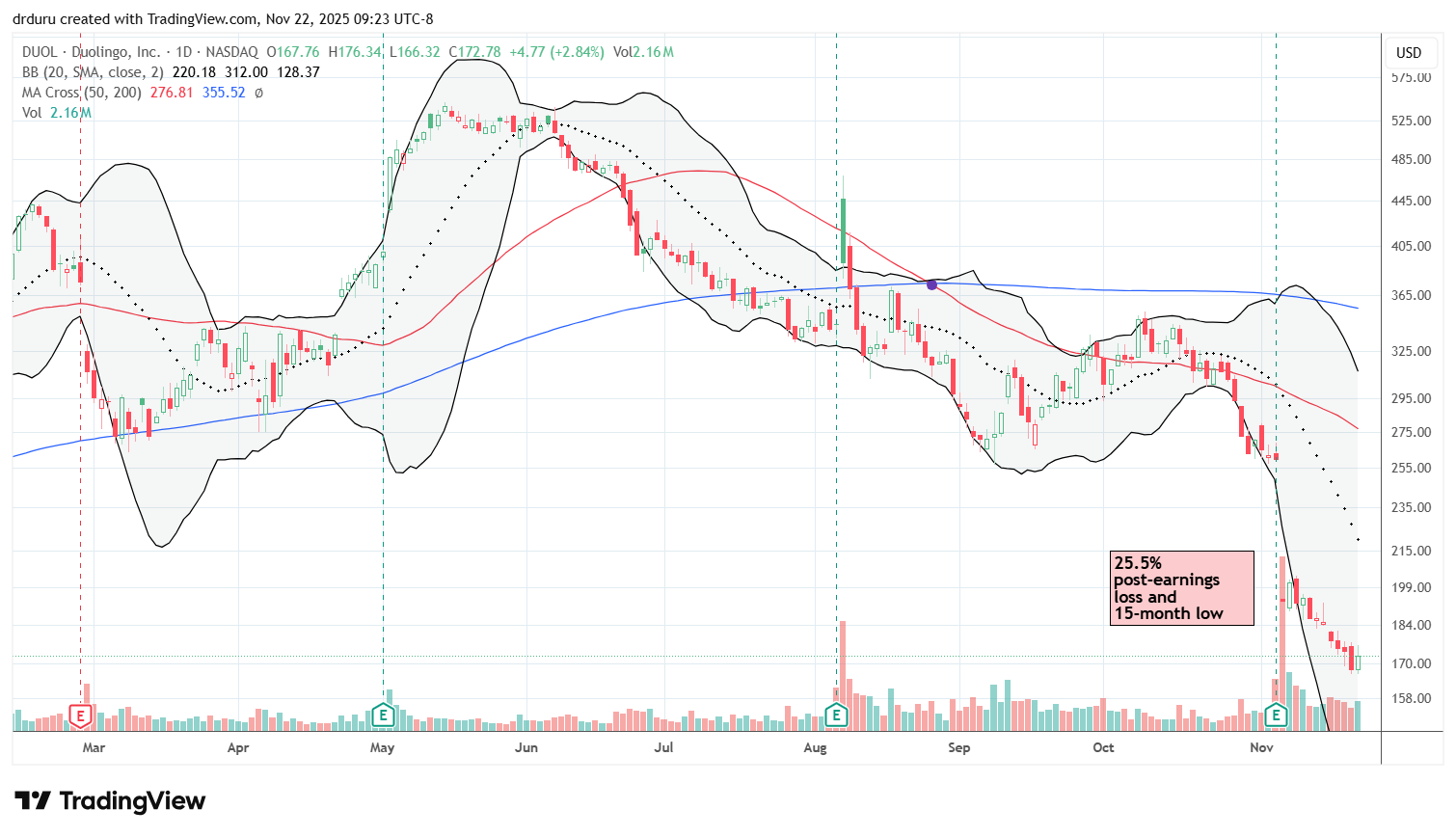
Technical status: Duolingo (DUOL) extended its steep post-earnings decline and traded to lows last seen in mid-2024.
Trade commentary: Duolingo crashed 25.5% post earnings. Concerns continue about the impact of AI on the app. WIX looks topped out as it last traded this low in summer 2024. At its all-time high, DUOL almost hit $550/share and is now around $172/share. Only a massive catalyst could possible return DUOL to its all-time high.
ARK Innovation ETF (ARKK)
Description: The ARK Innovation ETF invests in companies focused on disruptive innovation.
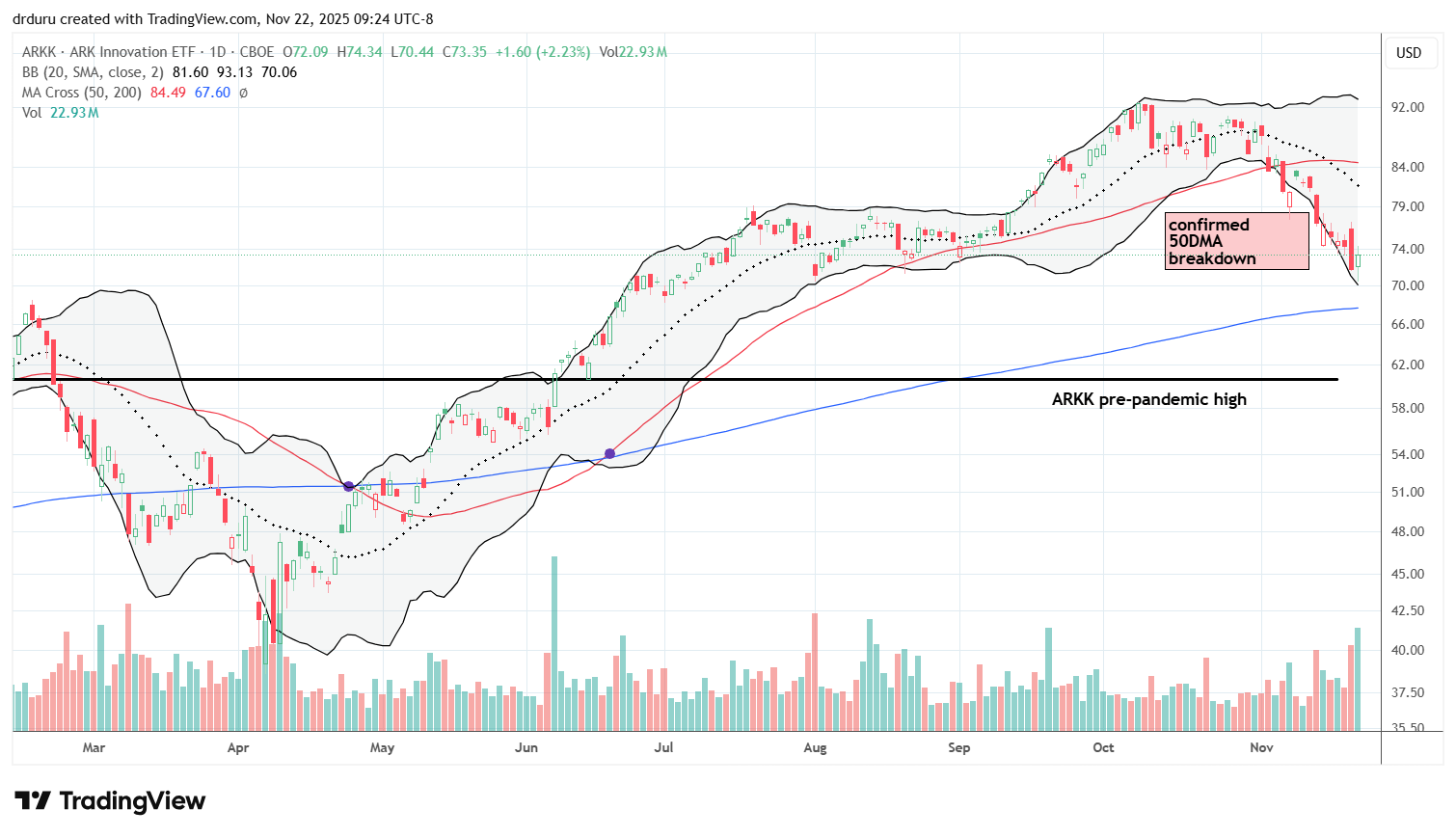
Technical status: The ARK Innovation ETF (ARKK) traded below its 50DMA and moved toward potential 200DMA support in an ongoing bearish phase.
Trade commentary: ARKK has steadily sold off since its 50DMA breakdown, and now the 20DMA is trending downward. I got back into ARKK using my strategy of buying shares and selling calls. I will not add to the position until the stock tests 200DMA support. As a reminder, I finally flipped bullish when ARKK broke out above its pre-pandemic high. While ARKK still looks like a popped bubble that may never recover, the ETF continues to perform well as a trading vehicle.
ARK Genomic Revolution ETF (ARKG)
Description: The ARK Genomic Revolution ETF invests in companies focused on genomics and biotechnology innovation.
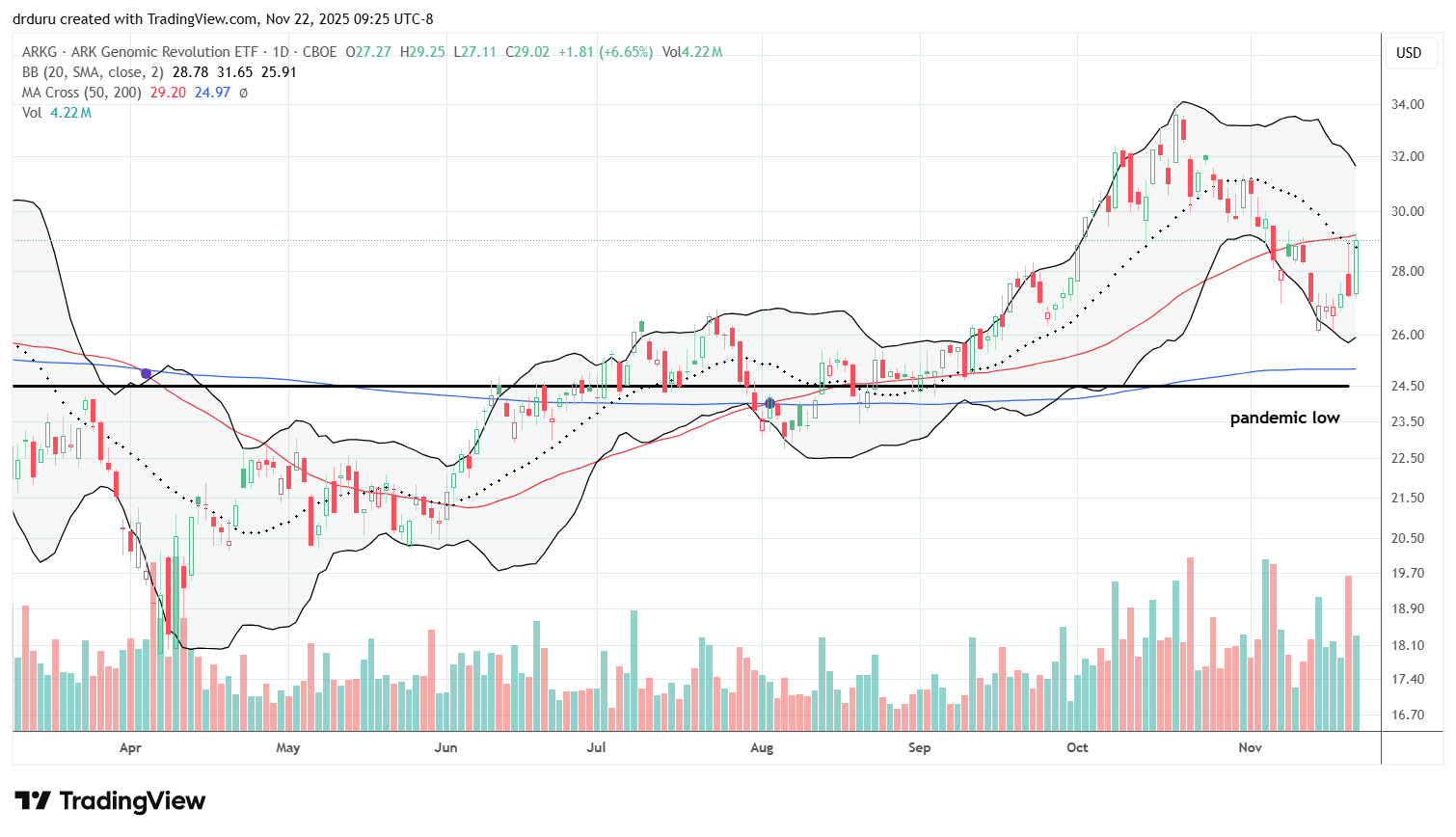
Technical status: The ARK Genomic Revolution ETF (ARKG) rebounded strongly but closed right at converging resistance from its 20DMA and 50DMA.
Trade commentary: ARKG benefited from the relief rally with a 6.6%. I will consider buying on a 50DMA breakout given the recent outperformance of biotech stocks. Unfortunately, ARKG is weighed down by a large number of broken stocks, many of which are headed to zero given current momentum. Cathie Wood generally holds on to losers far too long.
iShares Biotechnology ETF (IBB)
Description: The iShares Biotechnology ETF tracks a basket of biotechnology companies.
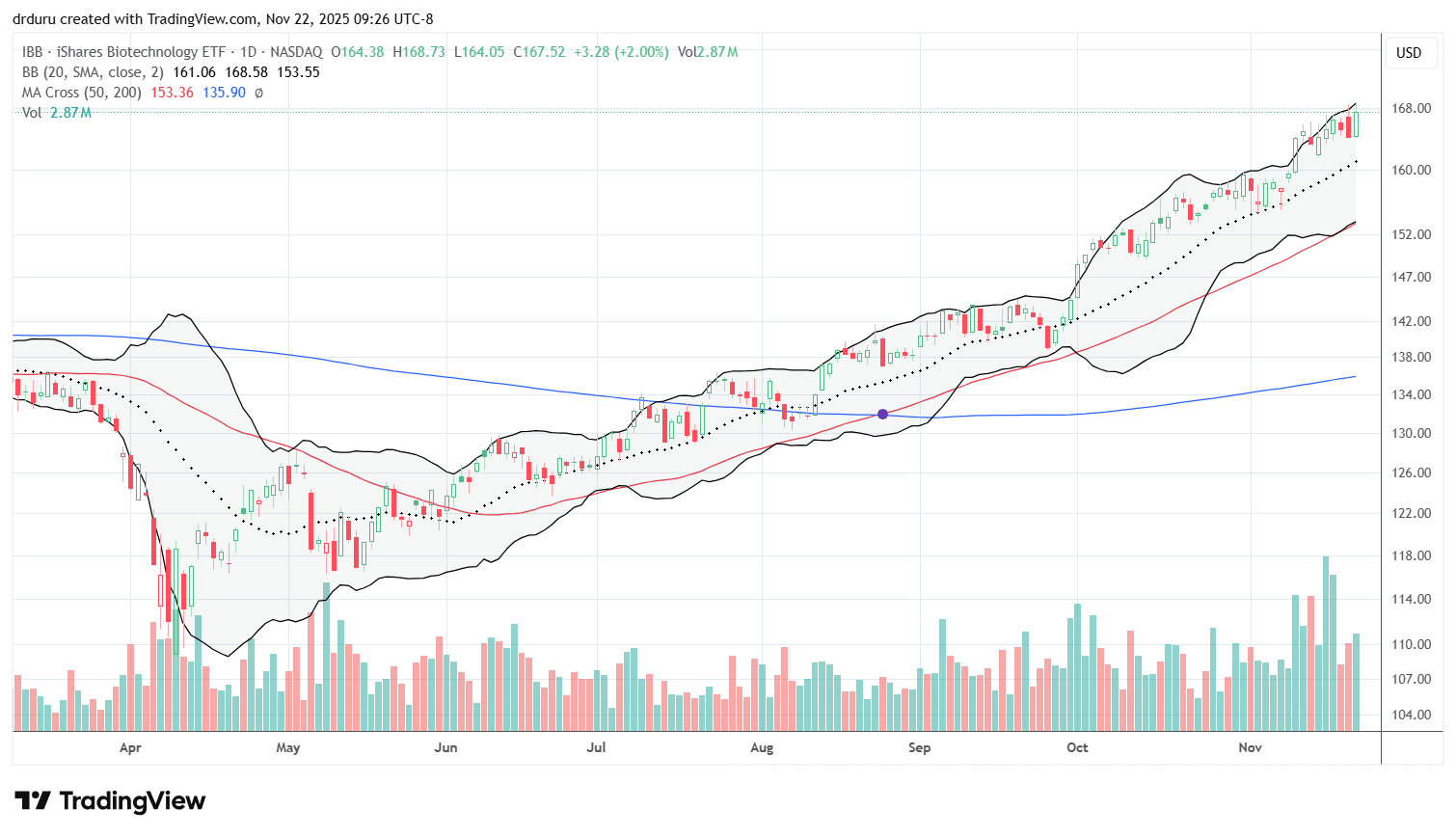
Technical status: The iShares Biotechnology ETF (IBB) traded near all-time highs after an extended bullish trend.
Trade commentary: IBB has performed fantastically and far better than ARKG. IBB is almost at its all-time high from 2021. In the meantime, I prefer to trade and hold a few select biotech stocks like SNDX.
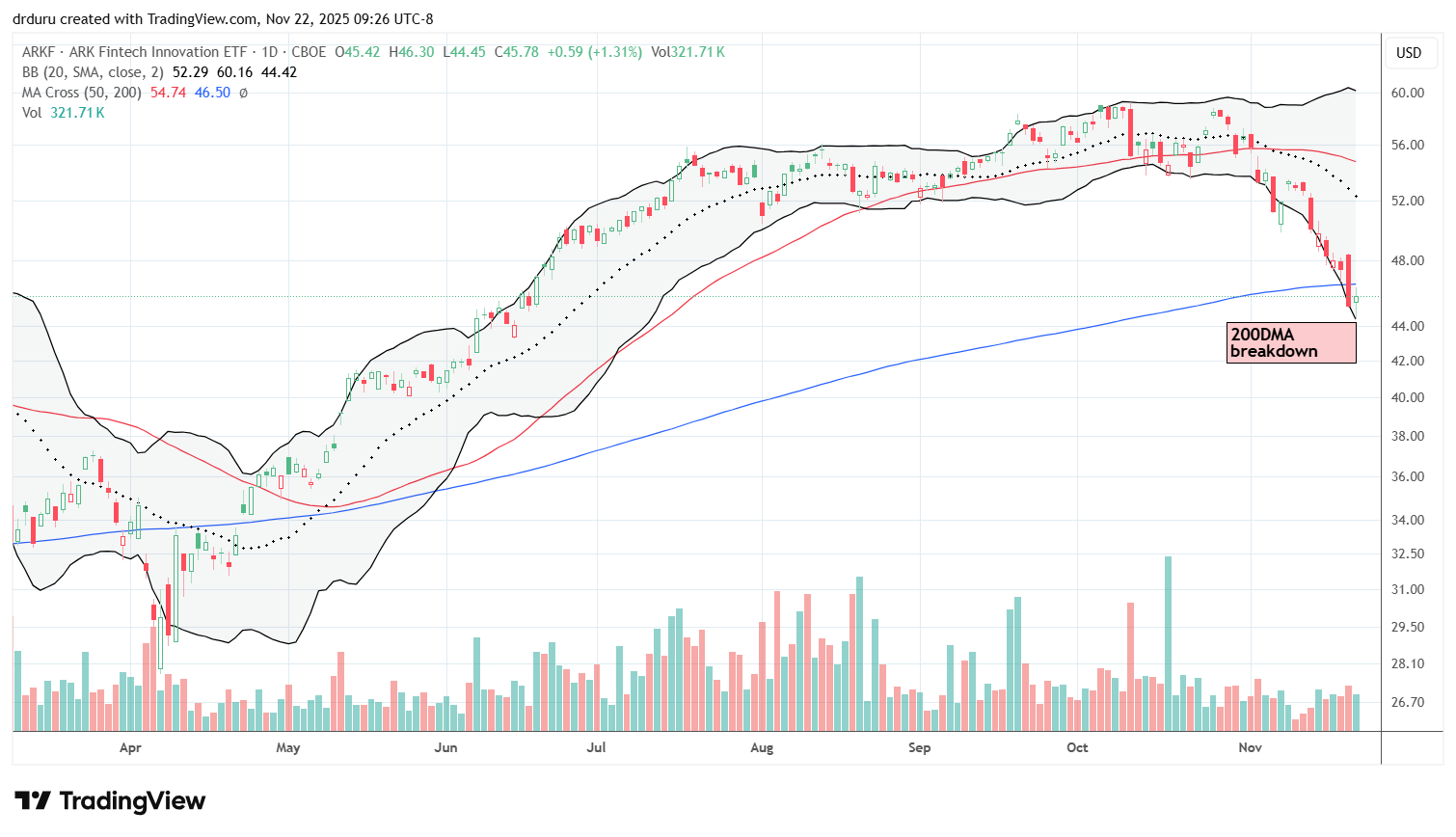
ARK Fintech Innovation ETF (ARKF)
Description: The ARK Fintech Innovation ETF invests in companies developing financial technology and digital payments.
Technical status: The ARK Fintech Innovation ETF (ARKF) dropped into bearish territory below its 200DMA.
Trade commentary: I shorted ARKF some time ago as a hedge. Now the ETF is trading in bearish territory below its 20)DMA after selling off all month. I am staying short as an even better hedge.
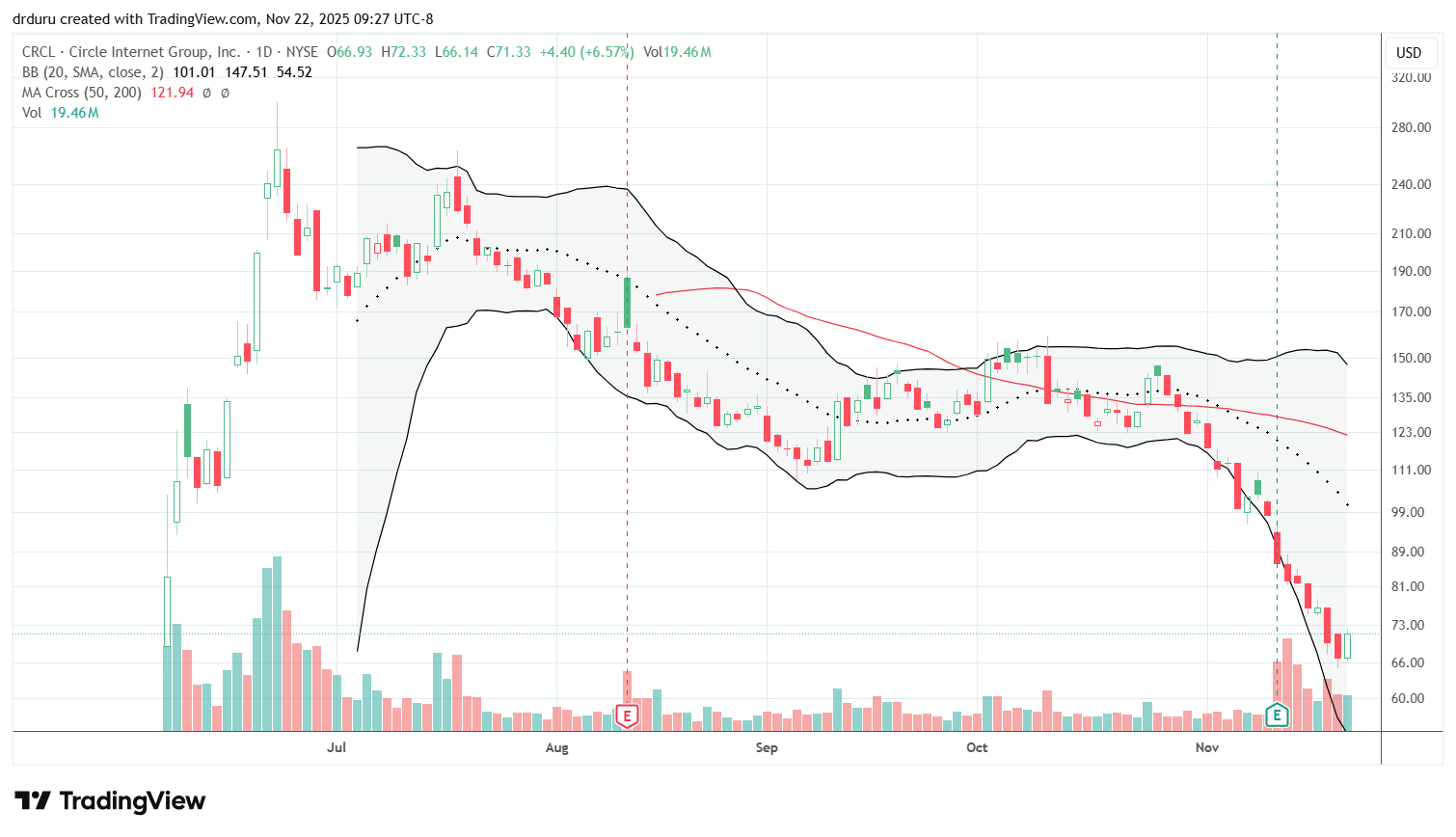
Circle Internet Financial (CRCL)
Description: Circle Internet Financial operates payment infrastructure and stable-coin-related financial services.
Technical status: Circle Internet Financial (CRCL) retraced its entire post-IPO advance and circled back to its opening levels amid crypto-related selling pressure.
Trade commentary: CRCL has completed a full circle since its IPO. The stock gained multiples after its IPO only to reverse all those gains. Selling accelerated this month as crypto unraveled amid increasing crypto worries. Last month, ominously, NYDIG’s Global Head of Research, Greg Cipolaro, claimed that stablecoins like USDC, USDT, and USD “are not truly pegged to the U.S. dollar, but rather float based on market supply and demand” according to an article in CoinDesk. October’s crypto breakdown occurred as some stablecoins “broke the buck” and dropped well below $1.
CRCL may still be part of the future of finance, so I am waiting for signs of life to try a buy of shares (previous call spreads failed).
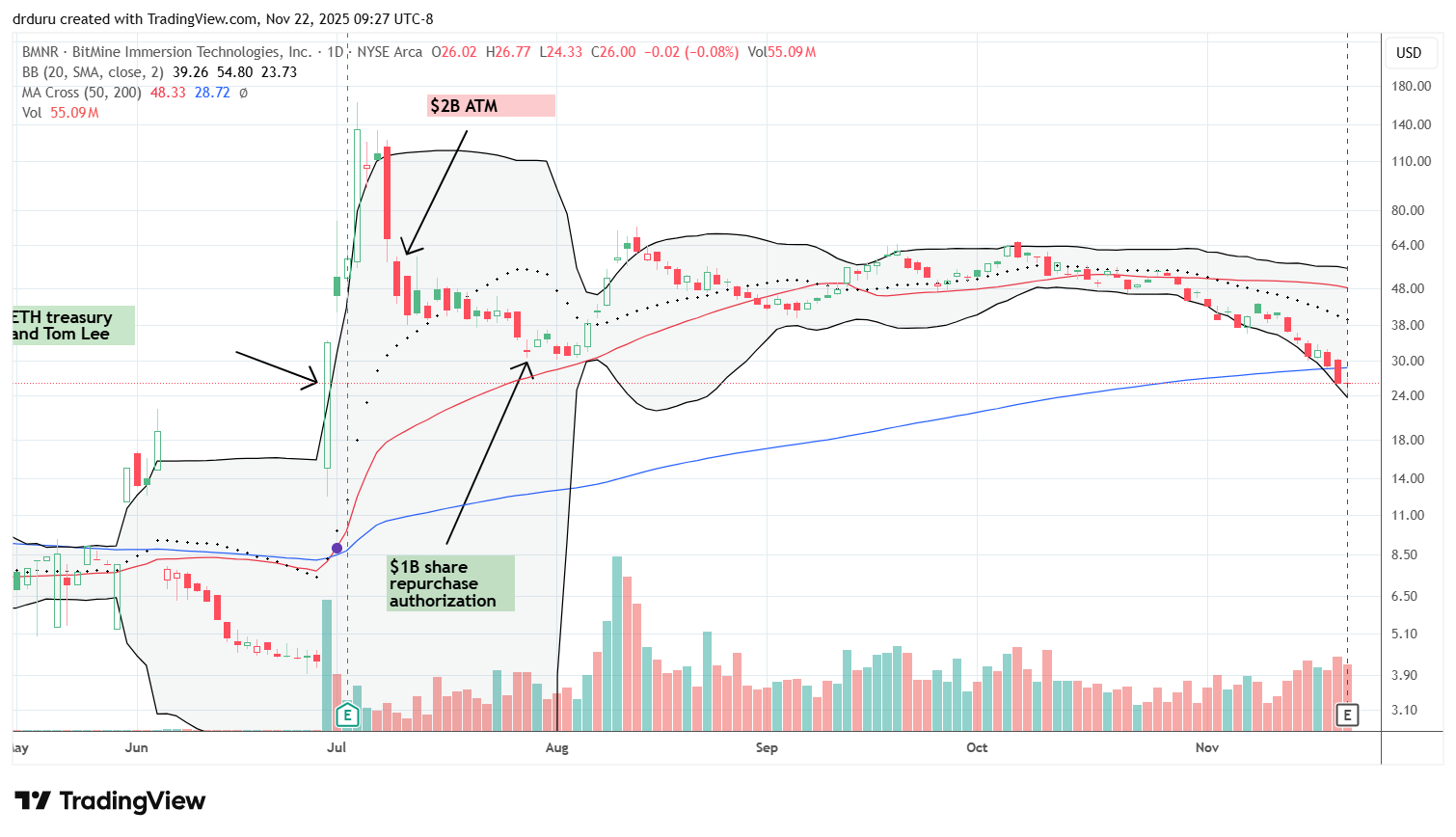
BitMine Immersion Technologies (BMNR)
Description: BitMine Immersion Technologies develops immersion-cooled infrastructure for cryptocurrency mining operations.
Technical status: BitMine Immersion Technologies (BMNR) traded below its 200DMA and entered bearish territory alongside broader crypto weakness.
Trade commentary: BMNR joined bearish territory with a 200DMA breakdown. I do not think the company has yet spent any of its $1B authorization for repurchases. The persistent selling in crypto makes buying treasury companies particularly risky. The deeper the sell-off, the more likely these treasury companies will find themselves forced to sell their crypto which in turn begets more selling in the crypto market. Still, I am trying to hang on to BMNR as a potential rare and unique winner in this crypto financial engineering.
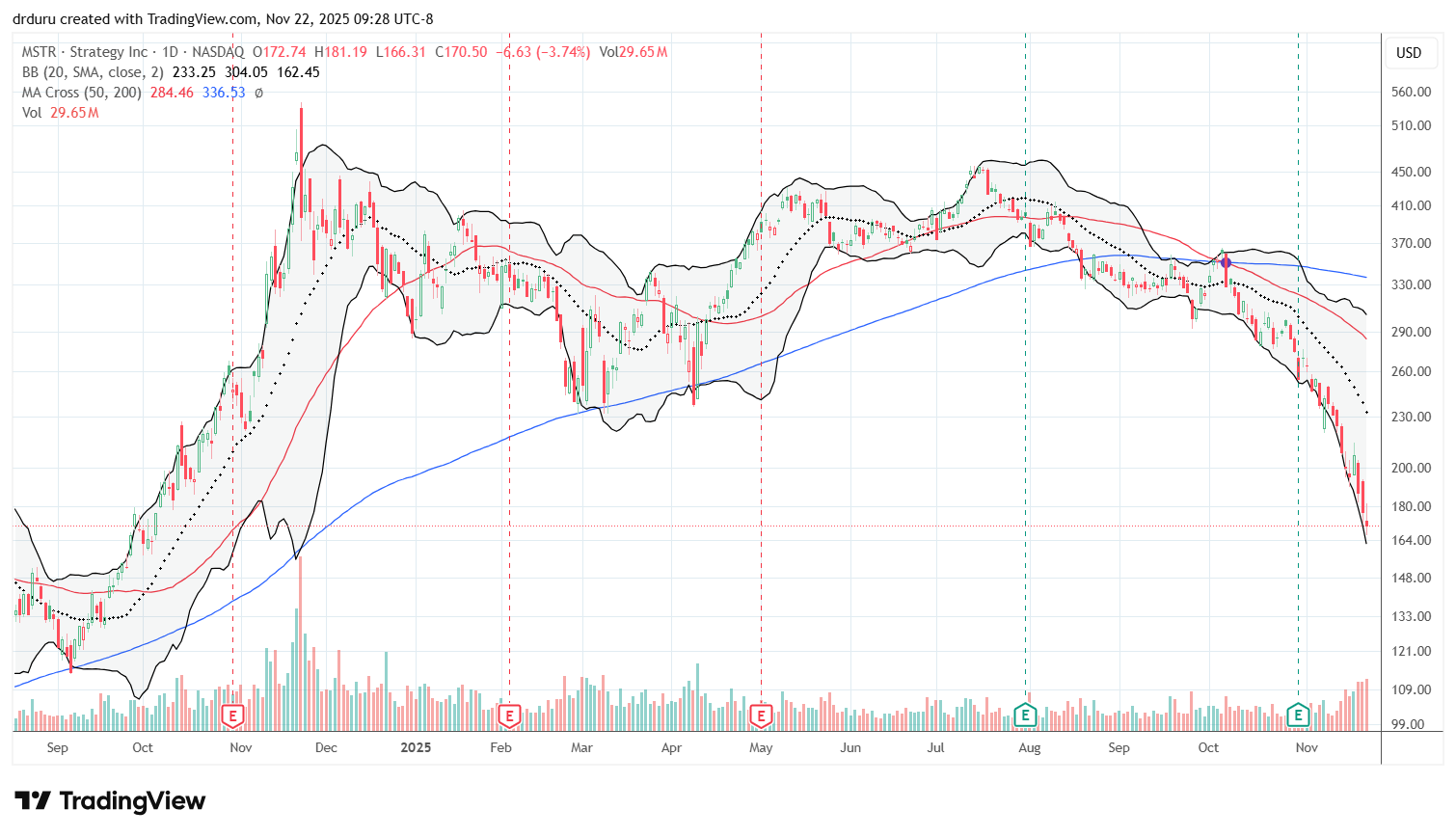
MicroStrategy (MSTR)
Description: MicroStrategy provides business intelligence software and holds significant Bitcoin exposure as part of its corporate strategy.
Technical status: MicroStrategy (MSTR) traded to thirteen-month lows and continued its decline amid mounting crypto-related selling pressure.
Trade commentary: MSTR finds itself smack in the middle of the latest crypto troubles. The stock did not even benefit from Friday’s relief rally; the stock fell another 3.7% instead. Per Tom Lee’s explanation in the video above, financial institutions have crowded into MSTR put options to hedge crypto exposure. The pressure is evident in November’s accelerated sell-off. MSTR last traded this low 13 months ago. A blowup in MSTR could create major repercussions in the sector. Still, MSTR has managed to survive prior panics. Certainly, CEO Michael Saylor is unbowed and unconcerned based on his Twitter feed.
Bitcoin (BTC/USD)
Description: Bitcoin is a decentralized digital asset used as a cryptocurrency and store of value.
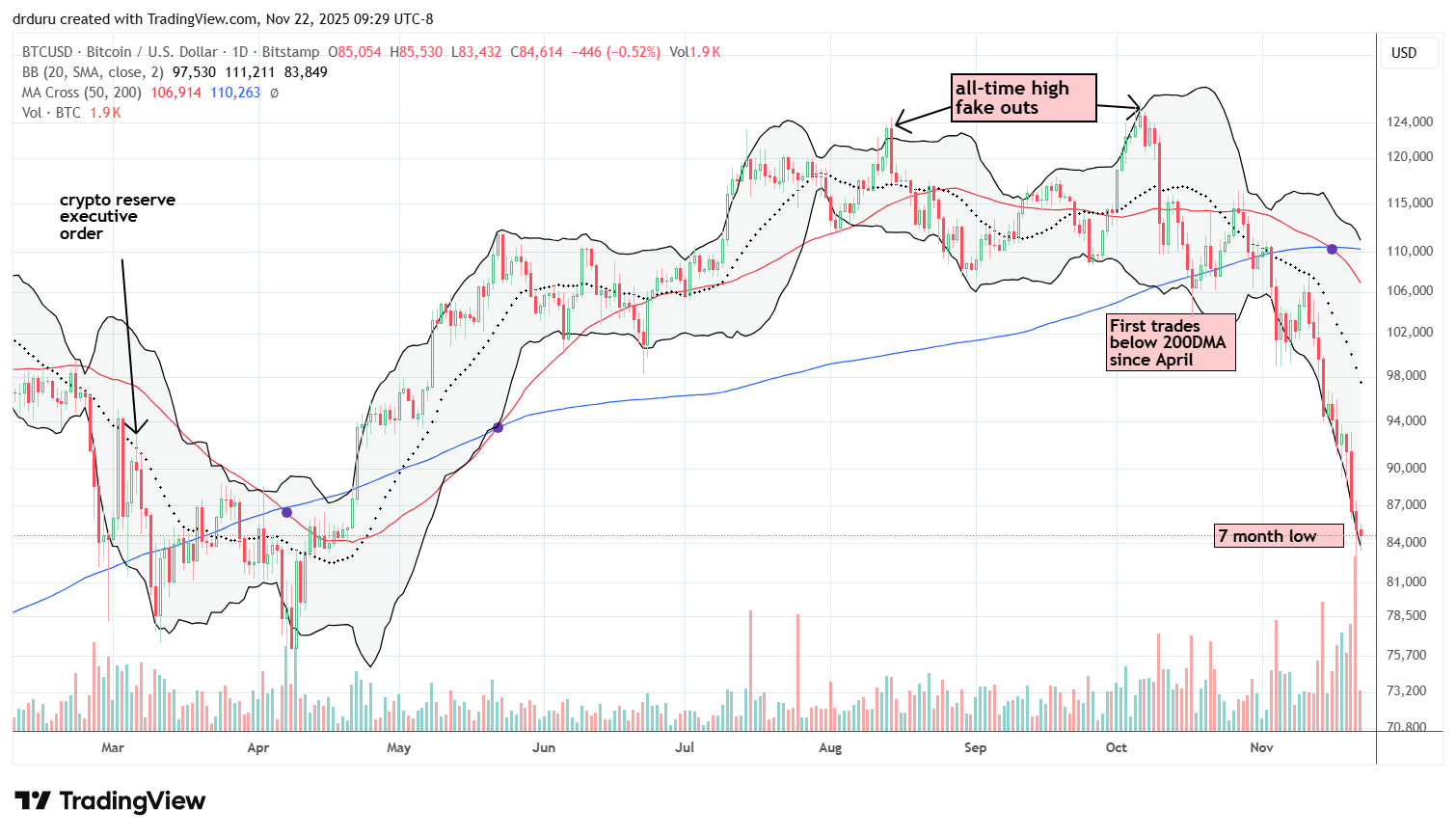
Technical status: Bitcoin (BTC/USD) traded below both its 50DMA and 200DMA and extended its decline toward major technical support levels.
Trade commentary: I have slowly accumulated Bitcoin during this selloff. I prefer to buy aggressively into crashes, so I have tried to stay patient in this accumulation phase. Given cryptocurrencies can move abruptly for little reason and at random, I do not strictly trade on the technicals. The “glitch” that Tom Lee described must not have seemed serious at the time given it did not come with a crash. The extended selling exposes the significance of the failure.
Elastic (ESTC)
Description: Elastic provides search, observability, and security software solutions built on the Elasticsearch platform.
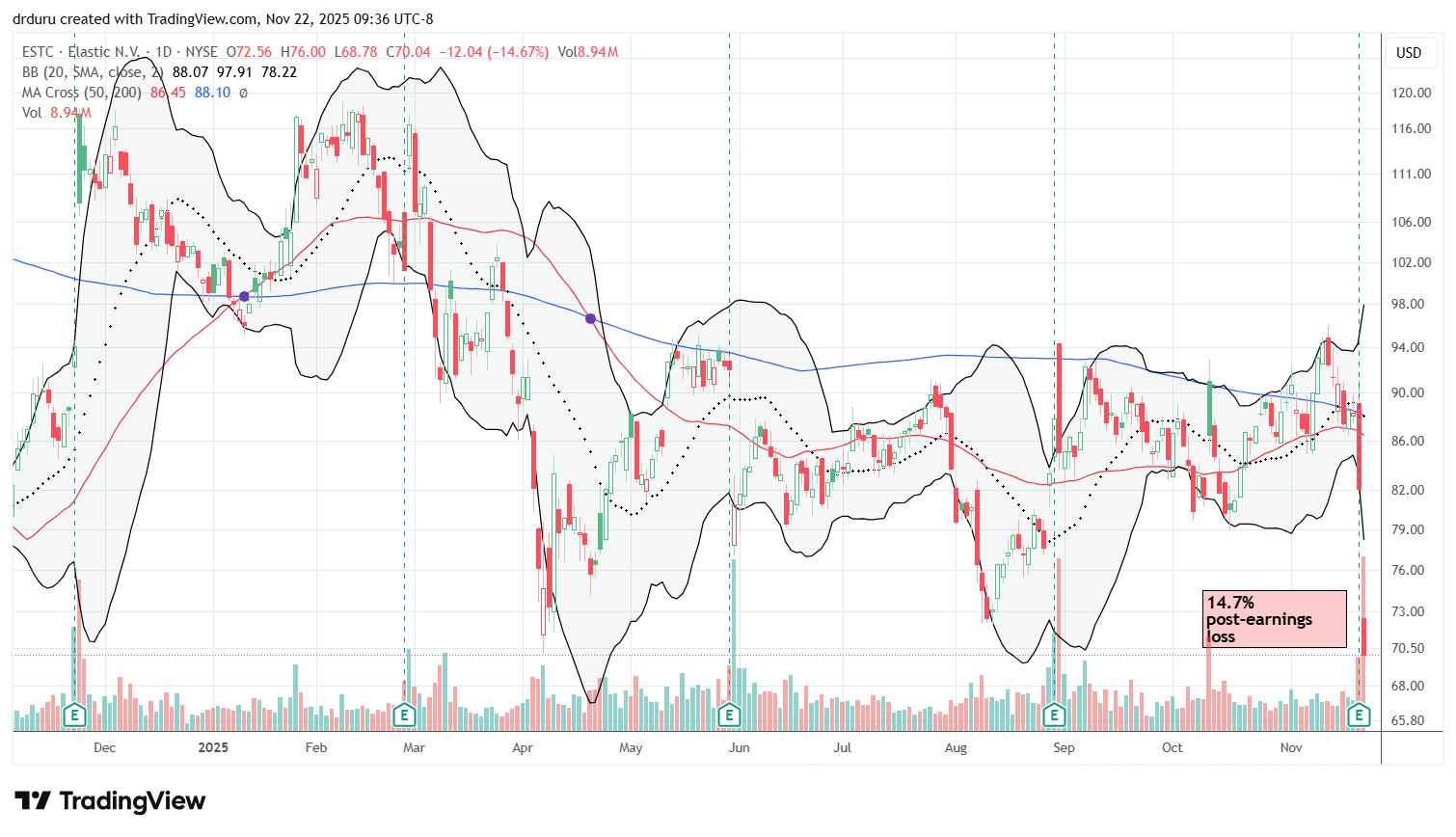
Technical status: Elastic (ESTC) dropped 14.7% post-earnings and traded near prior support despite raised guidance.
Trade commentary: ESTC is a dead money stock overall. The stock has gone nowhere for more than two years. However, I got bullish after August earnings. I bought a call spread that barely changed in value until implied volatility soared ahead of last earnings. Rather than risk holding through earnings, I took profits. While I am relieved after the 14.7% post-earnings sell-off, I am also bewildered given the company beat earnings and increased guidance. I am watching ESTC closely as the stock tries to hold support at the lower part of its trading range.
Be careful out there!
Footnotes
Subscribe for free to get email notifications of future posts!
“Above the 50” (AT50) uses the percentage of stocks trading above their respective 50-day moving averages (DMAs) to measure breadth in the stock market. Breadth defines the distribution of participation in a rally or sell-off. As a result, AT50 identifies extremes in market sentiment that are likely to reverse. Above the 50 is my alternative name for “MMFI” which is a symbol TradingView.com and other chart vendors use for this breadth indicator. Learn more about AT50 on my Market Breadth Resource Page. AT200, or MMTH, measures the percentage of stocks trading above their respective 200DMAs.
Active AT50 (MMFI) periods: Day #112 over 20%, Day #1 over 30% (overperiod), Day #7 under 40% (underperiod), Day #19 under 50%, Day #43 under 60%, Day #85 under 70%
Source for charts unless otherwise noted: TradingView.com
Full disclosure: long IWM shares, long SPY put spreads, long ARKK, long DELL, long MU call spread, long MSFT, long ITB shares and calls, short EAT, long UBER, short ARKF, long BMNR, long BTC/USD
FOLLOW Dr. Duru’s commentary on financial markets via StockTwits, BlueSky, and even Instagram!
*Charting notes: Stock prices are not adjusted for dividends. Candlestick charts use hollow bodies: open candles indicate a close higher than the open, filled candles indicate an open higher than the close.
* Blog notes: this blog was written based on the heavily edited transcript of the following video that includes a live review of the stock charts featured in this post. I used ChatGPT to process the transcript.