

The Market Breadth Summary
- A no dips market pushed major U.S. indexes sharply higher all week as FOMO (fear of missing out) drove aggressive buying and limited pullbacks.
- The S&P 500 broke above key moving averages and closed at a fresh all-time high, confirming strong upside momentum.
- The NASDAQ surged to new highs, invalidated a prior double-top pattern, and extended a powerful multi-day winning streak unseen since 1992.
- Market breadth rapidly improved as AT50 moved to overbought territory, signaling broad participation but raising the risk of short-term exhaustion.
- Falling volatility and renewed strength in technology, commodities, and select cyclicals reinforced the bullish tone despite stretched conditions.
Stock Market Commentary
There are no dips allowed in this stock market.
A week ago, I labelled the trading environment as “buy-the-dips” because of the psychology of post-oversold trading. Those dips turned out to be hard to find. Only day traders could notice any weakness in the price action. The stock market ripped higher day after day as FOMO, the fear of missing out, drove market breadth right to overbought territory.
As the Iran war fades quickly in the stock market’s rear view mirror, buyers confront a test of their resolve at the boundary of overbought trading conditions. All the urgency of this current buying strength faces its first technical test since the resounding breakouts on April 8 following the ceasefire news.
I have seen commentators call the market dumb for rallying since March’s bottom. For example, given the destructive and disastrous impact of the closure of the Strait of Hormuz, the stock market should reflect the corresponding burdens. In actuality, the market gets to choose what it cares about and how far into the future it wants to look for better (or worse) days. The market is neither smart nor dumb. The market just is. Price action pays, not feelings or opinions, so I defer to price action.
Right now, price action says this is a no dips allowed market fueled by fear of missing out. My current focus rests at the overbought threshold for market breadth.
The Stock Market Indices
S&P 500 (SPY)
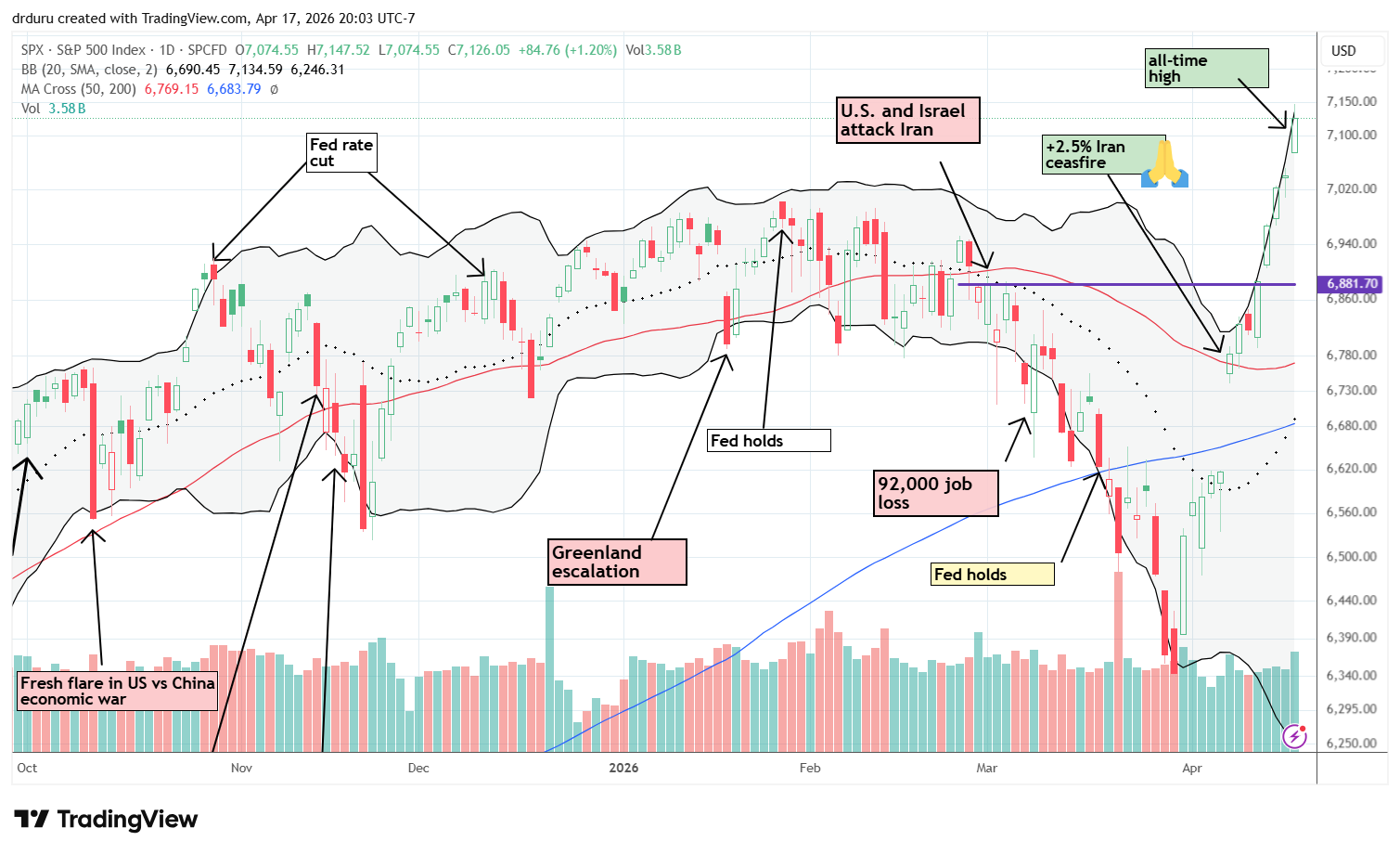
The S&P 500 surged 2.5% after the ceasefire announcement, clearing 200DMA and then 50DMA resistance, and never looked back. The index paused for a day where it closed on the first trading day after the war started. The continued surge with no dips placed the index firmly in bullish territory.
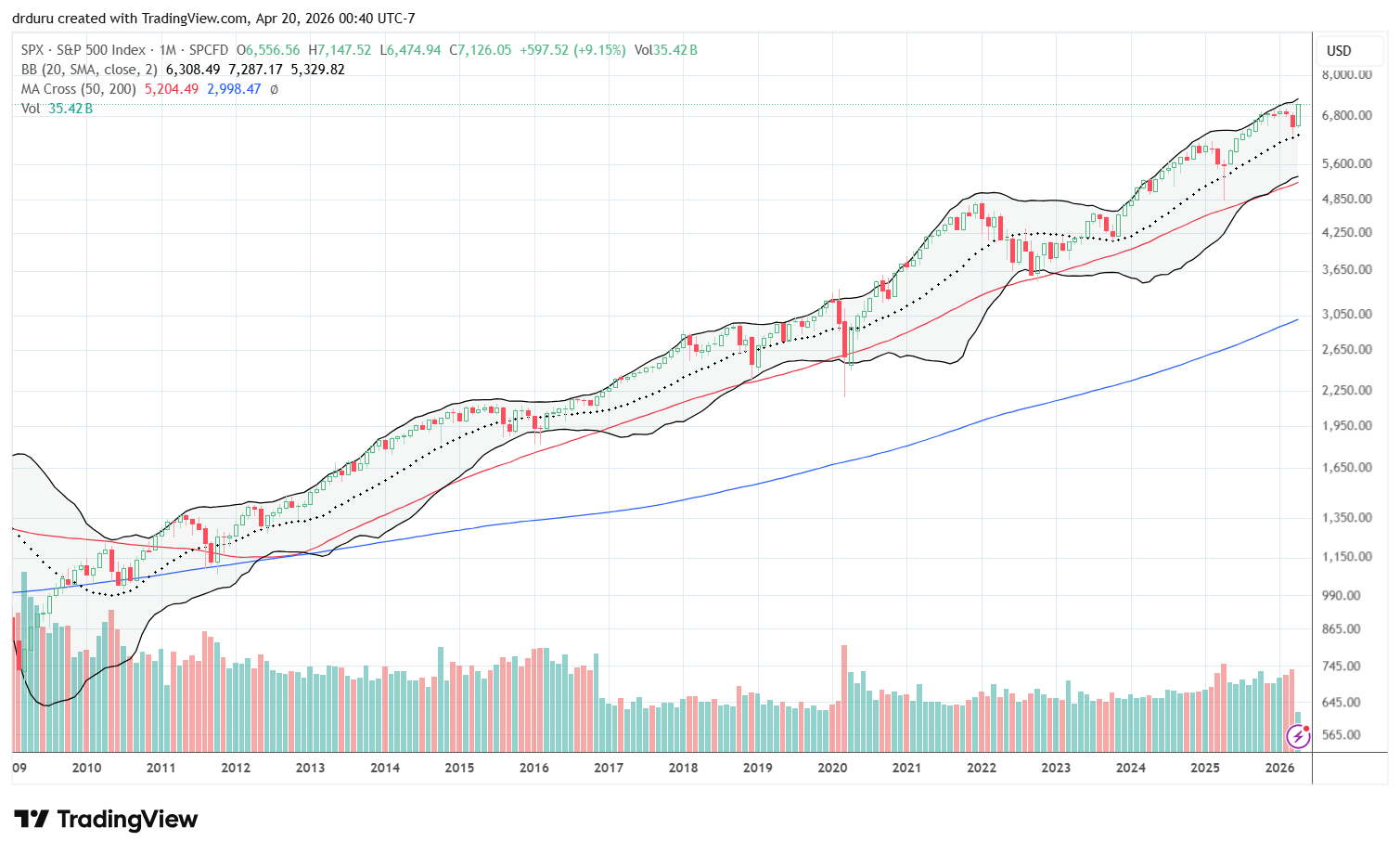
In a moment like this FOMO drive to bid up the market, I find a long-term perspective helpful. The monthly chart below reminds me how minor March’s sell-off was in the context of a longer-term up trend. In fact, March’s low pulled off a picture perfect test of the uptrend from the dashed line (a 20-monthmoving average). Also note that a continued rally from current levels would be quite within the norms of the last 12-14 years.
NASDAQ (COMPQ)
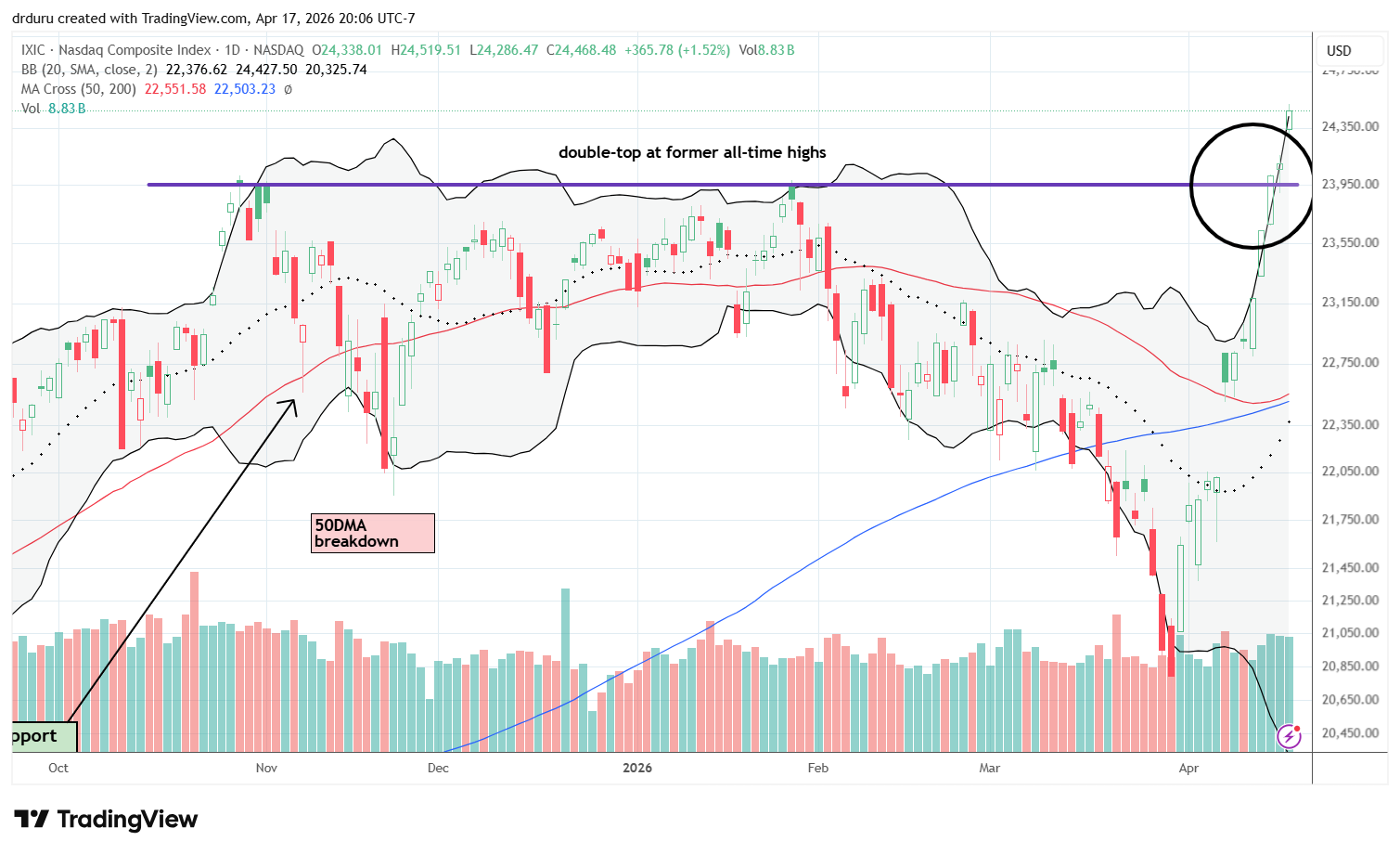
The NASDAQ showed even more urgency than the S&P 500. The tech-laden index gained 6.8% for the week versus the S&P 500’s 4.5% gain for the week. The NASDAQ closed at or above its upper Bollinger Band every day of the week. This aggressive return to tech stocks has created a 13-day winning streak, unmatched since 1992 (according to CNBC). Needless to say, the NASDAQ definitively invalidated the double-top that presided over the index’s bearishness for the first three months of this year.
iShares Russell 2000 ETF (IWM)
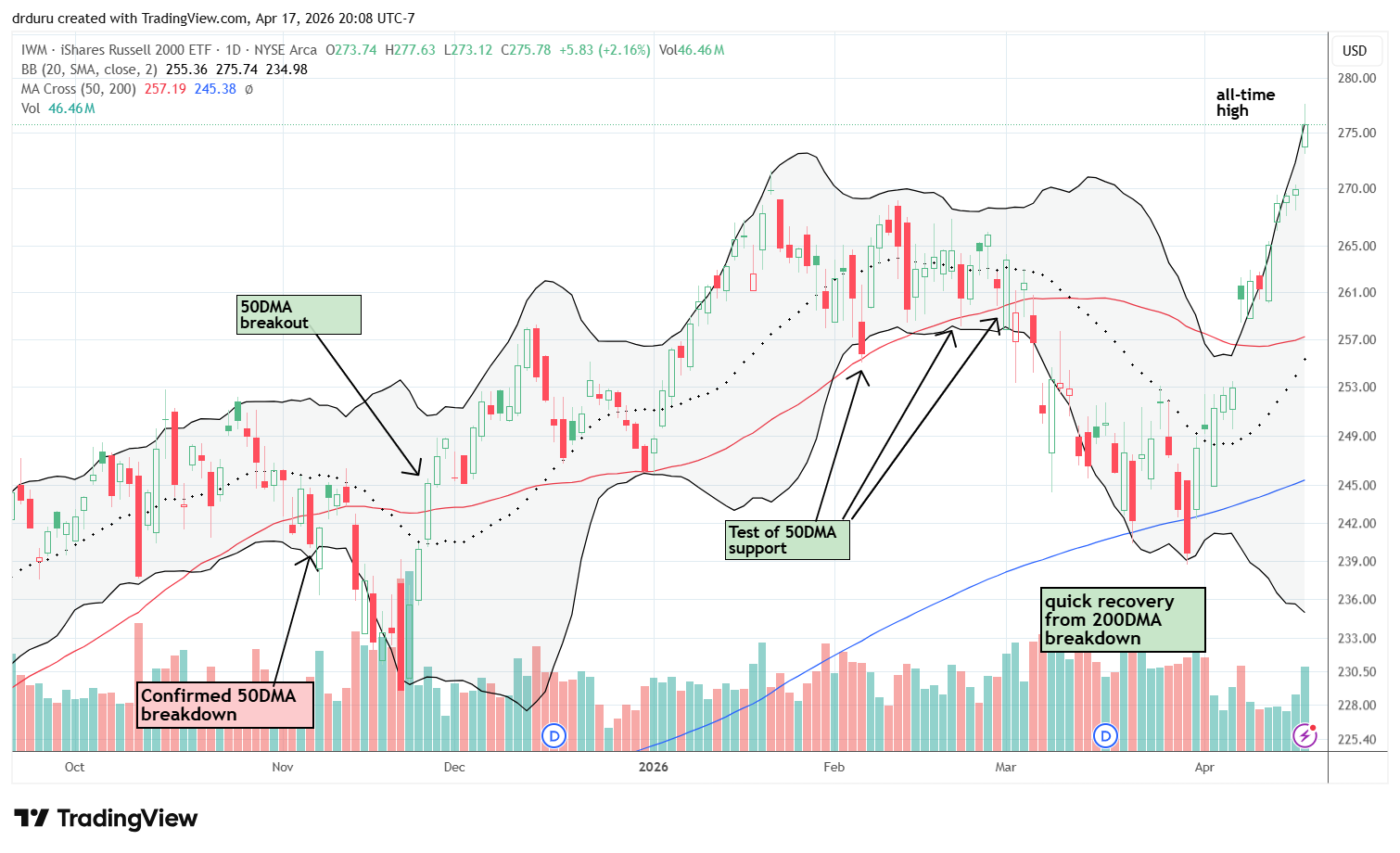
IWM continued higher and also reached all-time highs. Admittedly, I feel strange watching this latest part of the gains mostly from the sidelines. I managed to flip a calendar call spread, but I am definitely not bullish enough…on IWM or the stock market in general.
The Short-Term Trading Call With No Dips Allowed
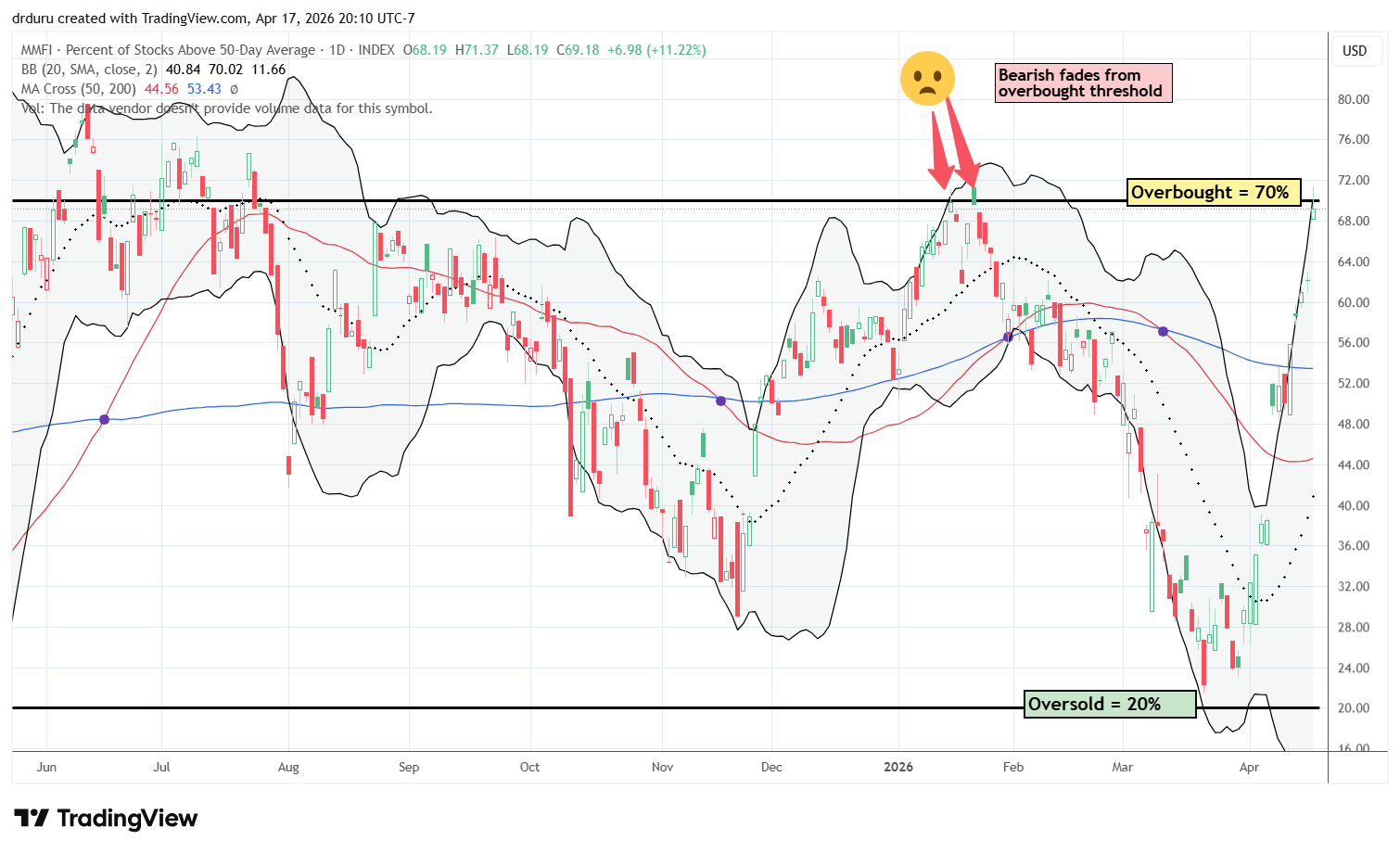
- AT50 (MMFI) = 69.2% of stocks are trading above their respective 50-day moving averages
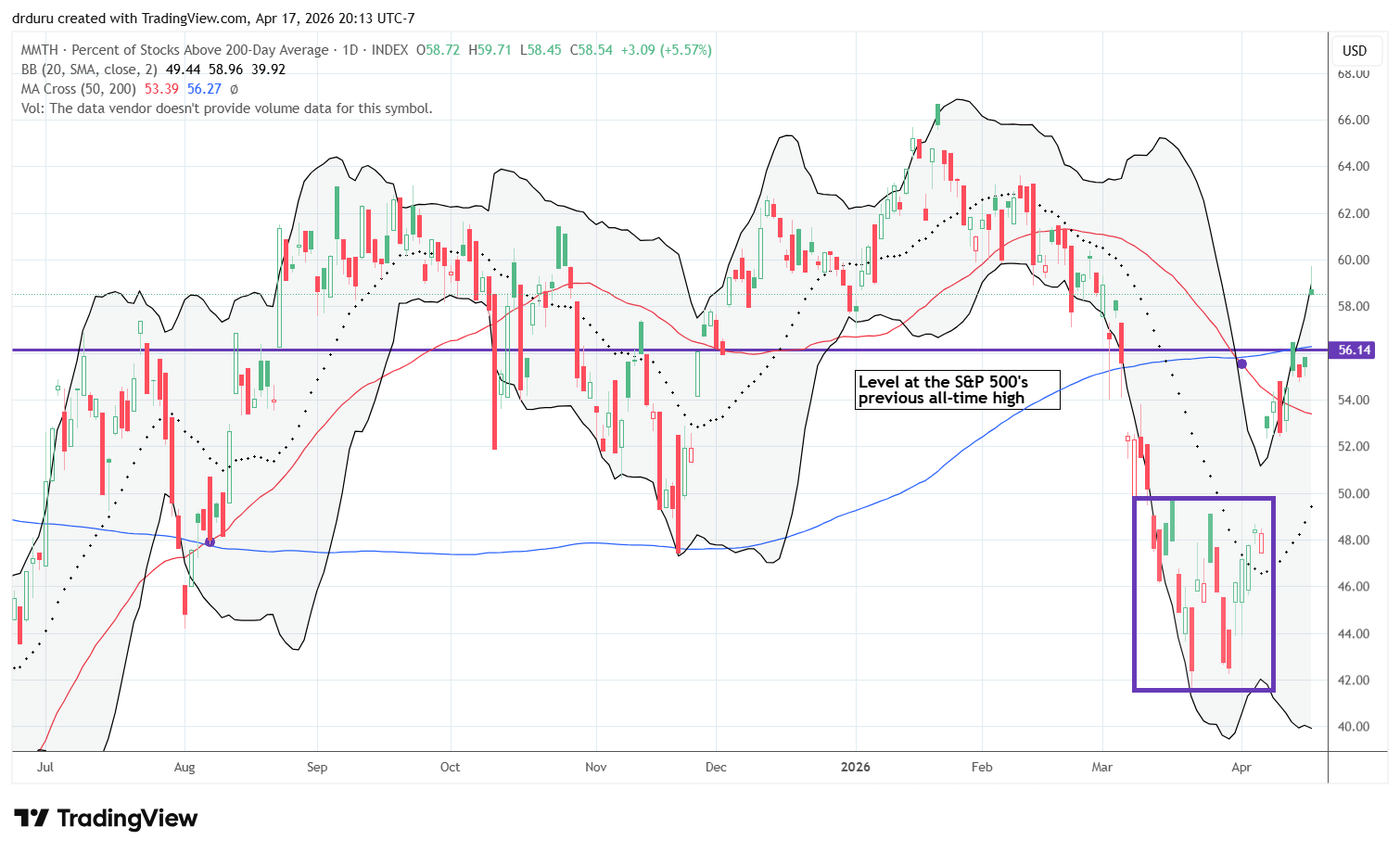
- AT200 (MMTH) = 58.5% of stocks are trading above their respective 200-day moving averages
- Short-term Trading Call: cautiously bullish
AT50 (MMFI), the percentage of stocks trading above their respective 50DMAs, closed the week at 69.2%. My favorite technical indicator punched its way into overbought territory with an intraday high of 71.4% before falling back. This fade is a subtly bearish sign, but I am not on alert until AT50 makes a close below Friday’s intraday low of 68.2%. The chart below reminds us of the bearish implications of falling from the overbought threshold. January’s failure coincided with the slide in tech and the eventual sell-off across the stock market.
AT200, the percentage of stocks trading above their respective 200DMAs, closed at 58.5%. Longer-term market breadth has improved with a bullish clearance from the consolidation at the lows and a gap higher above the level that marked the all-time for the S&P 500 in February, 2025. However, longer-term breadth remains far off its recent highs, so AT200 is lagging AT50.
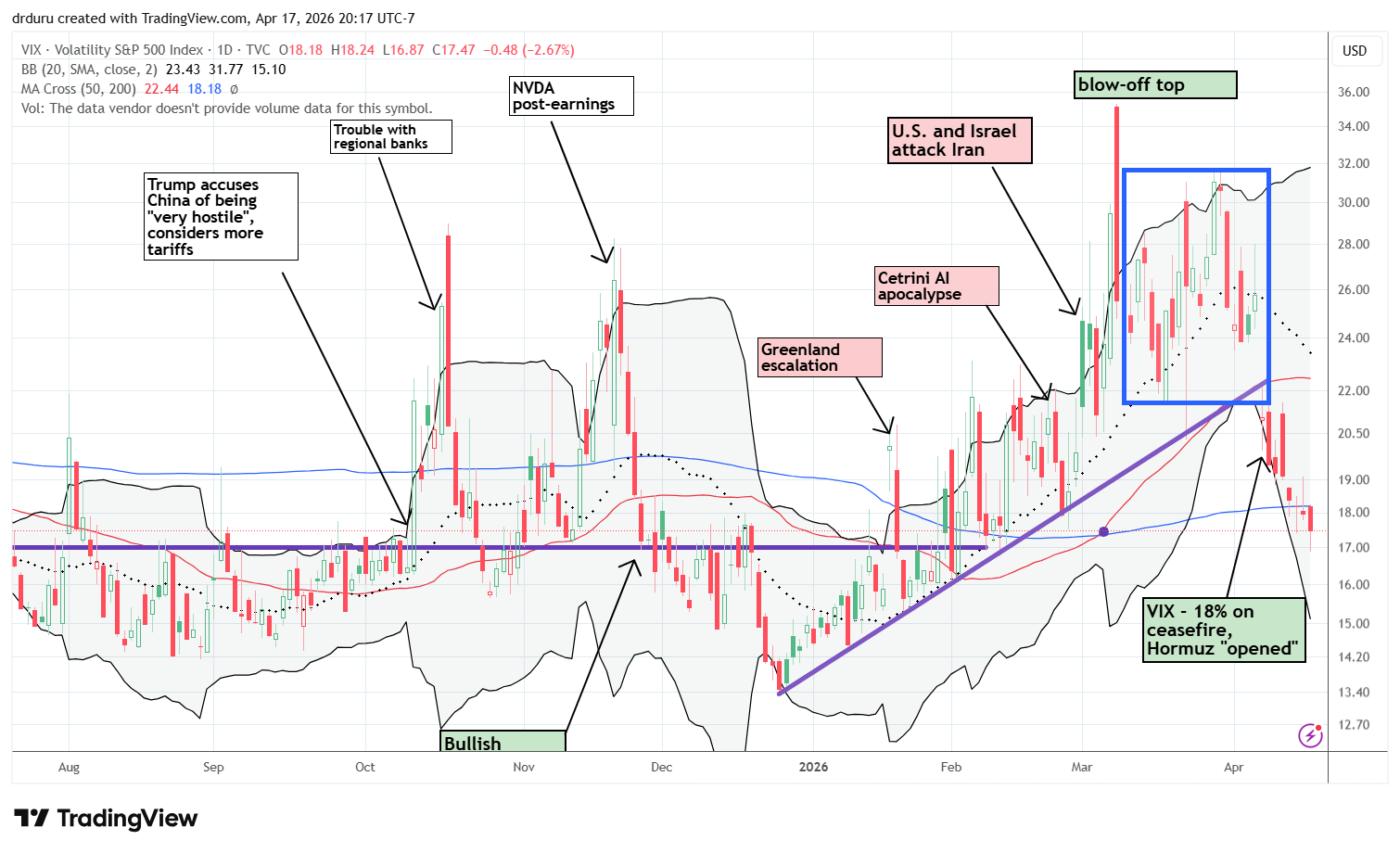
The volatility index (VIX) continues to reinforce the bullish message from the market. Fear has evaporated from the market with the VIX ending the week just above its tranquil level of 17 right before last year’s tariff drama, trauma, and noise.
In case you missed it…
I reviewed the confirmation of a bottom in Oracle Corporation (ORCL). I first made the case for a bottom about two months ago.
The Stocks and ETFs
United States Oil Fund (USO)
Description: United States Oil Fund, LP is an exchange-traded product designed to reflect changes in the price of West Texas Intermediate crude oil futures.
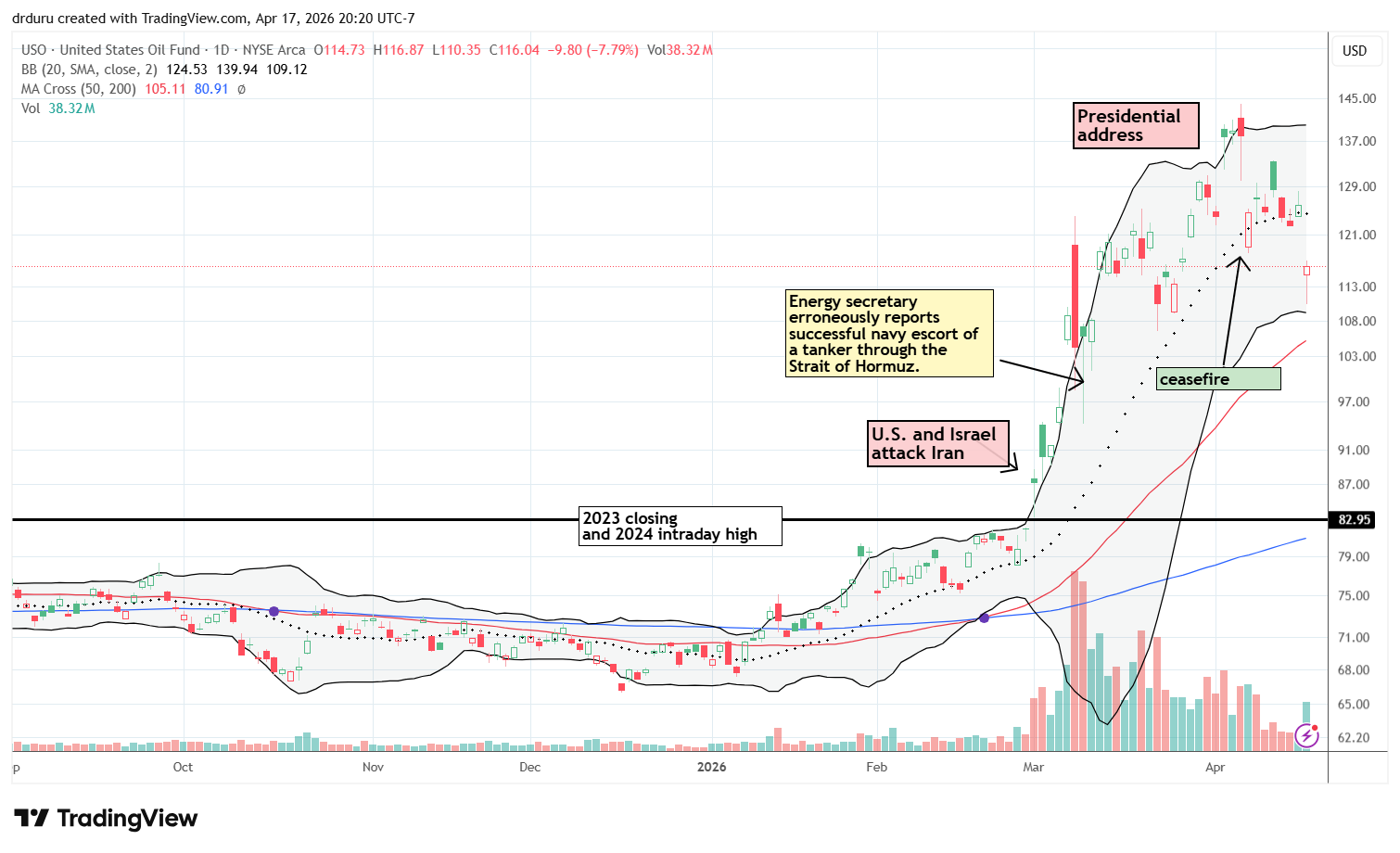
Technical status: United States Oil Fund (USO) dropped sharply after the ceasefire, stayed elevated because of uncertainty around the Strait of Hormuz, and then fell again on fresh news of Hormuz opening.
Trade commentary: Oil did not fall as much as I would have expected given news of the ceasefire and then claims about the Strait of Hormuz opening. Damage to infrastructure will take many months and years to repair. Thus, oil will not return to “normal” for quite some time.
After the ceasefire, USO lost 9.8%, but it rallied off the low and stayed elevated because there was still uncertainty about whether the Strait of Hormuz was actually open. Notably, the stock market remained focused on good news to come (eventually) and continued to rally through elevated prices. Last Friday, with more news confirming the Strait of Hormuz was open and with more talk of a deal between the U.S. and Iran, USO fell again, this time 7.8%. USO’s sharp bounce off its intraday low signals the ongoing, overall resilience in the price of oil.
LyondellBasell Industries (LYB)
Description: LyondellBasell Industries is a global chemical company that produces chemicals, polymers, and fuels and develops technologies used in those businesses.
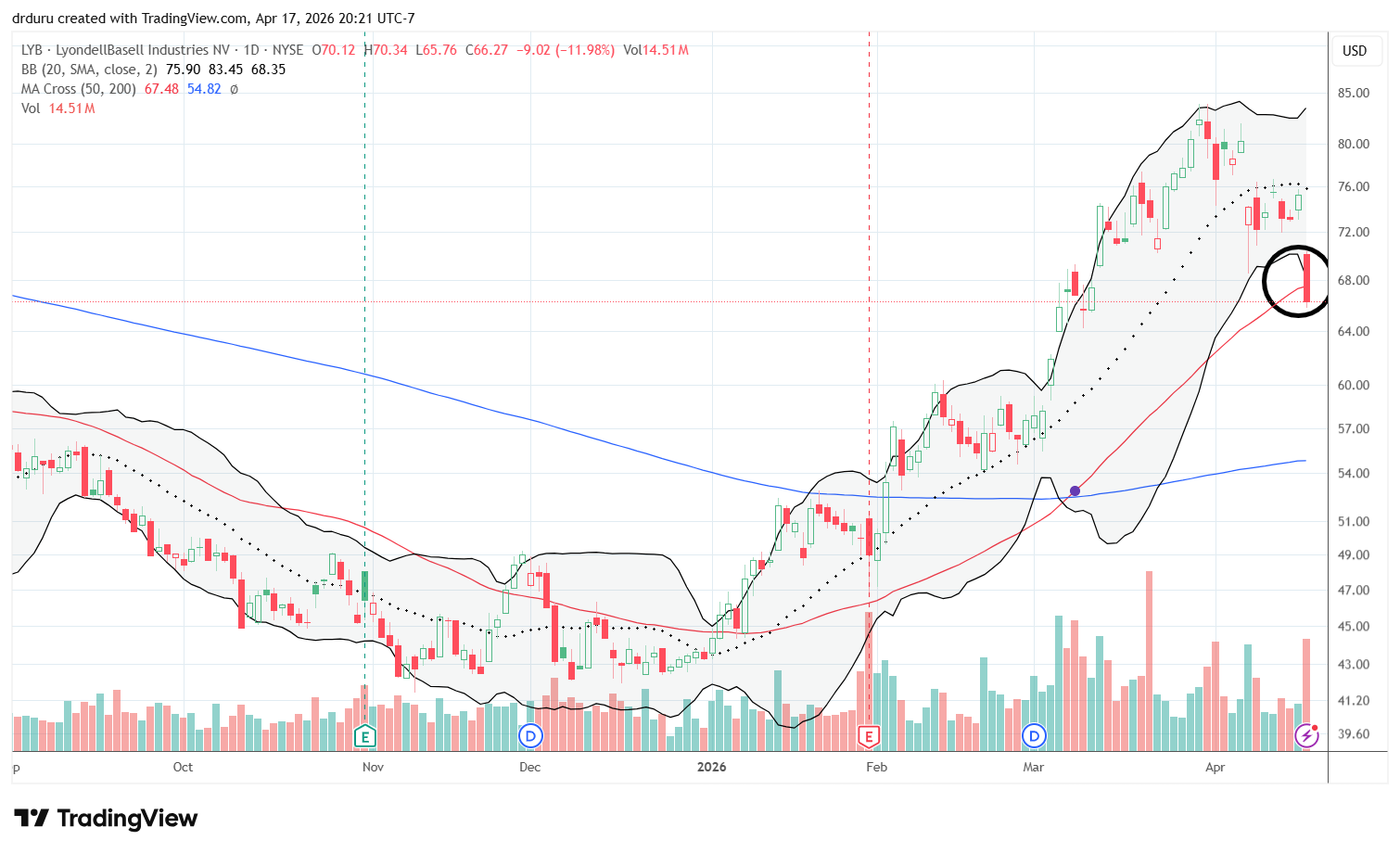
Technical status: LyondellBasell Industries (LYB) plunged 12% and broke down below its 50DMA. An open Hormuz puts an end to the fertilizer trade.
Trade commentary: With the market getting more confident in the opening of the Strait of Hormuz, the fertilizer trade essentially came to an end. LYB is topping out, confirmed by the 50DMA breakdown.
Freeport-McMoRan (FCX)
Description: Freeport-McMoRan is a mining company that produces copper, gold, and molybdenum.
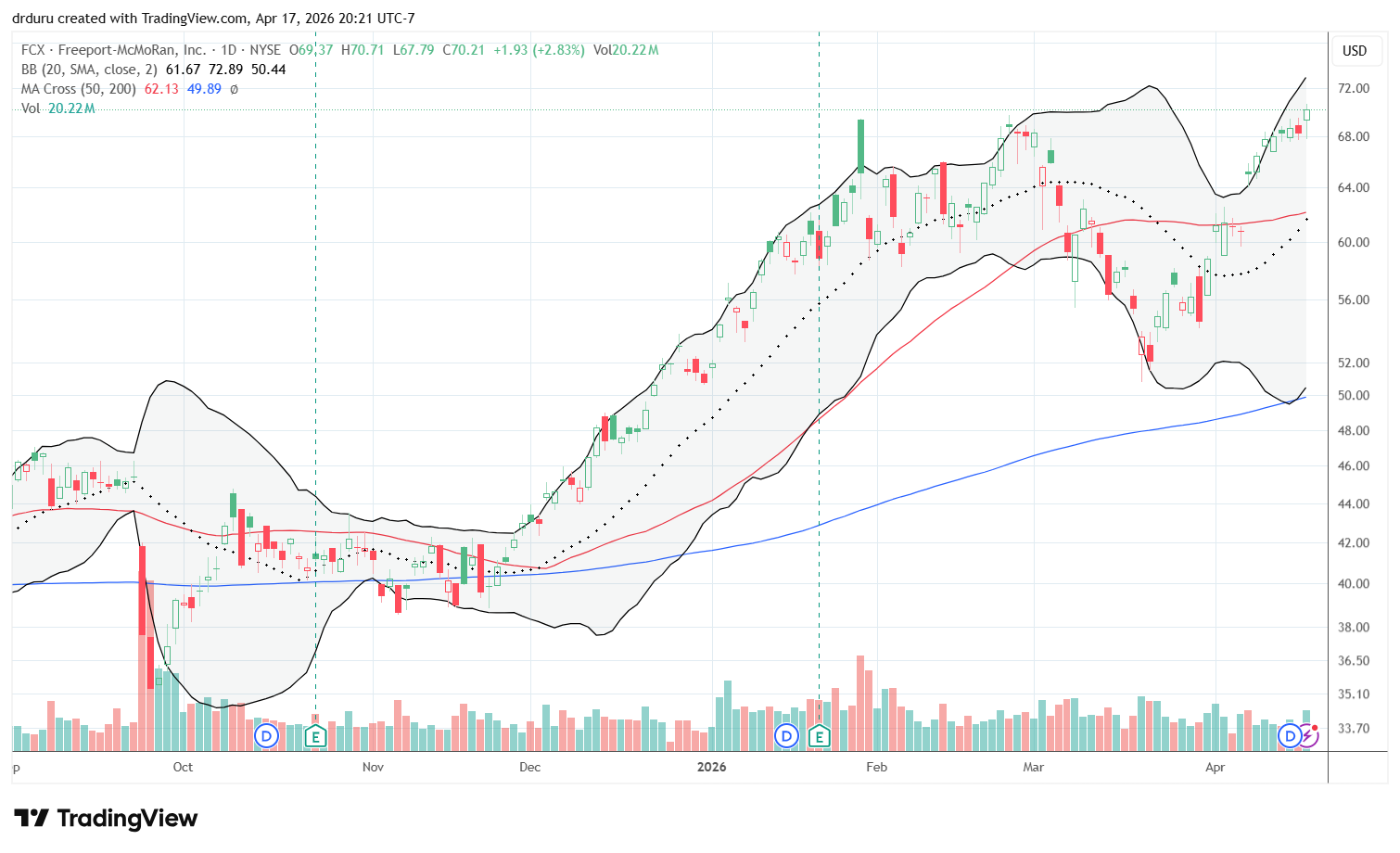
Technical status: Freeport-McMoRan (FCX) broke out to all-time highs as commodities regain momentum.
Trade commentary: I reentered FCX on its breakout after preserving profits a month ago. That exit was part of risk management as breakdowns across the stock market signaled the potential for an extended sell-off. FCX remained resilient and never tested 200DMA support (the blue line) before rebounding. Of course I wish I never sold, especially given my firmly bullish thesis on commodities, but I chose to stick to my trading and investing rules around managing risk. Going forward from here, I expect FCX to hold its next test of 50DMA support.
iShares Silver Trust (SLV)
Description: iShares Silver Trust is an exchange-traded fund designed to reflect the price performance of silver bullion.
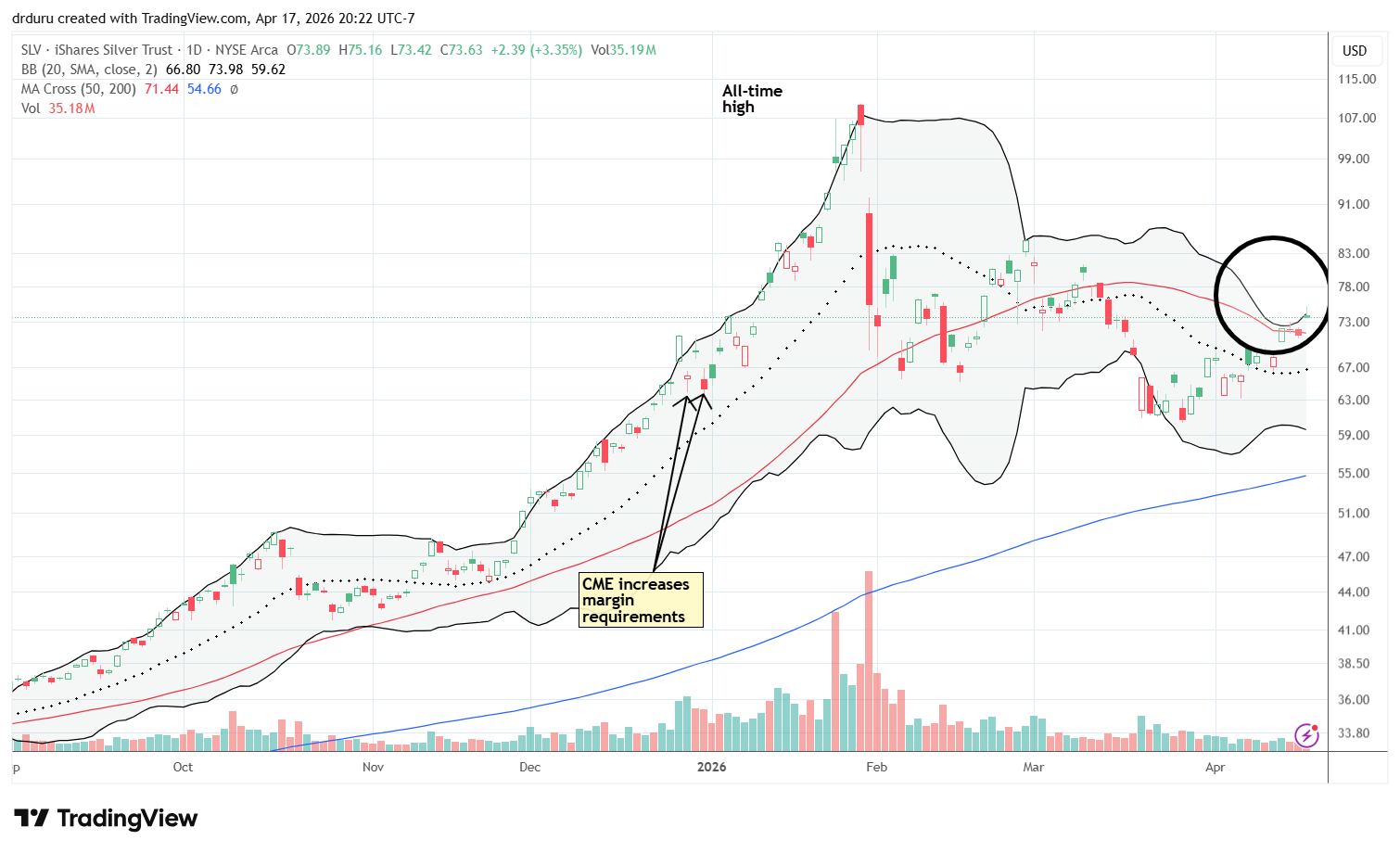
Technical status: The iShares Silver Trust (SLV) gained 3.4% and broke out above its 50DMA.
Trade commentary: I bought the 50DMA breakout with a speculative May 80/90 call spread. I positioned for a rapid continuation move or a quick failure of the breakout. Next firm resistance should be around $85.
Expedia Group (EXPE)
Description: Expedia Group operates online travel brands that provide travel booking services for lodging, air travel, rental cars, and related services.
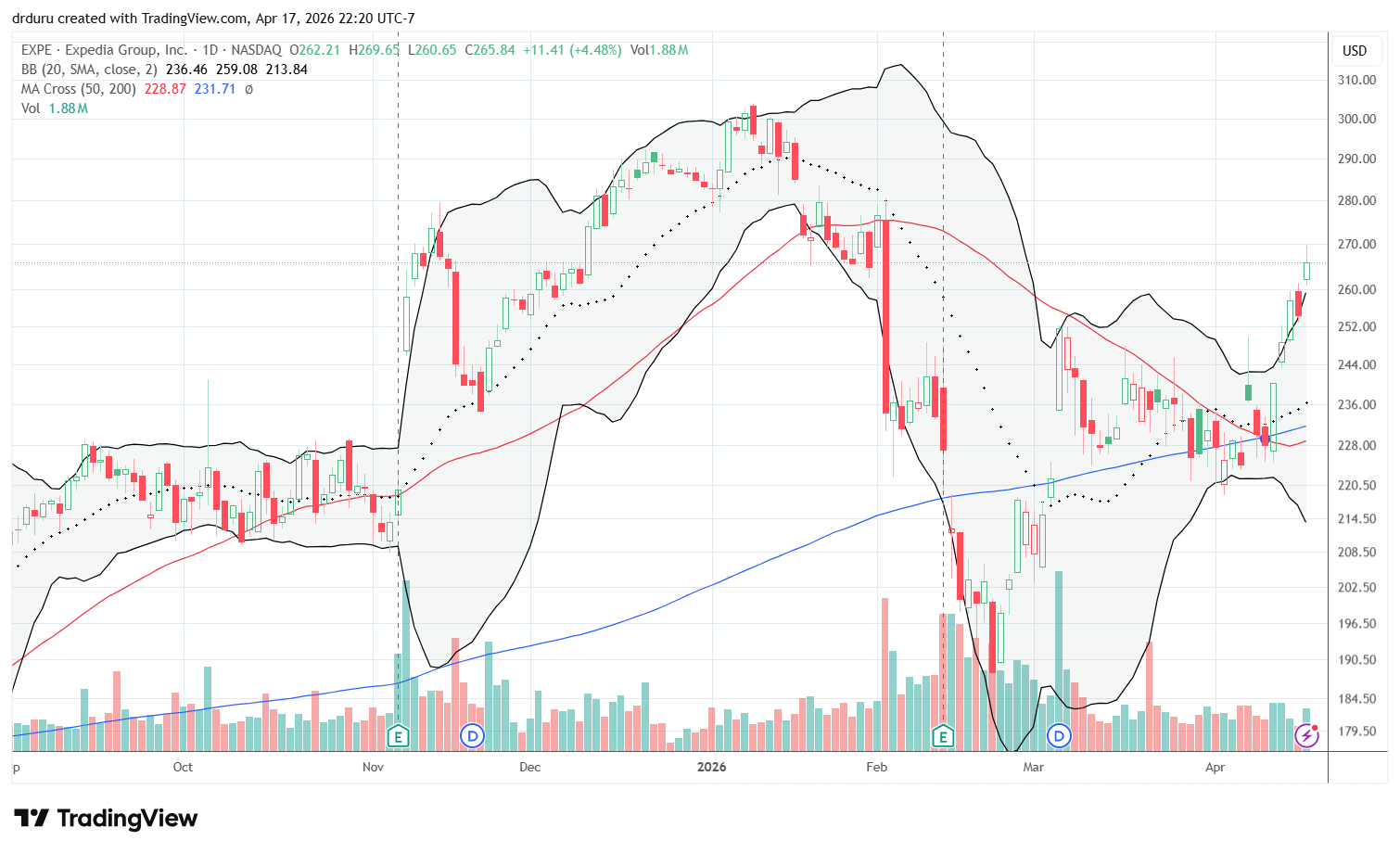
Technical status: Expedia Group (EXPE) bounced away from its 20, 50, and 200DMAs and joined the market’s no dips momentum.
Trade commentary: EXPE was one of my biggest missed trades of the week, especially given I pointed out the setup a week ago. I failed to set up price alerts or even add it to my watchlist. This kind of breakdown in execution discipline is worse than taking a loss on a well-executed trade. I should have bought at any point during the stock’s 5.3% rally on Monday. EXPE sliced through all three major moving averages to start the week. I could have even justified buying on Tuesday’s gap higher. Now, I will look to buy the next dip. EXPE is a direct beneficiary of wartime optimism.
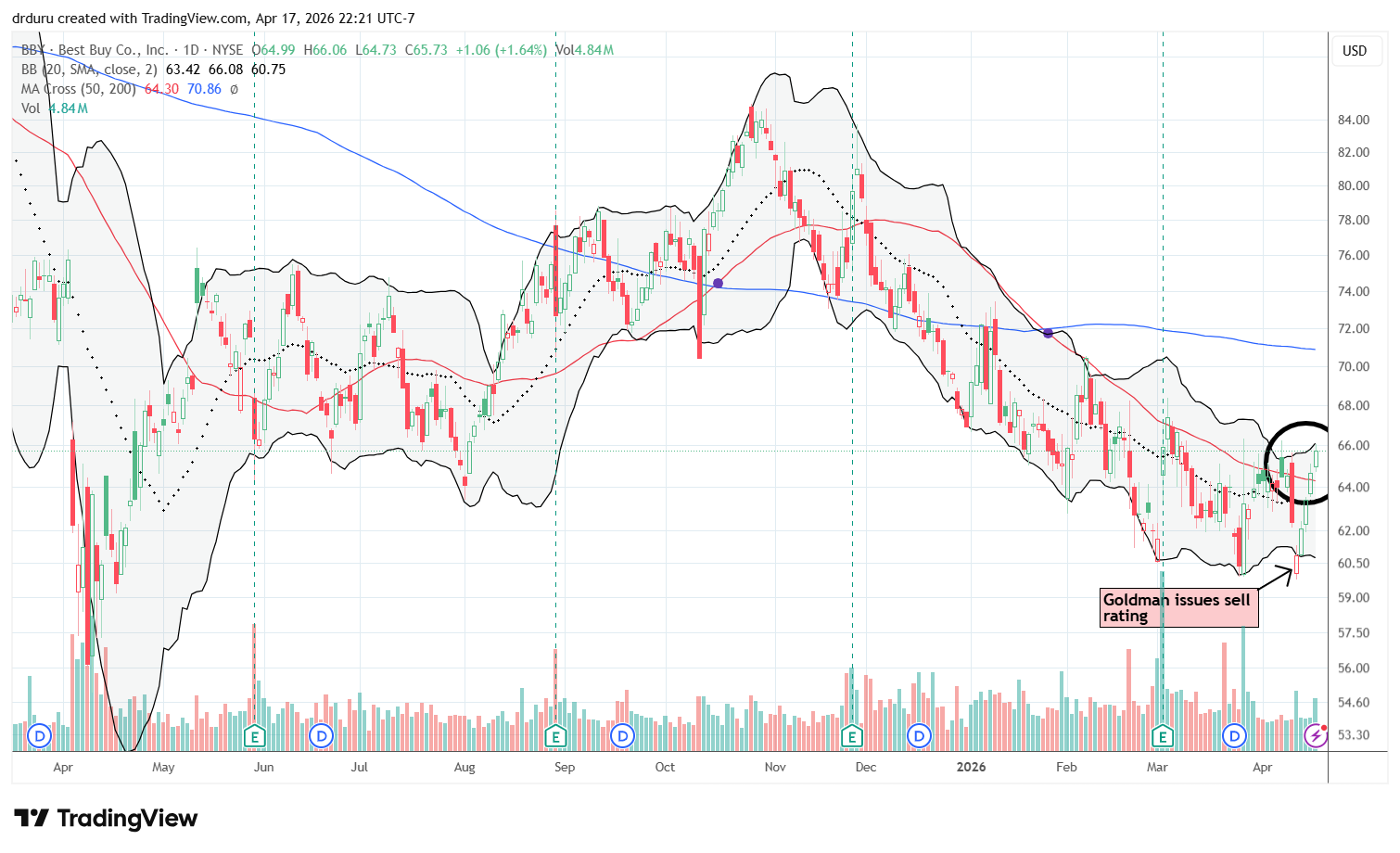
Best Buy (BBY)
Description: Best Buy is a retailer of consumer electronics, appliances, computing products, and related services.
Technical status: Best Buy (BBY) recovered from a Goldman downgrade to sell and emerged stronger with a 50DMA breakout.
Trade commentary: I bought a single BBY May $62.50 put option as a hedge, expecting Goldman’s sell thesis to matter if market sentiment turns south again. Otherwise, another higher close makes BBY a great candidate for a contrarian buy with a profit target at 200DMA resistance.
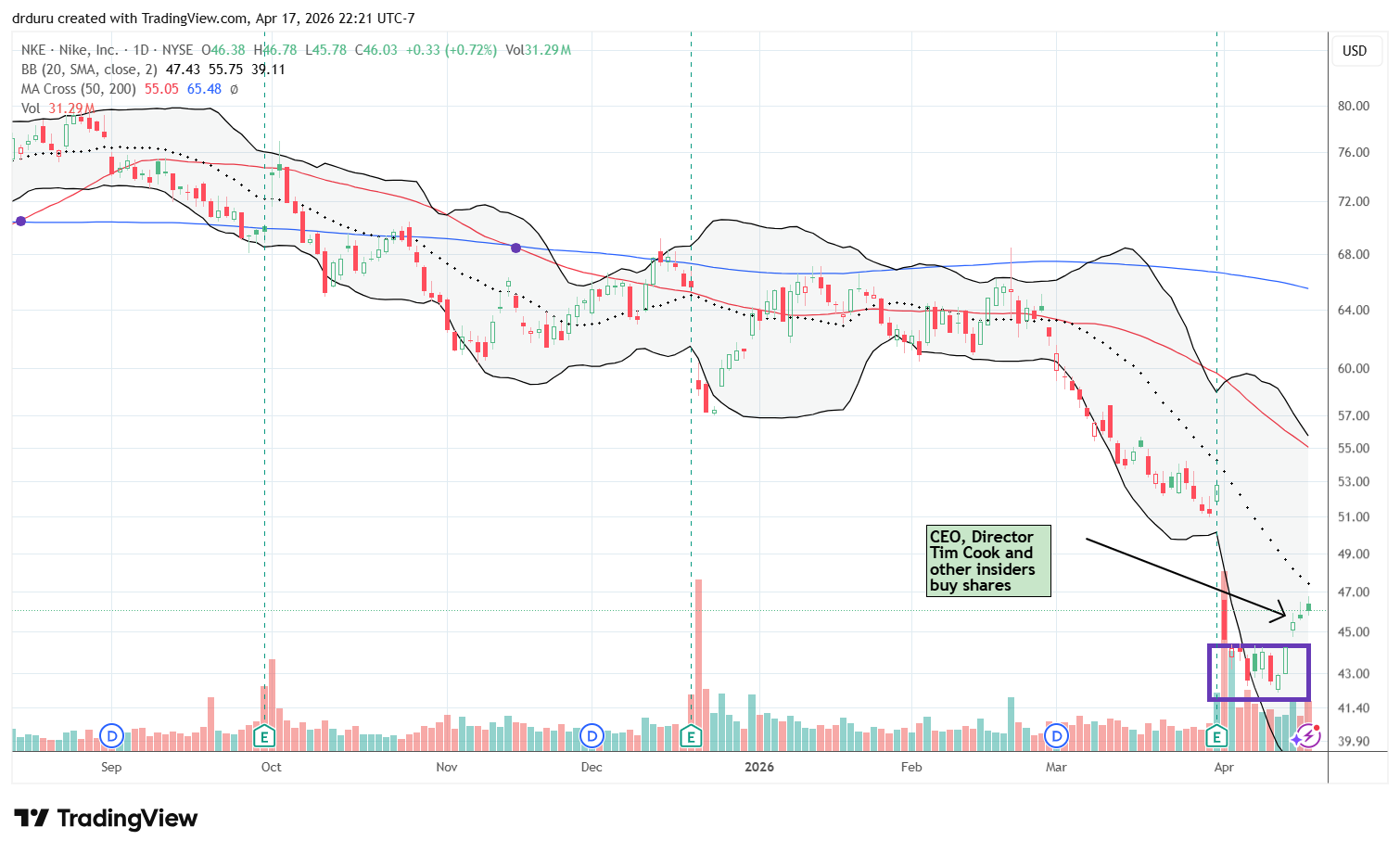
Nike (NKE)
Description: Nike designs, markets, and sells athletic footwear, apparel, equipment, and accessories.
Technical status: Nike (NKE) broke out above a price congestion zone after news of major insider buying. The stock remains under its steeply downtrending 20DMA resistance.
Trade commentary: I followed insiders into the stock. Nike’s CEO and director Tim Cook (CEO of Apple) loaded up on shares and provided me the main justification for ignoring NKE’s persistent 5-year downtrend and recent 12-year low. I expect a continued rebound to be slow, uneven, and full of setbacks, but I plan to hold these shares through whatever is coming…assuming the major lows hold as support.
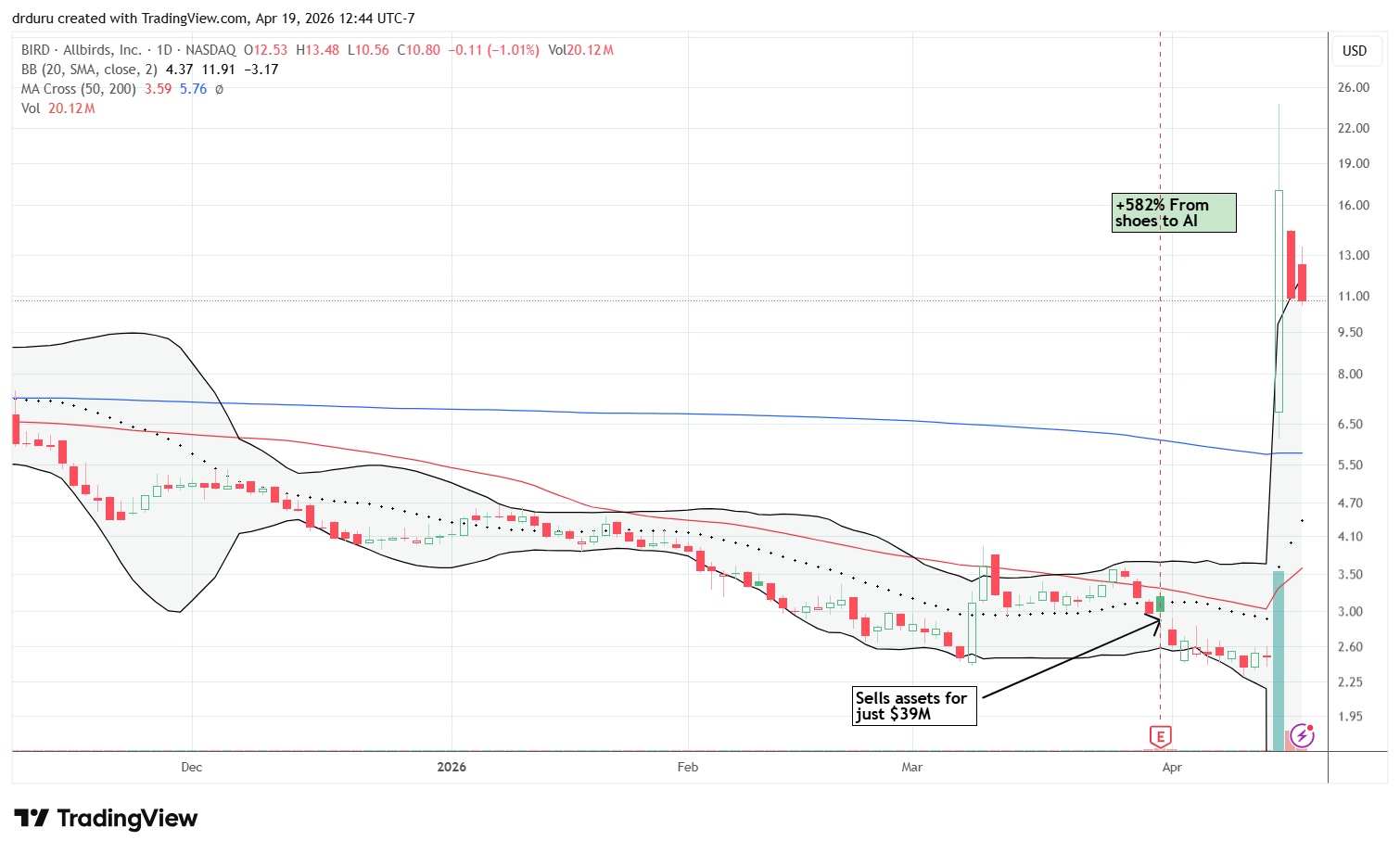
Allbirds (BIRD)
Description: Allbirds is a lifestyle brand that sells footwear, apparel, and accessories directly to consumers and through retail stores and third-party outlets.
Technical status: Allbirds (BIRD) soared 582% in one day on AI conversion news and then gave back 35.8% the next day.
Trade commentary: The surge in BIRD symbolizes a convergence of forces in the stock market. At the end of March, Allbirds announced the sale of the assets of its shoe business and looked ready to close down. On April 15, Allbirds announced its resurrection as an AI infrastructure company:
“NewBird AI’s long-term vision is to become a fully integrated GPU-as-a-Service (GPUaaS) and AI-native cloud solutions provider. Over time, the Company intends to grow its neocloud platform by expanding its compute and service offerings, deepening partnerships with operators and customers, and evaluating strategic M&A opportunities.”
The market loves AI again and awarded BIRD an instant 582% gain. The other force at work is the return of feverishly speculative trading as FOMO motivates traders and investors to chase momentum and bid on “cheap” stocks. BIRD promptly fell 36% the next day. I am surprised it only fell 1% on Friday. I am not even tempted to speculate on this stock. The main good news here is that Allbirds could point the way toward the future of job creation by demonstrating the “ease” of moving into this kind of business.
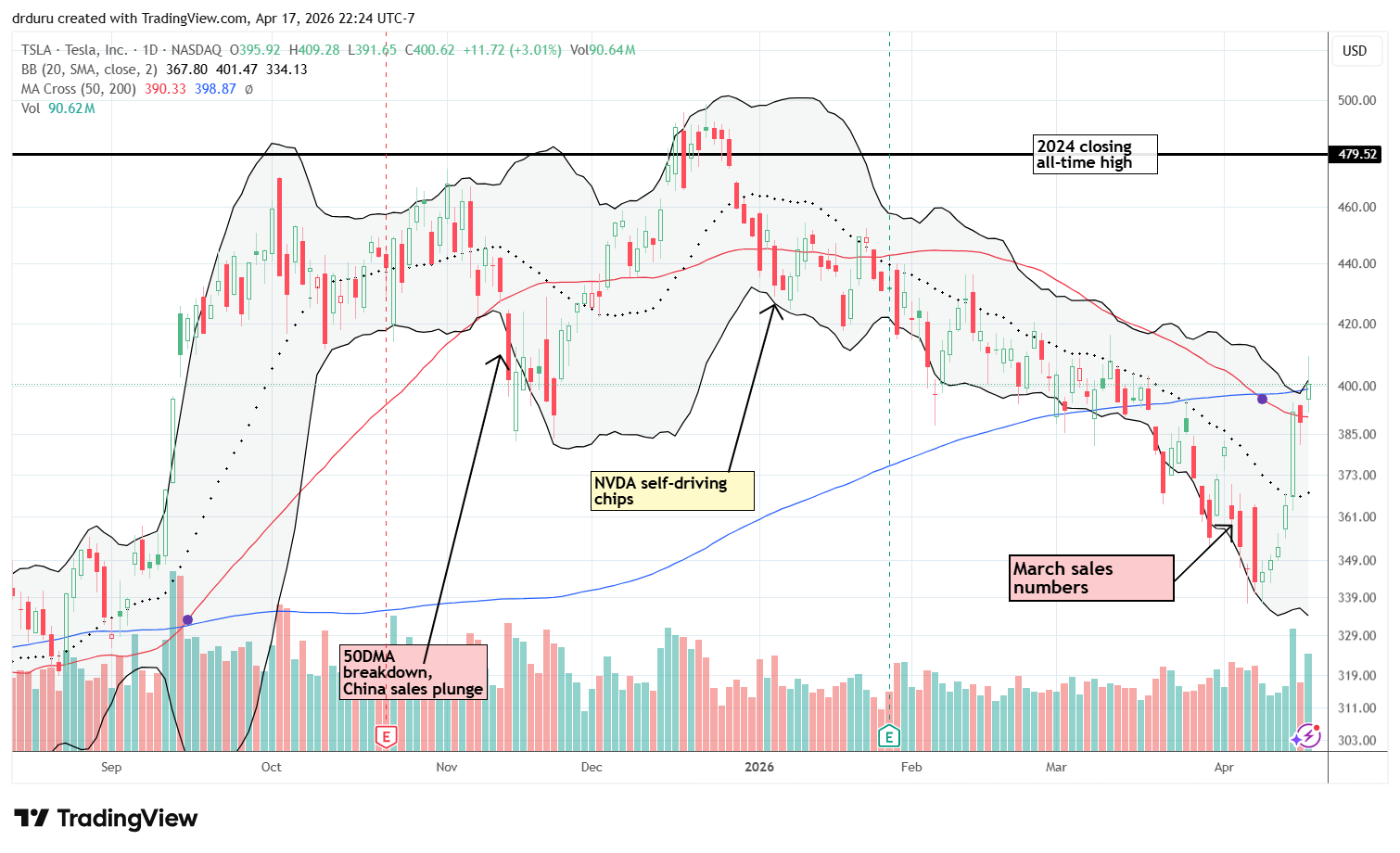
Tesla (TSLA)
Description: Tesla designs and manufactures electric vehicles, battery storage systems, and solar energy products.
Technical status: Tesla (TSLA) broke out above its 20DMA for the first time this year and then pushed into 50DMA and 200DMA resistance.
Trade commentary: I made an untimely bet that TSLA would once again fail at its downtrending 20DMA resistance (dashed line). I justified the speculation by positioning TSLQ as a hedge for an aggressively bullish trading portfolio. The very next day TSLA soared 7.6% in a move that was quite consistent with the “no dips allowed” momentum of the market. I added a little more TSLQ with TSLA at 50DMA resistance. Friday, TSLA moved directly to 200DMA resistance. A higher close from here will make me concede TSLA’s fresh membership in the growing group of bullish stocks.
Roundhill Magnificent Seven ETF (MAGS)
Description: Roundhill Magnificent Seven ETF is an actively managed ETF that seeks growth of capital by providing exposure to the Magnificent Seven companies.
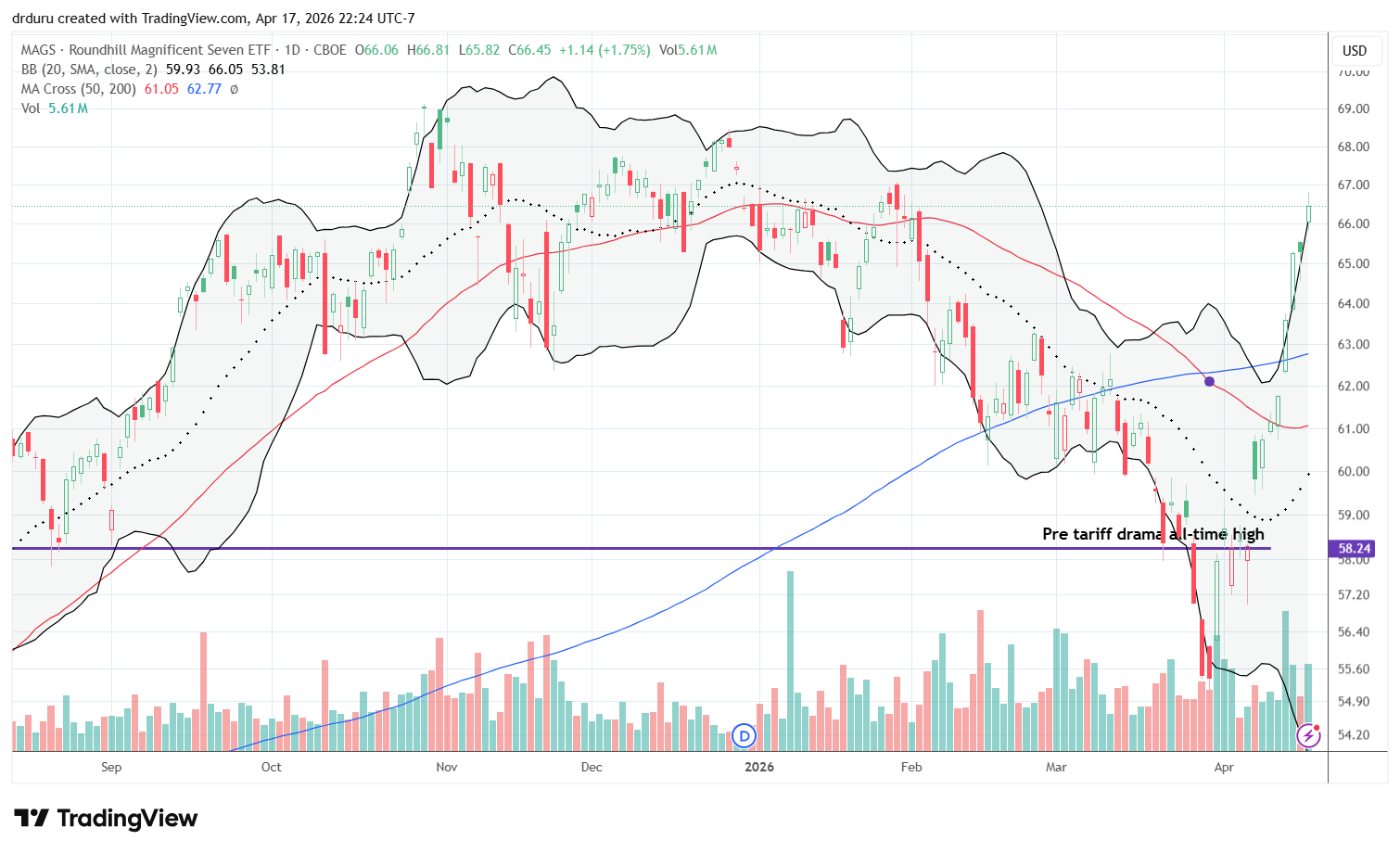
Technical status: Roundhill Magnificent Seven ETF (MAGS) rebounded strongly from a steep downtrend and ripped higher with the return of large-cap tech momentum.
Trade commentary: Even though the NASDAQ is already in all-time high territory, the Magnificent Seven as a group still have ground to make up. Like TSLA, MAGS had been in a steep downtrend all year, and the war accelerated the selling. Traders are now rushing back into the group. Market breadth’s run-up directly to overbought territory is even more impressive given it happened with so much attention and money returning to big cap tech.
Amazon.com (AMZN)
Description: Amazon.com offers a wide range of products and services through its online stores and physical stores, including consumer products, seller services, advertising, subscription services, and cloud computing.
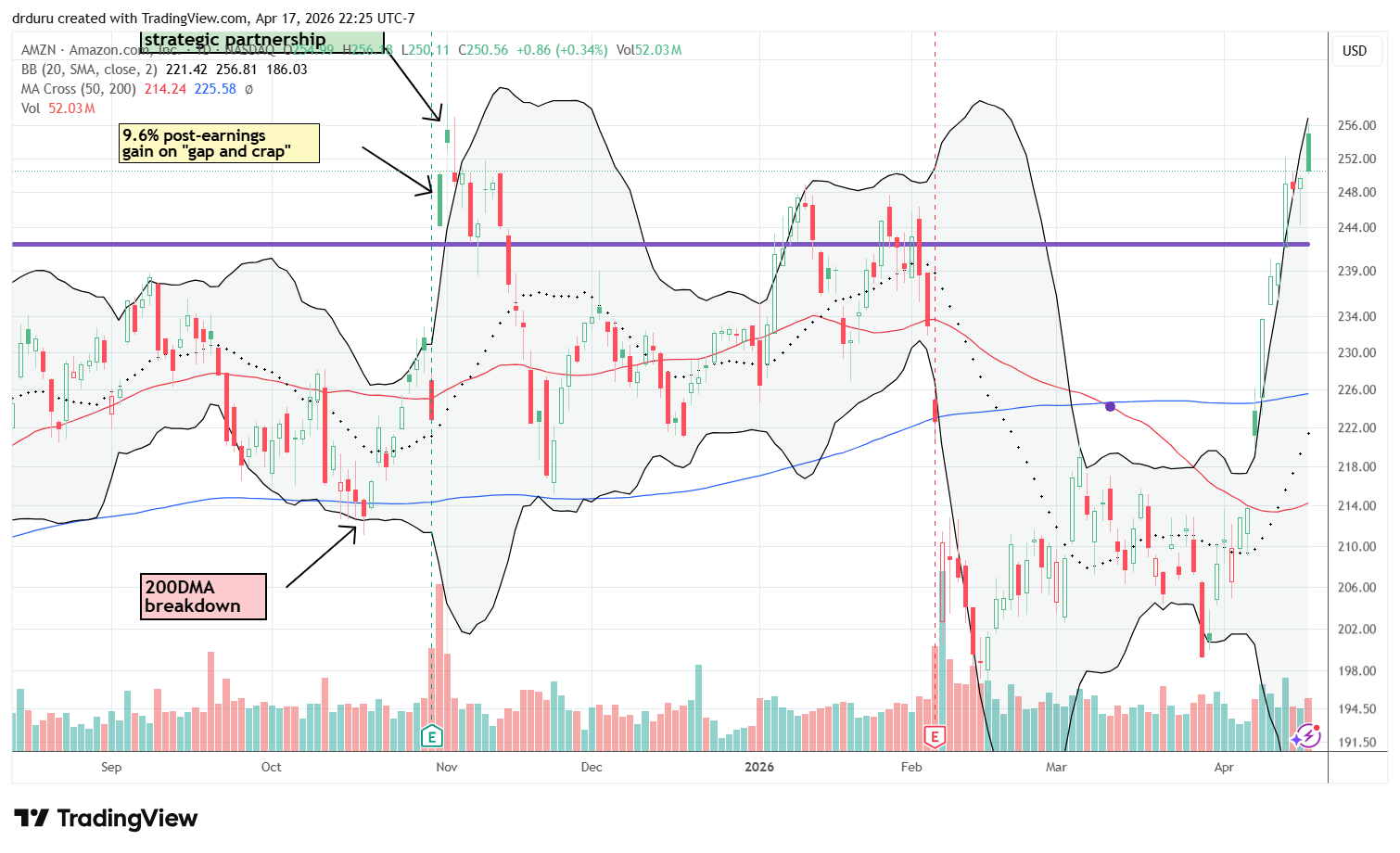
Technical status: Amazon.com (AMZN) surged sharply and approached an all-time high.
Trade commentary: AMZN was one of the biggest contributors to the surge in MAGS. AMZN went straight up including closes well above its upper Bollinger Band. I took profits on a position I bought in March. This kind of risk management is the mirror image of what I did with FCX. Here, AMZN is well over-extended. Moreover, the stock stalled around all-time highs after an outlier kind of move. My risk management will almost always move me to take profits from outsized moves. My initial profit target was a rebound to the purple line below that represents the all-time high from 2025.
Advanced Micro Devices (AMD)
Description: Advanced Micro Devices designs semiconductors, processors, graphics products, and related technologies.
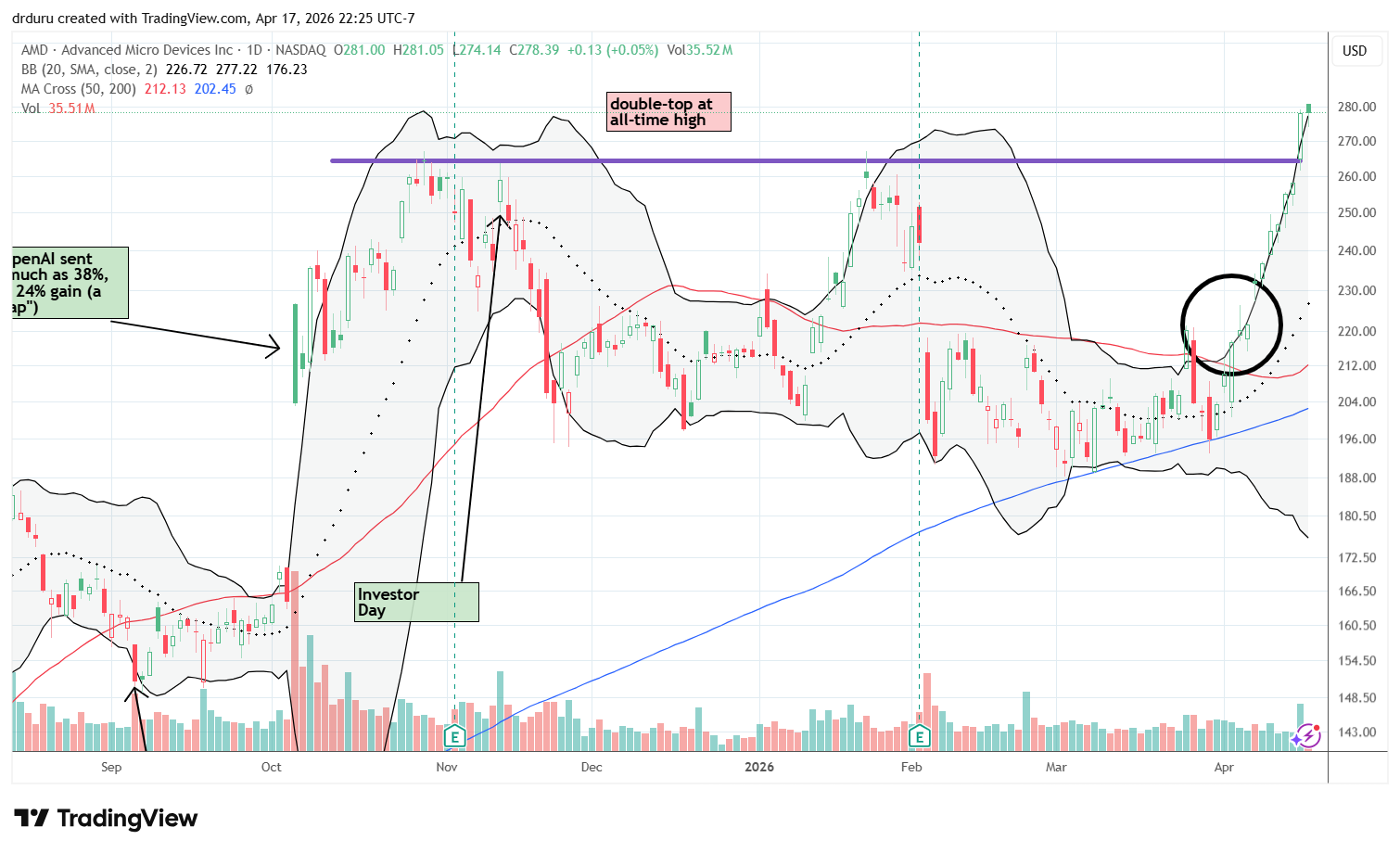
Technical status: Advanced Micro Devices (AMD) broke out above its prior double top and surged 7.8% to an all-time high.
Trade commentary: AMD is another big miss of the week. While I successfully traded the stock while it was trapped between 200DMA support and 50DMA resistance, I did not prepare myself to trade on a breakout (or breakdown) from this range. The circle in the chart below points to the area of buying AMD’s 50DMA breakout. From there, AMD surged along its upper Bollinger Band and closed last week with its 13th straight day of gains. AMD is confirmed bullish with its breakout from the double-top at the previous all-time highs.
AMD neatly danced around the investing rules I placed around the stock last October in an interest to hold the stock and continue riding my gains. A little over a month later, I reluctantly stopped out on a 50DMA breakdown. I resisted returning to the stock on its test of 50DMA resistance in January. Soon after, I bought the 50DMA breakout only to take profits after the stock stalled at resistance at its all-time high. Finally, I stared at AMD on April 4th waiting for a follow-through on its last 50DMA breakout…and inexplicably failed to do my own follow-through!
Intel (INTC)
Description: Intel designs and manufactures semiconductors, processors, and computing platform technologies.
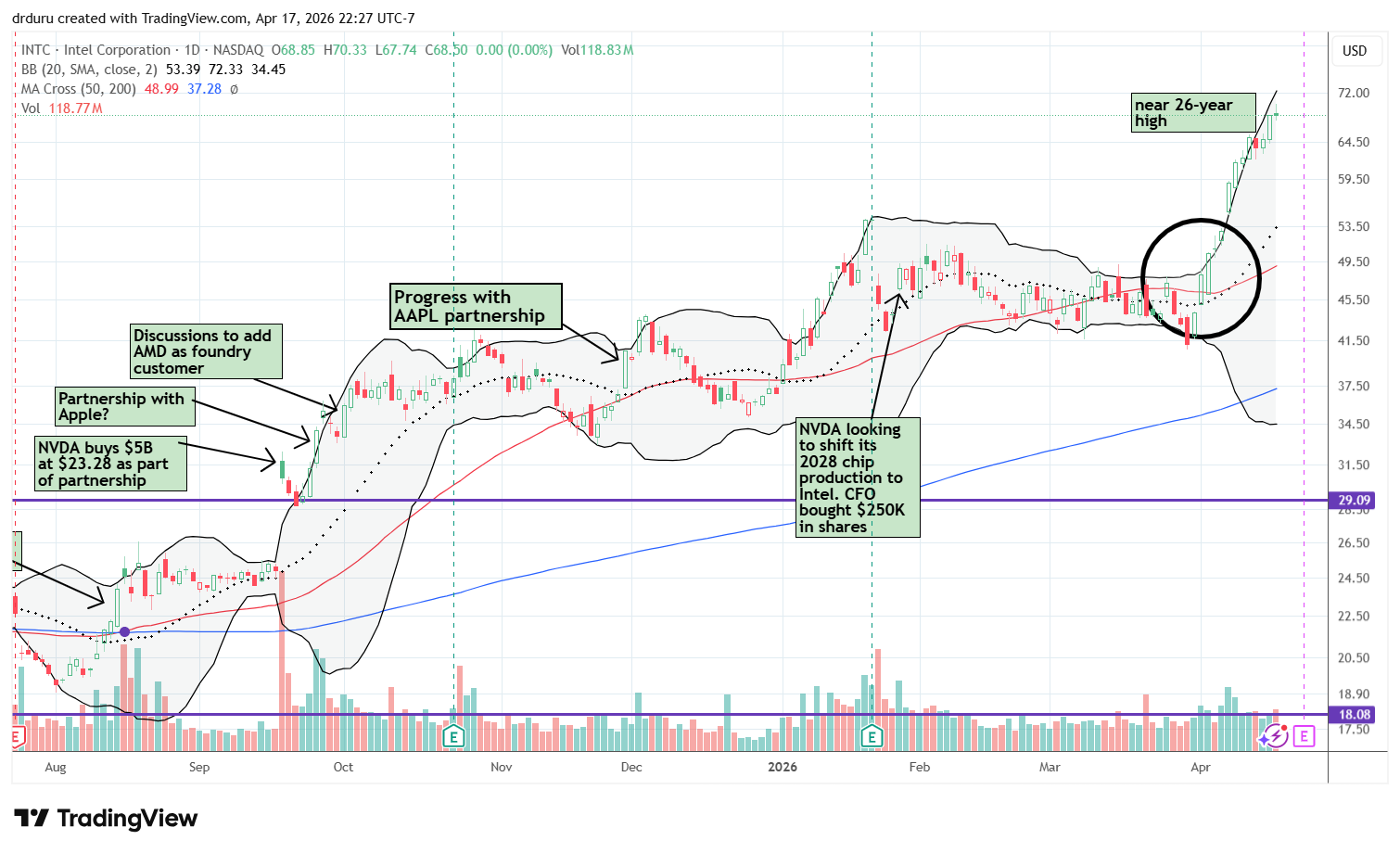
Technical status: Intel (INTC) confirmed a 50DMA breakout and continued sharply higher near a 26-year high.
Trade commentary: I already lamented about how I missed the next great trade in INTC. The GOOD news in all these misses is that I have been so busy with other great trades. I have just been inconsistent in keeping tabs on the old, tried and true. Anyway, with INTC near a 26-year high, the stock is at a major juncture. While I will not chase the stock higher ahead of earnings this week on April 23rd, I will most likely buy a post-earnings dip, especially to support from a moving average.
Dell Technologies (DELL)
Description: Dell Technologies provides personal computers, servers, storage, networking products, and IT services.
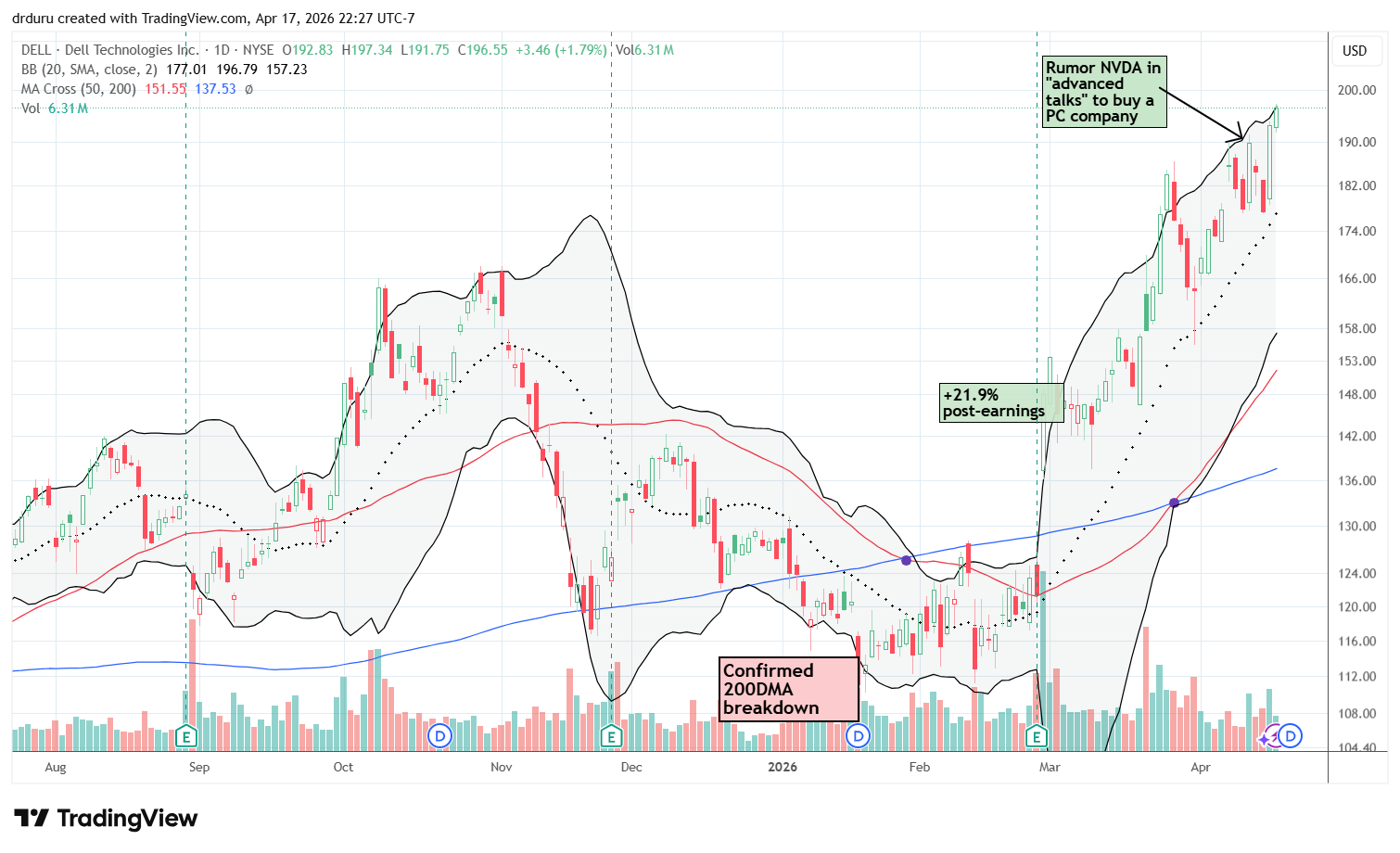
Technical status: Dell Technologies (DELL) held its strong uptrend despite an initial fade of acquisition rumors. DELL closed the week at an all-time high.
Trade commentary: DELL is another tale of a stock where I got stopped out. Eager to preserve my remaining profits, I placed a stop below last November’s low. That stop gave way in January. I reluctantly sold despite my strong desire to hold on to my AI-related stocks as long as possible. As (bad) luck would have it, I exited right around DELL’s last low.
The stock’s 21.9% post-earnings surge in March took me (and clearly a lot of other people) completely by surprise. Sentiment flipped 180 degrees on DELL and became strong enough to prevent a post-earnings fade. DELL did not even test uptrending 20DMA support until early April. So when rumors hit the market last week that NVIDIA (NVDA) was in the market to buy a PC company, I did not hesitate to go after DELL. However, I sold a May $180 put instead of buying shares. Not only am I fine buying DELL at the implied $171.50 stock price, but also selling the put allows me to profit if the rumor is untrue and the stock just churns in place for the next month or so.
Credo Technology Group Holding (CRDO)
Description: Credo Technology Group develops high-speed connectivity solutions for data infrastructure, including integrated circuits, active electrical cables, and software.
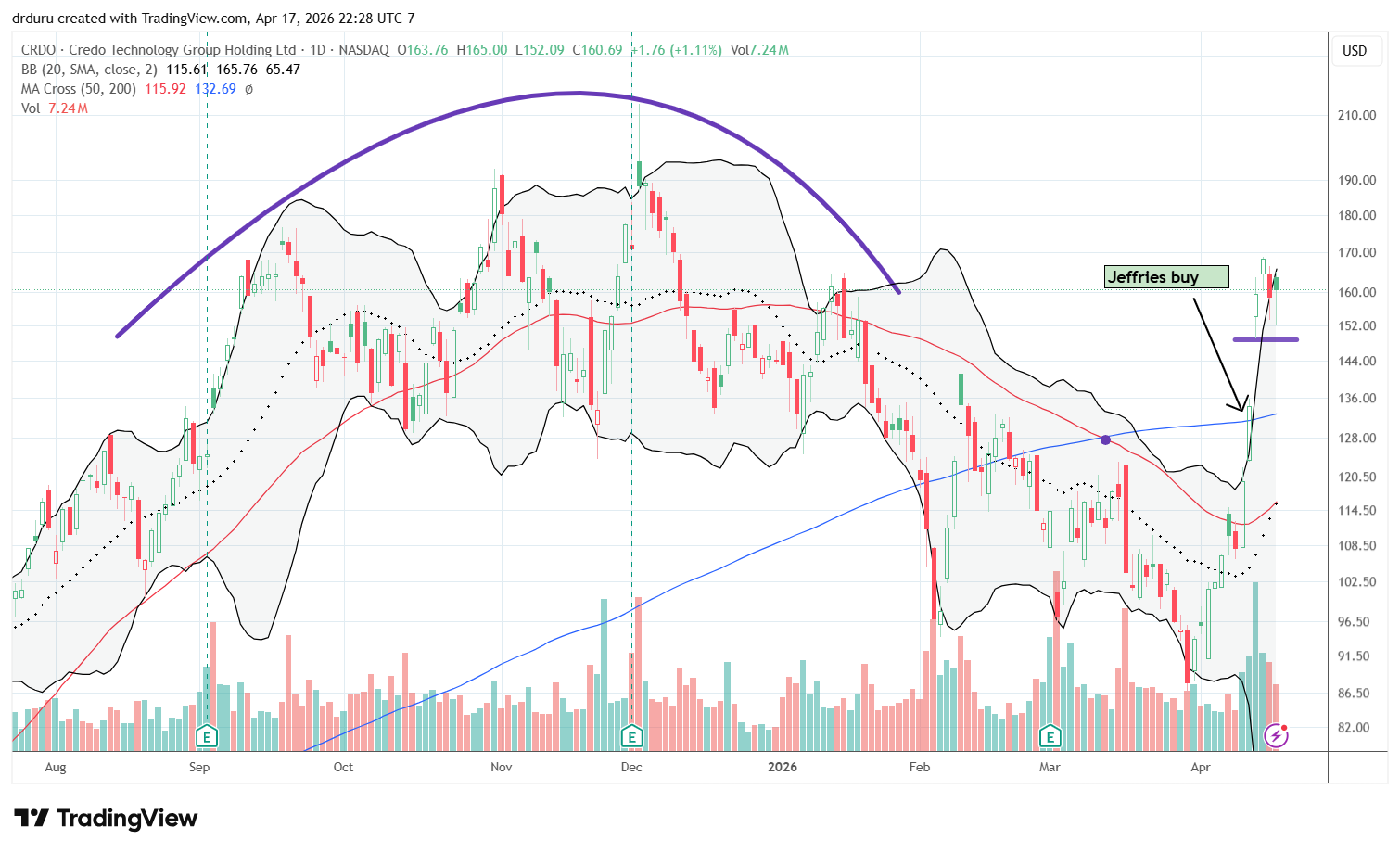
Technical status: Credo Technology Group Holding (CRDO) broke out above 200DMA resistance after a Jeffries buy rating. CRDO followed through with a high volume, gap higher the next day that is challenging the stock’s topping pattern.
Trade commentary: In February, I described CRDO’s topping pattern before it was clear that the stock was riding the downward momentum across high tech. When CRDO surged 10.8% through 50DMA resistance on April 10, I immediately put the stock back on my buy list. However, Jeffries beat me to the punch with an upgrade that sent the stock up another 12.4%. At that point, CRDO became too far extended for a good risk/reward entry. Yet, CRDO managed to gap higher AGAIN for an 18.7% gain! This sharp and abrupt turn-around is all the more remarkable given the stock fell 14.8% after reporting earnings at the beginning of March and eventually set a fresh 9-month low. Now, all I can do is watch for the stock to cool off and set a good risk/reward entry, albeit at a higher price than I targeted just a week and a half ago.
Vertiv Holdings (VRT)
Description: Vertiv Holdings provides critical digital infrastructure technologies and services, including power, cooling, and IT infrastructure solutions for data centers and communication networks.
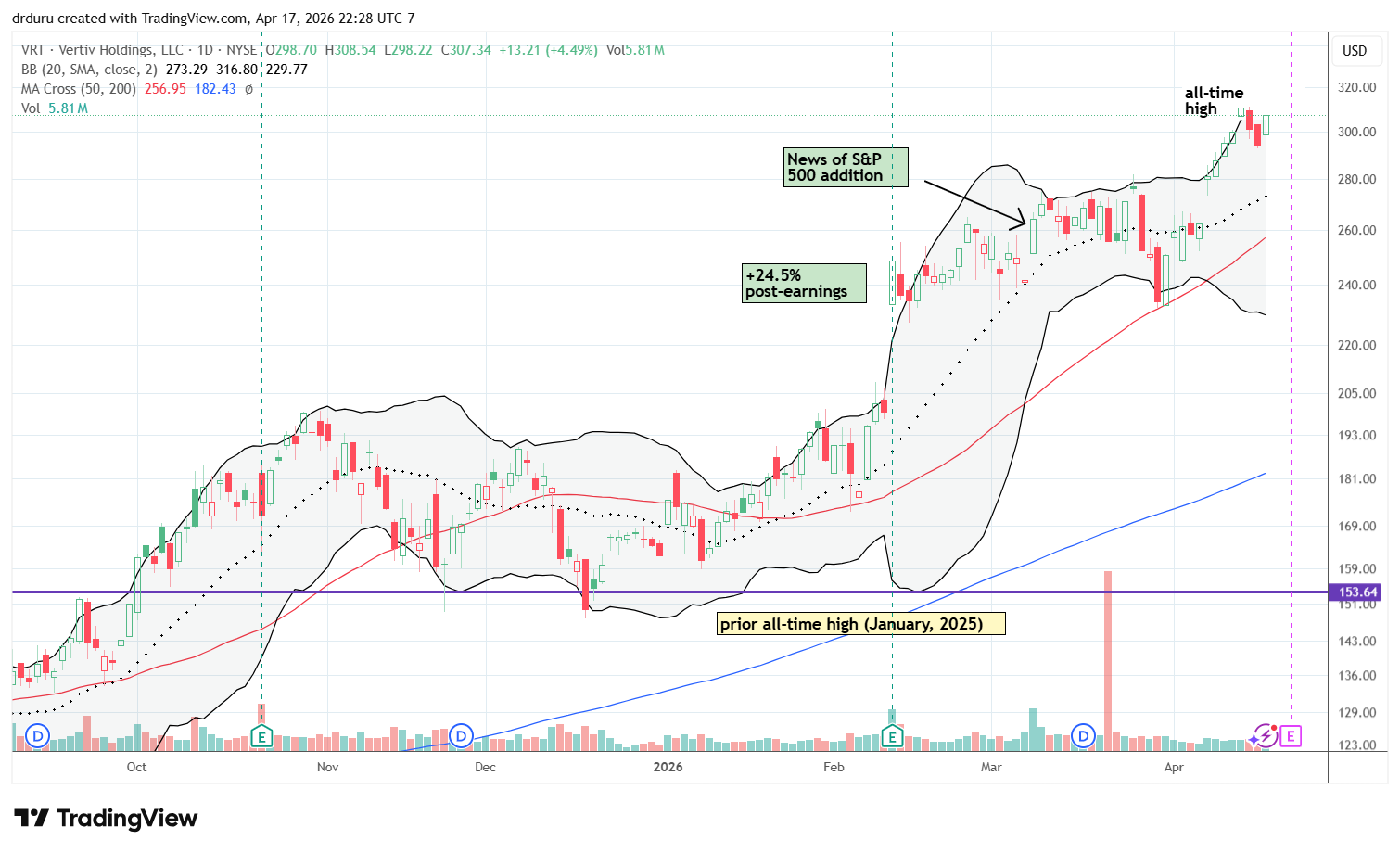
Technical status: Vertiv Holdings (VRT) broke out to a new all-time high on April 8 and stalled from there.
Trade commentary: VRT is still my favorite AI-related stock even though I got stopped out when VRT fell below the low from the day news dropped on its addition to the S&P 500 index. I set that rule because of the poor history of stocks getting added to the index. In retrospect, I should have further conditioned my stop by a 50DMA breakdown, especially since my profits allowed me plenty of wiggle room. VRT tested 50DMA support in picture-perfect form and has not looked back since. However, I doubt I will return to the stock. It was a good run, and I still suspect upside from here is limited.
Robinhood Markets (HOOD)
Description: Robinhood Markets operates a financial services platform offering brokerage, investing, and related products.
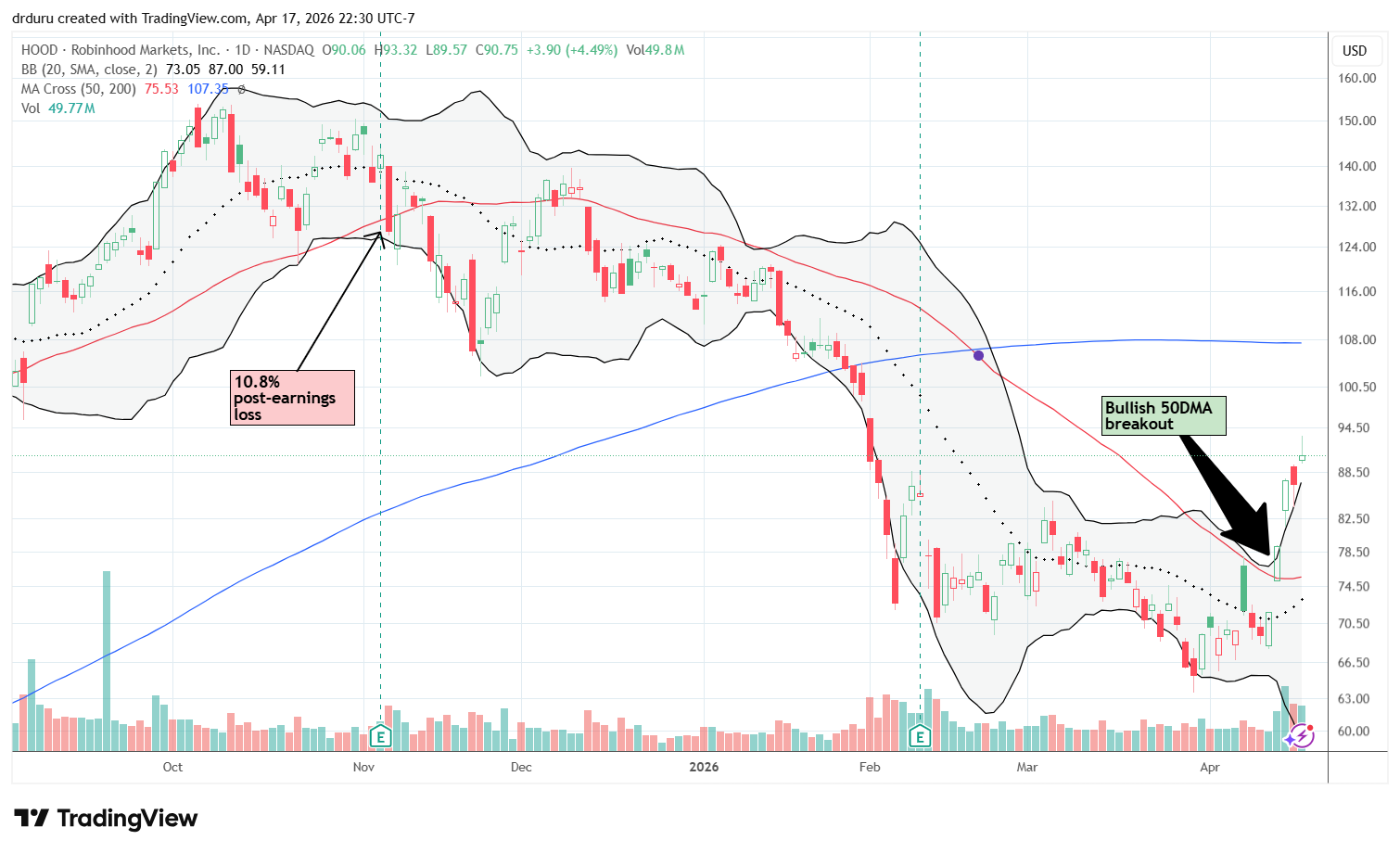
Technical status: Robinhood Markets (HOOD) benefited from SEC approval of a FINRA proposal to loosen rules on day trading. The resulting 50DMA breakout generated significant follow-through.
Trade commentary: In a recurring theme for this post, I missed a clear, bullish trade on HOOD. Ever since February’s successful flip in shares of HOOD, I have kept an eye on the stock for the next trade. The ongoing weakness kept me away. Somehow I did not notice the HOOD 50DMA breakout until the following day. I placed an order for shares that never filled. Ironically, if I had kept the order on the books, it would have closed at the lows of the following day. Now, like other missed trades, I wait for the next good risk/reward entry on a dip or after some cooling through a price consolidation.
Robinhood Ventures Fund (RVI)
Description: Robinhood Ventures Fund is a closed-end investment fund that provides public market investors exposure to a portfolio of privately held growth companies and venture-backed businesses.
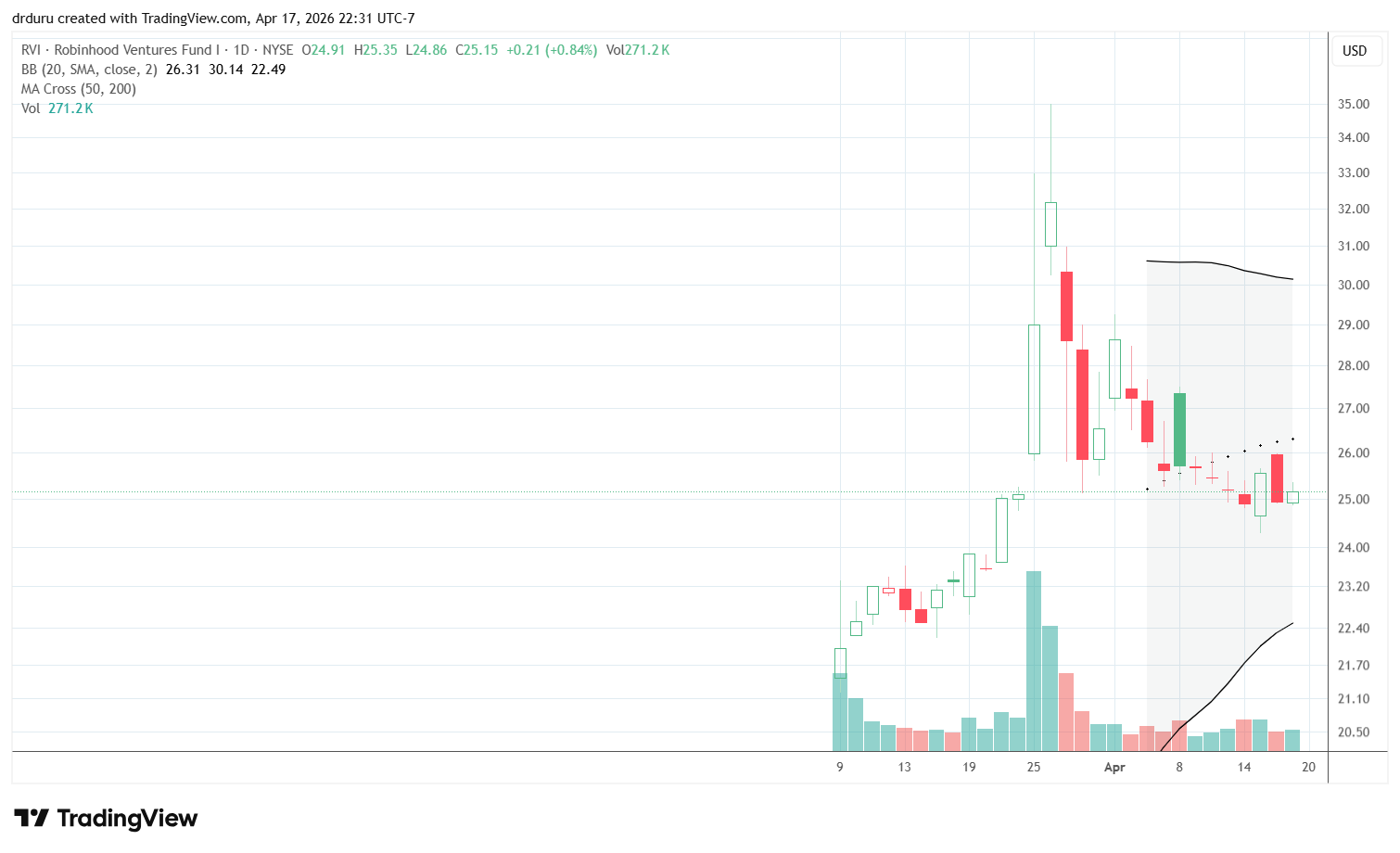
Technical status: Robinhood Ventures Fund (RVI) finished a full reversal of late March’s surge and closed the week at its IPO price.
Trade commentary: RVI came to market with an IPO price of $25 but opened much lower. It crept higher until surging 15.5% and then 11.0% above its IPO price. I jumped into RVI on Friday, happy to get the IPO price. RVI includes holdings in data and AI-related companies I am eager to invest in like Databricks and Mercor. I do not know whether RVI has allowed me to participate below an eventual IPO price (if IPOs ever happen), but I am willing to take the chance at these levels.
Netflix (NFLX)
Description: Netflix provides subscription streaming entertainment services and produces original content.
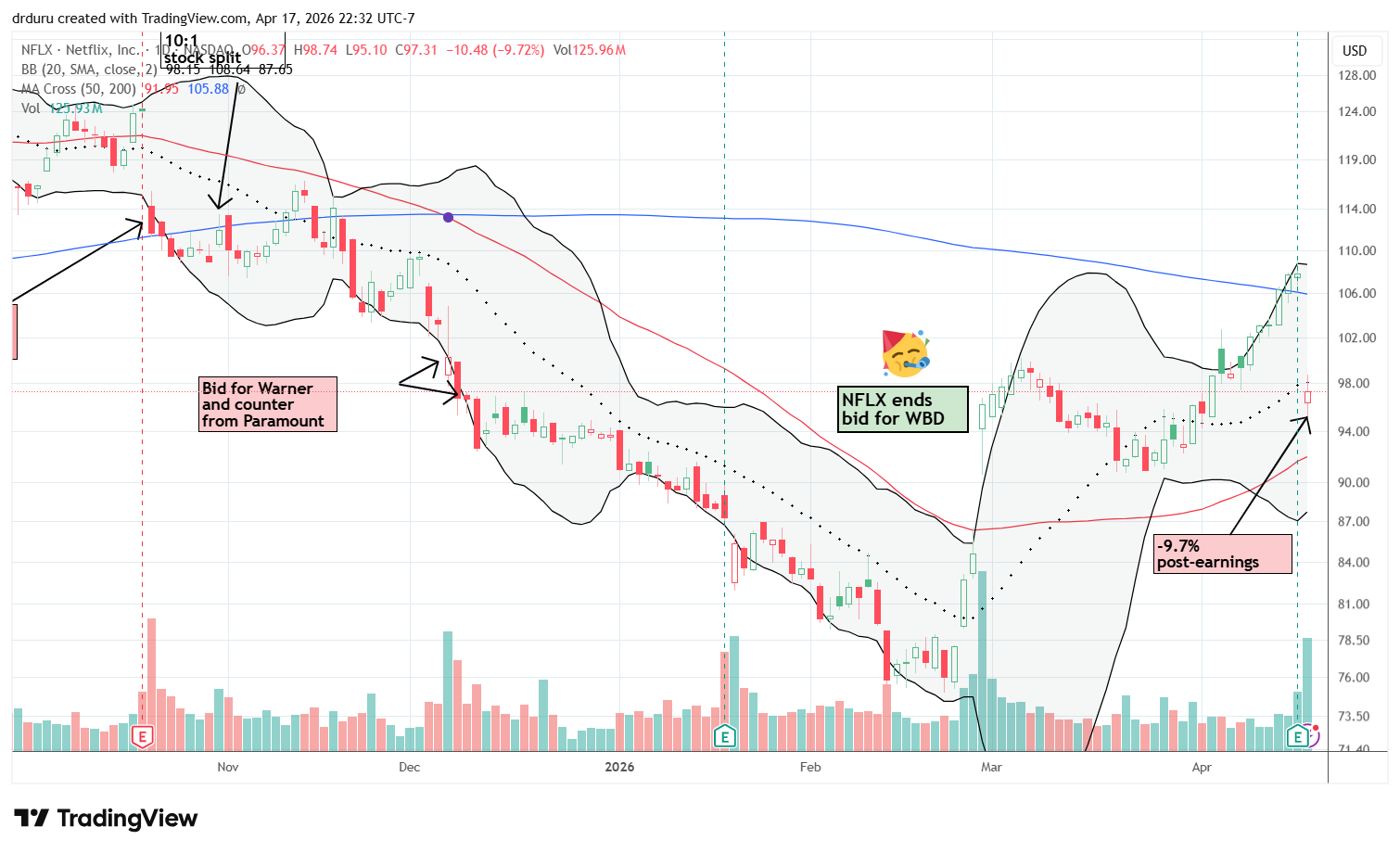
Technical status: Netflix (NFLX) fell 9.7% after earnings and left behind a fake 200DMA breakout.
Trade commentary: Thanks to the post-earnings loss, NFLX traded back to the price where I took profits on my bet that NFLX would back out of its bid for Warner Brothers Discovery (WBD). I am looking to start buying the stock again if 50DMA support holds. I think the market is over-reacting to founder and CEO Reed Hastings’ move to the board. Investors also seemed disappointed by Q2 guidance that looks weaker than it should be given recent price increases.
UnitedHealth Group (UNH)
Description: UnitedHealth Group provides health insurance benefits and healthcare services.
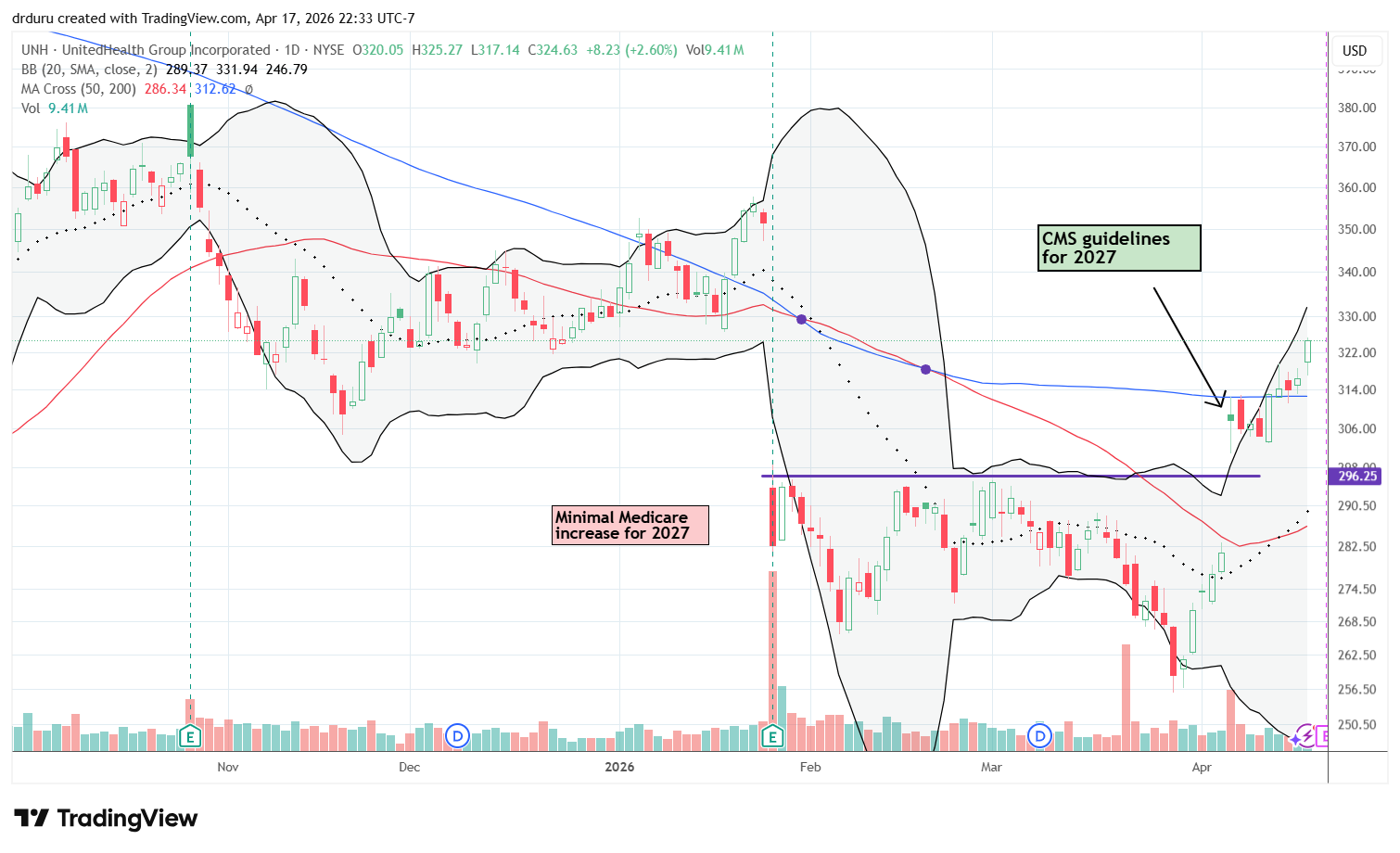
Technical status: UnitedHealth Group (UNH) confirmed a 200DMA breakout after wavering near resistance.
Trade commentary: I did not hesitate to buy UNH’s 200DMA breakout on better than expected news on Centers for Medicare & Medicaid Services (CMS) guidelines. I targeted a buy on a drift that tested the previous high as support. This position is a long-term holding.
Be careful out there!
Footnotes
Subscribe for free to get email notifications of future posts!
“Above the 50” (AT50) uses the percentage of stocks trading above their respective 50-day moving averages (DMAs) to measure breadth in the stock market. Breadth defines the distribution of participation in a rally or sell-off. As a result, AT50 identifies extremes in market sentiment that are likely to reverse. Above the 50 is my alternative name for “MMFI” which is a symbol TradingView.com and other chart vendors use for this breadth indicator. Learn more about AT50 on my Market Breadth Resource Page. AT200, or MMTH, measures the percentage of stocks trading above their respective 200DMAs.
Active AT50 (MMFI) periods: Day #185 over 20%, Day #12 over 30%, Day #8 over 40%, Day #7 over 50%, Day #3 over 60% (overperiod), Day #158 under 70% (underperiod)
Source for charts unless otherwise noted: TradingView.com
Full disclosure: long SPY put spread, short DELL put, long NKE, long UNH, long BBY put, long TSLQ, long SLV call spread, long FCX
FOLLOW Dr. Duru’s commentary on financial markets via StockTwits, BlueSky, and even Instagram!
*Charting notes: Stock prices are not adjusted for dividends. Candlestick charts use hollow bodies: open candles indicate a close higher than the open, filled candles indicate an open higher than the close.
* Blog notes: this blog was partially written based on the heavily edited transcript of the following video that includes a live review of the stock charts featured in this post. I used ChatGPT to process the transcript.
I liver that you tend to cover so many of the stocks that I track or invested. I messed with UNH and HOOD by converting them to Poor man’s covered calls during the red days, and capping my leaps profits. I still don’t have a solid repeatable strategy for entries. What strategy do you use to pick an entry? Albeit I trade options exclusively and I see you do shares primarily.
The same technical rules apply to options and stocks. With options, since time is NOT your friend, your risk management has to be even tighter and trade objectives even clearer.
I only do covered calls when I am prepared to let go of a stock, but think there is a good chance of expiring worthless.
LEAPS are tough. I almost never trade them. I don’t have a rule there. I have ONE position in LEAPS right now: SNAP. Seemed like a potential opportunity for tremendous upside where the LEAPs tightly limit my potential loss while I wait things out. The low share price means I can size my options accordingly.
I primarily use leaps with a .80 delta to leverage my portfolio and be able to trade good stocks, while buying myself time and lowering theta to a few bucks a day. SNAP is a interesting choice I didn’t see how they could make money outside of ad revenue. As far as the exact technical you use for trades, can that be found in the How TO Trade section of the site?
Ah! I see what you are doing now. That makes plenty of sense. I like that approach, and I never thought about such a strategy!
(Also see my response to your comment on the About page).
The “How to” page points readers to resources I have found helpful: https://drduru.com/onetwentytwo/how-to-trade-and-invest-key-books/
The Market Breadth” explains how I trade the technicals of market breadth: https://drduru.com/onetwentytwo/t2108-resource-page/
My overall technical approach keeps things simple. I focus primarily on the 50DMA and the 200DMA. I focus on support and resistance levels, breakdowns and breakouts. You just gave me an idea to write a short post that summarizes approach. I bet AI could help me summarize things. 🙂
Ok Thank You Doc. I will head over to the resources you’ve suggested. I just started watching the Humbled Trader interview with Adam Khoo, it’s great so far.
Excellent!