
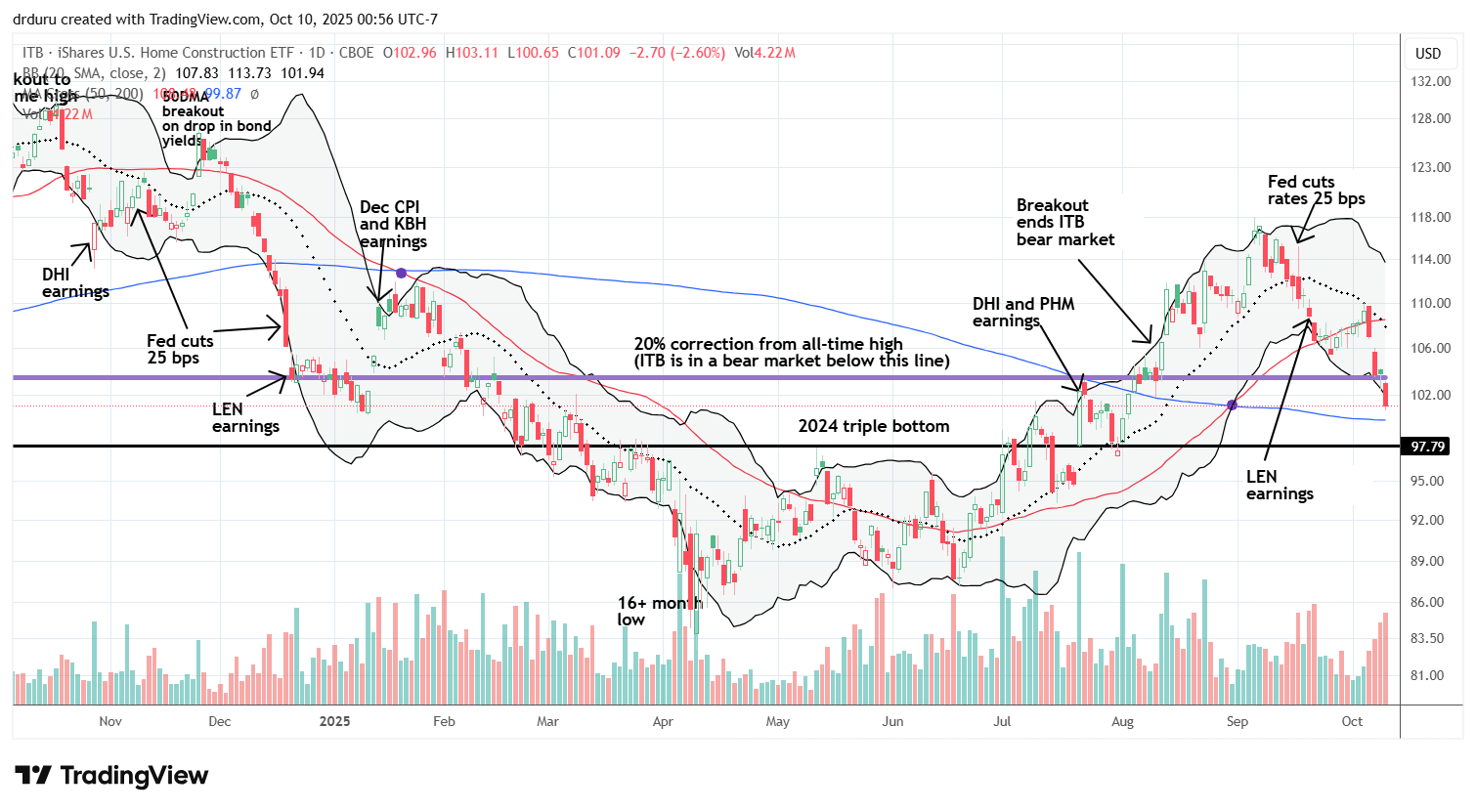
The bearish to bullish reversal ended for home builder stocks with a return to bear market territory. Today, October 9, 2025, the iShares U.S. Home Construction ETF (ITB) dropped under the threshold that defines a bear market: 20% below the all-time high (see chart below). The 2.6% slide on the day is part of a brutal week of underperformance including a 7.5% week-to-date loss versus the S&P 500’s ongoing melt-up and 0.3% gain for the week so far. ITB is also back to a loss for the year at -2.2%. ITB is suffering from a convergence of headwinds culminating in a major sector-wide downgrade from Evercore:
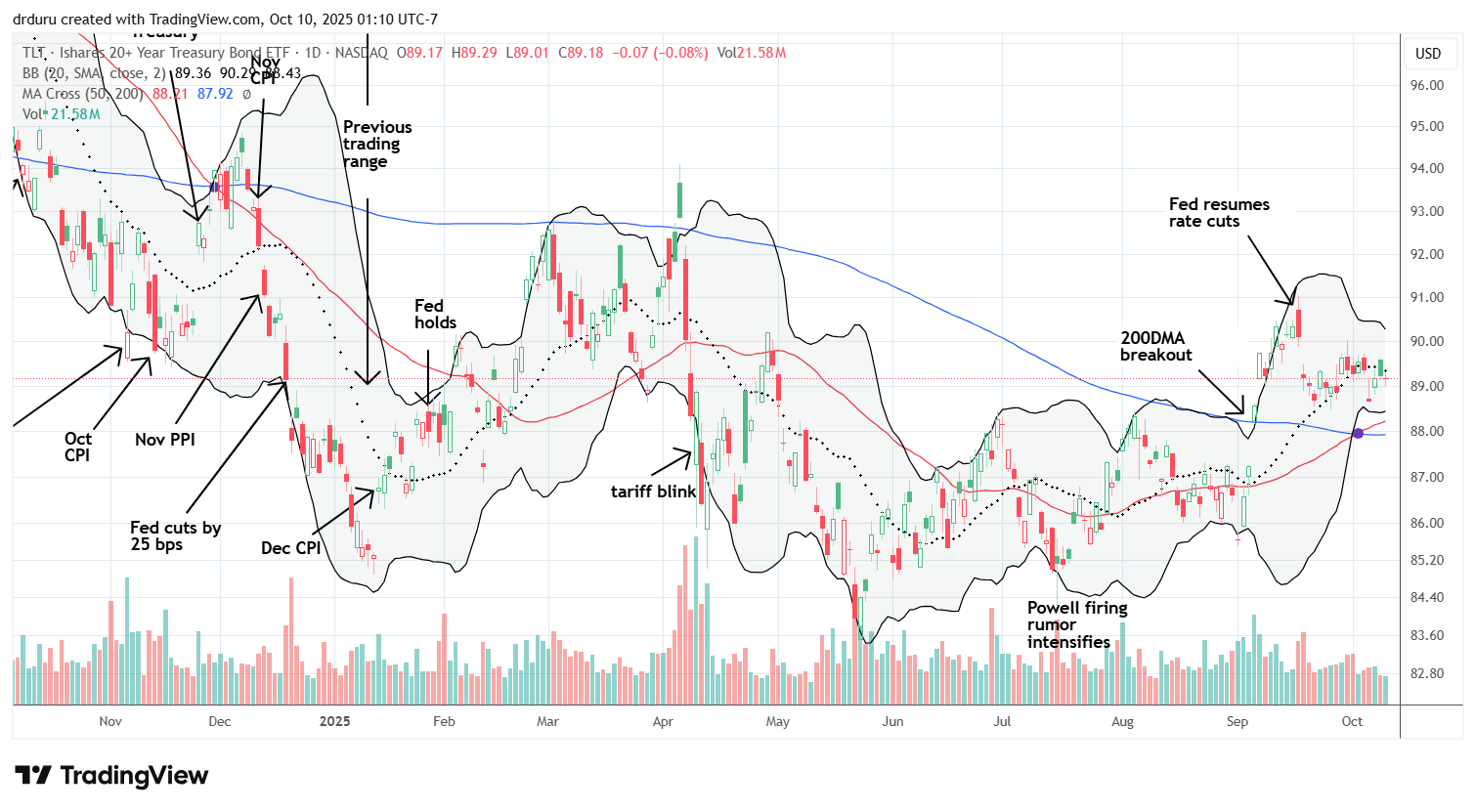
- Mortgage rates are no longer falling as the bond market has cooled its expectations for a lower rate environment and is wary about the potential for a stubbornly persistent inflationary economy.
- The President accused home builders of causing the affordability crisis by purposely constraining supply.
- A sector-wide downgrade from Evercore highlighted regulatory risks to builder profitability.
Mortgage rates paused downtrend
Mortgage rates resumed a longer-term decline starting with a recent peak in January of this year. This anticipation of a lower interest rate environment ended when the Federal Reserve finally cut interest rates in September by 25 basis points. Long-term bond yields increased immediately and the descent in mortgage rates took a pause.
![Source: Freddie Mac, 30-Year Fixed Rate Mortgage Average in the United States [MORTGAGE30US], retrieved from FRED, Federal Reserve Bank of St. Louis; https://fred.stlouisfed.org/series/MORTGAGE30US, October 9, 2025.](https://drduru.com/onetwentytwo/wp-content/uploads/2025/10/20251009_30-Year-Fixed-Rate-Mortgage-Average-in-the-United-States.png)
A key test of bond market dynamics may arrive after the Fed’s next rate cut. If the bond market once again responds with higher long-term yields, optimism over a low rate catalyst will evaporate…and take down the stocks of home builders. Just as rate optimism helped drive the bearish to bullish reversal, rate pessimism will likely lock ITB into a bear market.
Home Builders Are To Housing As OPEC Is (Was) to Oil?
Builders always carry multiple years of inventory of land and lots, often optioned. They carefully and strategically plan these investments around balance sheet needs and to provide sufficient time to work through regulatory processes to get a lot developed into a home for sale. The President thinks the industry is collectively holding too much of this inventory and purposely limiting the supply of homes. According to Realtor.com, the President posted the following on Truth Social:
“Before I became President, “OPEC” kept Oil prices high. It wasn’t right for them to do that but, in a different form, is being done again — This time by the Big Homebuilders of our Nation. They’re my friends, and they’re very important to the SUCCESS of our Country, but now, they can get Financing, and they have to start building Homes. They’re sitting on 2 Million empty lots, A RECORD. I’m asking Fannie Mae and Freddie Mac to get Big Homebuilders going and, by so doing, help restore the American Dream!”
Housing starts have declined and permits are down as a result of depressed home builder sentiment about the demand environment and the high costs of building. To prop up demand and maintain cash flows, builders have extended incentives and rate buydowns. These actions alone speak volumes about the weak demand environment. (CNBC noted that the 2.2 million lots controlled by builders is not a record and only a quarter of those lots are ready for construction).
Construction financing is not tight, but interest rates are high and adding to the expense of building. The builder response to ramp down construction is quite rational. Builders collectively learned hard lessons from the extreme over-building during the housing bubble and resulting Great Financial Crisis (GFC). Increasing the supply of homes may indeed drive down prices but mainly because of oversupply. The total supply of new and existing homes has reached 11-year highs as builders have pushed to respond to a stuck market for existing homes.
Remarkably, despite these challenging market conditions, home builders have been excellent stewards of capital. They generally have maintained strong balance sheets even with margins trending downward. Any regulatory actions that artificially increase housing supply will lower prices at the expense of builder margins which could perversely incentivize builders to reduce instead of increase housing starts.
In other words, commanding builders to build more will not make the housing market healthier. Yet, builders are an easy target given the increasing market concentration by the country’s largest builders. According to the most recent update of the National Association of Home Builders (NAHB) report called “Concentration of Large Builders in Metropolitan Markets“:
“The four-firm concentration ratio rose from 29.1% in 2009 to a peak of 51.4% in 2023, before leveling at 51.1% in 2024. Large national builders expanded their market share from 30.6% in 2009 to 58.1% in 2023, then stabilized at 58.5% in 2024. The combined market share of all national builders climbed from 34.3% in 2009 to 66.2% in 2023, where it essentially remained in 2024. National and regional builders together grew their collective share from 37.5% in 2009 to 69.1% in 2023, before leveling at 69.4% in 2024.”
Thus, the President can use the term “Big Homebuilders” to evoke the image of an OPEC-like stranglehold on the market.
Evercore Undermines the Builders
Evercore apparently rushed out a sector-wide downgrade of the home builders to respond to the increased uncertainty looming from the “exogenous risks” of potential government intervention. In an interview on CNBC’s Fast Money, Evercore’s housing analyst shared worries that the administration’s supply-side solutions do not address the true issue: soft demand. Without lower mortgage rates, demand will not show up to greet increased supply. Evercore called supply-side solutions the “worst thing for builders.” (Of course, the National Association of Realtors (NAR) has long claimed that poor supply is a main impediment to existing home sales).
However, Evercore’s downgrade from buy to neutral is a short-term call. Over the long-term, Evercore remains bullish on builders and anticipates multiple expansion as the financial markets finally come to appreciate the financial health of builders from deleveraging, competitive advantages over private builders, and improved operations. Evercore’s reduced price target even remains above current trading levels. Thus, Evercore looks like a market timing call. The resulting acceleration of the decline of home builders into a bear market could be the beginning of a setup for attractive entry points for the seasonal trade on home builders that will start sometime this month (November at the latest). Moreover, the spring’s tariff drama, trauma, and noise taught markets not to overreact to negative catalysts from the President.
Conclusion: Setting Up for the Seasonal Trade In Home Builders
Individual home builder stocks are suffering extensive damage. Along with ITB, these stocks have broken down below major trendlines, the 50-day moving average (DMA), and in some cases 200DMAs. One stock even sits at multi-year lows. The following summary describes the technical positions of the key builders in my universe along with year-to-date stock performance as calculated by Seeking Alpha:
- Century Communities (CCS): Below 50DMA and 200DMA, -19.6%
- D.R. Horton (DHI): Below 50DMA, below price on news of Berkshire investment, +8.3%
- KB Home (KBH): Below 50DMA and 200DMA, -12.4%
- Lennar Corporation (LEN): Below 50DMA and 200DMA, -13.5%
- LGI Homes (LGIH): Below 50DMA and 200DMA, 5 1/2 year low, -47.9%
- M/I Homes (MHO): Below 50DMA, 0%
- Meritage Homes Corporation (MTH): Below 50DMA and 200DMA, -11.7%
- PulteGroup (PHM): Below 50DMA, +11.5%
- Taylor Morrison Homes (TMHC): Below 50DMA, on 200DMA support, +1.3%
- Toll Brothers, Inc (TOL): Below 50DMA, +2.2%
- Tri Pointe Homes, Inc (TPH): Below 50DMA and 200DMA, -12.8%
I am particularly interested in builders that remain above their 200DMAs, a potential sign of longer-term health. DHI stands out because the stock trades below its price right before news broke of the Berkshire investment. Since I have already started adding to my core holding in ITB, I am not in a rush to trade against this fresh bear market in home builders. I do plan to have my first tranche of seasonal trades complete by the end of the month. This sell-off is timely and provides a classic setup for the seasonal trade. In due time, optimism for the spring 2026 selling season will lift these shares. In the past, only a harsh economic calamity has turned the tables on this trade.
Be careful out there!
Full disclosure: long ITB shares and calls, long TMHC, long MTH call spread, long KBH call spread