

The Market Breadth Summary
- The bullish divergence in market breadth ended nearly three months of bearish breadth despite continued technical breakdowns in the S&P 500 and NASDAQ.
- Price momentum rotated away from tech, especially large-cap and AI related trades, into small caps, consumer-facing companies, and defensive sectors.
- Small caps continued providing market leadership while blockbuster earnings from Micron Technology failed to sustain a rebound in semiconductors and only slowed the NASDAQ’s breakdown.
- The broader market setup favored monitoring whether improving breadth eventually pulls the major indices higher.
The Stock Market Summary
After months of bearish market breadth, the downtrend ended with a surprising bullish divergence. The stock market quickly transitioned from a bearish to bullish divergence thanks to a rotation away from high tech and AI-related stocks and into small caps, consumer-facing stocks, and others.
Micron Technology’s earnings on Wednesday night (June 24) sat in the middle of the transition. Going into MU earnings, technology stocks weakened especially with a large dip on Tuesday. I did not observe any obvious drivers, so the selling looked like vanilla profit-taking. Micron seemed to “save” the tech trade after reporting blockbuster earnings and soaring the next day. However, that renewed optimism faded quickly into more selling in tech stocks.
Thus, June has become the month where tech stocks weakened, especially with big cap tech selling off most of the month, and money strongly favoring consumer-facing stocks as oil sold off most of the month. This rotation is now the story I will monitor throughout the summer.
S&P 500 (SPY)
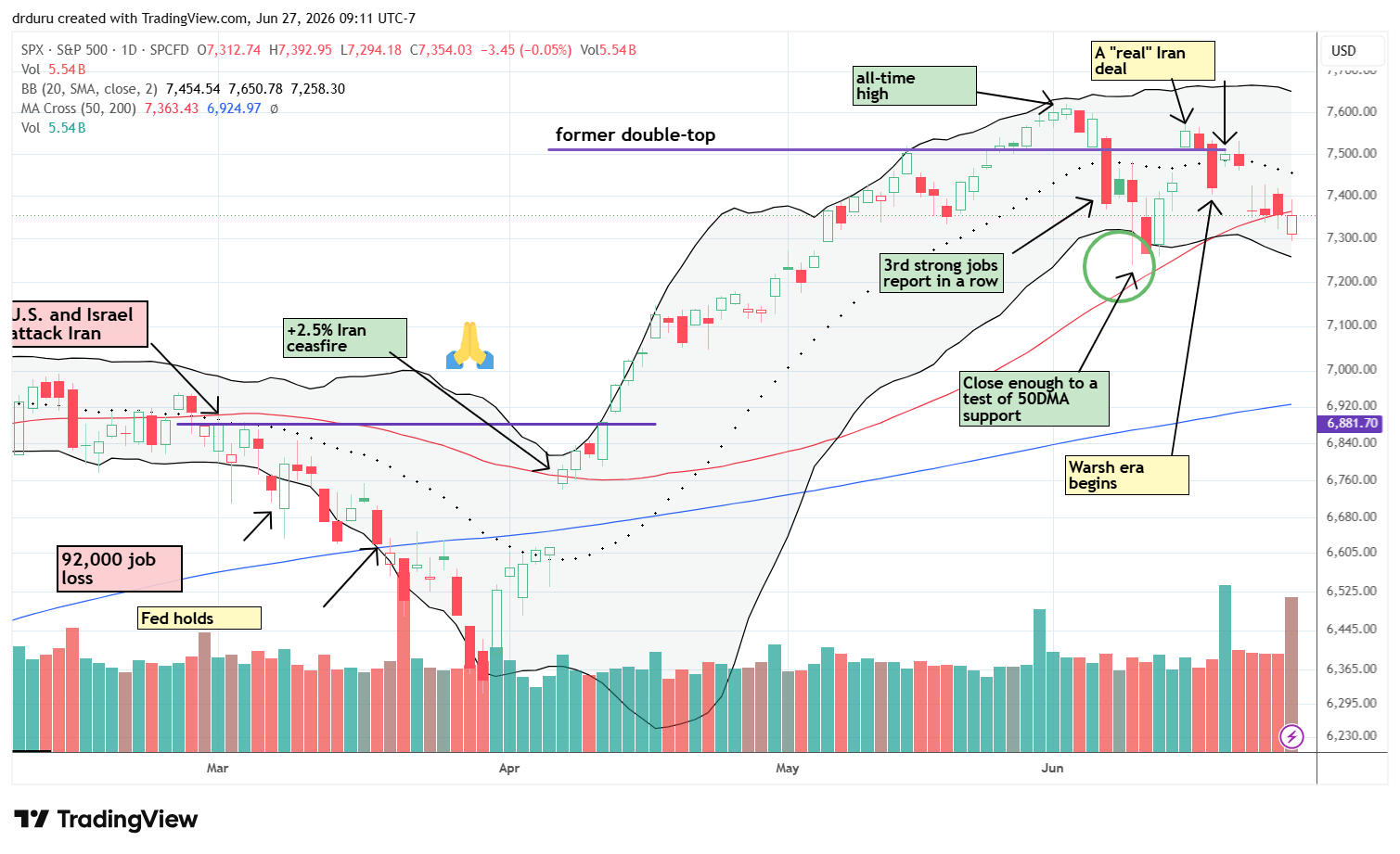
The S&P 500 broke below its 50-day moving average (DMA) (the red line below) for the first time since the day before the index gapped higher on news of the first ceasefire. Buyers defended 50DMA support several times during the week, but the S&P 500 ultimately succumbed on Friday. Intraday buying pulled the index to a close right under its 50DMA.
Importantly, the 20DMA (the dotted line below) is drifting downward as the index fades further away from its all-time high. Yet, though the technical picture has weakened, I do not consider the bearish move fully confirmed unless the index breaks below its June low where it got “close enough” to a test of 50DMA support. Until then, I view the weakness as incomplete within the context of improving market breadth.
NASDAQ (COMPQ)
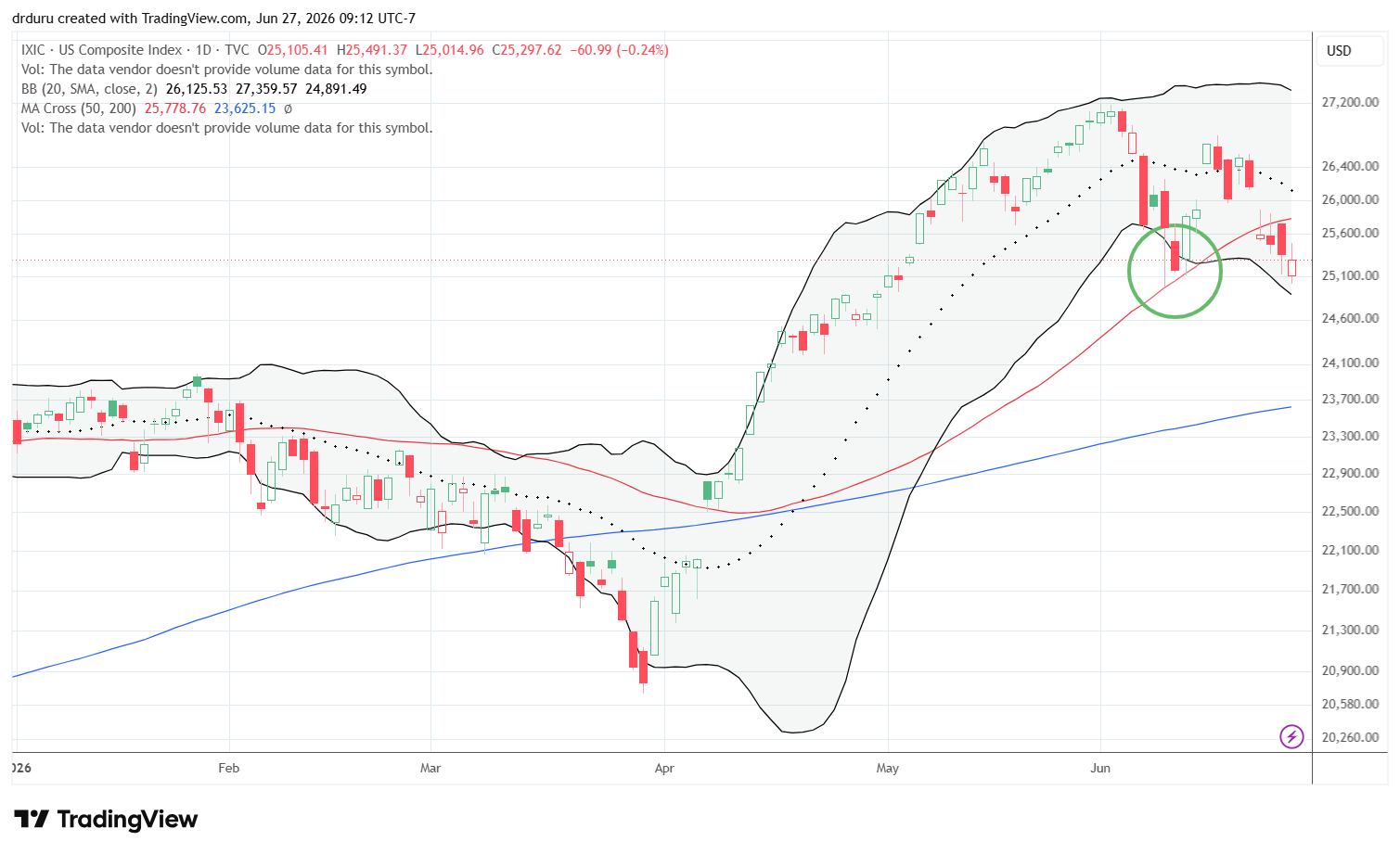
The NASDAQ remained the weakest of the major indices on a relative technical basis. The sharp selloff earlier in the week produced a confirmed breakdown below its 50DMA. Micron’s earnings delivered a gap higher that failed precisely at 50DMA resistance. Even so, buyers defended the June low where the tech-laden index perfectly tapped 50DMA as support three trading days in a row.
The NASDAQ teeters on a precarious condition given a lower close from here would create a downtrend and put 200DMA support (the blue line) in play.
iShares Russell 2000 ETF (IWM)
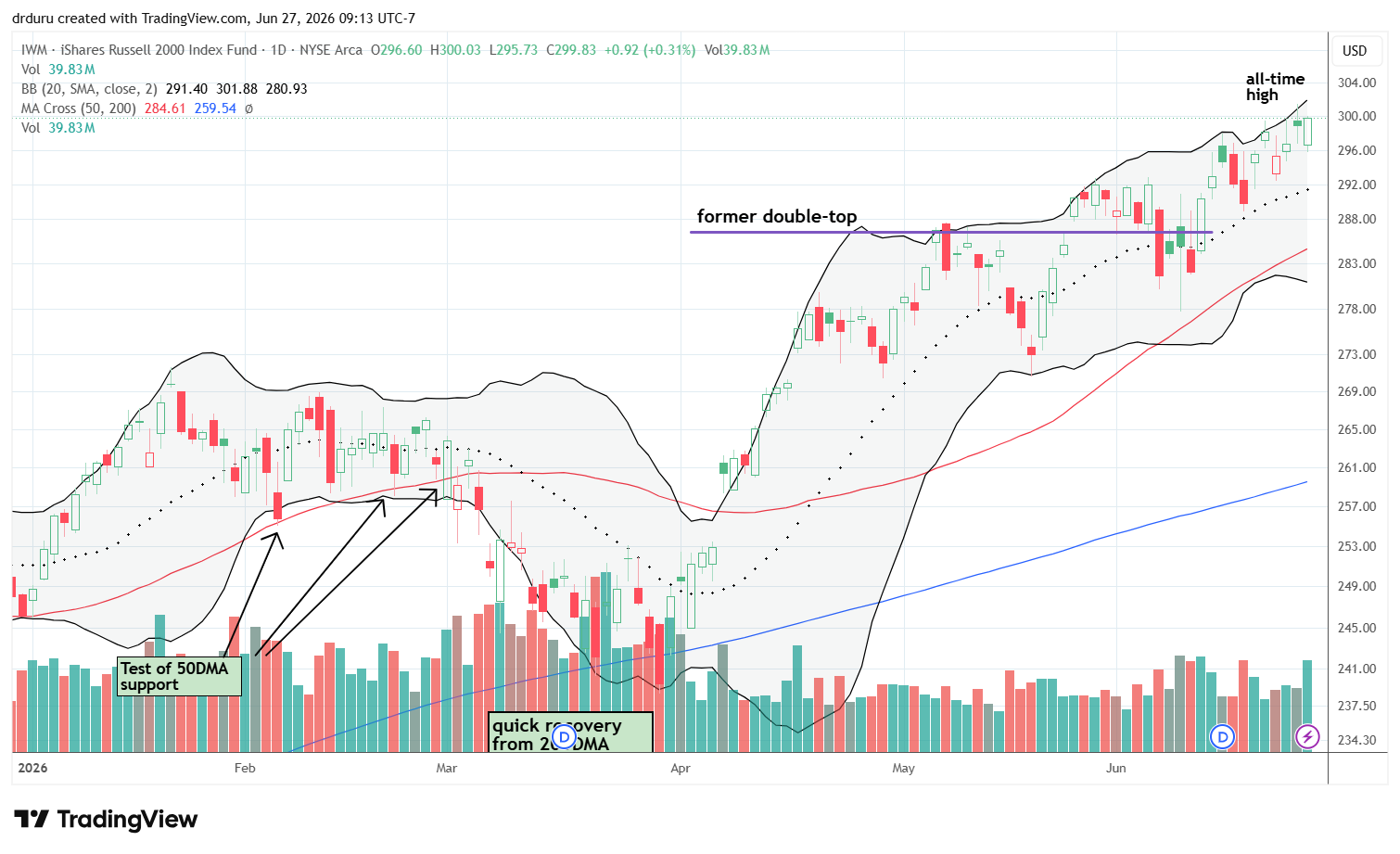
Small caps continued to provide the strongest technical leadership. After IWM last broke out above its previous double-top resistance, it tested 20DMA support and never looked back. IWM even closed the week at a fresh (marginal) all-time high. This leadership from small caps provides critical fuel for the bullish divergence in the market. Now the question is how long it will take for the other major indices to turn around…or will the bullish divergence end with small caps also losing momentum?
The Short-Term Trading Call With Market Tensions
- AT50 (MMFI) = 58.1% of stocks are trading above their respective 50-day moving averages
- AT200 (MMTH) = 58.2% of stocks are trading above their respective 200-day moving averages
- Short-term Trading Call: neutral
AT50 (MMFI), the percentage of stocks trading above their respective 50DMAs, closed the week at 58.1%. The breakout above the 2+ long downtrend ended the bearishness in market breadth without the calamity of the last downtrend that started in January (see the chart below). I left the short-term trading call at neutral given the 50DMA breakdowns in the S&P 500 and the NASDAQ. I will flip bullish once the S&P 500 recovers. After that trigger, I will be watching out for the next test of the overbought threshold, a key juncture according to the AT50 trading rules.
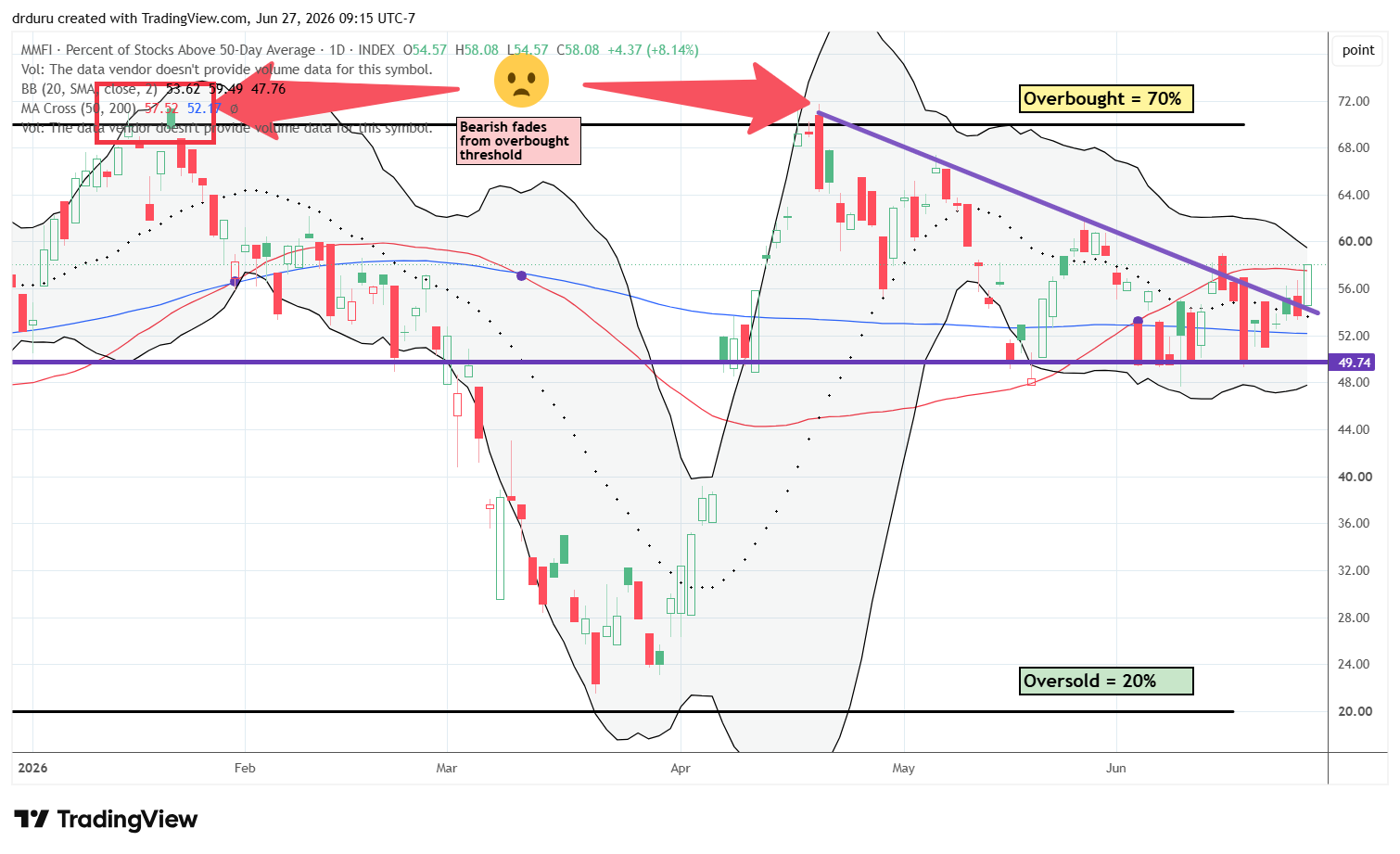
Market breadth has turned bullish while the S&P 500 and especially the NASDAQ are technically bearish. Because market breadth leads my market analysis, I interpret this setup as a bullish divergence. Rather than viewing weak index action as a reason to become bearish, I see the major indices as lagging indicators that may eventually catch up to improving breadth.
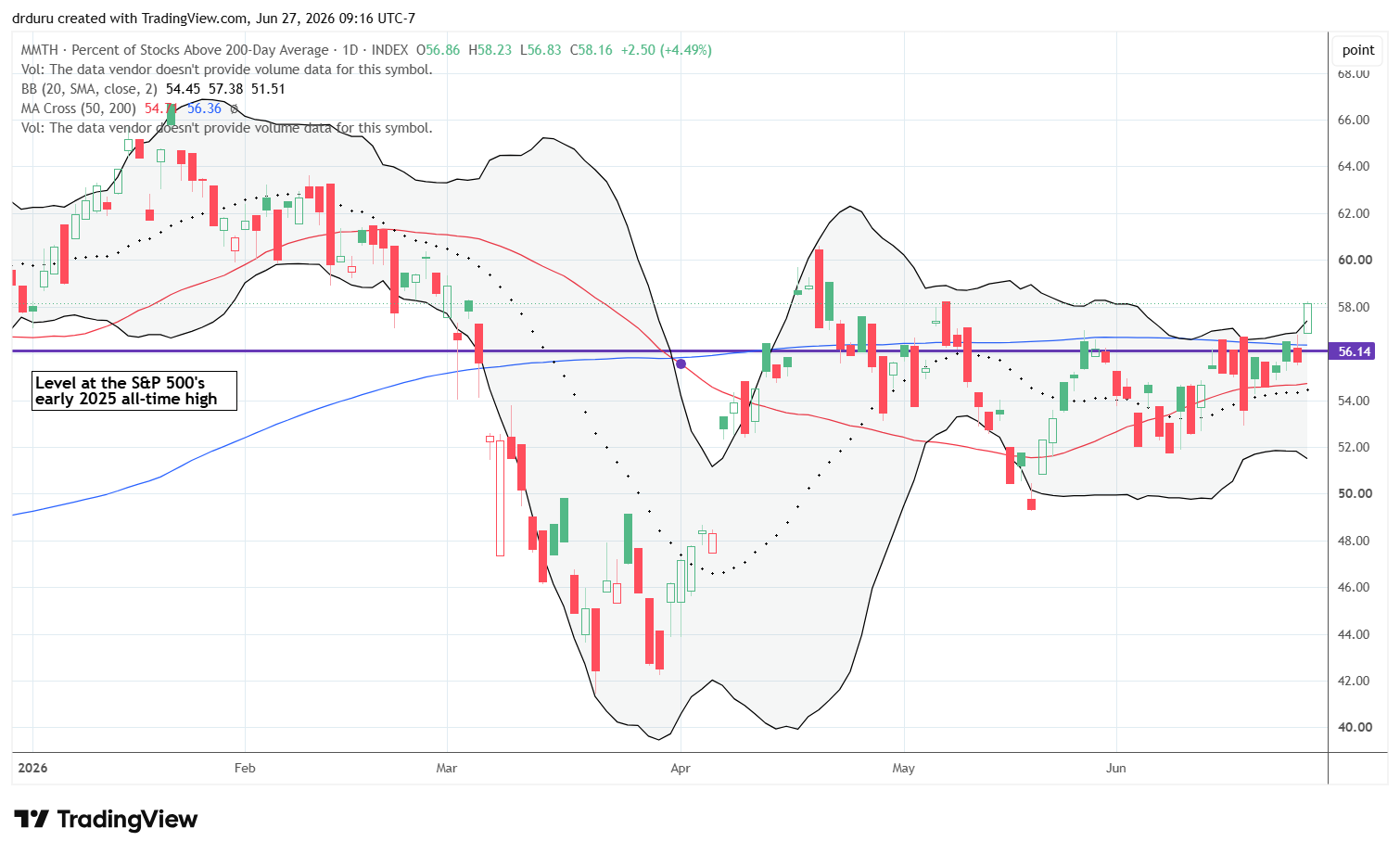
AT200, the percentage of stocks trading above their respective 200DMAs, closed the week at 58.2% after breaking out above its pivot line and closing at a 2-month high. The improvement in longer-term breadth reinforces the bullish message from AT50 while still leaving room for additional upside before overbought conditions become my next concern.
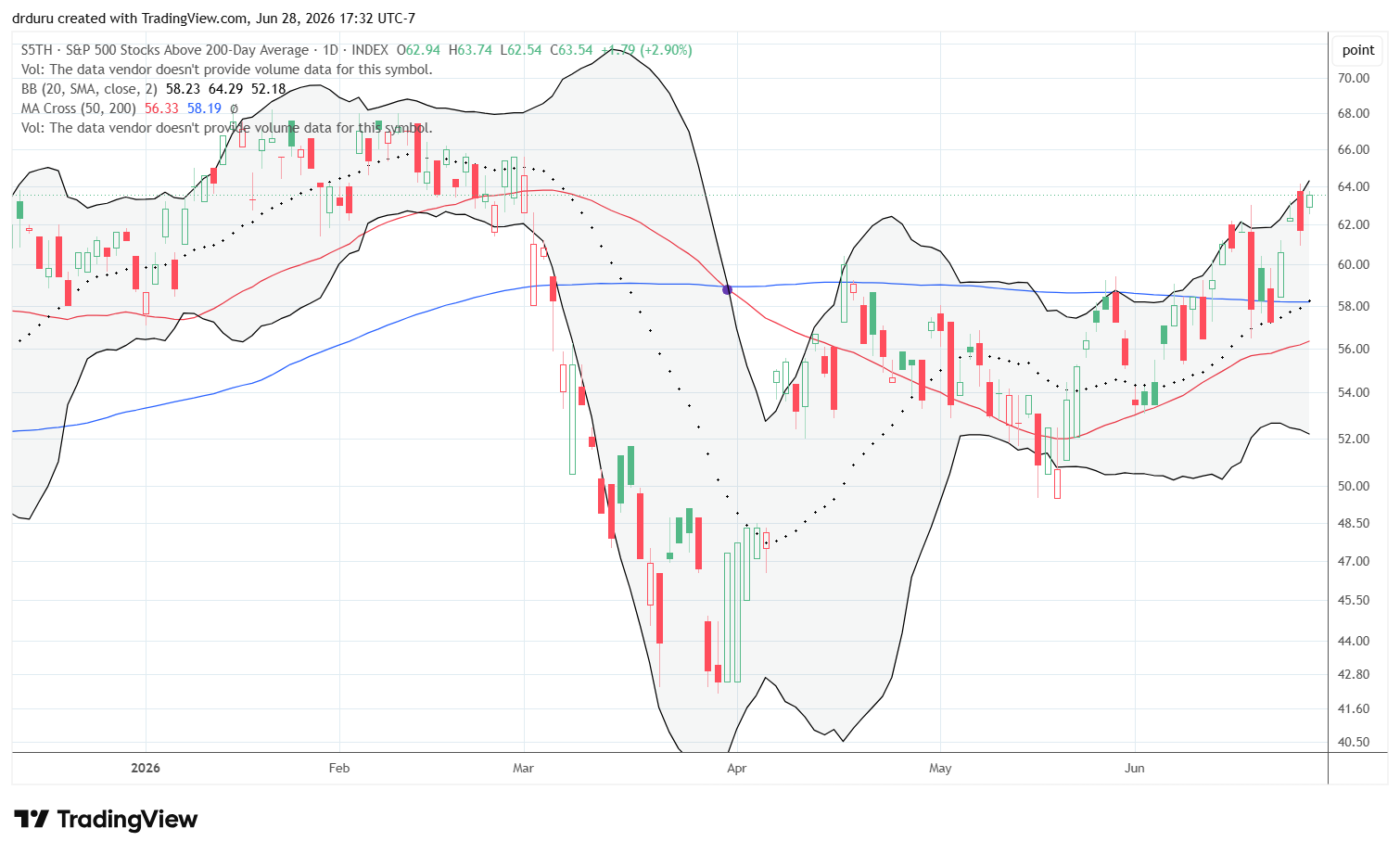
The short-term prospects look good for the S&P 500 to recover from its 50DMA breakdown as the percentage of S&P 500 stocks trading above their 200DMAs (S5TH) closed at its highest point since early March. This near recovery of the losses since the beginning of the war against Iran bodes well for the rest of the summer as well.
In case you missed it…
The SpaceX theme continued last week. I used the first 6 days of trading in the stock as a great tutorial on how to read candlestick charts. Next, a mini mea culpa on Cerebras Systems (CBRS) after my case for a bottom failed to recognize the upcoming risk from earnings. CBRS is now a busted IPO that bodes poorly for SPCX’s ability to cling to $150 support created by its IPO opening price.
The Equities
Micron Technology (MU)
Description: Micron Technology designs and manufactures memory and storage semiconductor products used in computing, networking, automotive, industrial, mobile, and data center applications.
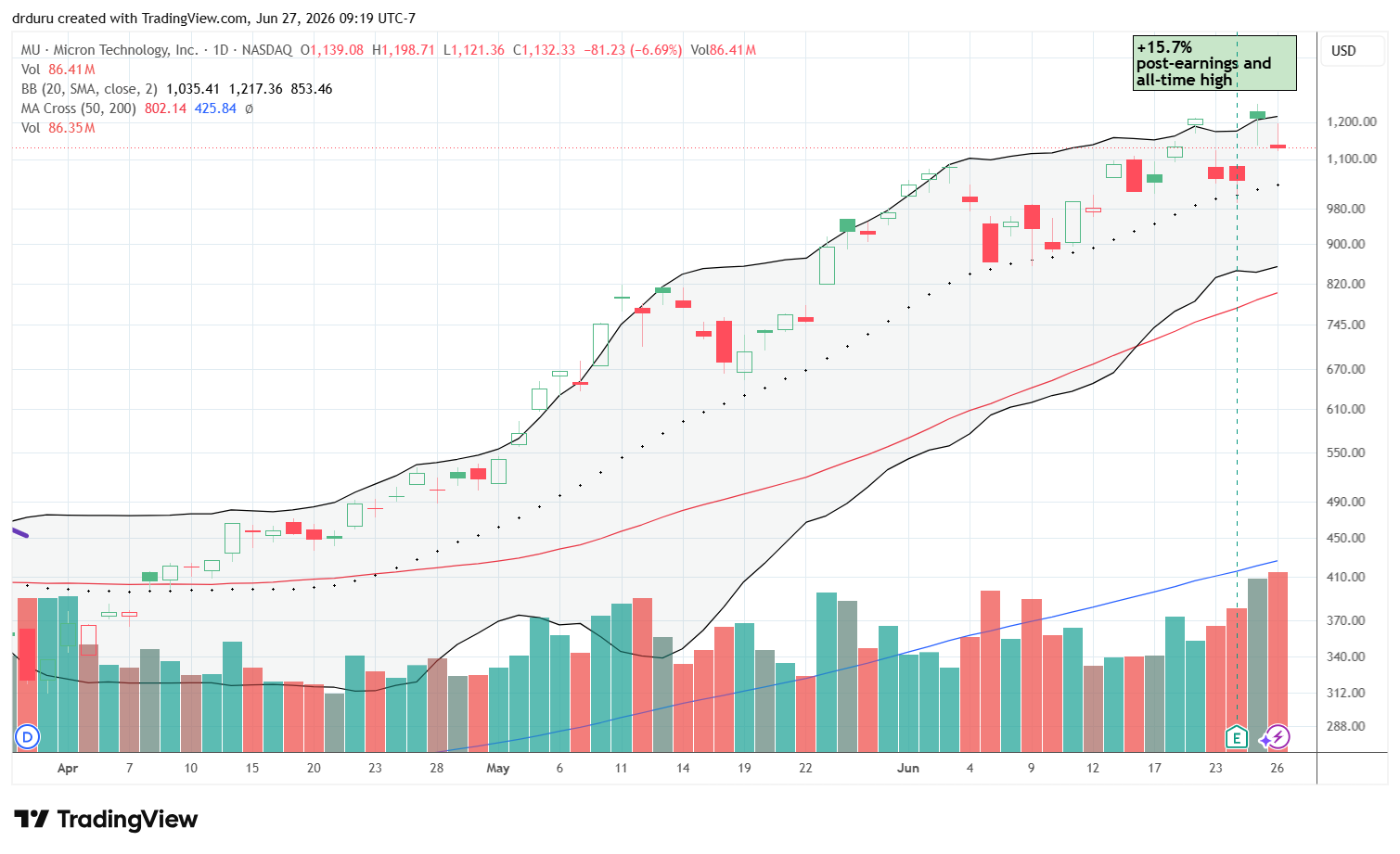
Technical status: Micron Technology (MU) remained in a powerful uptrend despite Friday’s pullback from a 15.7% post-earnings gain and all-time high.
Trade commentary: MU is a clear leader within the AI investing ecosystem. The company’s earnings report confirmed that leadership, but the post-earnings pullback became notable. Despite Thursday’s excitement, MU finished the week flat and faded from its all-time high. This tepid net response had a bigger significance in the sector as shown below in SMH.
VanEck Semiconductor ETF (SMH)
Description: The VanEck Semiconductor ETF seeks to track companies involved in semiconductor production and semiconductor equipment.
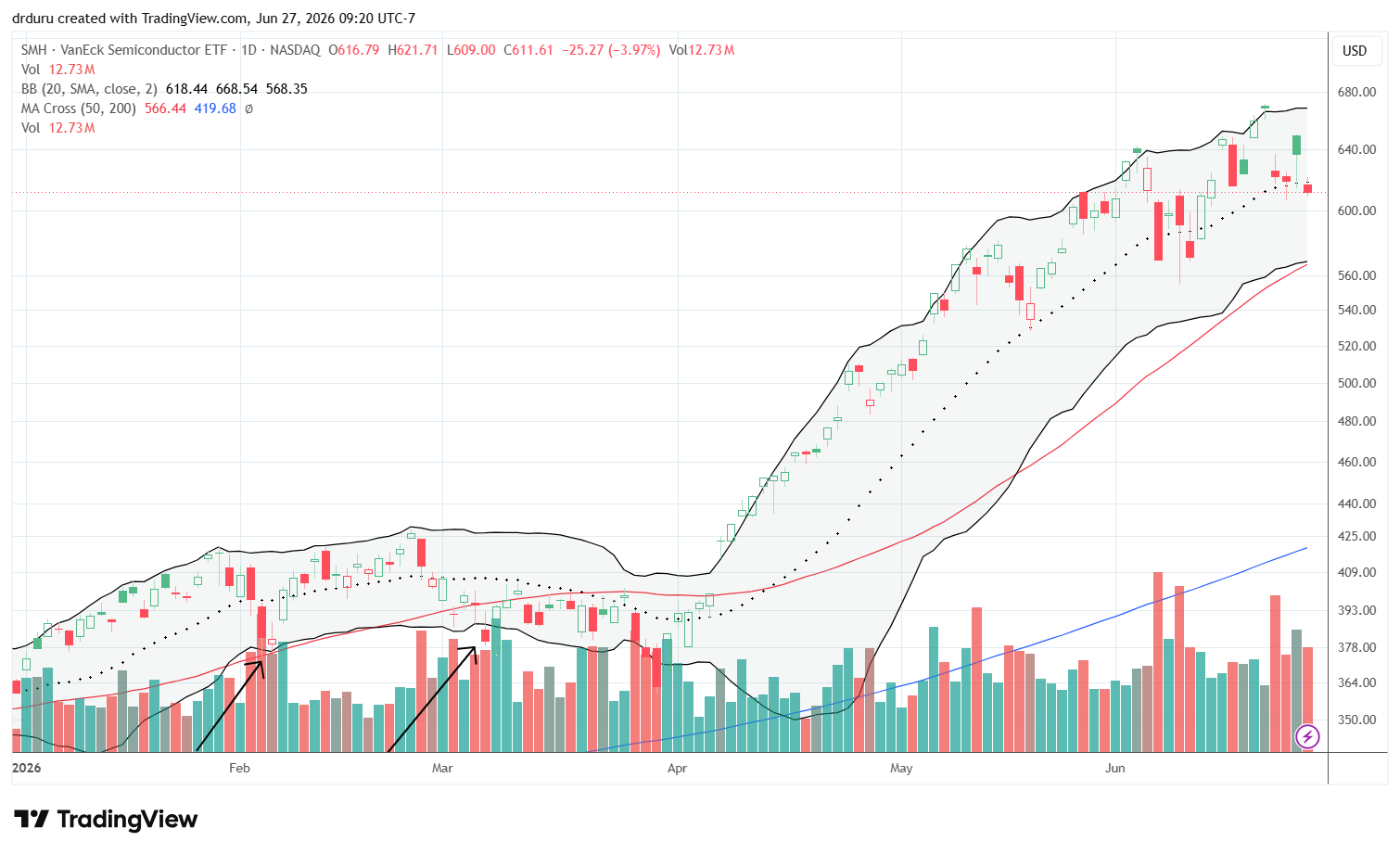
Technical status: The VanEck Semiconductor ETF (SMH) failed to challenge its all-time high despite MU’s earnings surge and slipped below 20DMA support.
Trade commentary: SMH’s chart summarizes a core story in the AI trade. April’s breakout has been particularly powerful. However, MU’s blockbuster post-earnings response failed to power SMH to a new all-time high. In fact, SMH fell far short, and Friday’s 3.0% loss finished erasing all of the benefits from MU’s post-earnings gains. Thus, ever so subtly, SMH could be slowly rolling over here, maybe not into a crash, but at least into a top that helps rotate more money out of the AI/semiconductor trade and into other parts of the market this summer.
ON Semiconductor Corporation (ON)
Description: ON Semiconductor Corporation is an American supplier of semiconductor-based solutions, specializing in intelligent power and sensing technologies that enable vehicle electrification, sustainable energy, and industrial automation.
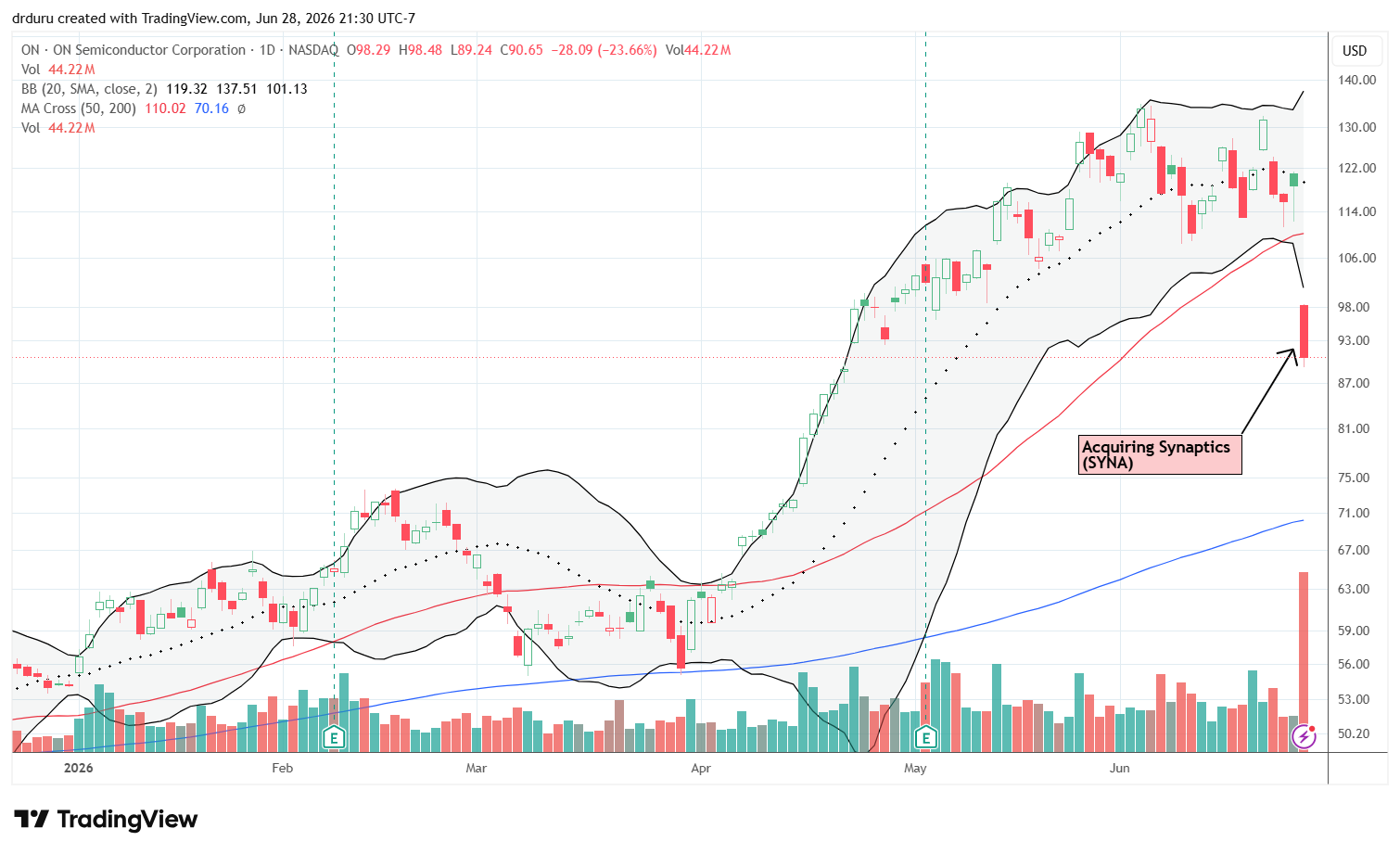
Technical status: ON Semiconductor Corporation (ON) collapsed into a 50DMA breakdown after announcing its plans to acquire Synaptics Incorporated (SYNA)
Trade commentary: When a company’s stock gets expensive, it becomes valuable currency for cashing out and buying things. ON Semiconductor announced on Friday its intent to buy Synaptics Incorporated (SYNA). The reaction was so extremely poor that even SYNA lost 3.7% on the day. The sudden and abrupt sell-off serves as a reminder to respect topping signals. In ON’s case, the topping signal was subtle because the churn while SMH continued to rally did not generate a blow-off top or a breakdown. Friday’s breakdown confirms a top. I am now on alert for signs of fragility in other semiconductor stocks.
NVIDIA (NVDA)
Description: NVIDIA develops graphics processors, accelerated computing platforms, and artificial intelligence hardware and software.
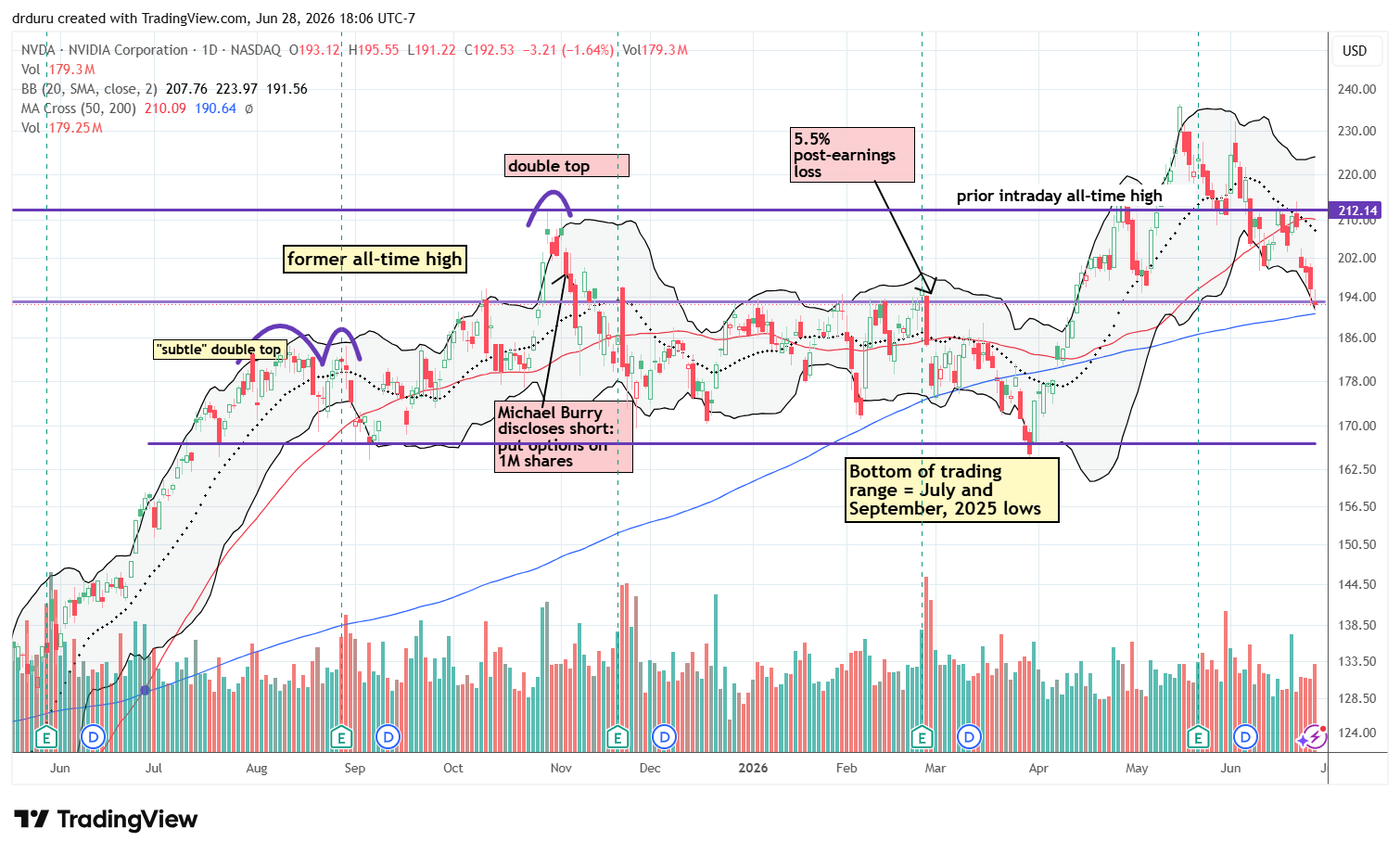
Technical status: NVIDIA (NVDA) challenged its 200DMA after rolling over from its May all-time high. The stock continued trading within a broad range.
Trade commentary: I have struggled trading NVDA recently, and the chart helps to explains why. Instead of trending cleanly, the stock has spent months churning within a wide range. I think there are now better opportunities elsewhere in the AI ecosystem. Note that NVDA is “only” up 3.2% for the year as it now stares down 200DMA support (the blue line). The stock is right back to a level where it traded to an all-time high in October, 2025. A lower close from here could drop the stock right back into a trading range that began almost a year ago.
Qualcomm (QCOM)
Description: Qualcomm develops semiconductors, wireless communications technologies, and mobile computing platforms.
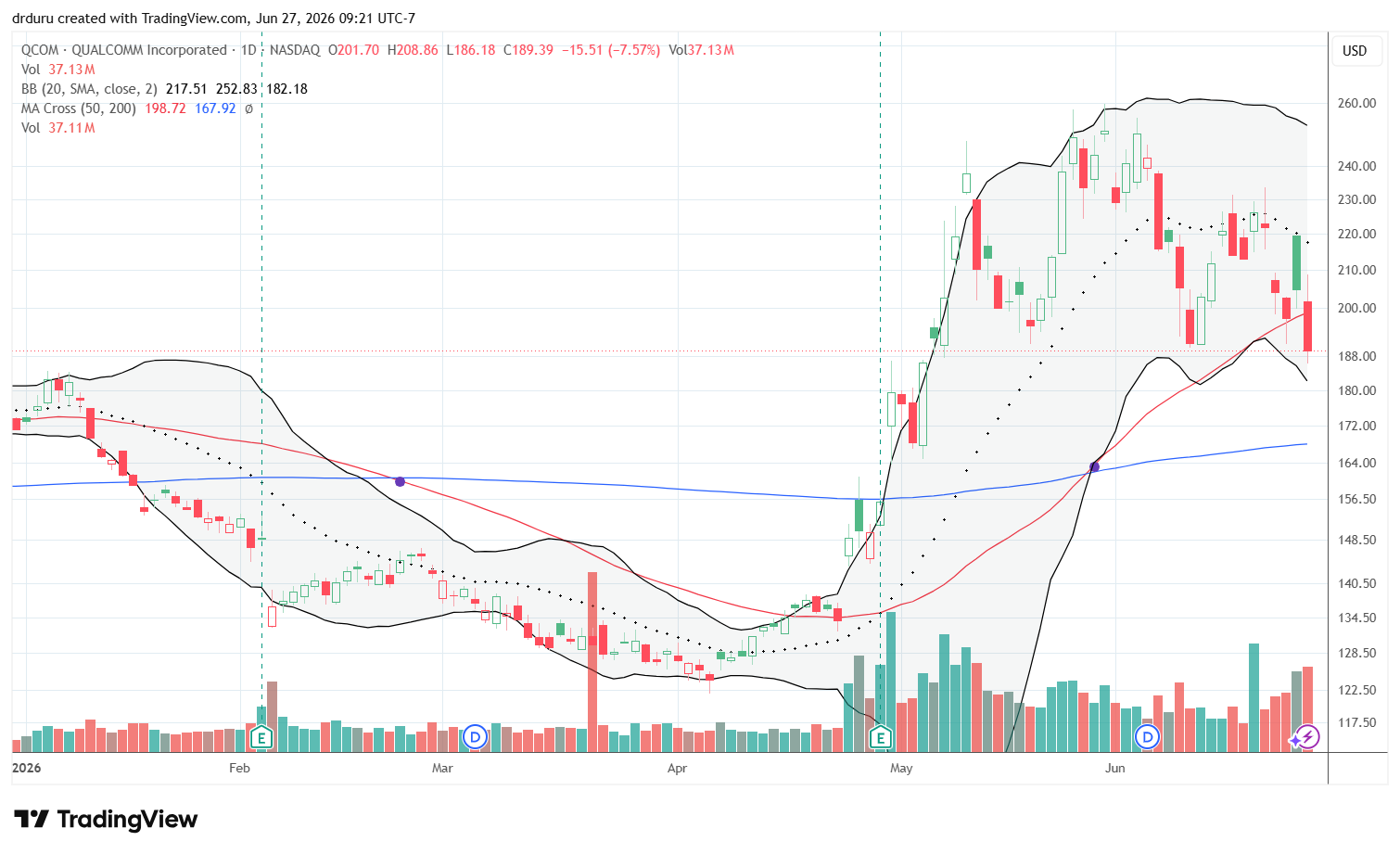
Technical status: Qualcomm (QCOM) broke down below its 50DMA while completing what appeared to be a topping formation following its April/May run-up to all-time highs.
Trade commentary: QCOM’s loss of momentum after reaching new highs creates a poor technical picture closely associated with the shorter duration of churn in ON. The excitement from the May run-up is evaporating, and the 50DMA breakdown to a near 2-month low confirms the topping pattern.
Roundhill Magnificent Seven ETF (MAGS)
Description: The Roundhill Magnificent Seven ETF provides concentrated exposure to the seven largest U.S. technology companies.
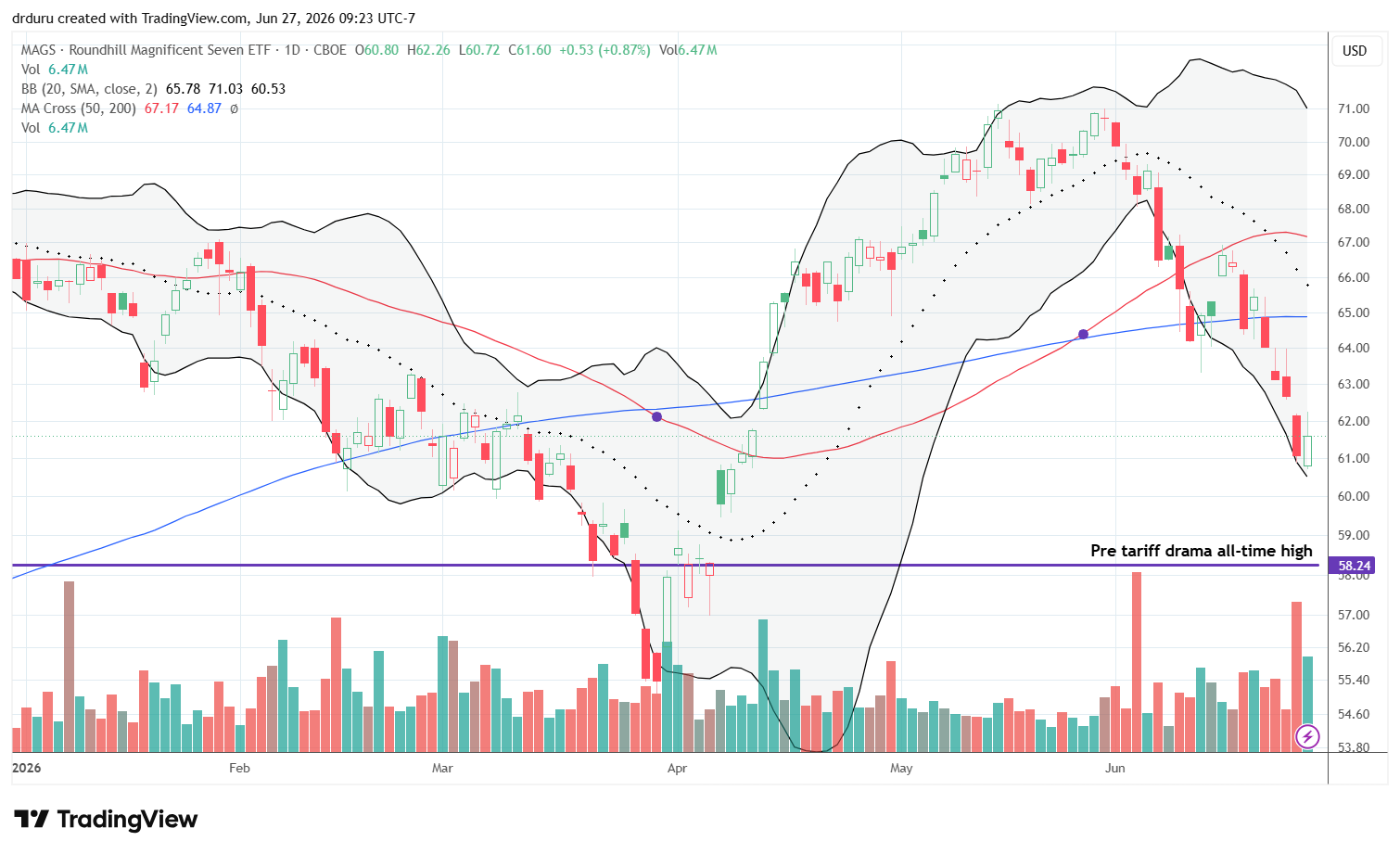
Technical status: The Roundhill Magnificent Seven ETF (MAGS) sold off all of June and is bearishly trading well below its 200DMA.
Trade commentary: The “sell in May and go away” strategy has not worked for the overall market in recent years, but it worked remarkably well for MAGS this year. Investors who reduced exposure in May are now in a much stronger position to redeploy capital if attractive opportunities develop. That time may be now with MAGS nearly reversing all its gains since the first ceasefire in the Iran war on April 8th. A significant move back into MAGS will likely slow the expansion of AT50 and market breadth.
Apple (AAPL)
Description: Apple designs and sells consumer electronics, software, and digital services.
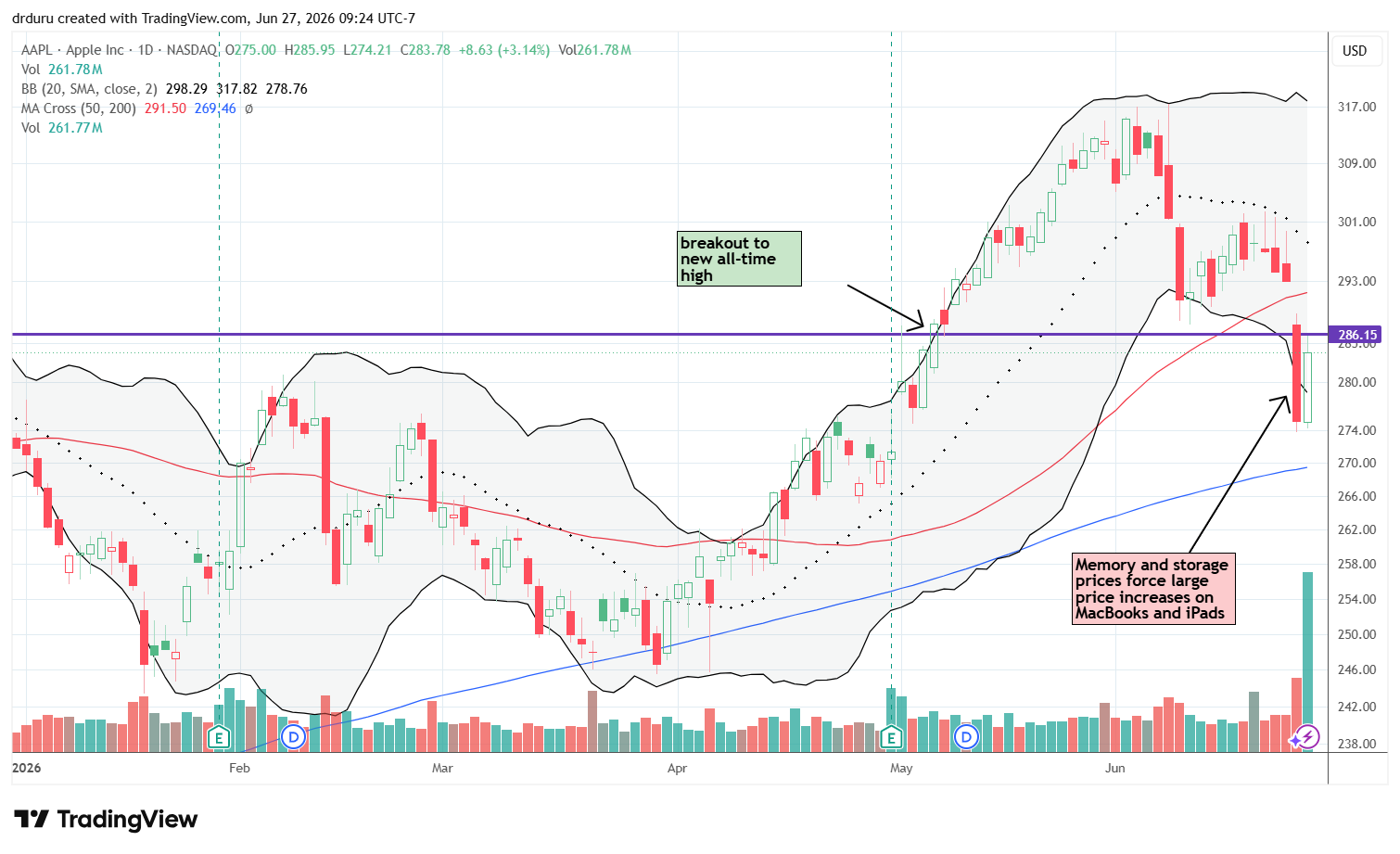
Technical status: Apple (AAPL) plunged 6.1% on pricing news before rebounding 3.1% with exceptionally strong buying volume. The stock remained below its 50DMA.
Trade commentary: Apple announced major price increases for its iPad and Macbook products. The company explained that higher memory prices have forced the move. Now, investors fear demand destruction that could get worse if Apple next must raise iPhone prices. The subsequent 6.1% plunge looked extreme, and Friday’s extremely high volume buying seemed to validate the oversold nature of the stock. If AAPL manages to close above its 50DMA soon, I will be an aggressive buyer of AAPL calls. Otherwise, my best guess scenario is a lot of churn as the 200DMA creeps slowly higher to create support for the stock.
Microsoft (MSFT)
Description: Microsoft develops software, cloud computing services, artificial intelligence platforms, and enterprise technology products.
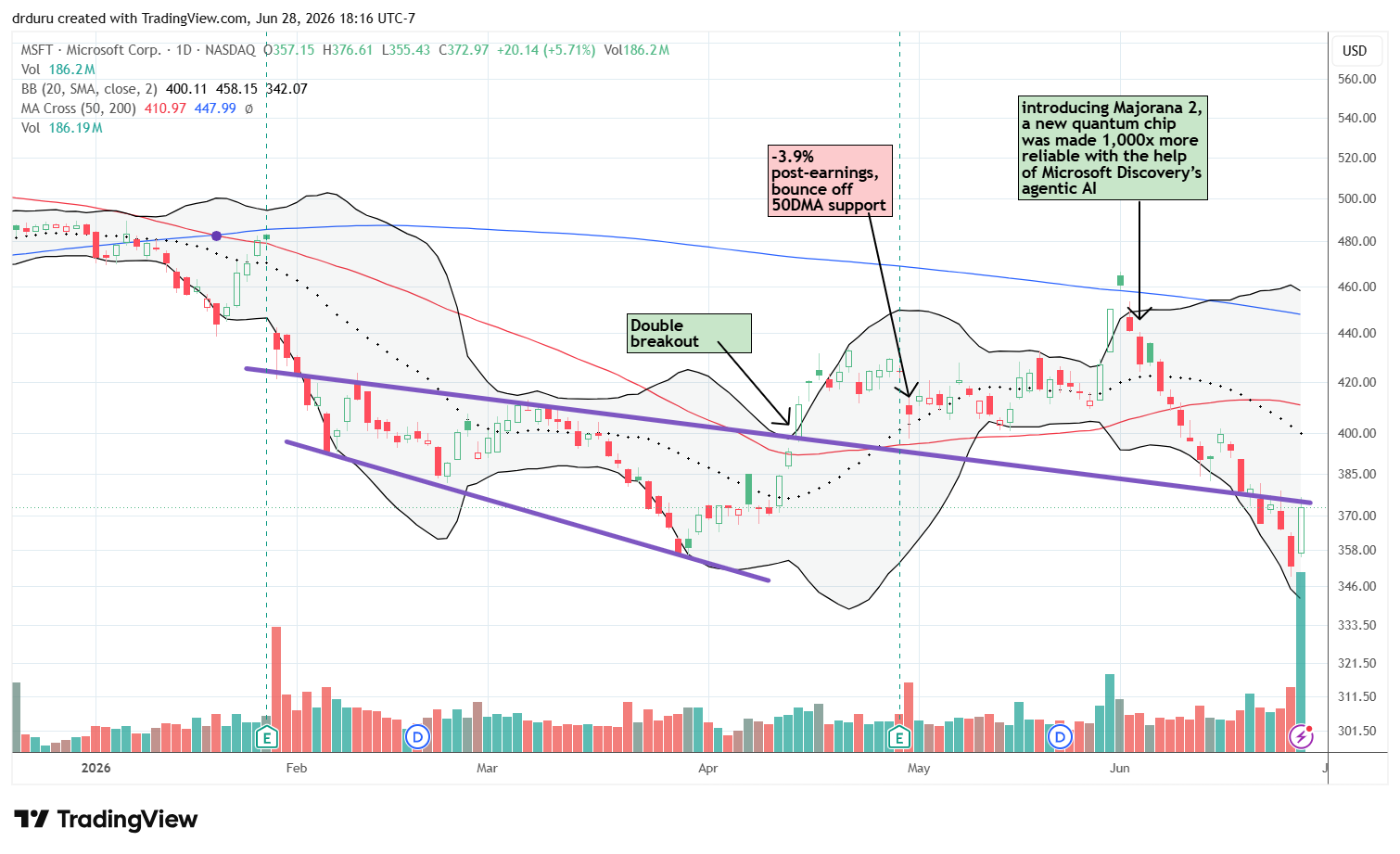
Technical status: Microsoft (MSFT) remained below its 50DMA and failed at former downtrend resistance despite a strong Friday 5.7% rebound.
Trade commentary: I hope the latest bounce for MSFT proves to deliver a durable bottom, but I am not optimistic yet. Over the longer-term, I remain convinced that MSFT will trade much higher in due time. Unfortunately, for now, MSFT is suffering from collecting headwinds from the AI Panic in software to higher memory prices potentially suppressing PC demand, and doubts that MSFT will sufficiently benefit much from its AI investments.
iShares Expanded Tech-Software Sector ETF (IGV)
Description: The iShares Expanded Tech-Software Sector ETF tracks U.S. software companies.
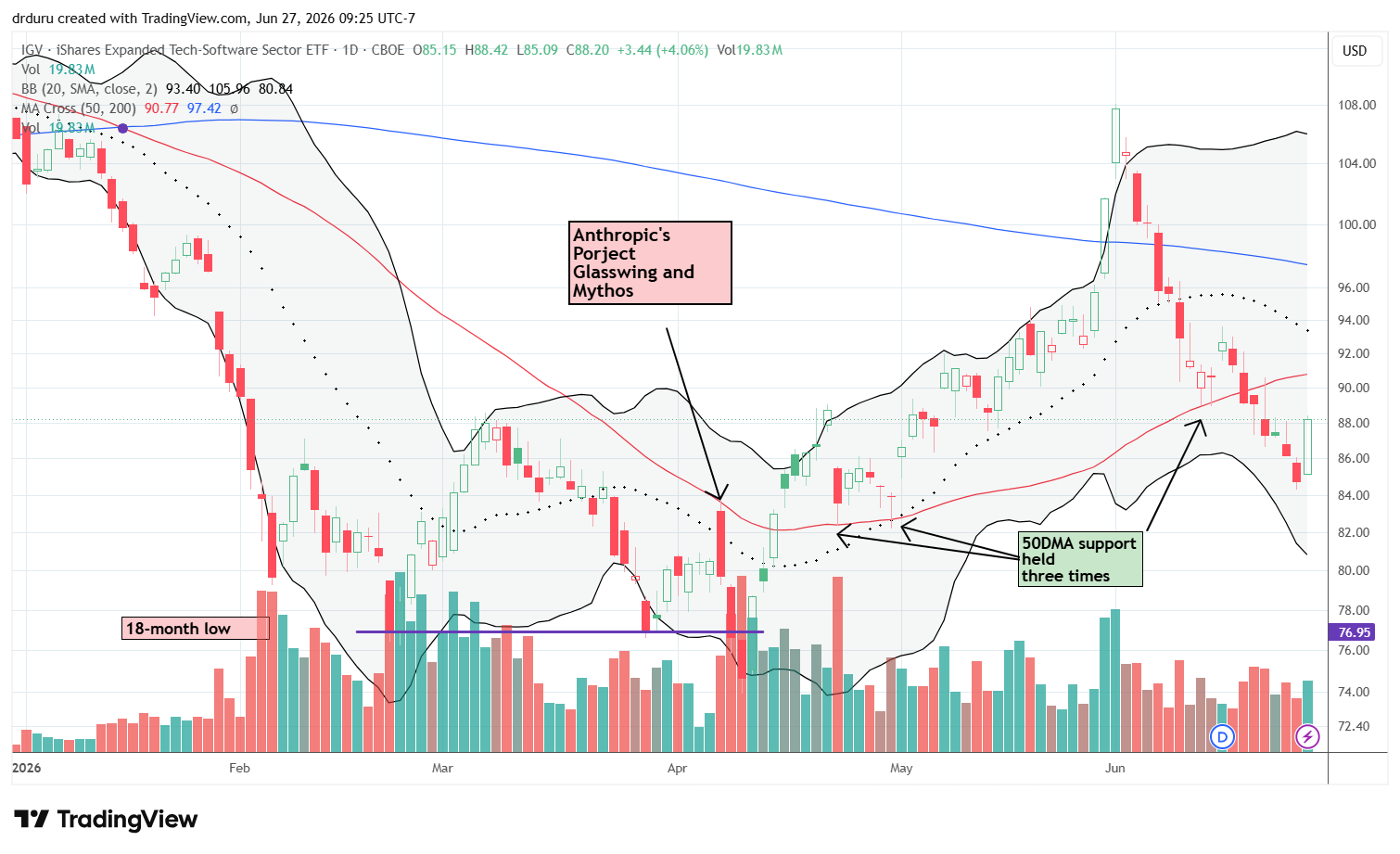
Technical status: The iShares Expanded Tech-Software Sector ETF (IGV) rebounded sharply but remained below its 50DMA after selling off all of June.
Trade commentary: Software has been sold aggressively enough to become interesting again for swing trades, but I still view the latest rally with caution. Until IGV recovers its 50DMA, the AI Panic in software is wearing on investor sentiment in the sector. Friday’s 4.1% gain, partially thanks to MSFT, at least interrupted the bearish momentum to the downside.
Palantir Technologies (PLTR)
Description: Palantir Technologies develops software platforms for data integration, analytics, and artificial intelligence for government and commercial customers.
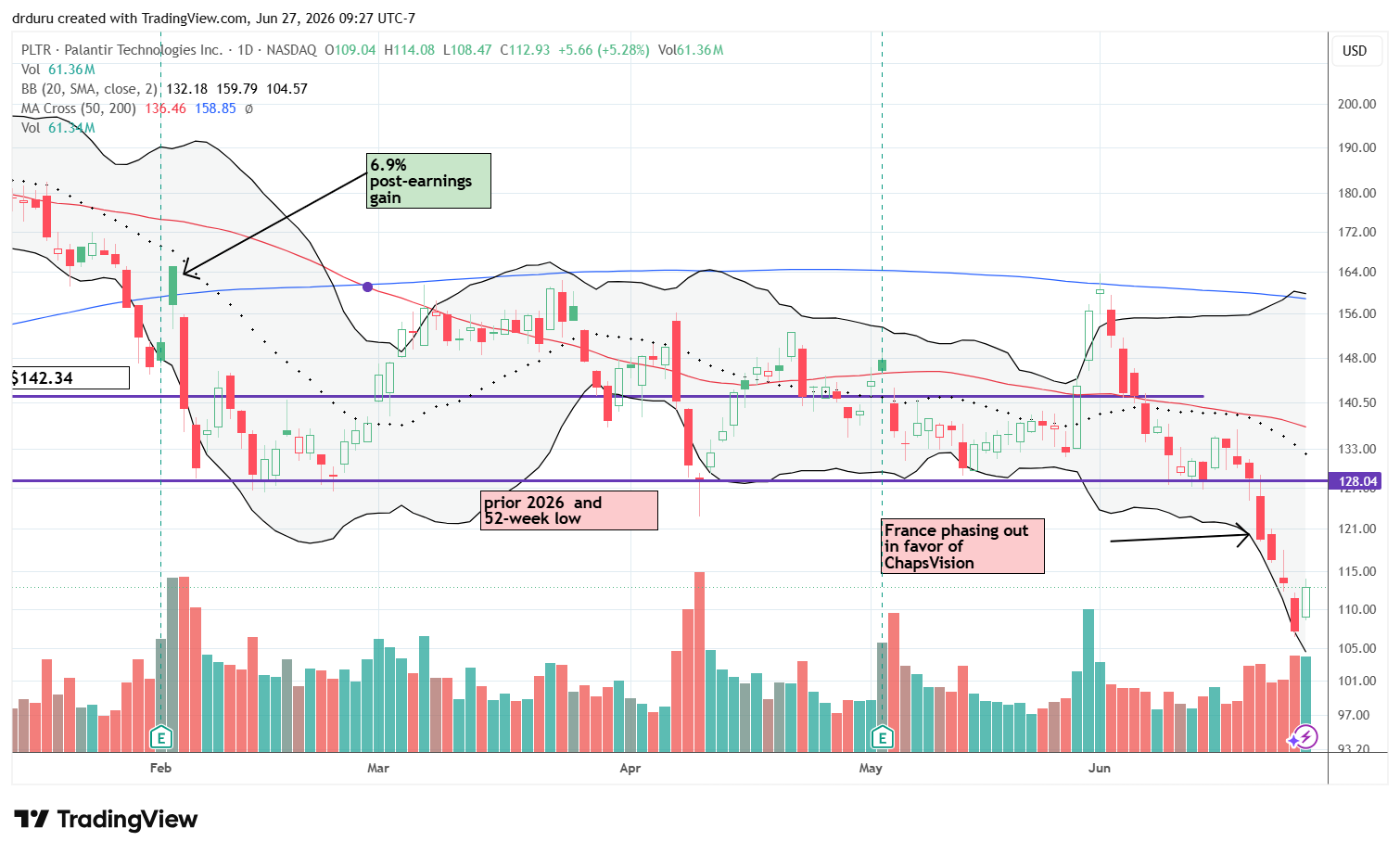
Technical status: Palantir Technologies (PLTR) broke below long-standing support after a June sell-off, capped by losing the French government as a customer.
Trade commentary: PLTR is now a no-touch stock for me. I do not want to short it because the stock could suddenly surge on trader randomness, but I also have no interest in buying until the technical damage comes to an end. I want to see PLTR reclaim both former support and its 50DMA before I consider becoming constructive again. PLTR benefited from Friday’s software rebound, but it remains at prices last seen in May, 2025. If weakness resumes, I see $99 as the next potential sustainable line of support.
Figma (FIG)
Description: Figma develops cloud-based collaborative design and product development software.
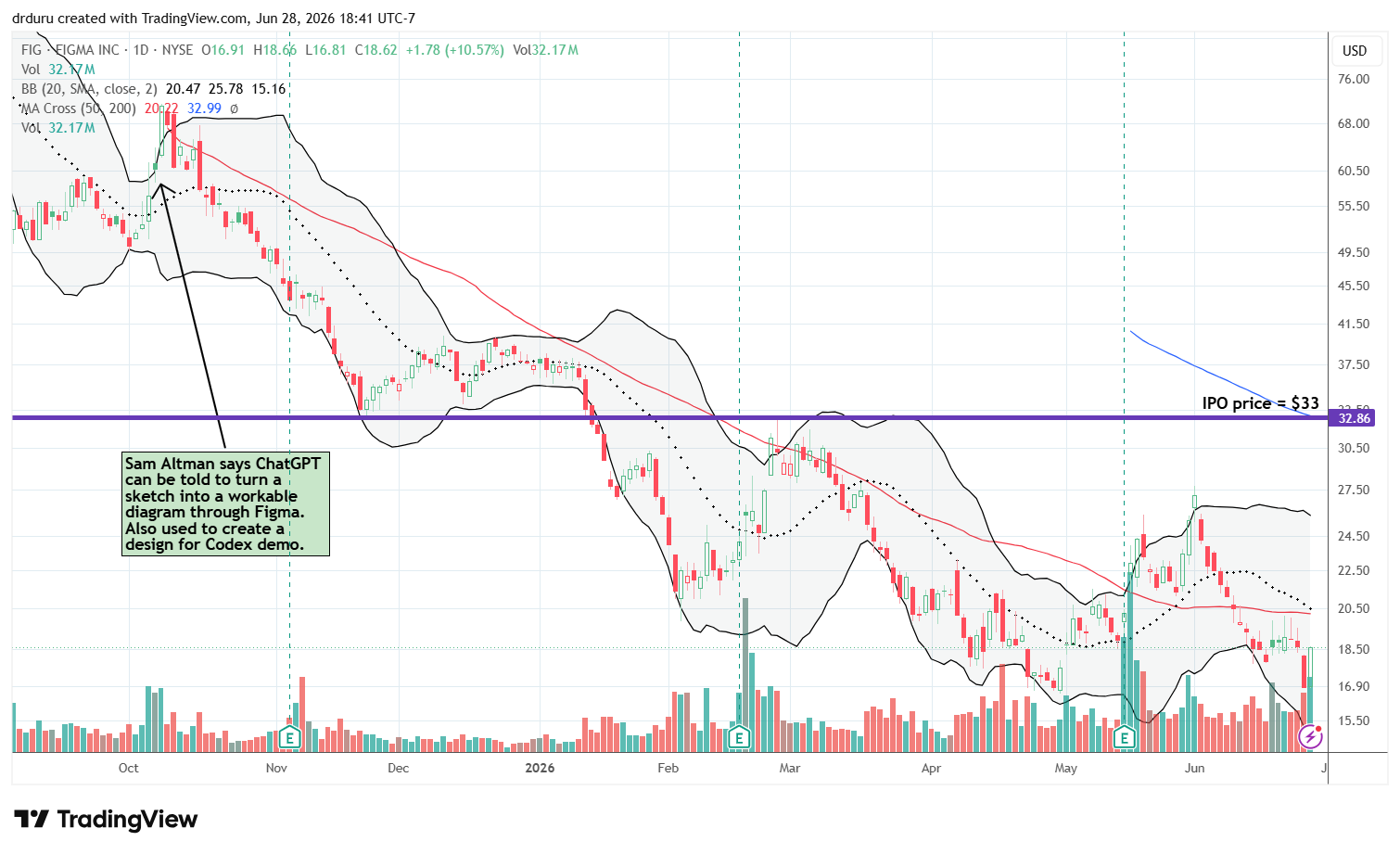
Technical status: Figma (FIG) resumed its persistent decline following its post-earnings breakout and tested all-time lows before a 10.6% rebound.
Trade commentary: I was hopeful the earnings breakout would mark the beginning of a sustainable reversal for FIG, but the June software selloff overwhelmed the resumed buying interest. I own FIG and have partially offset the decline by selling covered calls. Even so, the pain of the fresh technical breakdown is significant. FIG is a classic example of the lasting damage a stock can suffer once it trades below its IPO price. FIG held $33 as support in November, broke down in January, failed at $33 resistance in March and has not been the same since.
Hormel Foods (HRL)
Description: Hormel Foods manufactures and markets branded food products across retail, foodservice, and international markets.
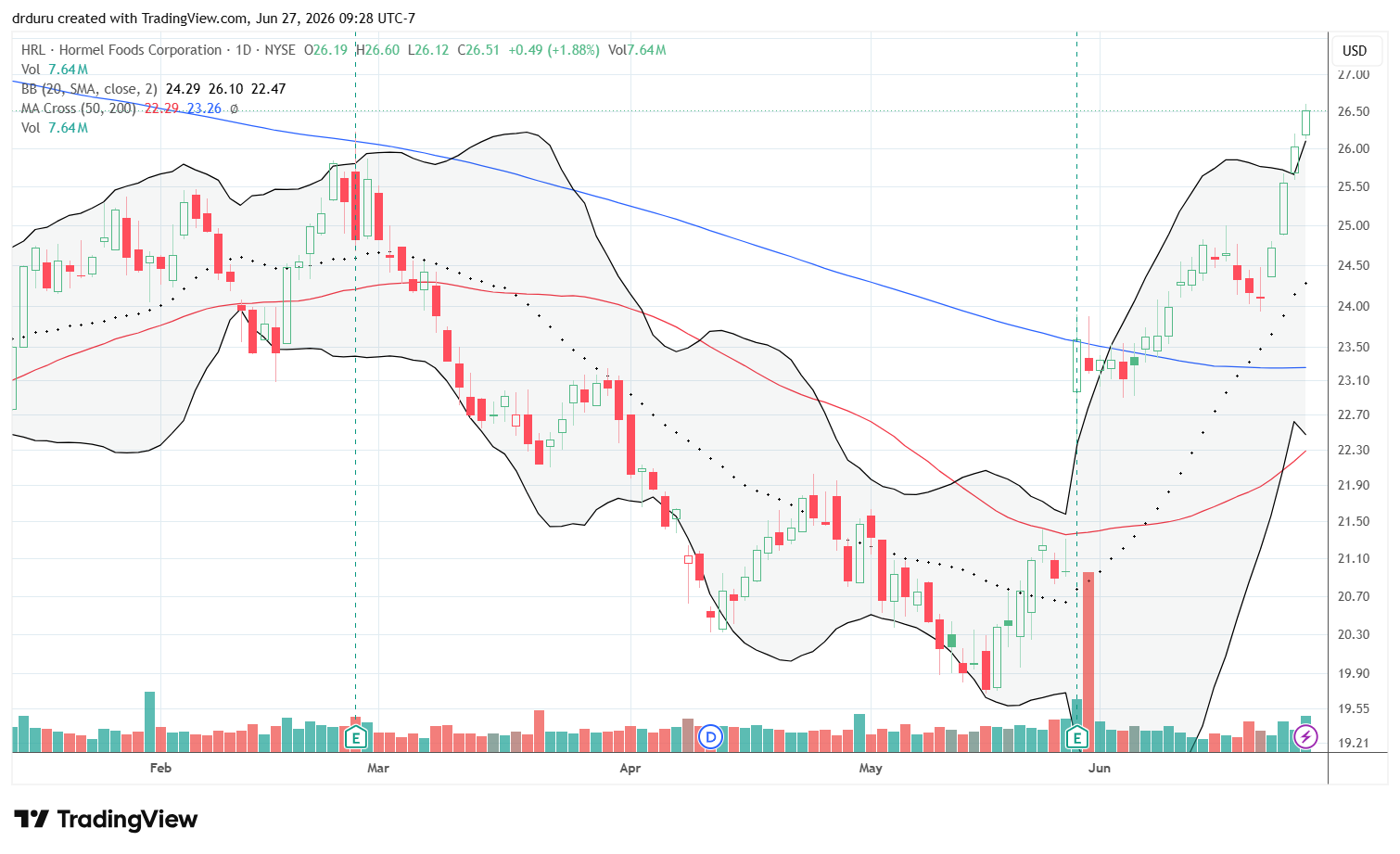
Technical status: Hormel Foods (HRL) produced a powerful breakout during a June rally and after a prolonged multi-year downtrend.
Trade commentary: HRL has not likely entered a brand-new bull market, but I like what this move says about the ongoing rotation into consumer-facing defensive stocks like consumer staples. Sticky inflation continues to support my decision to own consumer staples, and the attractive dividend makes the position even easier to hold.
Red Robin Gourmet Burgers (RRGB)
Description: Red Robin Gourmet Burgers operates a chain of casual dining restaurants specializing in gourmet burgers and related menu offerings.
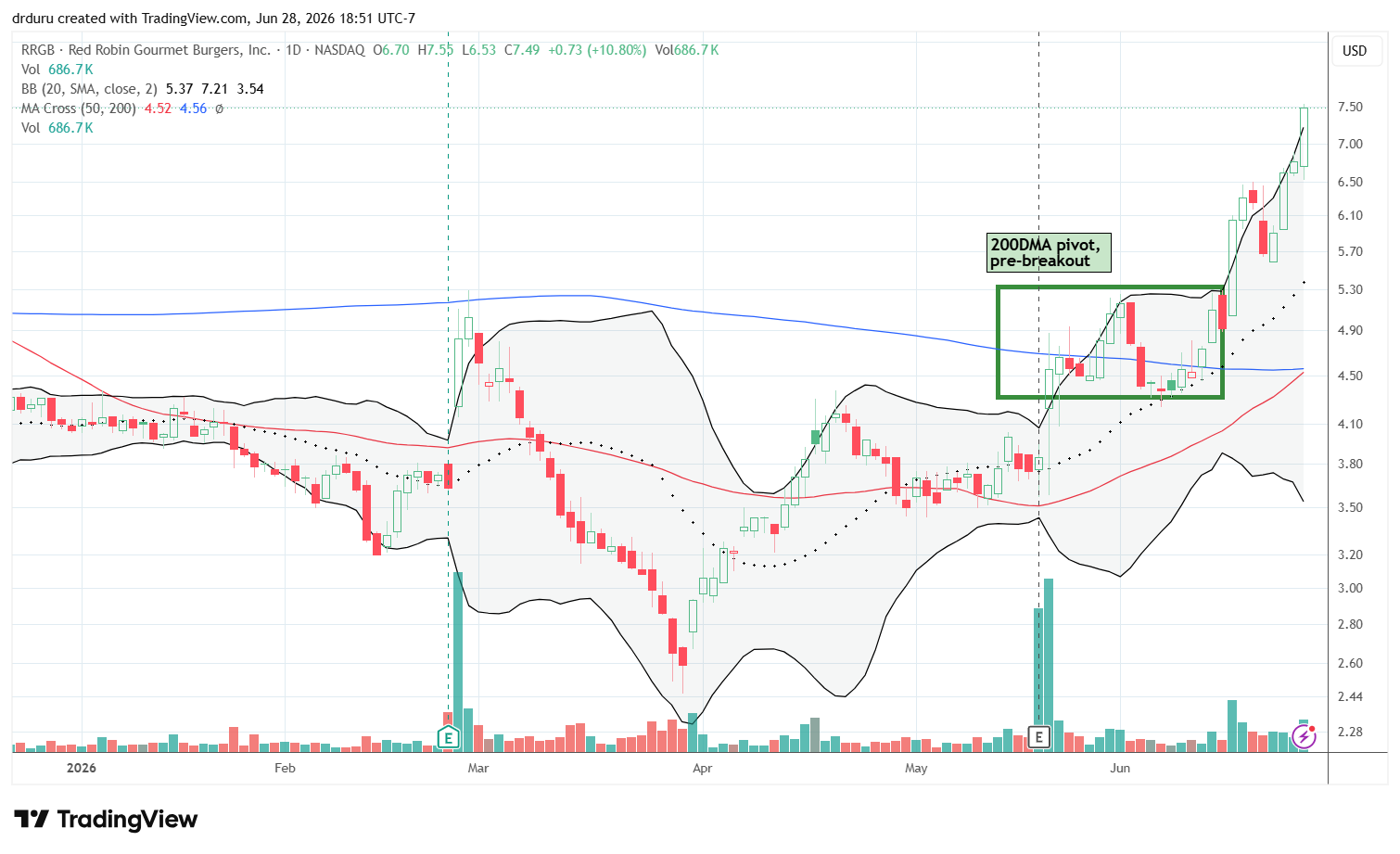
Technical status: Red Robin Gourmet Burgers (RRGB) continued its advance with a fresh surge taking the stock to a 2 1/2 year high.
Trade commentary: My decision to continue holding RRGB was further validated by another strong week. A 19.7% gain for the week was capped by a 10.8% gain on Friday. I am still holding as the overall bullish thesis remains well intact.
iShares U.S. Home Construction ETF (ITB)
Description: The iShares U.S. Home Construction ETF provides exposure to U.S. homebuilders and related housing companies.
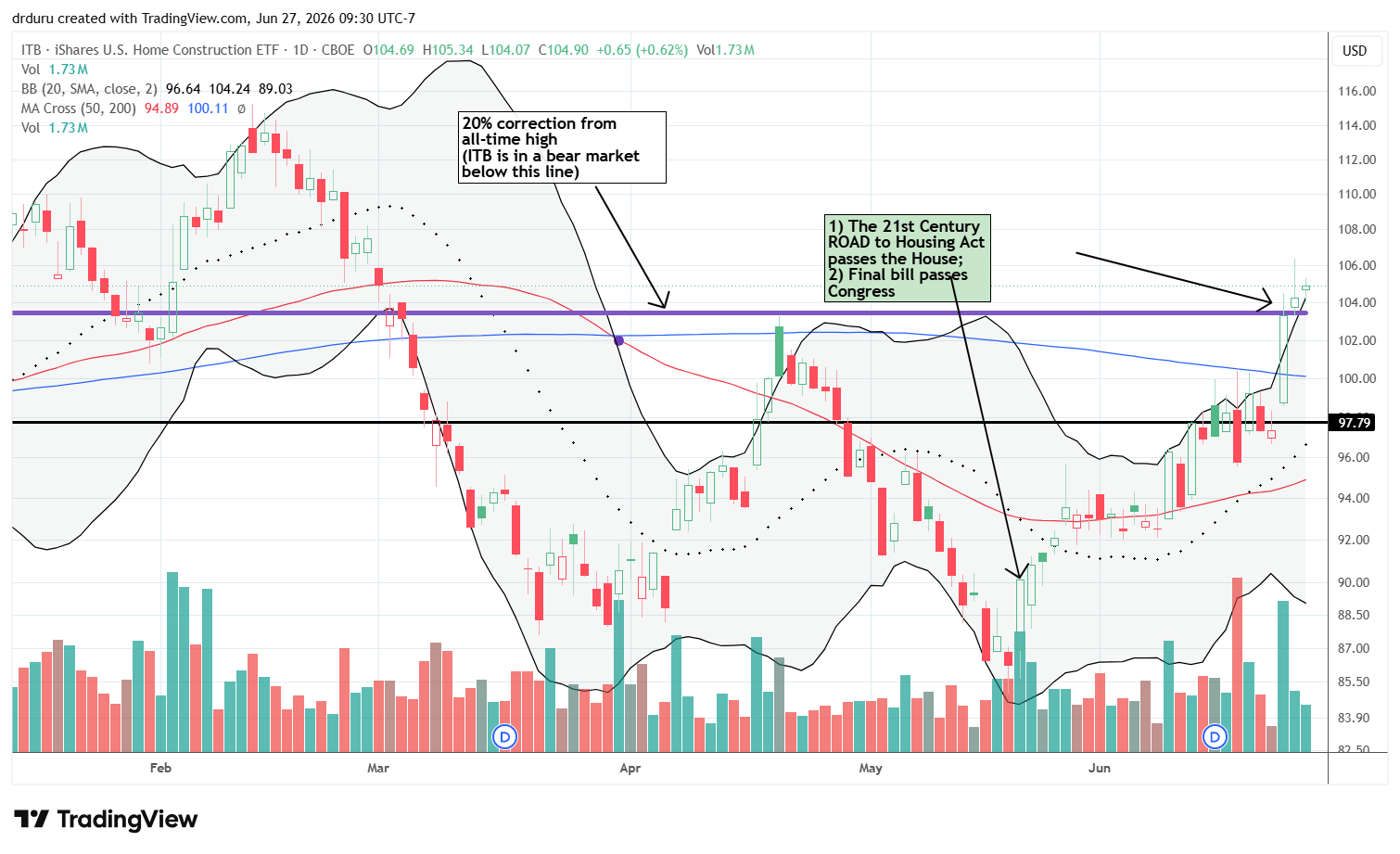
Technical status: The iShares U.S. Home Construction ETF (ITB) finally broke out of its bear market despite continuing weakness in housing fundamentals thanks to the passage of supportive legislation.
Trade commentary: I recognize ITB’s latest emergence from its long-standing bear market could easily fail because housing data remain weak, but I still view the technical improvement as constructive. Recent developments in housing have already caused me to make strategic portfolio adjustments that I will discuss further in a future post.
Shoulder Innovations (SI)
Description: Shoulder Innovations develops shoulder replacement systems and related orthopedic medical technologies.
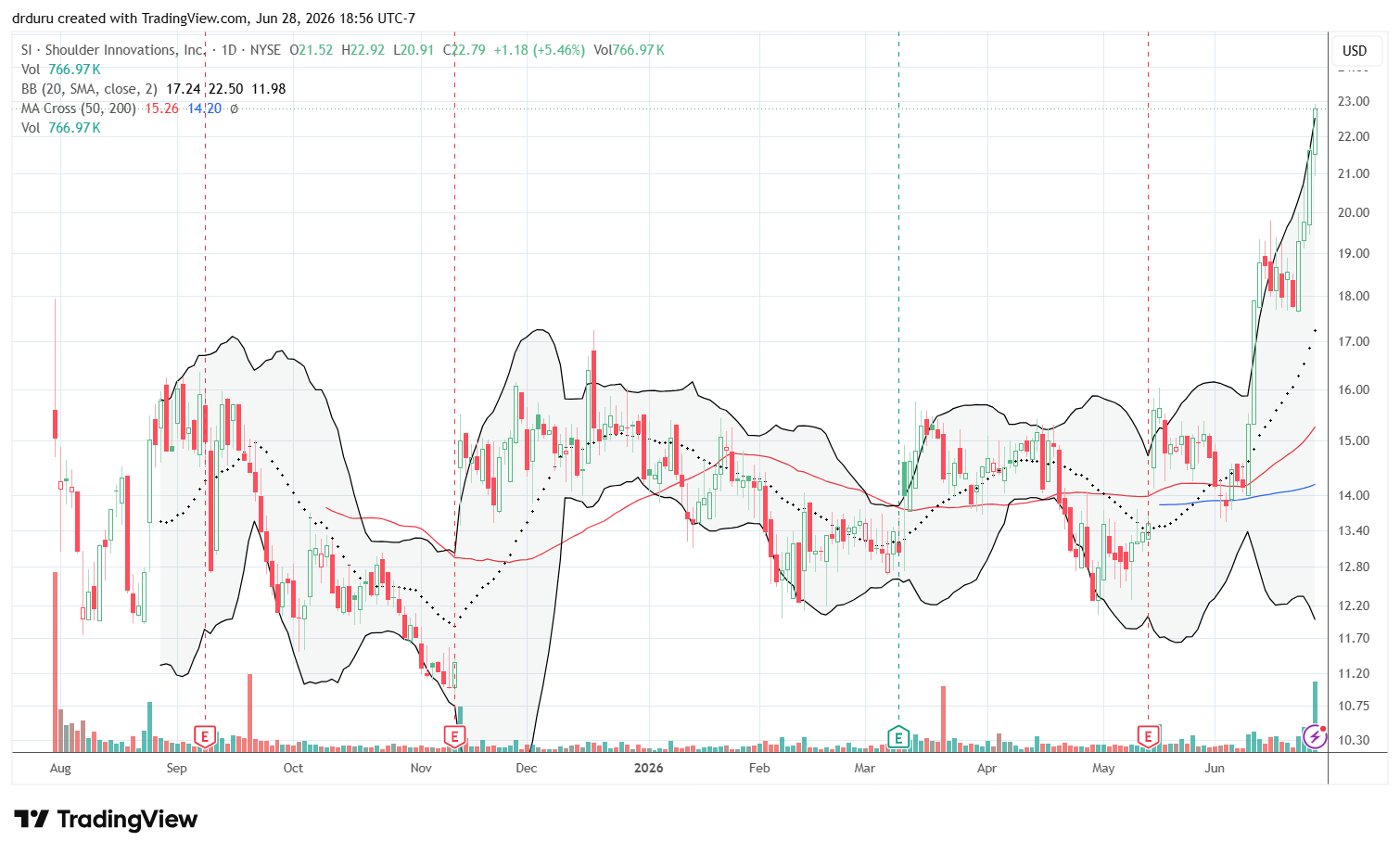
Technical status: Shoulder Innovations (SI) broke out to new all-time highs while strong buying volume continued confirming the uptrend.
Trade commentary: The breakout in recent IPO Shoulder Innovations (SI) reminded me of the importance of price alerts. After SI hurdled its intraday all-time high set on its first day of trading, I put the stock on my shopping list. I watched as the stock slowly chopped lower, waiting to see whether a buying opportunity would emerge from a successful test of uptrending 20DMA support. However, an 8.6% surge ended the pullback, and I quickly jumped in to buy shares in case the stock was ready to surge again. This “no regrets” buy allowed me to participate in some gains even though risk management did not allow me to buy a full position.
Strategy, Inc (MSTR)
Description: Strategy, Inc is a business intelligence software company that also holds Bitcoin as its primary treasury reserve asset.
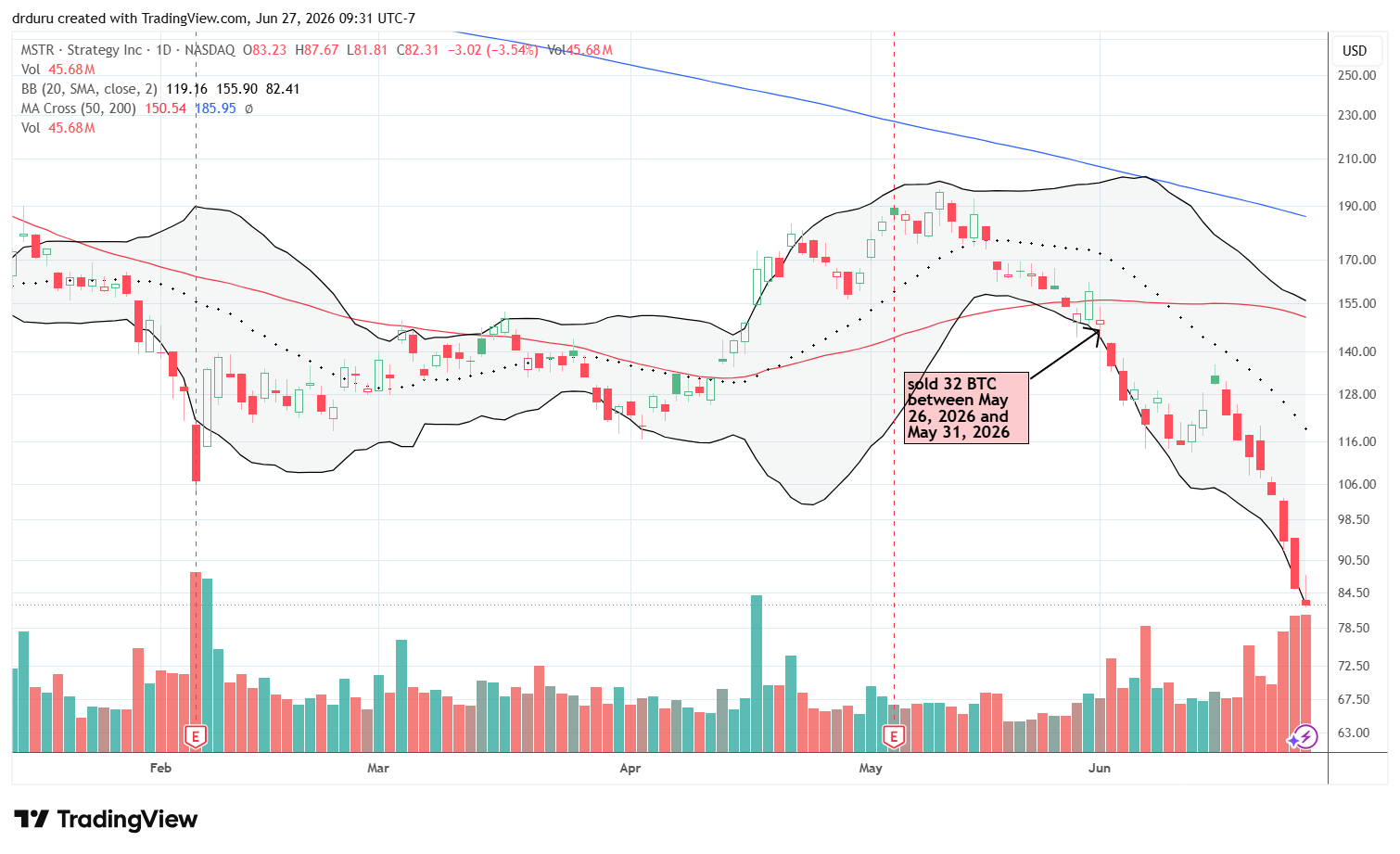
Technical status: Strategy, Inc (MSTR) remained in a persistent downtrend with accelerating downside volume and closed the week at a 2+ year low.
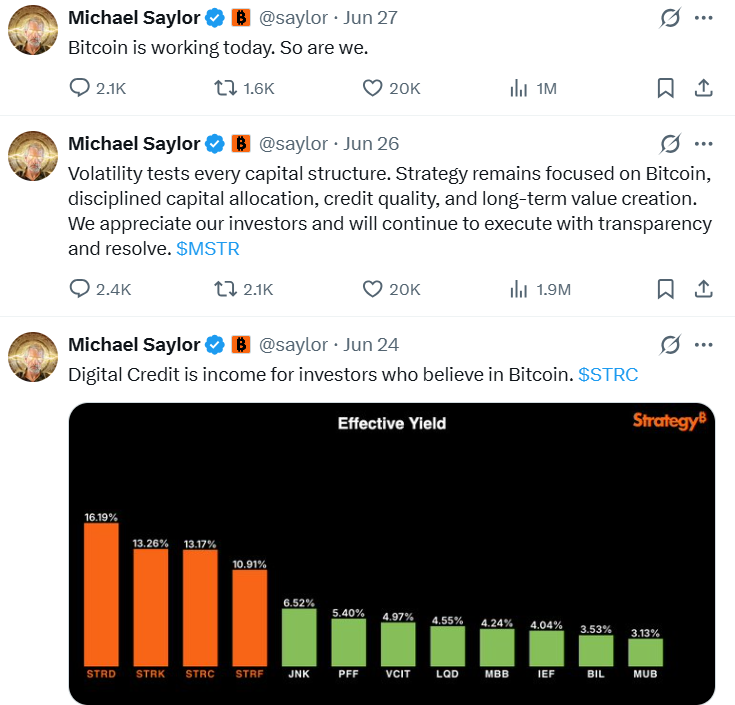
Trade commentary: The selling in MSTR has become so extreme that the stock is even falling more steeply than Bitcoin (BTC/USD). At this point, MSTR has almost fully reversed its gains since an early 2024 run-up shortly after the SEC approved Bitcoin ETFs while Bitcoin would still need to lose another 30% to complete a roundtrip. Just since its last peak, MSTR has lost 58% in value. You would never know anything is wrong with MSTR scanning through Michael Saylor’s tweets during this time. I am now wondering whether the market is anticipating some imminent calamity in MSTR. I will keep trading hedged plays from here.
Bitcoin (BTC/USD)
Description: Bitcoin is a decentralized digital asset that operates on a blockchain network without a central authority.
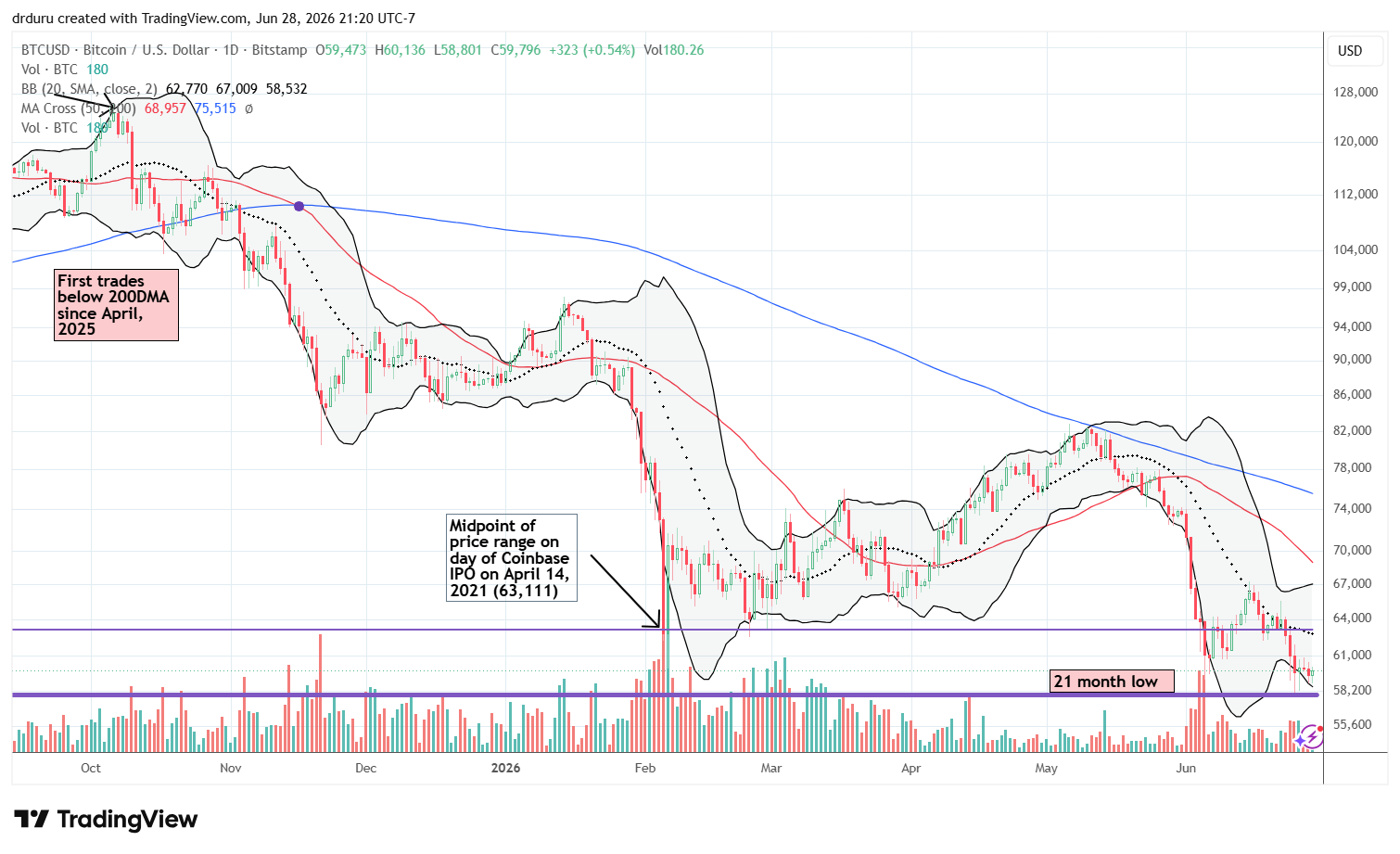
Technical status: Bitcoin (BTC/USD) continued holding important technical support despite repeated tests from sellers.
Trade commentary: Bitcoin’s technicals say everything that needs to be said about the flailing cryptocurrency (and all its peers). The true believers like Saylor keep talking like nothing has really changed and explanations about Bitcoin’s extended downfall rarely acknowledge that the price acts like it is simply controlled by belief and unbelief. Right now, unbelief rules and a liquidation cycle is reaching a year in length.
I continue to hold a small amount of Bitcoin (and other crypto) “just in case” this thing becomes even half of what the proponents dream it to be. However, I see every reason to believe and accept that the technology could finally find broader use and appeal without the price appreciation accompanying the adoption.In the meantime, I have all but stopped trading crypto because the rebounds here offer little upside and the downside risks remain large.
Footnotes
Subscribe for free to get email notifications of future posts!
“Above the 50” (AT50) uses the percentage of stocks trading above their respective 50-day moving averages (DMAs) to measure breadth in the stock market. Breadth defines the distribution of participation in a rally or sell-off. As a result, AT50 identifies extremes in market sentiment that are likely to reverse. Above the 50 is my alternative name for “MMFI” which is a symbol TradingView.com and other chart vendors use for this breadth indicator. Learn more about AT50 on my Market Breadth Resource Page. AT200, or MMTH, measures the percentage of stocks trading above their respective 200DMAs.
Active AT50 (MMFI) periods: Day #233 over 20%, Day #60 over 30%, Day #56 over 40%, Day #11 over 50% (overperiod), Day #33 under 60%, Day #206 under 75%
Source for charts unless otherwise noted: TradingView.com
Full disclosure: long NVDA call spread, long MSFT, long FIG, long HRL, long RRGB, long ITB and short a call, long SI, long a call and put on MSTR, long BTCUSD and IBIT
FOLLOW Dr. Duru’s commentary on financial markets via StockTwits, BlueSky, and even Instagram!
*Charting notes: Stock prices are not adjusted for dividends. Candlestick charts use hollow bodies: open candles indicate a close higher than the open, filled candles indicate an open higher than the close.
* Blog notes: this blog was partially written based on the heavily edited transcript of the following video that includes a live review of the stock charts featured in this post. I used ChatGPT to process the transcript.