

The Market Breadth Summary
- Bears managed to seize the market narrative as a strong jobs report triggered a broad selloff and reinforced expectations for higher interest rates.
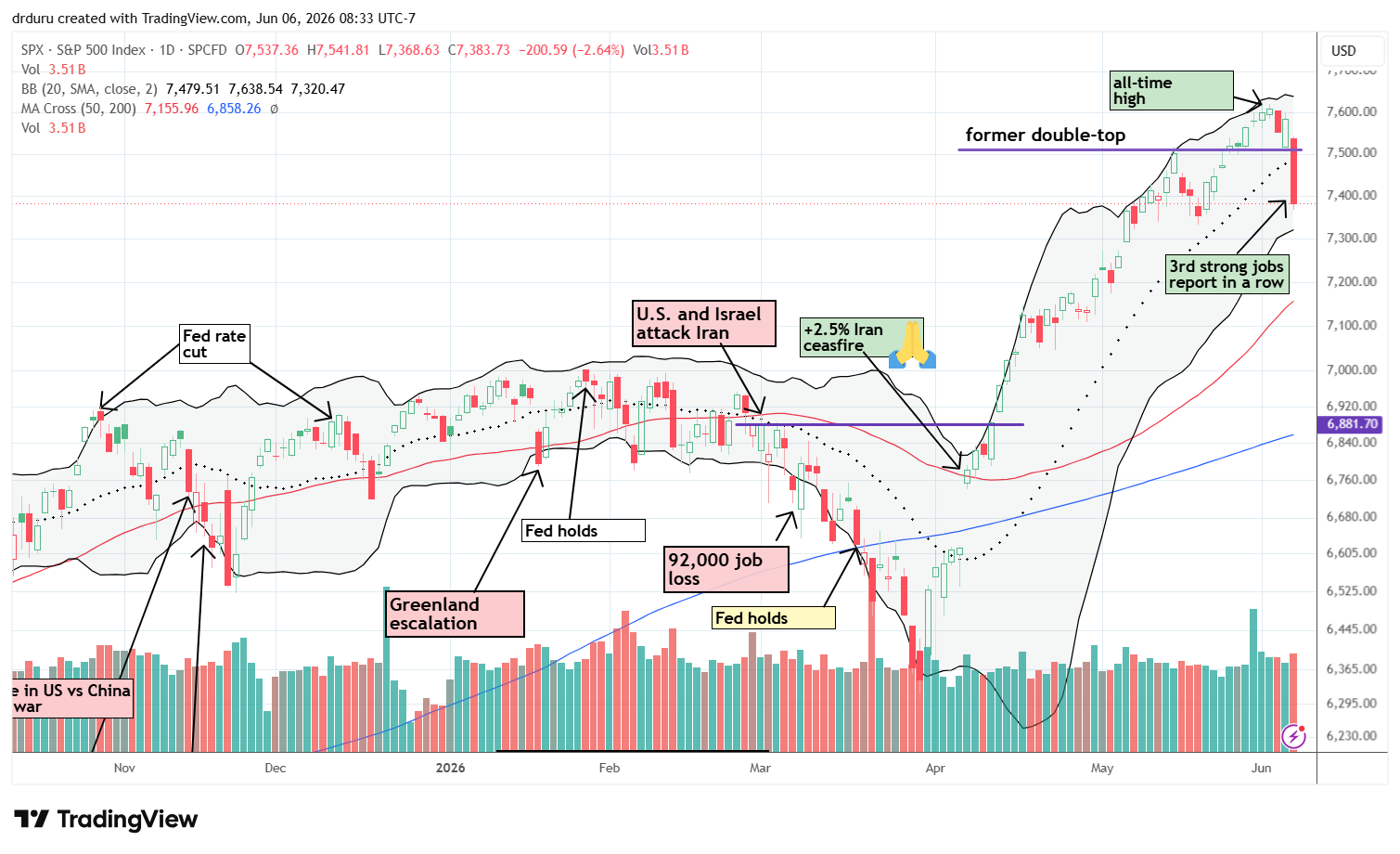
- The S&P 500 broke below a former double-top breakout level and its 20-day moving average, increasing the likelihood of a consolidation phase.
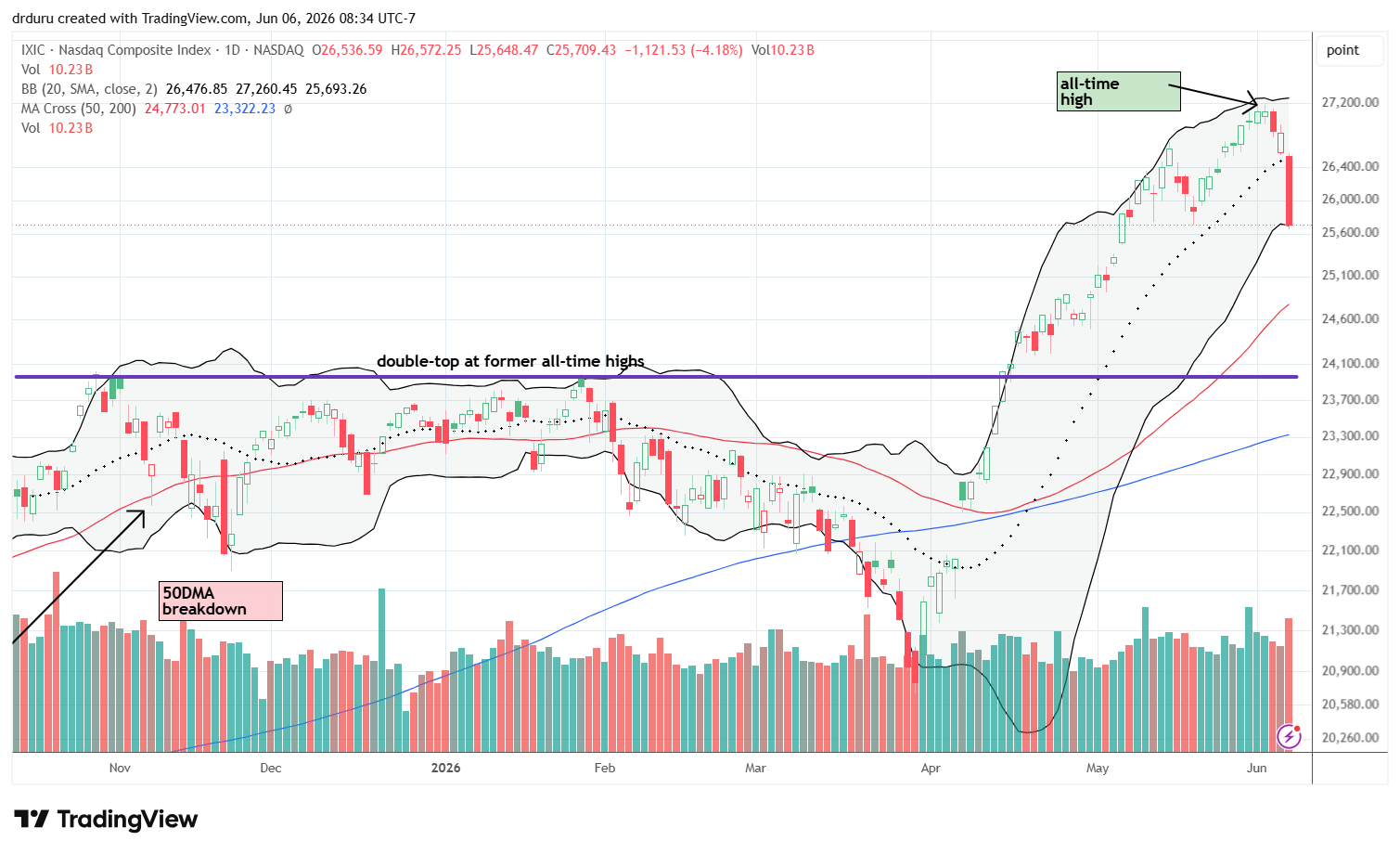
- The NASDAQ suffered a sharp decline, lost 20DMA support, and now faces an elevated risk of testing 50DMA support.
- Market breadth remained weak as AT50 stayed below 50%. Yet, positive divergence in AT200 and S&P 500 long-term breadth measures suggested underlying participation remained stronger than headline index performance implied.
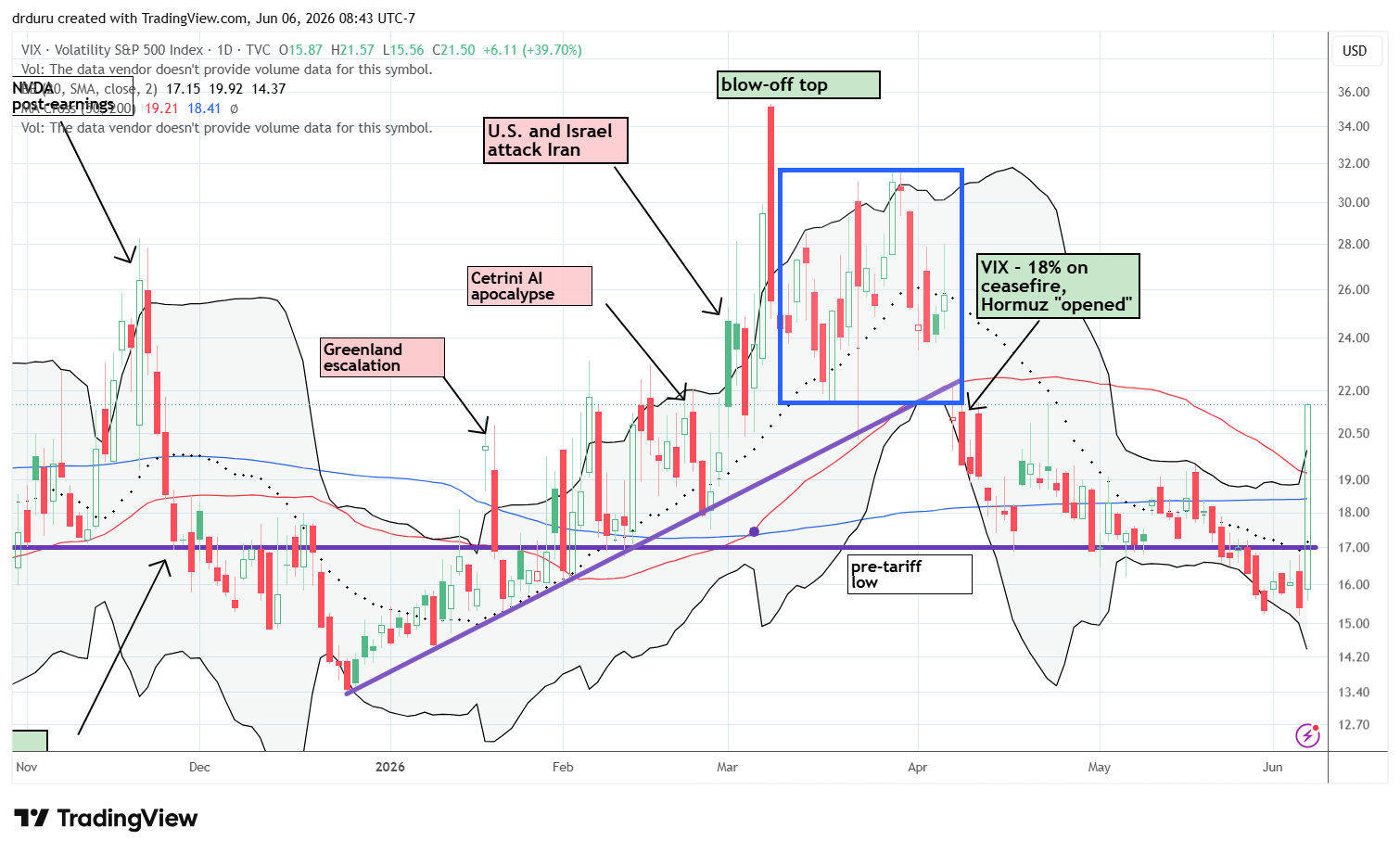
- The volatility index surged nearly 40%, confirming that bears had temporarily managed to seize control of sentiment and short-term price action.
The Stock Market Indices
Well, it had to happen. I did not know when, how, or just how bad it would be, but at some point the stock market had to cool off. This past week delivered a cooling of all coolings as bears decided to seize the narrative back from the bulls.
Friday (June 5, 2026) brought a broad selloff across the market, but the damage was particularly severe among the high-flyers and speculative names that had dominated trading for more than two months. The immediate catalyst was an extremely strong jobs report, a third strong report in a row. The hiring recession appears to have ended as job creation remains robust. That news supports the narrative of a resilient American economy, but Wall Street lamented the implication for a Fed rate hike sooner than later. The rate dynamics represent a stunning turnaround from the beginning of the year when the market expected 3 rate cuts. The stock market is doing quite well to be as high as it is with such a dramatic change in rate expectations.
For now, bears have managed to seize short-term control of sentiment, but the broader trend has not yet surrendered. In the meantime, I expect the recent highs to hold for a while, especially given the Iran war continues to drag on with no real resolution. A buffer of inventories and a plunge in Chinese oil demand have prevented extensive damage to the global economy, but time is close to running out.
S&P 500 (SPY)
The S&P 500 completed a remarkable nine-week rally before finally breaking down last week. The index had gained 10.4% for the month of April and another 5.2% in May, an extraordinary advance considering the backdrop of persistent inflation and fading expectations for rate cuts while little to no progress was made during the ceasefire in the Iran war.
Friday’s 2.6% decline erased a significant portion of May’s gains and pushed the index back below a former double-top. That development is bearish, especially accompanied by a 20DMA breakdown. If the market rebounds quickly, I will be watching whether that former breakout level acts as resistance. I suspect much of the market’s buying power and enthusiasm has been largely exhausted with much of the remainder saved for this coming week’s IPO for SpaceX. Thus, the S&P 500 is set up for price consolidation at best.
NASDAQ (COMPQ)
The NASDAQ looks even more toppy than the S&P 500. On Friday, the index plunged 4.2% and cleanly broke below its uptrending 20DMA support. The decline erased a large portion of the gains accumulated during May with the tech-laden index closing below the low of the last pullback that essentially and successfully tested 20DMA support. The NASDAQ gained an astonishing 8.4% in May and 15.3% in April.
With such aggressive selling pressure, I believe the NASDAQ has a realistic chance of testing its 50DMA before a meaningful rebound occurs. That move would effectively erase the entire May rally. The “sell in May and go away adage” has failed spectacularly for so many years, it has become non-functional. Given the strength of the recent price action, I would find a working “sell in May” season particularly ironic. Regardless, the overall history suggests that summer sell-offs are buying opportunities at least for swing trades.
iShares Russell 2000 ETF (IWM)
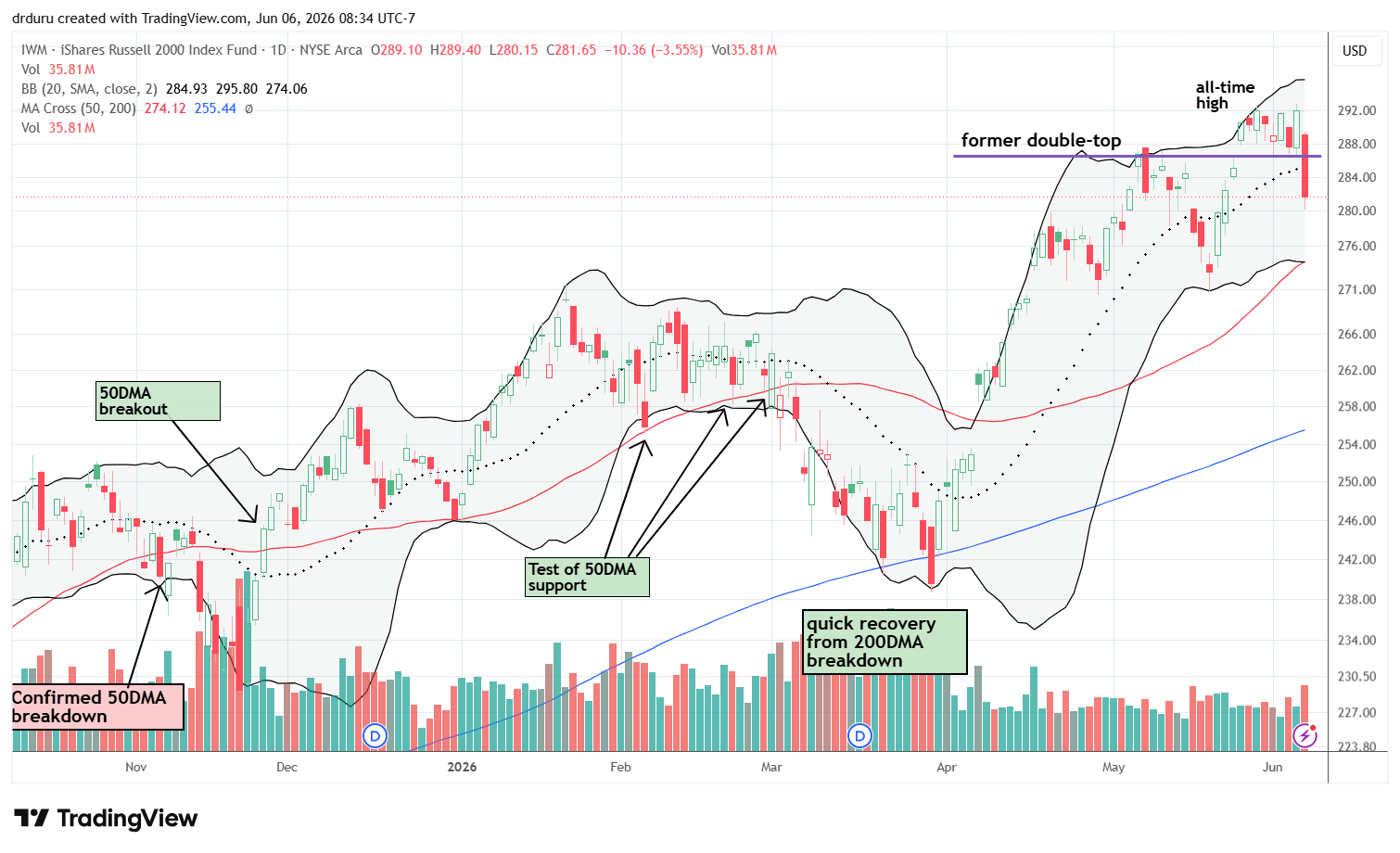
IWM also slipped back below its former double-top breakout level. That move places small caps back in bearish territory with the revival of a toppy technical setup. A drift toward 50DMA support would be a natural next step given this technical breakdown. Thus, I am putting on hold further call option trades until IWM has successfully tested this support level. I am not anticipating a new breakout anytime soon.
The Short-Term Trading Call As Bears Seize the Narrative
- AT50 (MMFI) = 49.7% of stocks are trading above their respective 50-day moving averages
- AT200 (MMTH) = 52.5% of stocks are trading above their respective 200-day moving averages
- Short-term Trading Call: neutral
AT50 (MMFI), the percentage of stocks trading above their respective 50DMAs, closed the week at 49.7%. For two months, I have chronicled an ongoing deterioration and bearishness in market breadth, so I am not surprised about a significant pullback at any given SPAN of time. I AM taken aback by so much selling in one day, especially in the wake of good economic news. The one small saving grace from Friday’s carnage is AT50’s ability to close the week right at the low set two days prior. I would have expected AT50 to be MUCH lower! AT50 also stopped short of the closing low for this cycle set on May 19, a time when I turned bearish for a brief period.
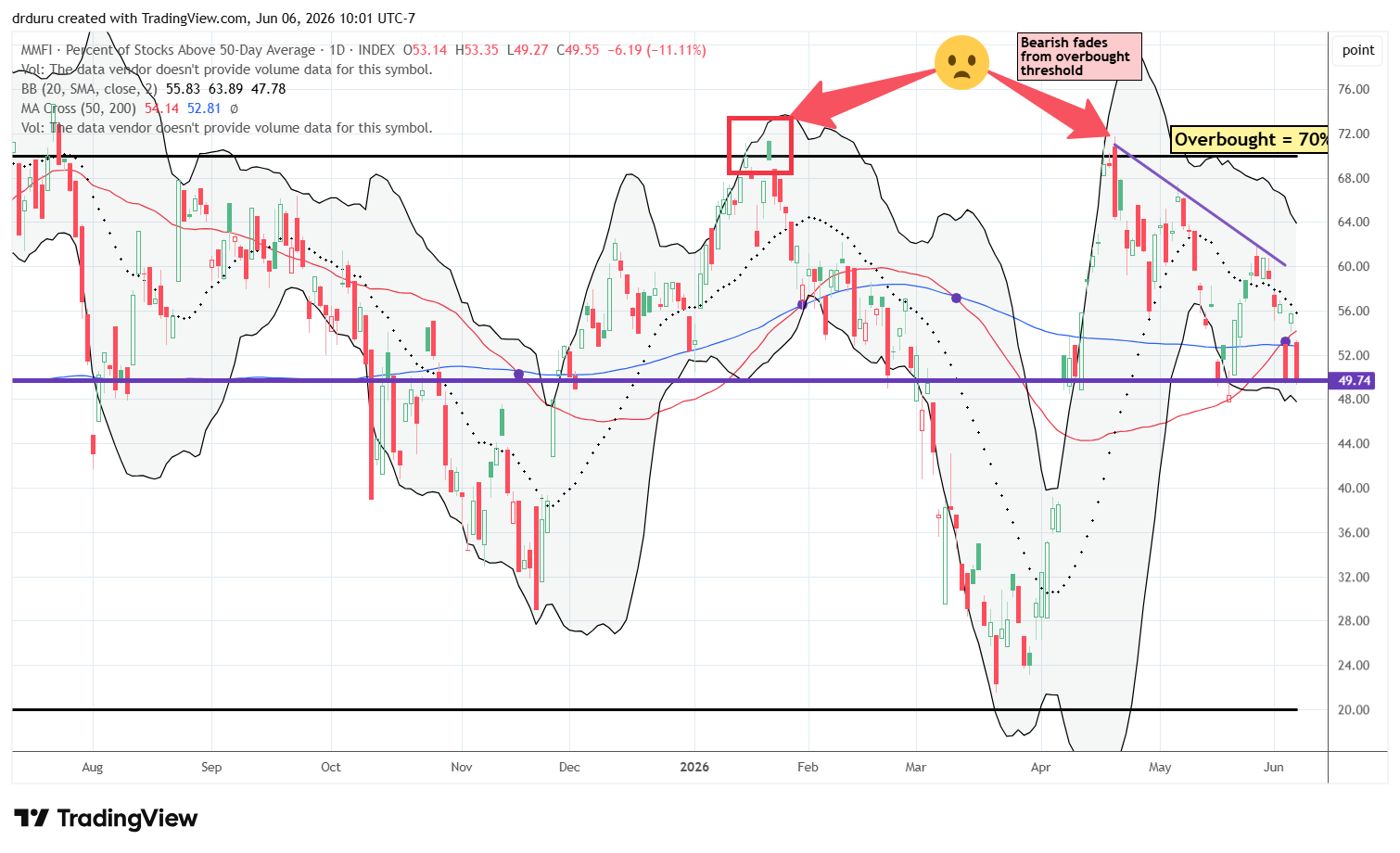
Interestingly, AT200 did not even make a new weekly low and thus stopped far short of testing its low for this cycle. This positive divergence suggests underlying participation remains slightly stronger than index performance implies. In other words, the underlying weakness in the market is “rotating” from the stocks already beaten up going into this week to previously hot stocks, a kind of source of funds trade.
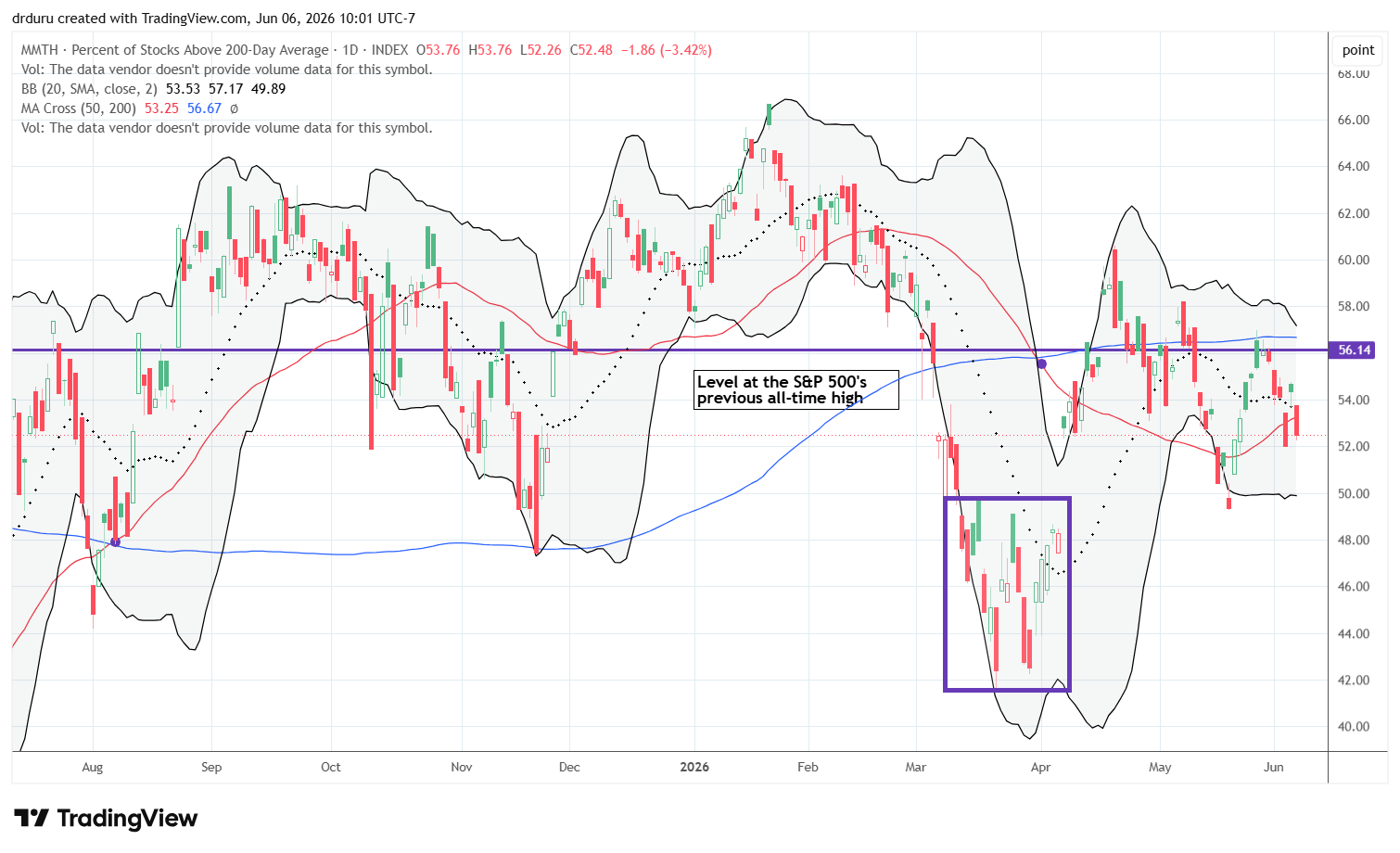
In the previous Market Breadth, I pointed out how Yahoo Finance noted that only 60% of S&P 500 stocks were trading above their 200DMAs while, typically, this measure of market breadth is at 73% with the S&P 500 at all-time highs. The article did not provide historical context to understand the significance of this particular divergence. Perhaps last week’s sell-off provides some quantification to the importance of that divergence!
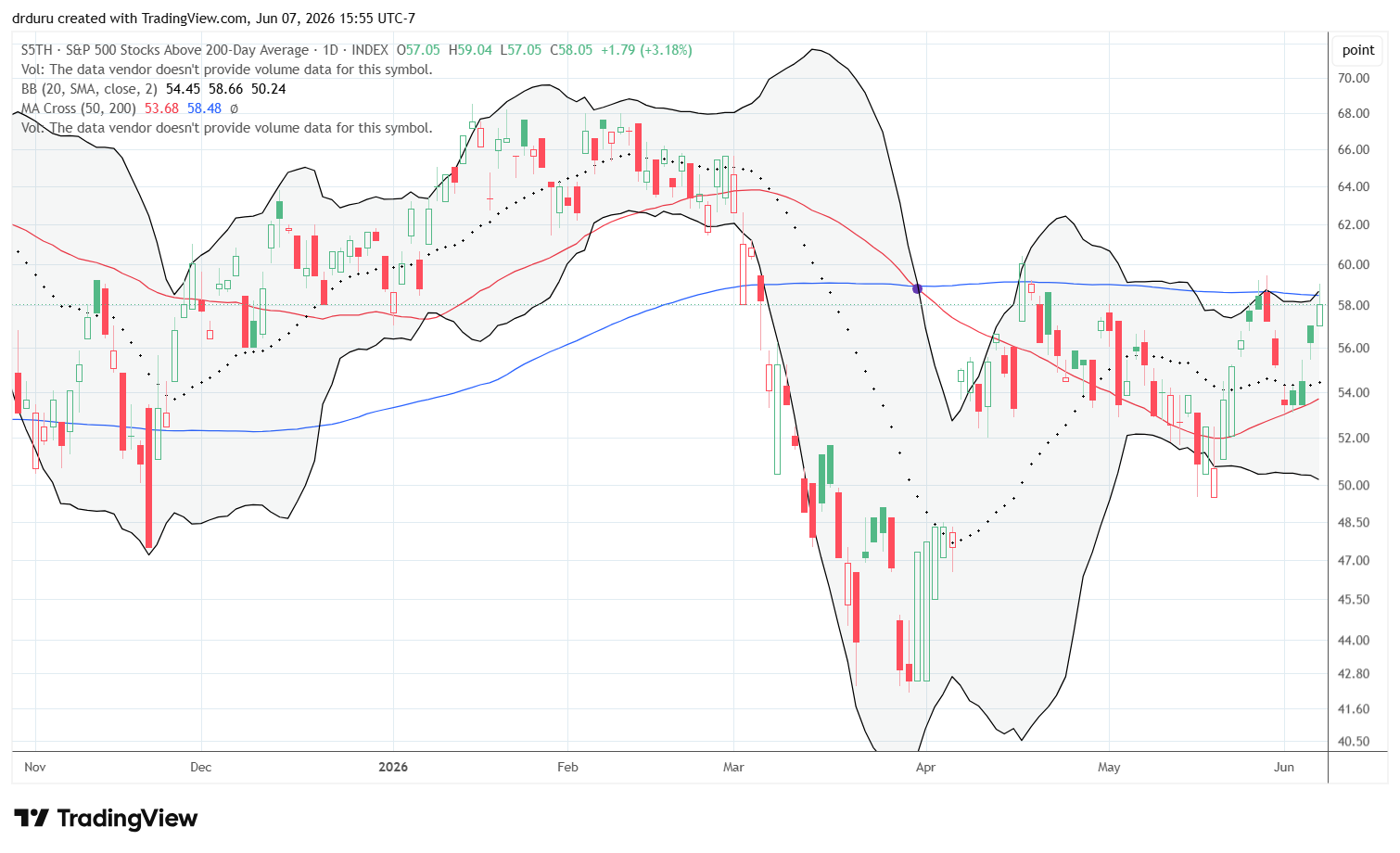
HOWEVER, the data from Tradingview.com tells a slightly different story and one of an even stronger positive divergence than AT200. The percentage of S&P 500 stocks trading above their 200DMAs (S5TH) INCREASED on Friday and is close to the cycle HIGH.
The volatility index (VIX) quickly flipped from confirming market bullishness to validating the new bearish narrative: the VIX surged 39.7% on Friday. However, the VIX is also overstretched to the upside and vulnerable to the volatility faders. Such a fade would likely help reverse losses in the Friday’s hardest hit stocks.
I already cleaned out many of my weaker positions during my previous bearish period, and I took some profits earlier in the week, so I did not feel compelled to sell anything into Friday’s decline. I am generally satisfied with the stocks that remain in my portfolio. If individual positions deteriorate enough to trigger bearish technical signals, I will exit them because I remain committed to technical discipline. For now, however, I do not see a need to begin widespread pruning.
In case you missed it…
These short videos feel a LOT different after Friday’s major sell-off. First Solar (FSLR) looked great one day and awful the next. International Business Machines (IBM) joined Microsoft (MSFT) in tech stock purgatory.
The Equities
SPDR Gold Shares (GLD)
Description: The investment objective of SPDR Gold Trust is for the shares to reflect the performance of the price of gold bullion, less the Trust’s expenses.
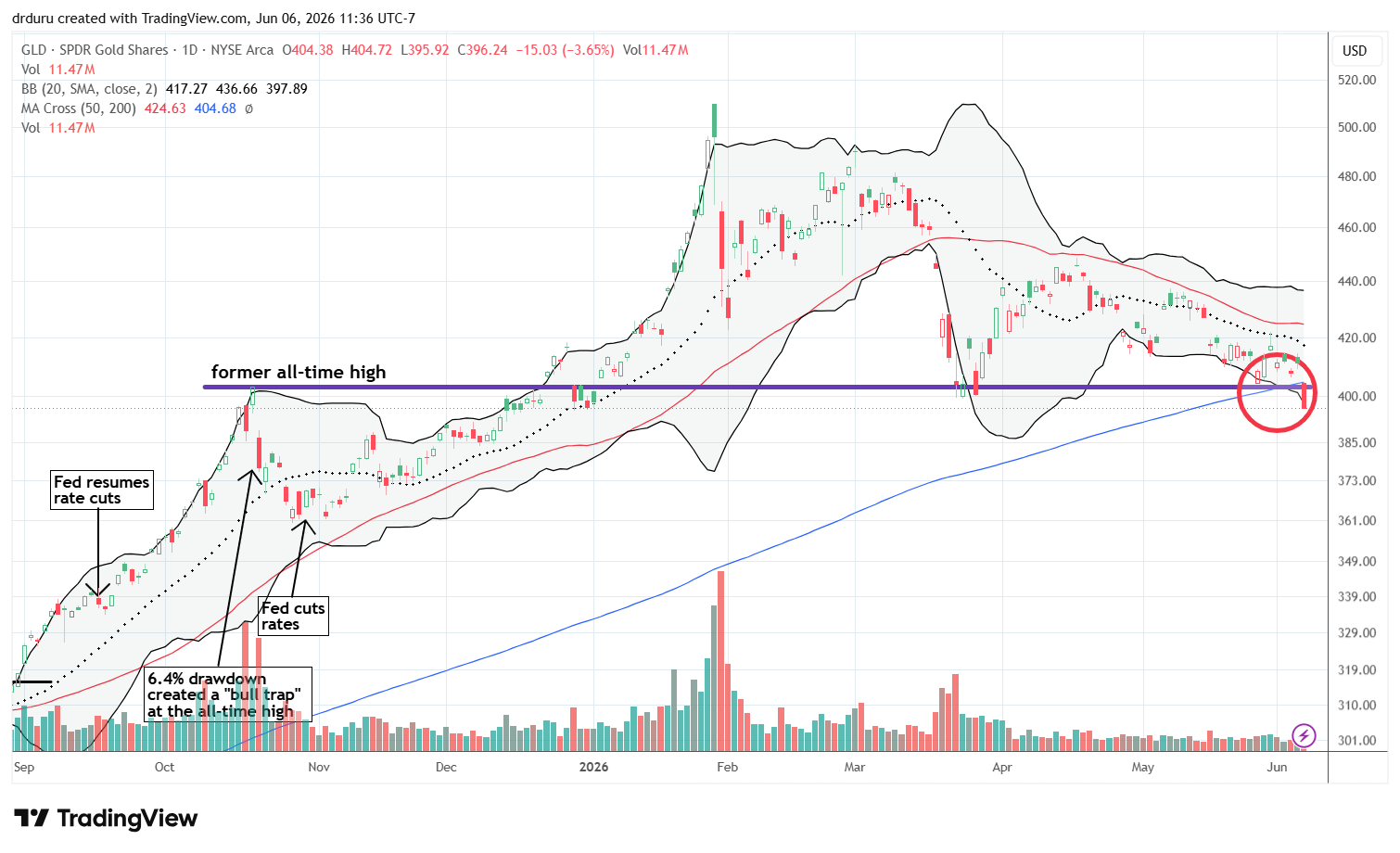
Technical status: The SPDR Gold Shares (GLD) is now in bearish territory after breaking down below converged support from its 200DMA and former all-time with a 3.7% loss.
Trade commentary: I am now officially hands off GLD. This bearish breakdown is a fresh confirmation of GLD’s blow-off top in January. I will return as an aggressive buyer on a 200dma breakout. (Note I am NOT selling my long-term position in RAXX which is heavily invested in physical gold).
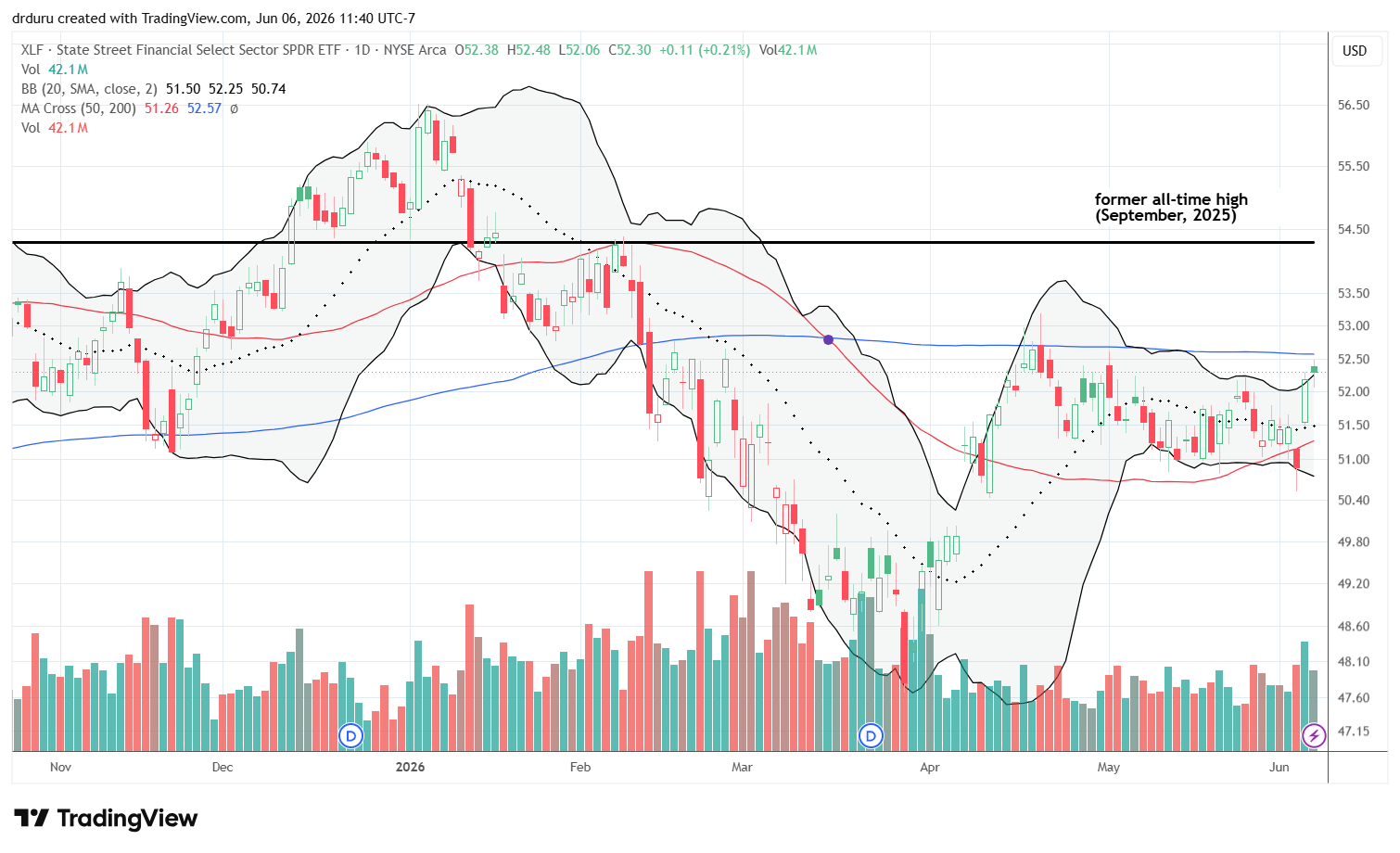
State Street Financial Select Sector SPDR ETF (XLF)
Description: State Street Financial Select Sector SPDR ETF is an exchange-traded fund that tracks large U.S. financial companies.
Technical status: SPDR Financial Select Sector ETF (XLF) rebounded strongly after a breakdown earlier in the week. XLF gained 2.6% on Thursday and managed another gain on Friday. The ETF remained trapped between 200DMA resistance and 50DMA support.
Trade commentary: I cannot call XLF’s outperformance a bullish signal, but it is “interesting.” Recall that I find it hard to be bullish on the stock market when financials are doing poorly, and XLF has been a significant underperformer since last topping out in April. I also find it hard to be bearish on the stock market when financials are doing well. Last week’s sharp divergence could be the beginning of financials making a move to drag the market back up…
VanEck Semiconductor ETF (SMH)
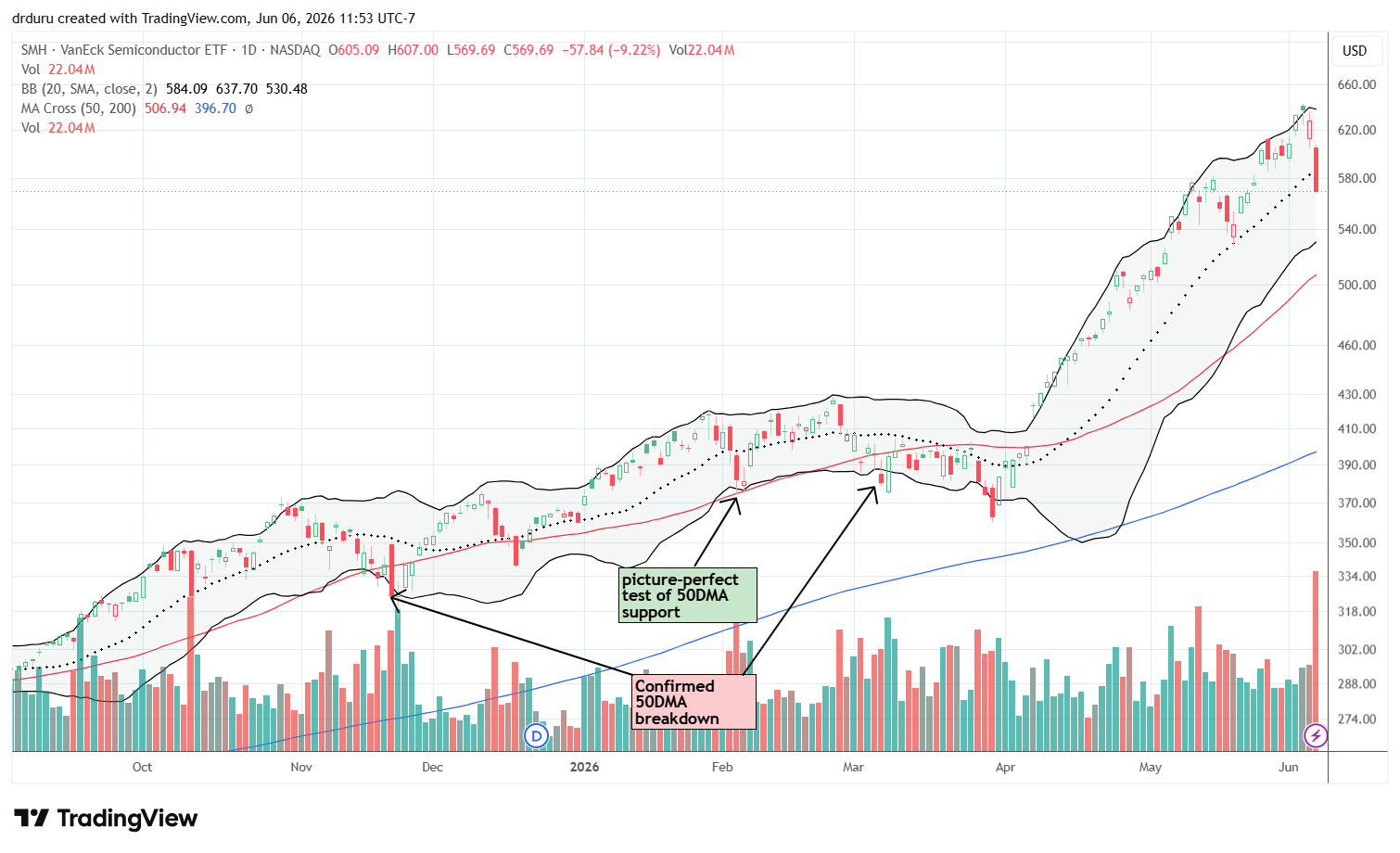
Description: The VanEck Semiconductor ETF seeks to track the performance of companies involved in semiconductor production and equipment manufacturing.
Technical status: VanEck Semiconductor ETF (SMH) plunged 9.2% and broke below its 20DMA uptrend. Still, SMH remains well above its last low which successfully tested 20DMA support.
Trade commentary: A 9.2% decline looks awful in isolation, but the broader SMH chart still shows considerable room before the long-term uptrend comes under serious threat. SMH still has plenty of room to drop before it tests the May low that itself was the first test of the 20DMA uptrend since the early April breakout. SMH is a classic case of what technicians call “steep and uncorrected.”
Broadcom Inc. (AVGO)
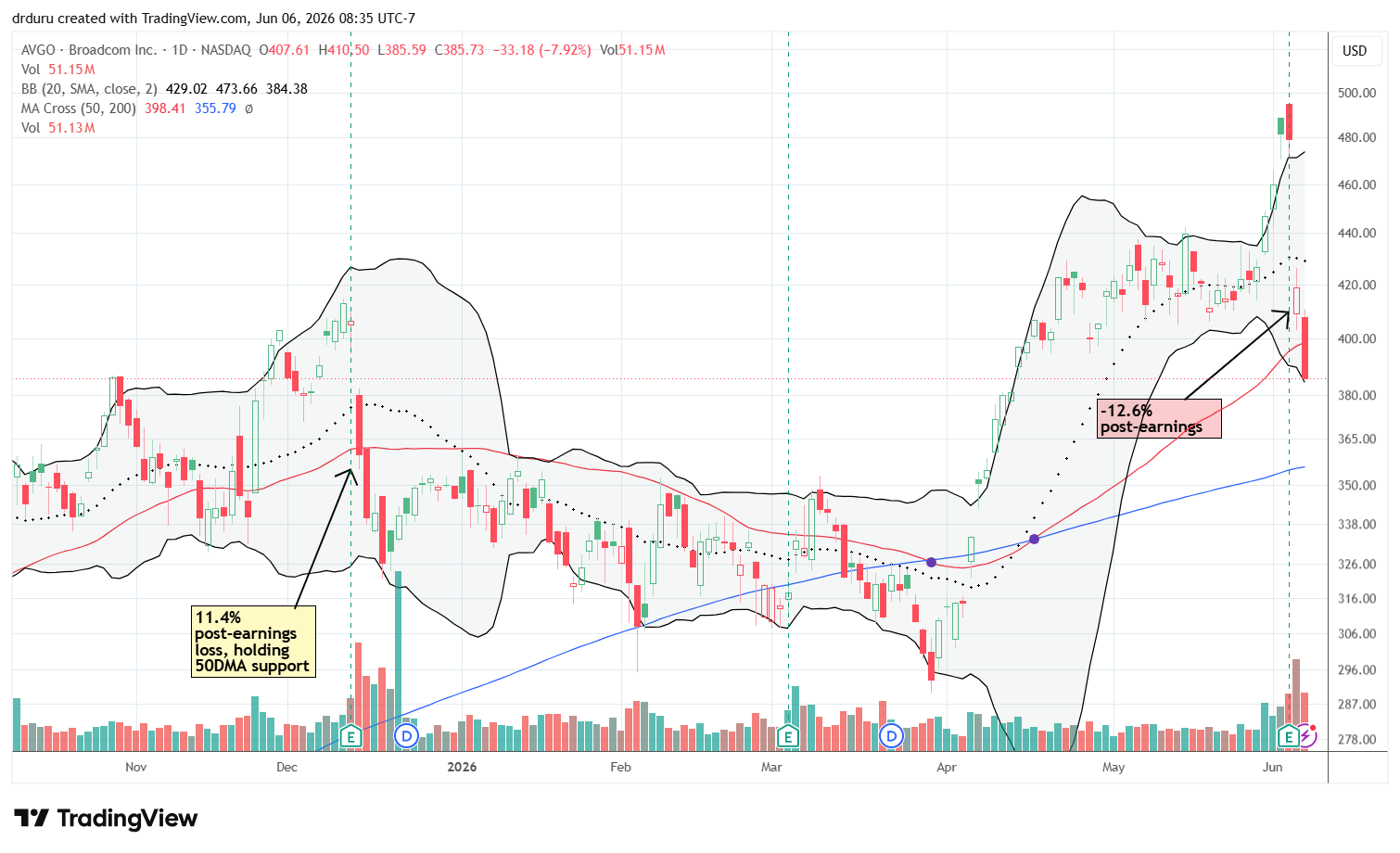
Description: Broadcom designs and supplies semiconductor and infrastructure software solutions for data centers, networking, broadband, wireless, and enterprise applications.
Technical status: Broadcom Inc. (AVGO) collapsed 12.6% post-earnings and fell below its 50DMA. The stock lost another 7.9% on Friday. The technical picture turned bearish.
Trade commentary: I do not think AVGO earnings themselves were terrible; the stock even got at least one upgrade in the wake of the 12.6% post-earnings collapse. The problem was overly aggressive expectations. AVGO had rallied aggressively before earnings and traded well above its upper Bollinger Band, always a huge warning sign. The stock is now in a “limbo” zone, neither a buy nor a sell. I will be watching for how the stock behaves at 50DMA resistance and/or 200DMA support. A bearish trader might short the stock here and put in a stop loss after a complete reversal of Friday’s 7.9% loss.
NVIDIA Corporation (NVDA)
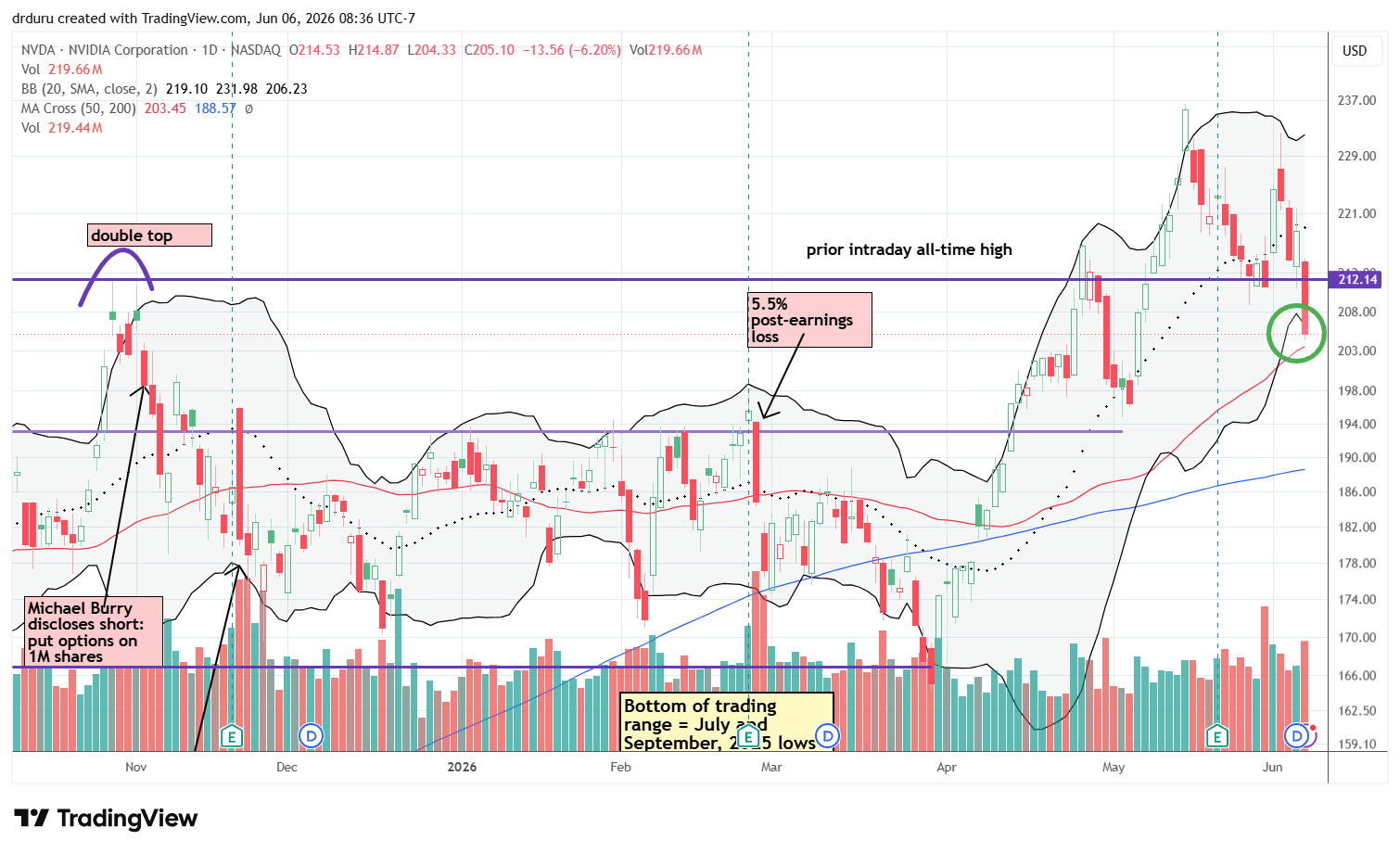
Description: NVIDIA develops graphics processing units, AI computing platforms, networking products, and software for data center, gaming, and professional markets.
Technical status: NVIDIA Corporation (NVDA) fell sharply. The stock cracked key support but remained above its 50DMA.
Trade commentary: I played NVDA from support (the purple horizontal line below) and held my call spread too long. Now I am closely watching 50DMA support. If NVDA bounces, the bullish trend survives. If it breaks below, the stock becomes a risk to drop to 200DMA support. Regardless, NVDA looks set for an extended period of rangebound trade given the fade short of the all-time high and a steep close below the double-top from last October.
Roundhill Memory ETF (DRAM)
Description: Roundhill Memory ETF provides exposure to companies involved in memory semiconductors and related technologies.
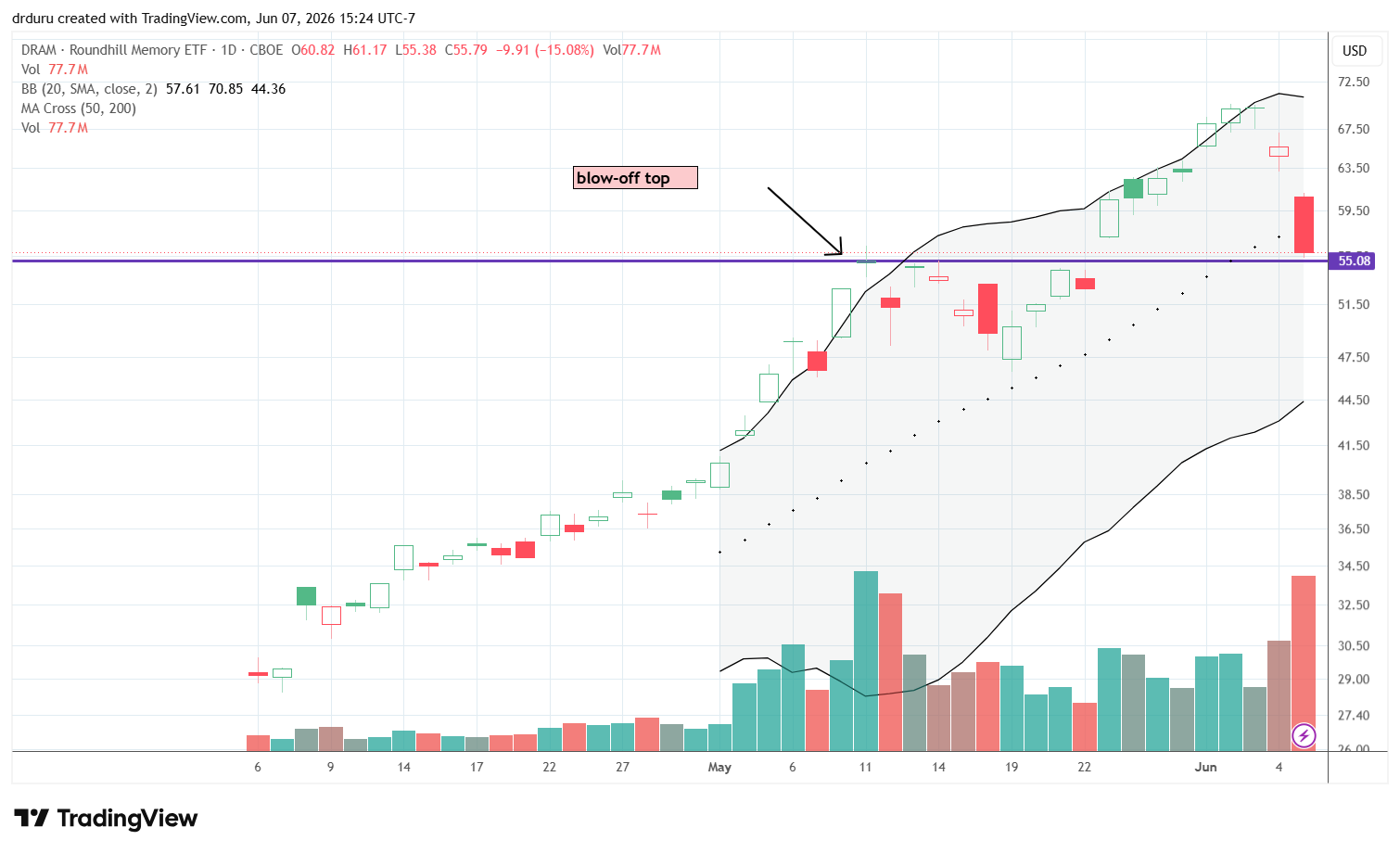
Technical status: The Roundhill Memory ETF (DRAM) plunged 15.1% to a two-week low that is challenging the former blow-off top as support.
Trade commentary: Incredibly, the Roundhill Memory ETF (DRAM) fell into a “bear market” in just two days of trading. Of course, this 20% loss from the all-time high is a drop in the buck for an ETF that is STILL up 91.3% from the day of its inception just two months ago. Thus, I am not thinking about conventional technical definitions and instead watching to see whether DRAM can hold presumed support from the line defining the former blow-off top. This line proved its importance when DRAM cleanly hurdled the line on May 26 with a 14.6% gain.
Micron Technology, Inc. (MU)
Description: Micron Technology designs and manufactures memory and storage semiconductor products.
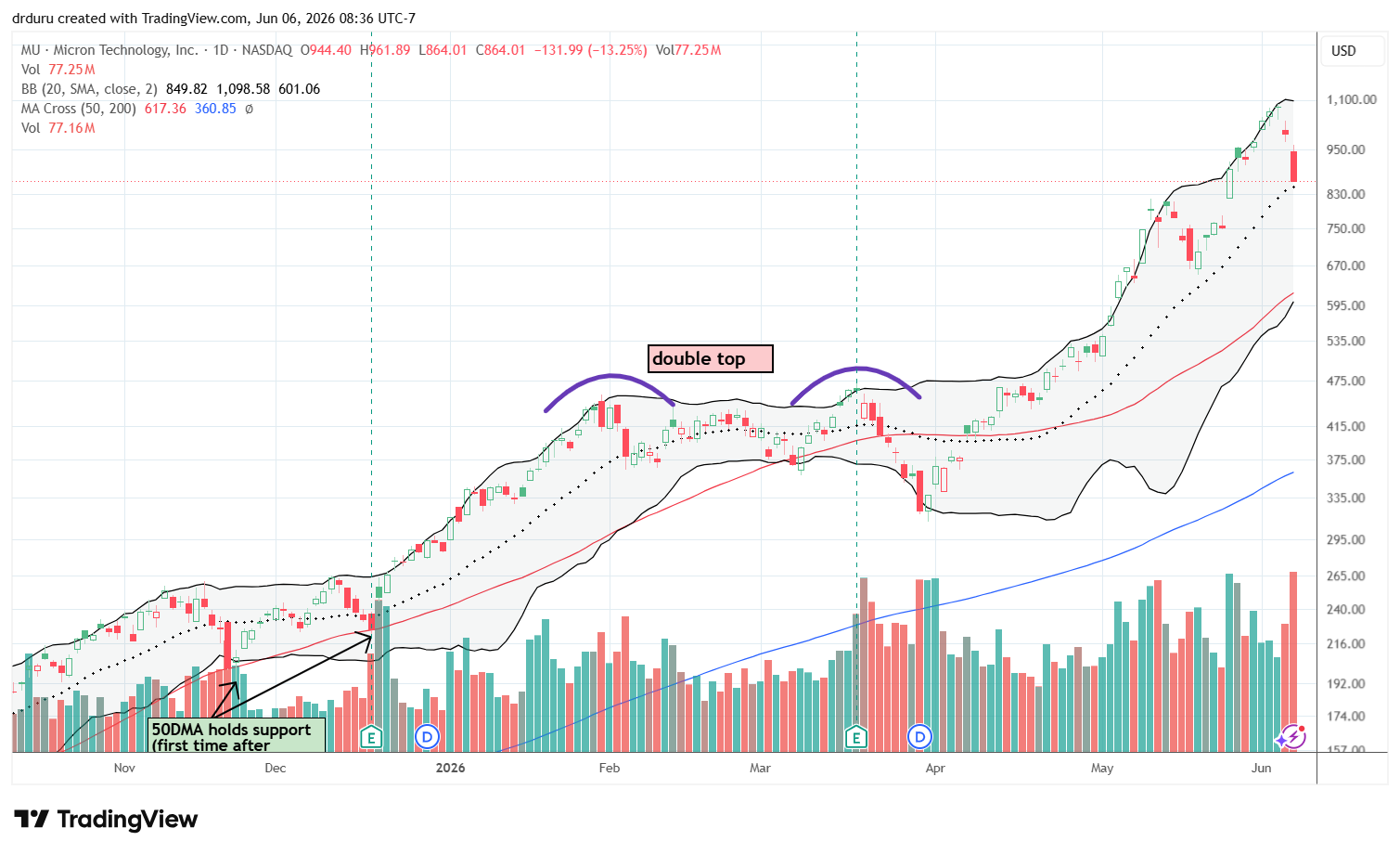
Technical status: Micron Technology, Inc. (MU) declined more than 13% but still remained above its uptrending 20DMA support.
Trade commentary: Despite the crash, MU remains one of the strongest semiconductor charts. By the time it reaches the May lows that nearly tested 20DMA support, MU will be testing 50DMA support. For now, the big tell is whether MU can bounce off uptrending 20DMA support.
VistaShares Artificial Intelligence Supercycle ETF (AIS)
Description: VistaShares Artificial Intelligence Supercycle ETF invests in companies positioned to benefit from artificial intelligence infrastructure, hardware, software, and related technologies.
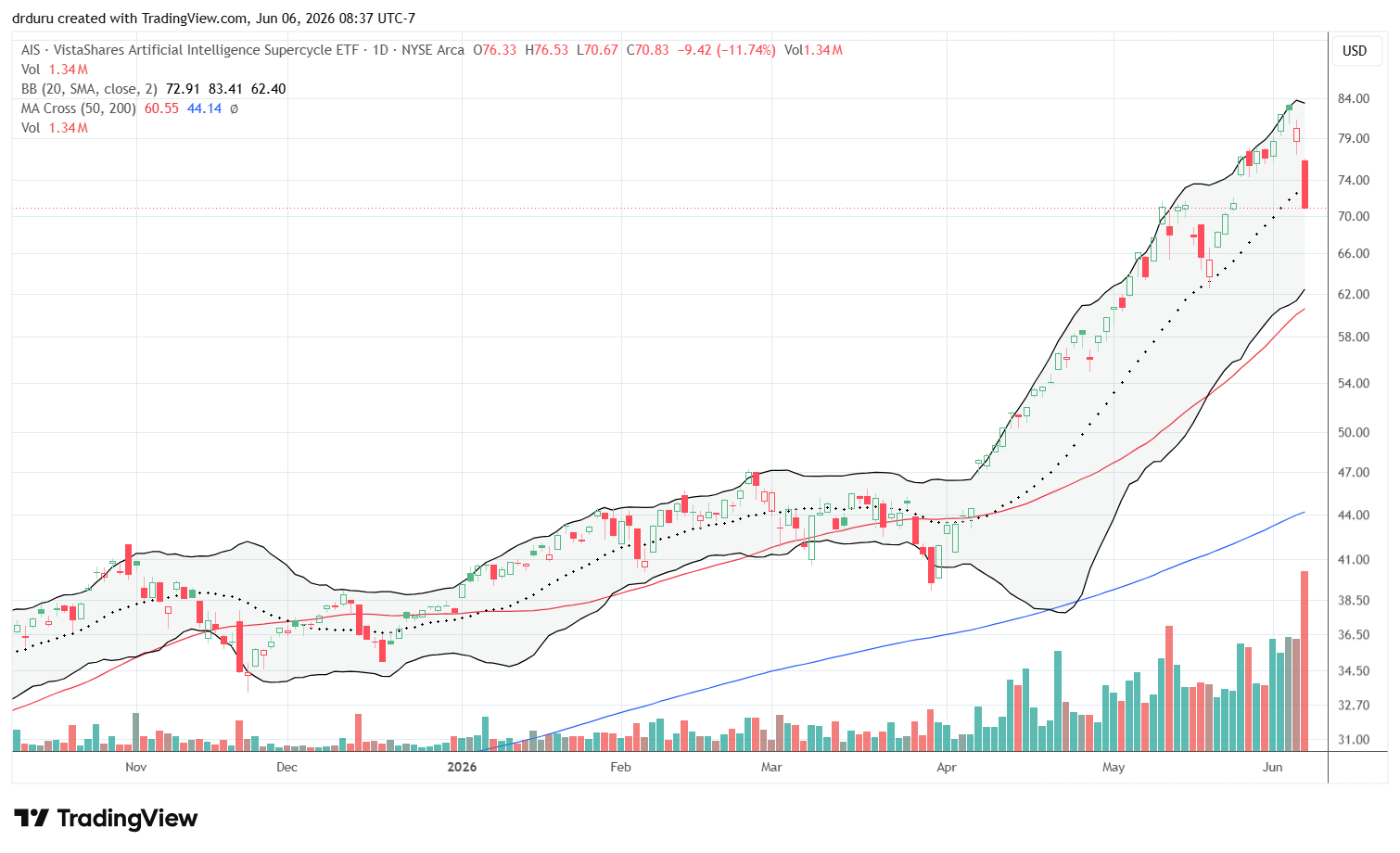
Technical status: VistaShares Artificial Intelligence Supercycle ETF (AIS) fell 11.7% and broke below its 20DMA. The ETF remained above its 50DMA and longer-term support levels.
Trade commentary: A friend told me about AIS after I shared that my core AI-related holding is ROBO Global Artificial Intelligence ETF (THNQ). AIS is a purer AI ETF stacked with so many of the hot semiconductor stocks at the core of AI right now. Thus, AIS has greatly outperformed even THNQ – if only he had told me a year ago! Notice how closely AIS resembles SMH.
Ciena Corporation (CIEN)
Description: Ciena Corporation provides networking equipment, software, and services used by telecommunications providers, cloud operators, and enterprises.
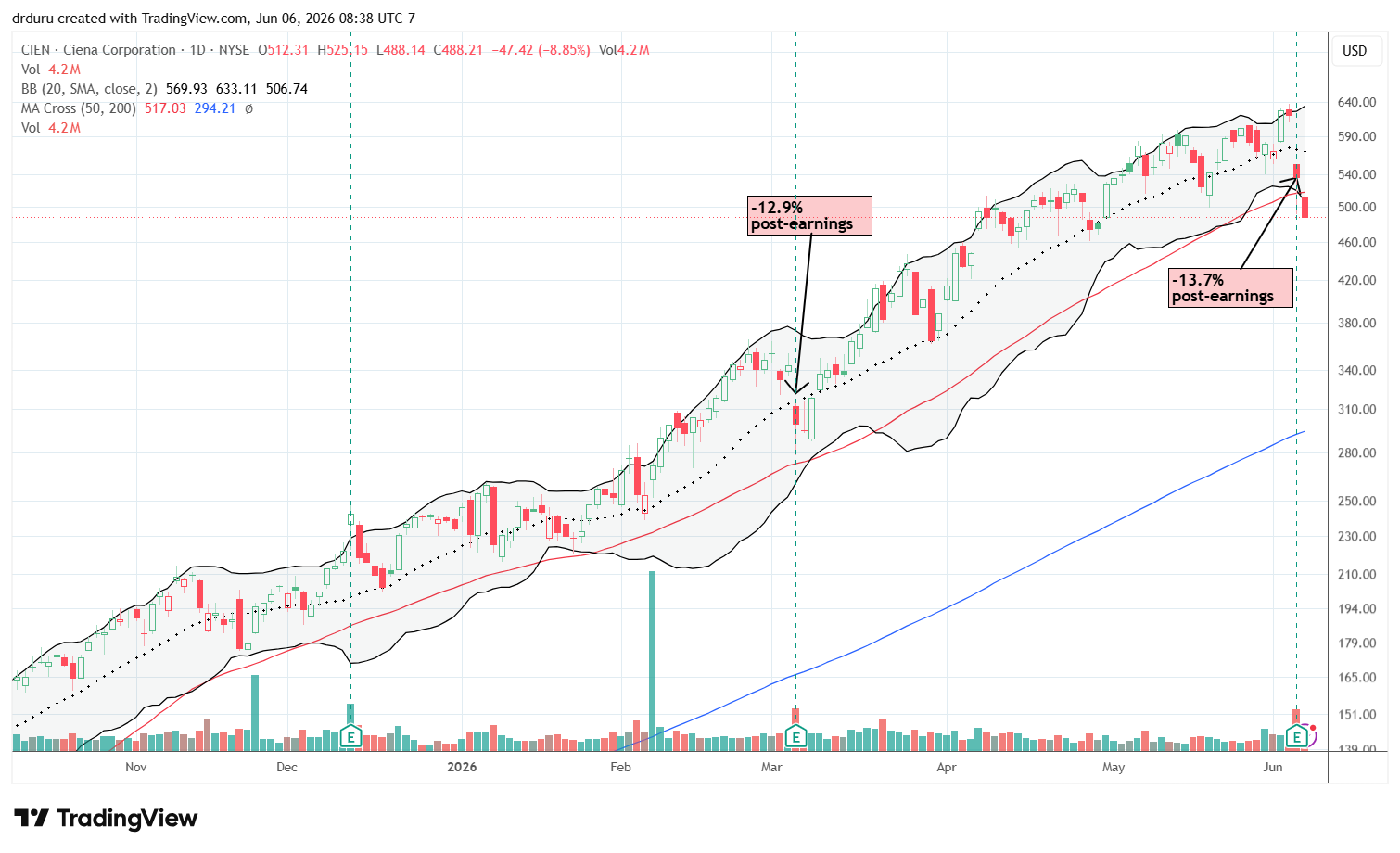
Technical status: Ciena Corporation (CIEN) lost 13.7% following earnings and another 8.9% during Friday’s session. CIEN broke below its 50DMA for the first time in more than a year.
Trade commentary: CIEN’s decline surely feels painful in the moment, particularly for recent buyers, but CIEN has soared over the past year. This pullback is relatively modest compared to an astonishing 568% 52-week gain. Still, CIEN has not traded below its 50DMA since April 2025. So buyers face a major technical test. A lower close from here makes CIEN bearish even if that lower close makes the stock even more over-extended below its lower Bollinger Band (the black lines that define 95% of expected price volatility around the 20DMA).
Cerebras Systems Inc (CBRS)
Description: Cerebras Systems, Inc. (CBRS) is an artificial intelligence infrastructure company that designs AI processors, builds AI computing systems and software, and delivers rack-scale platforms for AI training and inference workloads in data centers and supercomputing environments.
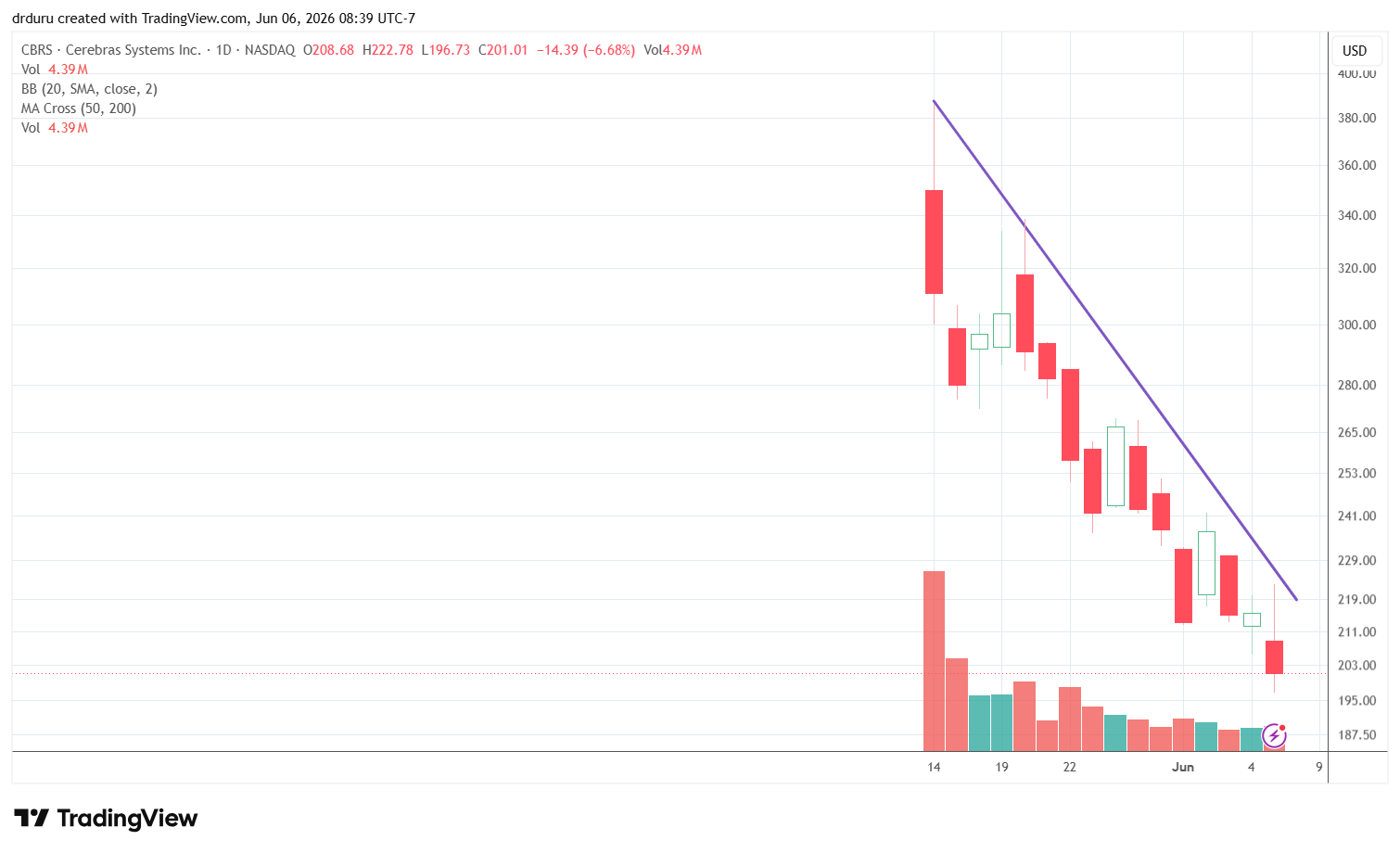
Technical status: Cerebras Systems (CBRS) has been stuck in a deep downtrend since its IPO. The $185 IPO price is now in play.
Trade commentary: The CBRS chart says everything. And ARK Investment Management’s large purchase within days of the IPO says a lot about ARK’s lack of concern with valuations. Nothing in the present seems to bother them and the future always excites them no matter how far they need to push that future out. I took profits on my short position after getting stopped out. I should have been more aggressive and set my stop ABOVE the downtrend line.
Hewlett Packard Enterprise Company (HPE)
Description: Hewlett Packard Enterprise provides enterprise networking, cloud, storage, computing, and related technology solutions.
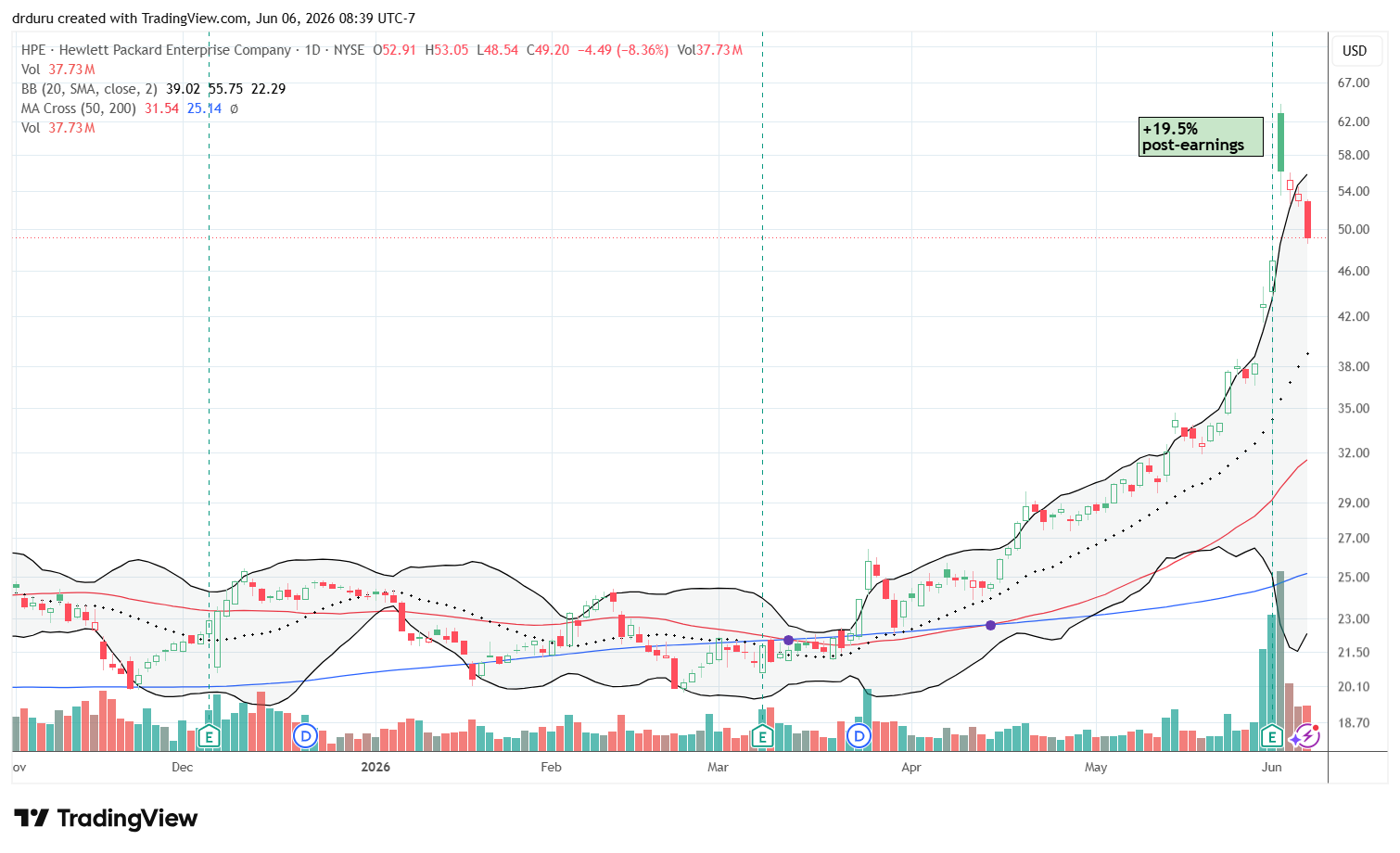
Technical status: Hewlett Packard Enterprise Company (HPE) gained 19.5% post-earnings but faders from the intraday high have nearly closed the entire gap.
Trade commentary: HPE followed the excitement with AI-boosted earnings from Lenovo and Dell Technologies (DELL). I am surprised the stock still could gain 19.5% post-earnings after the parabolic run-up into earnings, but the steep fade from the intraday high is of course not surprising given the near inevitable (short-term) collapse that follows parabolic moves. HPE was up 36.7% at its post-earnings intraday high.
iShares Expanded Tech-Software Sector ETF (IGV)
Description: The iShares Expanded Tech-Software Sector ETF tracks U.S. software and technology companies.
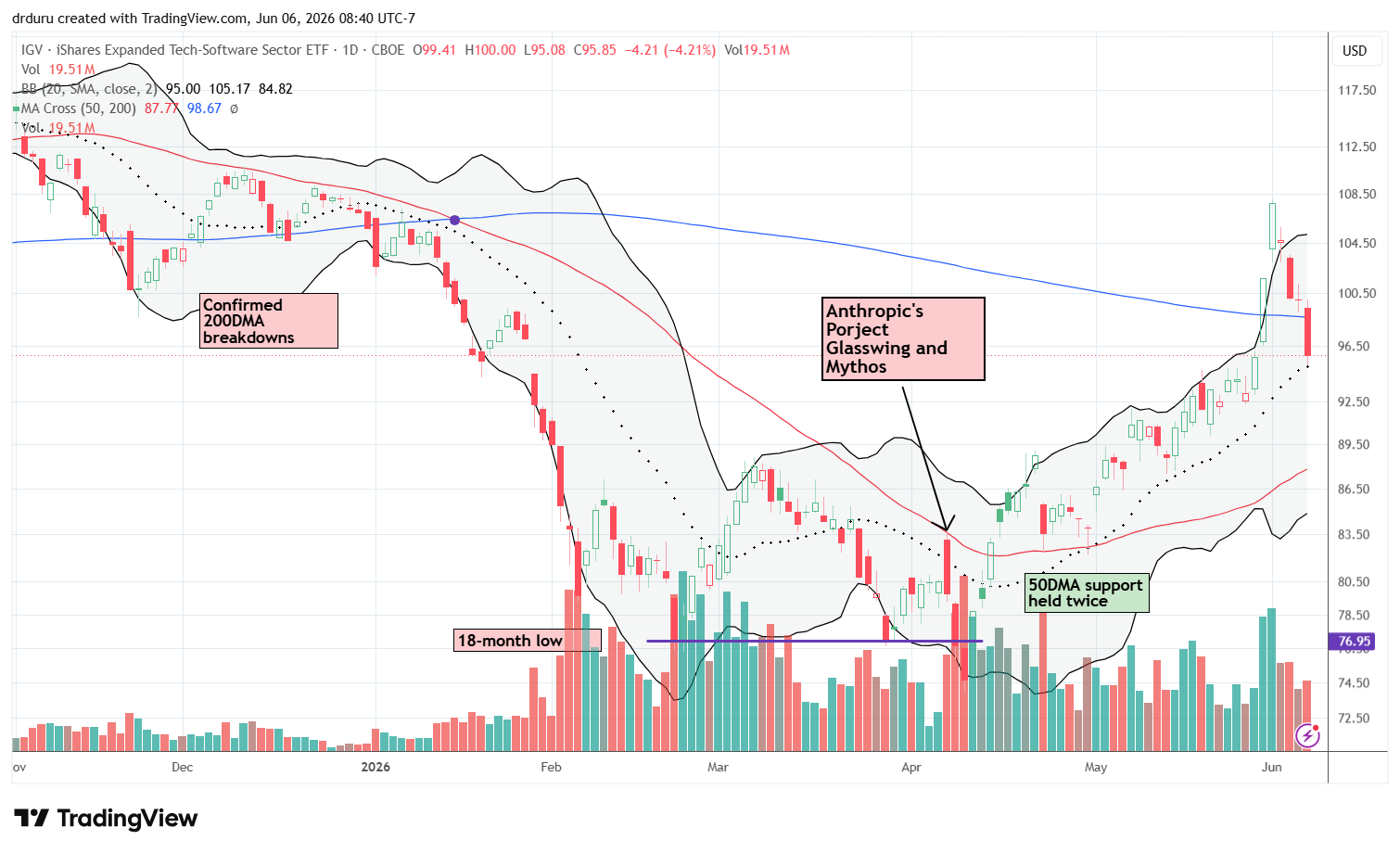
Technical status: The iShares Expanded-Tech Software ETF (IGV) broke down below 200DMA support and tested uptrending 20DMA support.
Trade commentary: A week ago I said “I will be ready to concede at least a pause in the recovery if IGV soon closes below its 200DMA.” That pause currently rests on an important test of 20DMA support. A 20DMA breakdown immediately puts a test of 50DMA support into play.
Sprout Social, Inc. (SPT)
Description: Sprout Social provides cloud-based social media management, analytics, customer engagement, and marketing software.
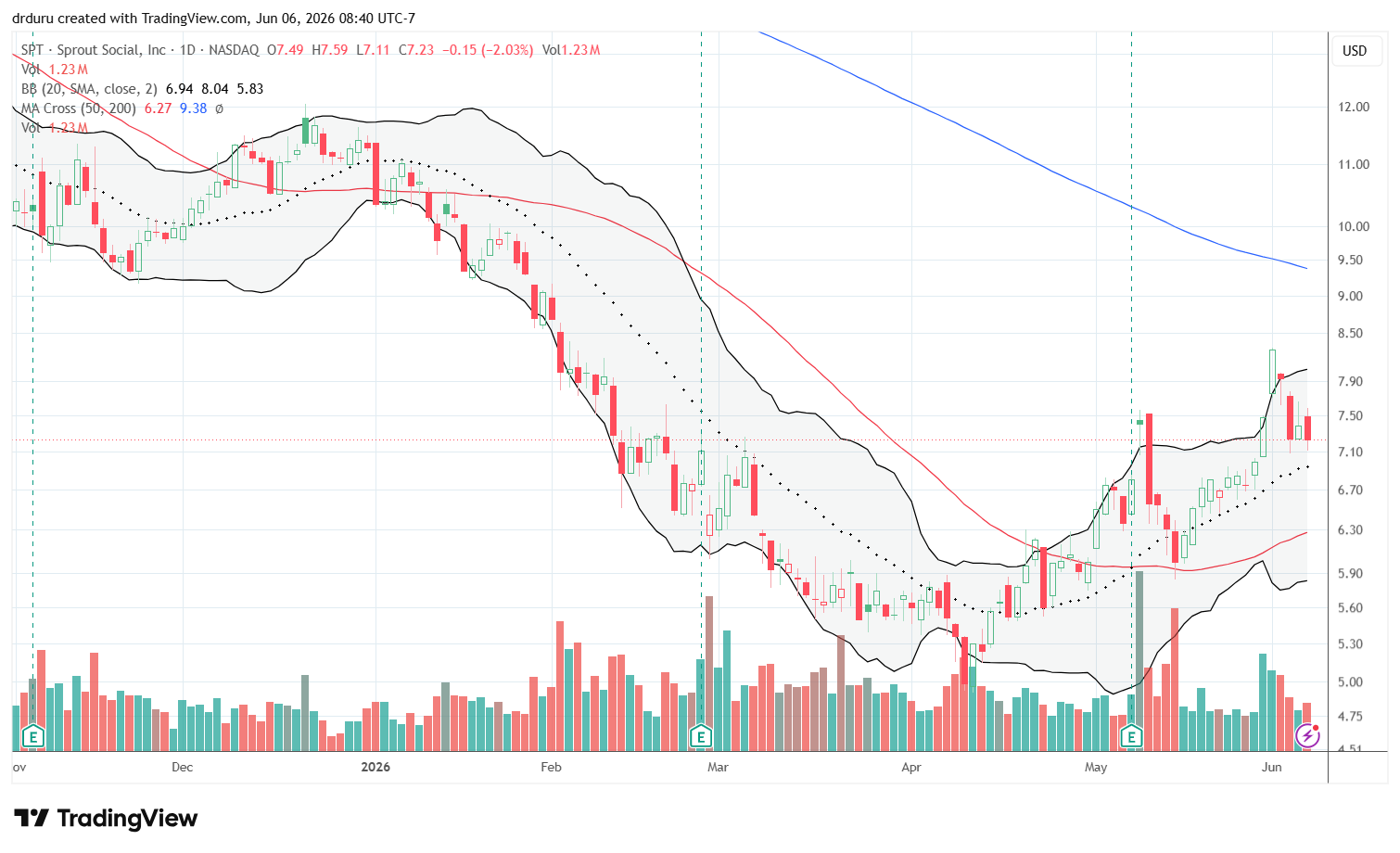
Technical status: Sprout Social, Inc. (SPT) held its 20DMA uptrend and avoided making a new weekly low.
Trade commentary: I have been “hawking” SPT for quite some time. The company has a very specialized domain and has survived since social media analytics became a thing. The perfect bounce off 50DMA support put the stock on my buy list. But since I had plenty of software stocks at the time, both short and long-term trades, I decided to pass. After taking some profits, I reallocated into SPT and bought last week’s pullback. I like how the stock held above 20DMA support while IGV broke down. Still, the stock has a long way to go to even test downtrending 200DMA resistance.
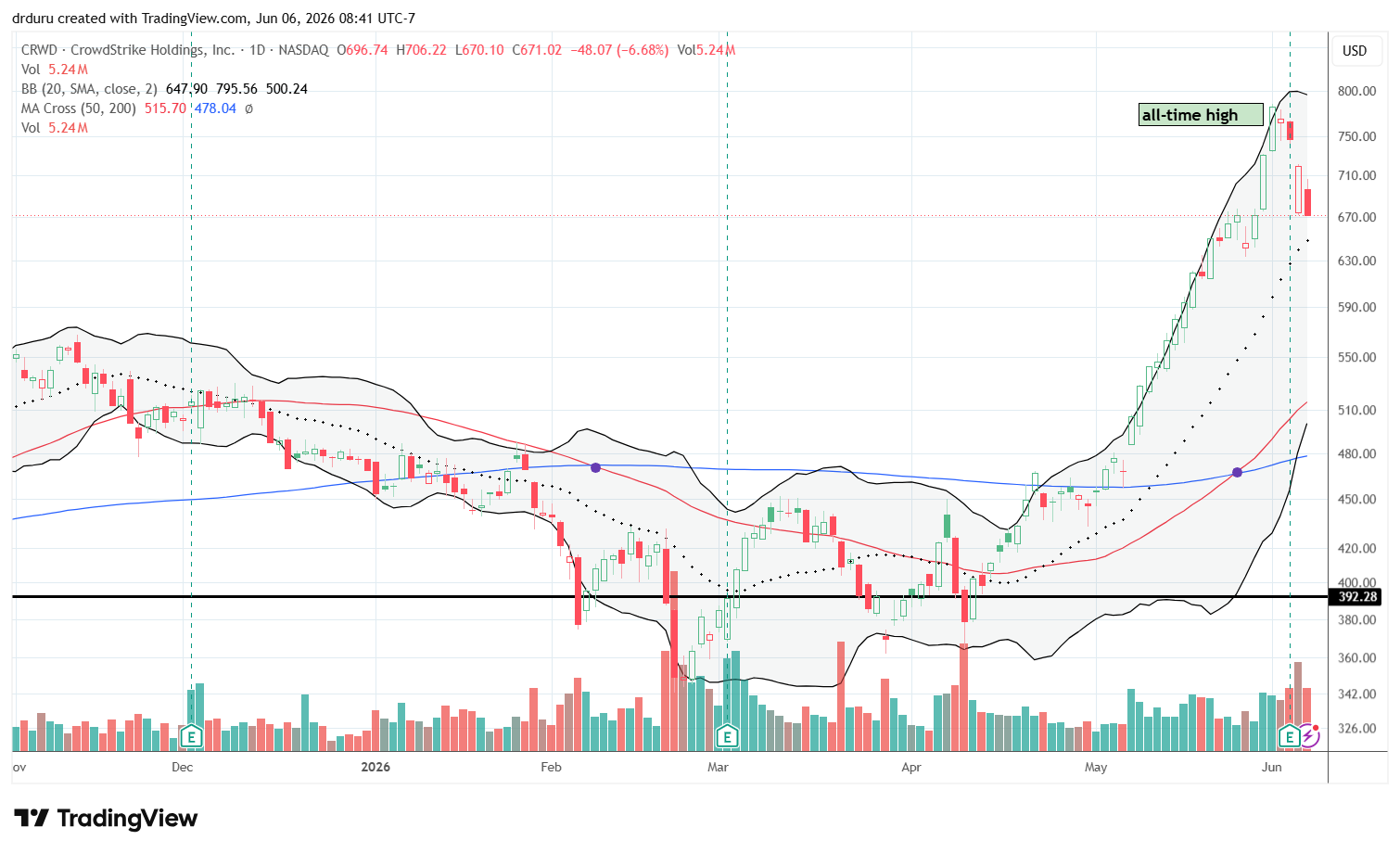
CrowdStrike Holdings, Inc. (CRWD)
Description: CrowdStrike provides cloud-native cybersecurity software focused on endpoint protection, threat intelligence, and security operations.
Technical status: CrowdStrike Holdings, Inc. (CRWD) lost 3.8% post-earnings and sellers the next day took the stock back to the intraday low.
Trade commentary: I held through earnings and hoped CRWD would react like Palo Alto Networks (PANW). It did not. I ultimately took profits during the intraday, post-earnings bounce because the reaction created a potential top. Buying power looks exhausted, and I do not expect 20DMA support to hold.
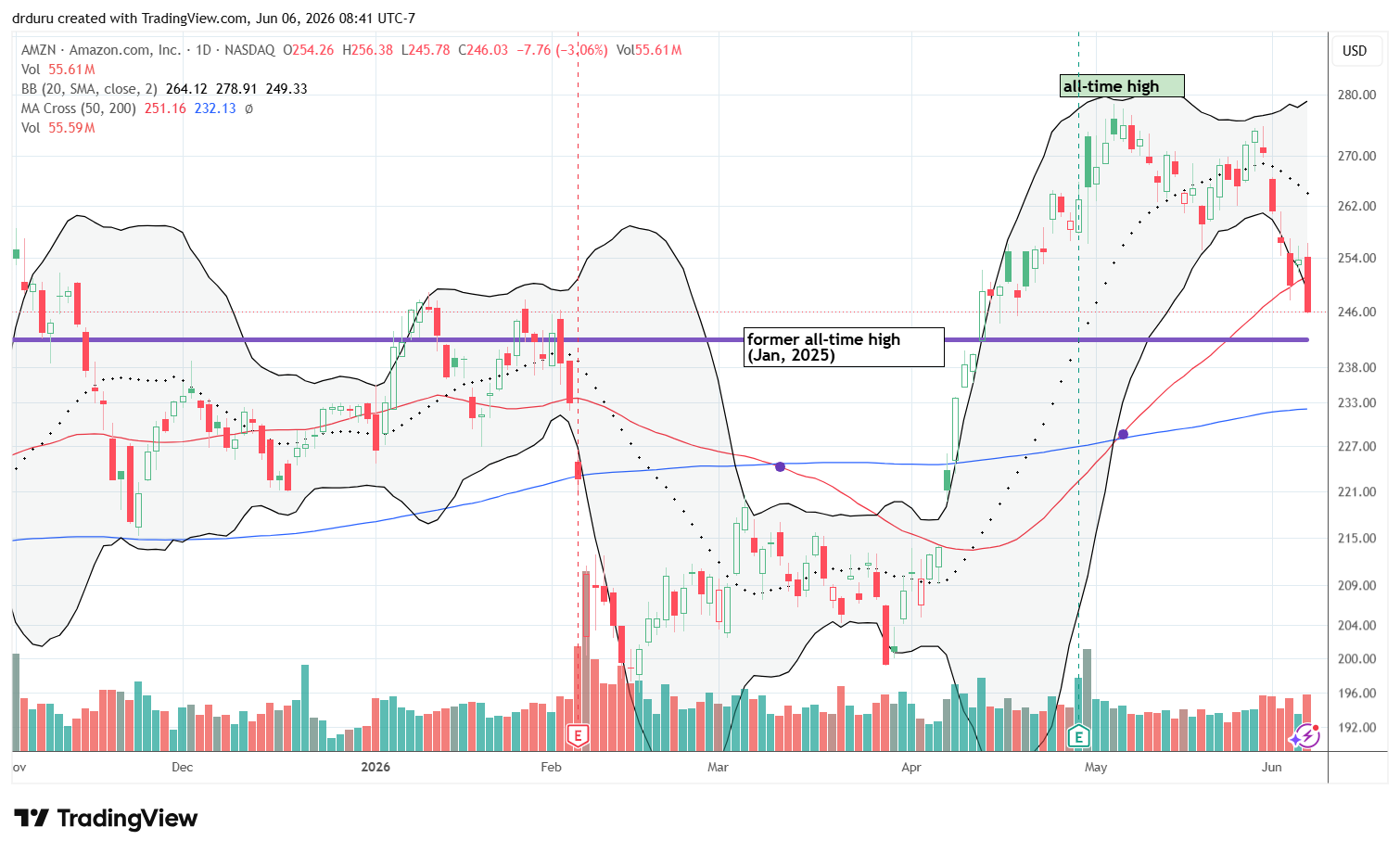
Amazon.com, Inc. (AMZN)
Description: Amazon operates e-commerce marketplaces, cloud computing services, digital content platforms, and logistics networks.
Technical status: Amazon.com, Inc. (AMZN) fell below its 50DMA and moved into a more bearish technical posture.
Trade commentary: AMZN failed to reclaim its all-time high and has now lost 50DMA support. If the stock falls below its former all-time high pivot line, I will consider the stock technically topped out even if the 200DMA survives as support.
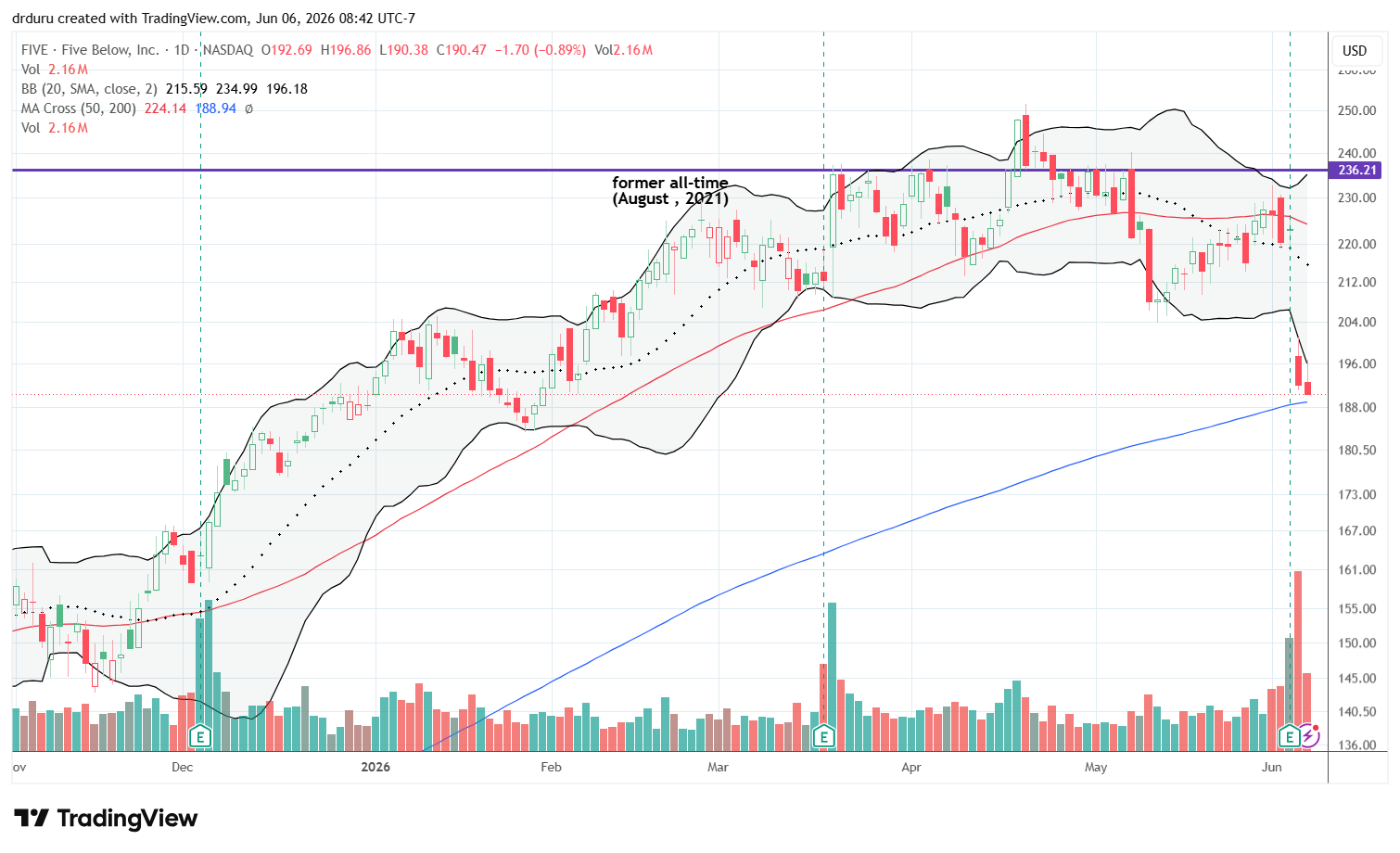
Five Below, Inc. (FIVE)
Description: Five Below operates specialty retail stores that sell value-priced merchandise targeted primarily at teens and pre-teens.
Technical status: Five Below, Inc. (FIVE) fell 13.8% post-earnings and the next day challenged 200DMA support.
Trade commentary: FIVE delivered a strong breakout in April, but sellers quickly took control. The stock now faces a critical test of 200DMA support a day after it lost nearly 14% following earnings. I am buying a bounce and shorting into a breakdown.
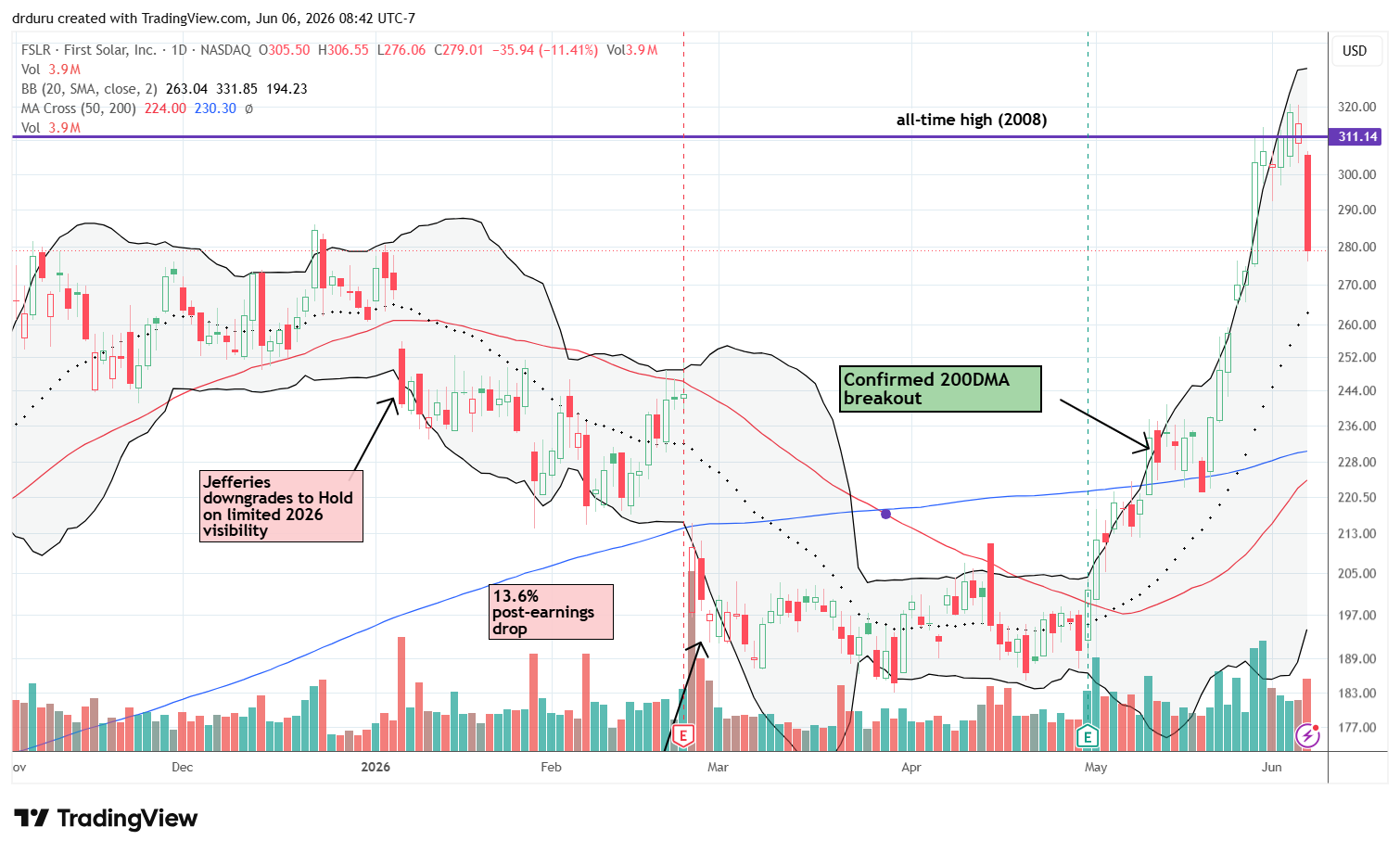
First Solar, Inc. (FSLR)
Description: First Solar manufactures solar panels and utility-scale photovoltaic power systems.
Technical status: First Solar, Inc. (FSLR) failed to hold a breakout above its all-time high from 2008. Friday’s 11.4% loss may have signaled another lasting top.
Trade commentary: Per the video I posted earlier, I liked FSLR’s breakout setup. In a market with continued strength, I think FSLR would have followed through nicely. Instead, the stock collapsed, and I was too busy on Friday to notice until after trading closed. This was poor execution as per the video I should have had a stop in place (not just a mental stop) upon FSLR opening lower on Friday below the breakout point. I suspect that the depth of the selling came from a cascade of traders getting stopped out of positions with rules similar to mine. Now I wait to see whether 20DMA support can hold.
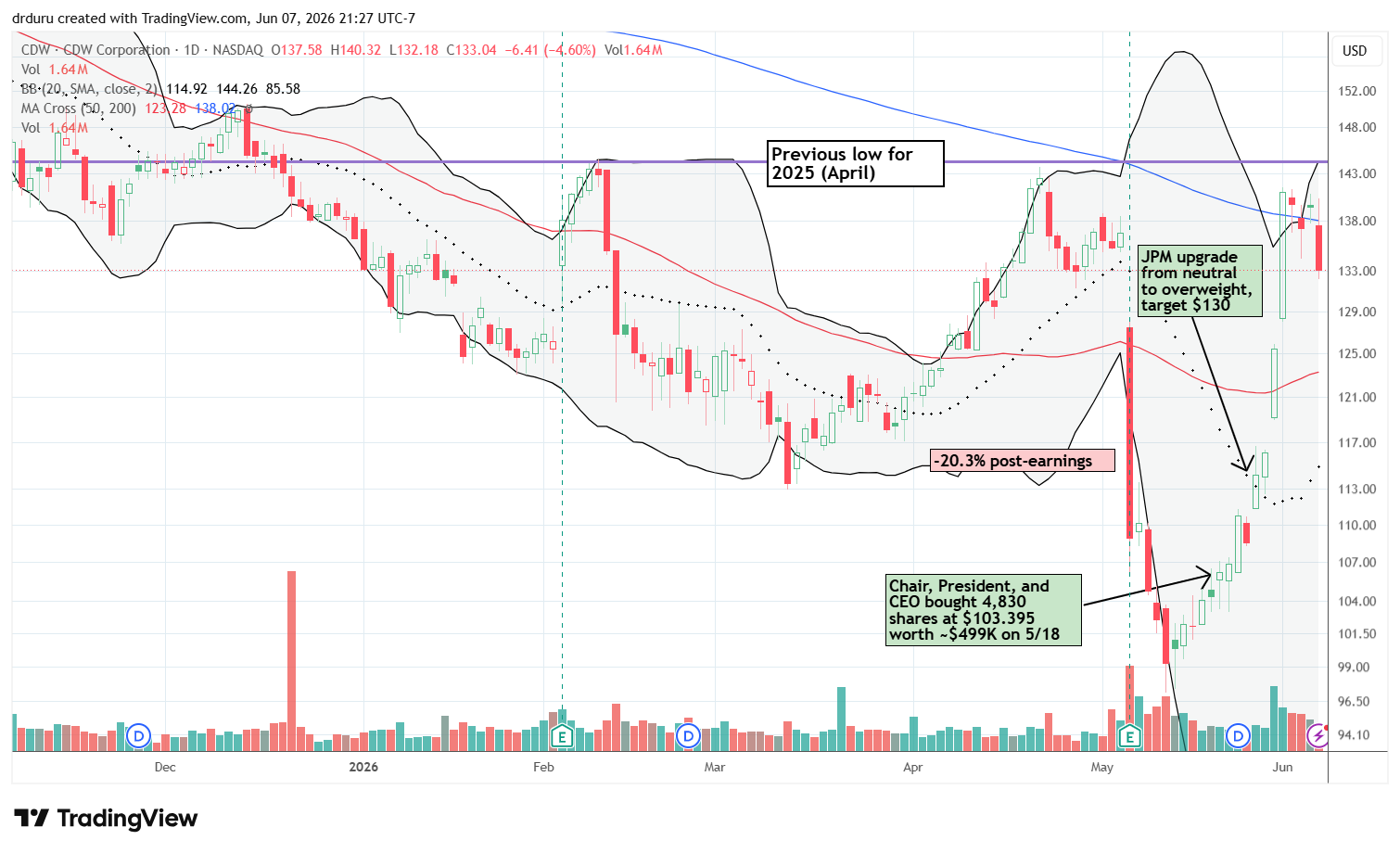
CDW Corporation (CDW)
Description: CDW provides information technology products, software, services, and solutions to business, government, education, and healthcare customers.
Technical status: CDW Corporation (CDW) staged a powerful (and inexplicable) rally into long-term resistance before reversing sharply.
Trade commentary: After reviewing the results of CDW’s last disastrous earnings report, I decided to buy the stock if it hurdled $115. I set a price alert and promptly ignored it when the buy signal triggered on May 27th. By that time, insiders had loaded up on stock and JP Morgan (JPM) issued an upgrade and $130 price target. The stock accelerated its rebound from there, and I failed to notice until CDW pressed against its 200DMA resistance. I bought a June $130 put option after CDW fell below its 200DMA. I did not take profits on Friday given what I figured at that time were high odds of at least one more day of selling.
Regardless, I consider CDW an example of how a good idea can fail without execution. CDW has suffered a downtrend since it last peaked in early 2024 and has thus completely missed the tech rally in the meantime. A bearish to bullish reversal will be underway with an end to the downtrend over the $144 resistance level. Perhaps another analyst will outdo JPM’s upgrade. The current analyst price range is from $123 to $195 with an average of $147.30.
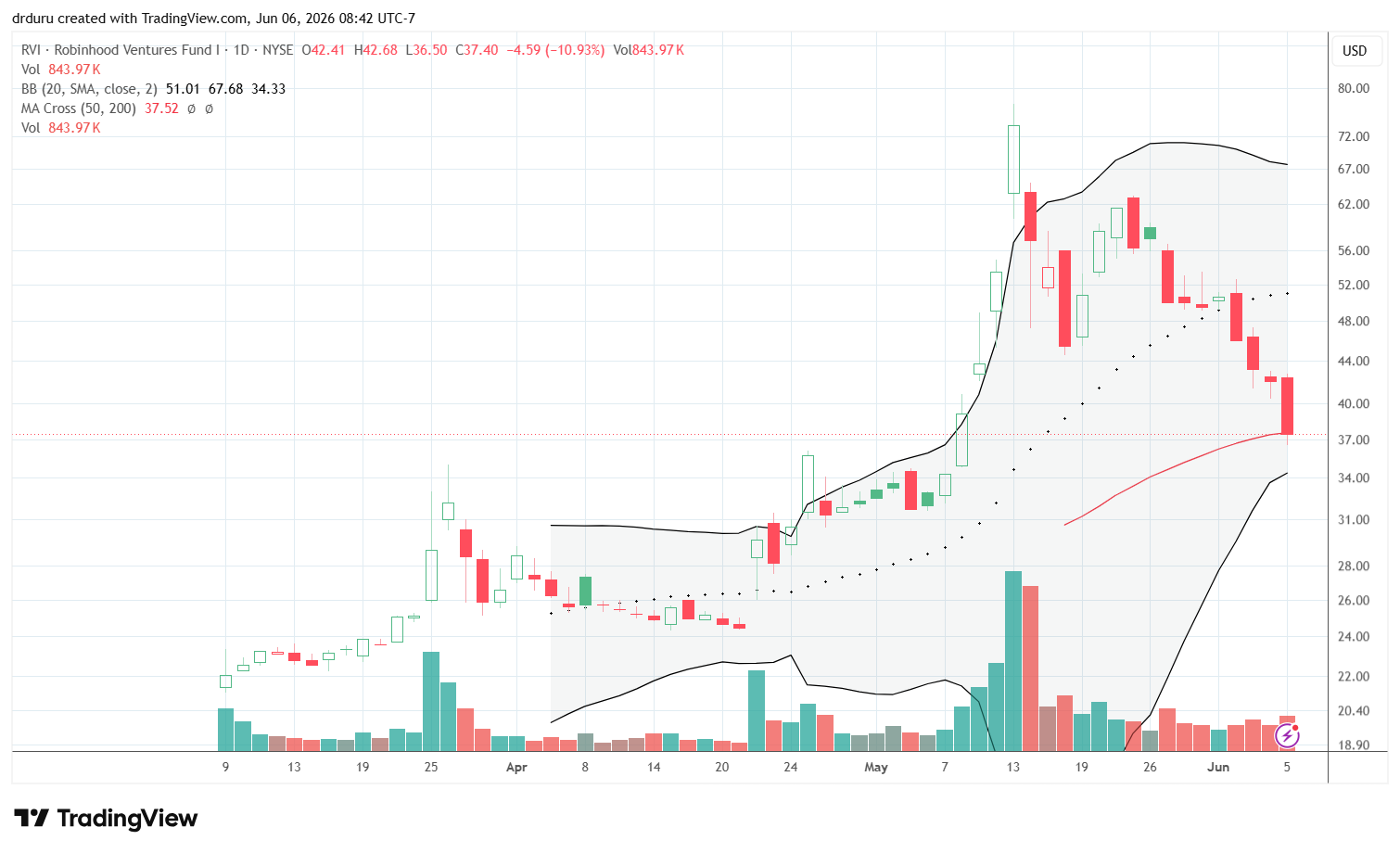
Robinhood Ventures Fund 1 (RVI)
Description: Robinhood Ventures Fund I (RVI) is a publicly traded closed-end fund that invests primarily in a concentrated portfolio of private companies operating at the frontiers of their industries, providing retail investors with exposure to private-market growth opportunities.
Technical status: RVI is testing 50DMA support after falling almost 50% from its all-time high in a sell-off symbolic of a steep retreat from speculation.
Trade commentary: RVI is yet another example of the dangers of chasing parabolic moves that extend well above the upper Bollinger Band. The stock peaked on a 37.8% gain on record volume, all the classic signs of a blow-off top that exposes exhausted buyers. The stock is down almost 50% since its all-time high. If not for the upcoming SpaceX IPO, I would be considering RVI on a bounce off 50DMA support.
Footnotes
Subscribe for free to get email notifications of future posts!
“Above the 50” (AT50) uses the percentage of stocks trading above their respective 50-day moving averages (DMAs) to measure breadth in the stock market. Breadth defines the distribution of participation in a rally or sell-off. As a result, AT50 identifies extremes in market sentiment that are likely to reverse. Above the 50 is my alternative name for “MMFI” which is a symbol TradingView.com and other chart vendors use for this breadth indicator. Learn more about AT50 on my Market Breadth Resource Page. AT200, or MMTH, measures the percentage of stocks trading above their respective 200DMAs.
Active AT50 (MMFI) periods: Day #219 over 20%, Day #46 over 30%, Day #42 over 40% (overperiod), Day #1 under 50% (underperiod), Day #19 under 60%, Day #192 under 75%
Source for charts unless otherwise noted: TradingView.com
Full disclosure: long QQQ put spread, long IWM shares and call, long SPT, long FSLR, long CDW put
FOLLOW Dr. Duru’s commentary on financial markets via StockTwits, BlueSky, and even Instagram!
*Charting notes: Stock prices are not adjusted for dividends. Candlestick charts use hollow bodies: open candles indicate a close higher than the open, filled candles indicate an open higher than the close.
* Blog notes: this blog was partially written based on the heavily edited transcript of the following video that includes a live review of the stock charts featured in this post. I used ChatGPT to process the transcript.