
The Market Breadth Summary
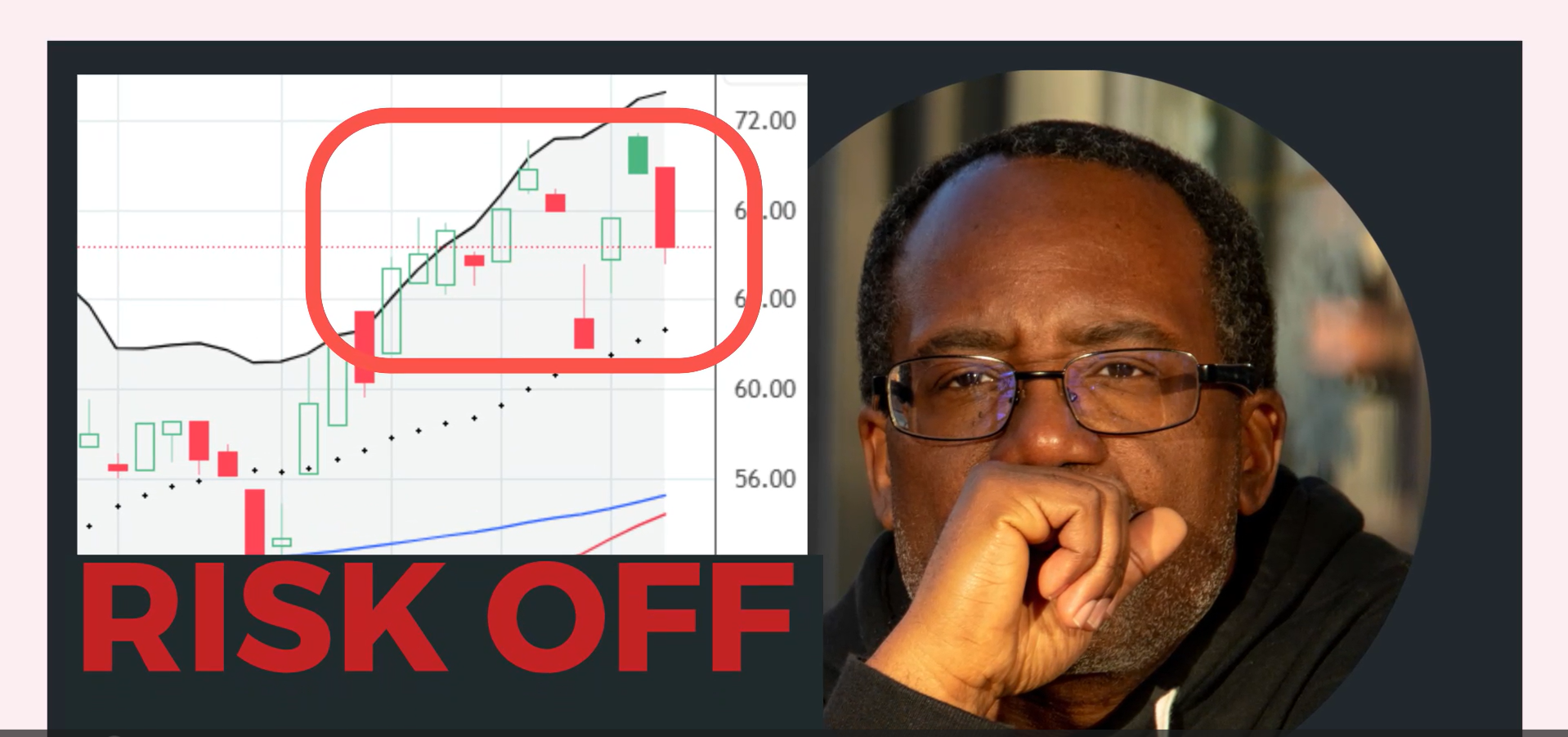
- Market breadth failed twice at the overbought threshold, so I am treating trading conditions as risk off.
- Earnings season is pushing me to manage risk tightly, prioritize observation, and avoid pressing short-term trades.
- The Federal Reserve decision looks largely priced in, yet I am still bracing for volatility from policy and headline risk.
- Technical levels are doing the heavy lifting: I am watching 20DMA and 50DMA reactions across SPY and the NASDAQ for confirmation or invalidation.
- The breadth downgrade to “cautiously bearish” reflects a trading bias toward fading resistance, while keeping core holdings largely intact.
- Defensive positioning is reinforced by weakness in financials, while select contrarian setups remain actionable.
Stock Market Commentary
I am risk off in the coming week because market breadth failed twice at the overbought level. One failure is enough to make me cautious, but two tells me that the market is fighting too hard just to go higher. Moreover, earnings season is in full swing. For short-term traders, earnings season is usually a time to manage risk anyway and not to press luck. Thus, this is a week for more watching and studying, not aggressive buying. Long-term holders can sit back and look for the dips to buy.
The next Federal Reserve decision this week should be the biggest “non-news” event. The market has priced in near certainty for rates to stay unchanged. The Supreme Court continues to hold the wildcard market catalysts as the court continues to deliberate on the fate of Federal Reserve Governor Lisa Cook who faces the prospect of being fired without proof of the charges levied against her. The Supreme Court is also dragging out the drama on its decision on the legality of the President’s tariff regime. I see no value in trying to predict the outcomes of these decisions or the market’s reaction to the decisions. Instead, I am bracing for volatility. Yet more reasons to stay…risk off!
The Stock Market Indices
S&P 500 (SPY)
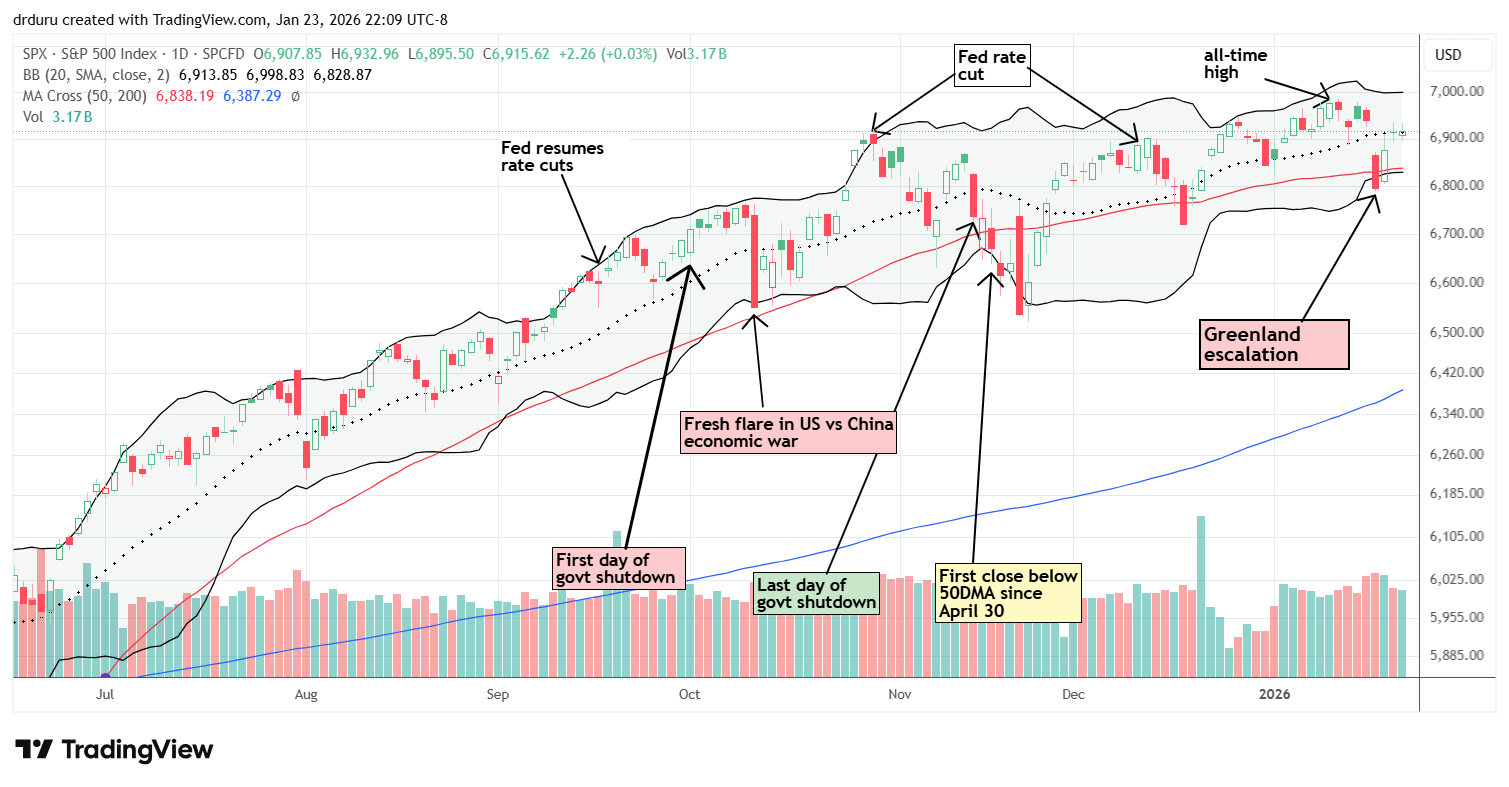
The S&P 500 remains in an uptrend with both its 20-day moving average (DMA) (dashed line) and 50DMA (red line) grinding higher. Yet, the repeated tests of 50DMA support seem designed for an eventual major failure. Otherwise, these bounces off or away from 50DMA support will become quite the consistent and predictable trade; the stock market usually does not make trading technical patterns this easy.
Then again, policy makers may also be watching the technicals closely. The rapid rebound from the “Greenland escalation” was well-timed. I just happened to buy SPY call options after the index gapped slightly higher at the open. In less than an hour, shockingly, these call options had gained nearly 10x in value on news that the President backed off threats of coercing Greenland and adding more tariffs to European countries that opposed his plans. Buying into policy fears has also become too predictable. Needless to say, with hindsight, I realized that I should have bought the gap open a lot more aggressively. I took profits before the close. Next up, the threat of 100% (additional?) tariffs on Canada for doing a trade deal with China.
Note that the follow-through buying stopped cold at 20DMA resistance and failed to fully reverse the Greenland loss. This failure leaves yet one more reason to stand down with risk off.
NASDAQ (COMPQ)
The NASDAQ made me even more wary because the tech-laden index stopped cold at 50DMA resistance on the first day of recovery from the Greenland escalation. However, unlike the S&P 500, the NASDAQ managed to (marginally) trade just above 20DMA resistance to close the week. Still, the NASDAQ’s all-time in October continues to loom as a topping signal. The NASDAQ remains suspect until it can join the other indices in printing an all-time high this year.

iShares Russell 2000 ETF (IWM)
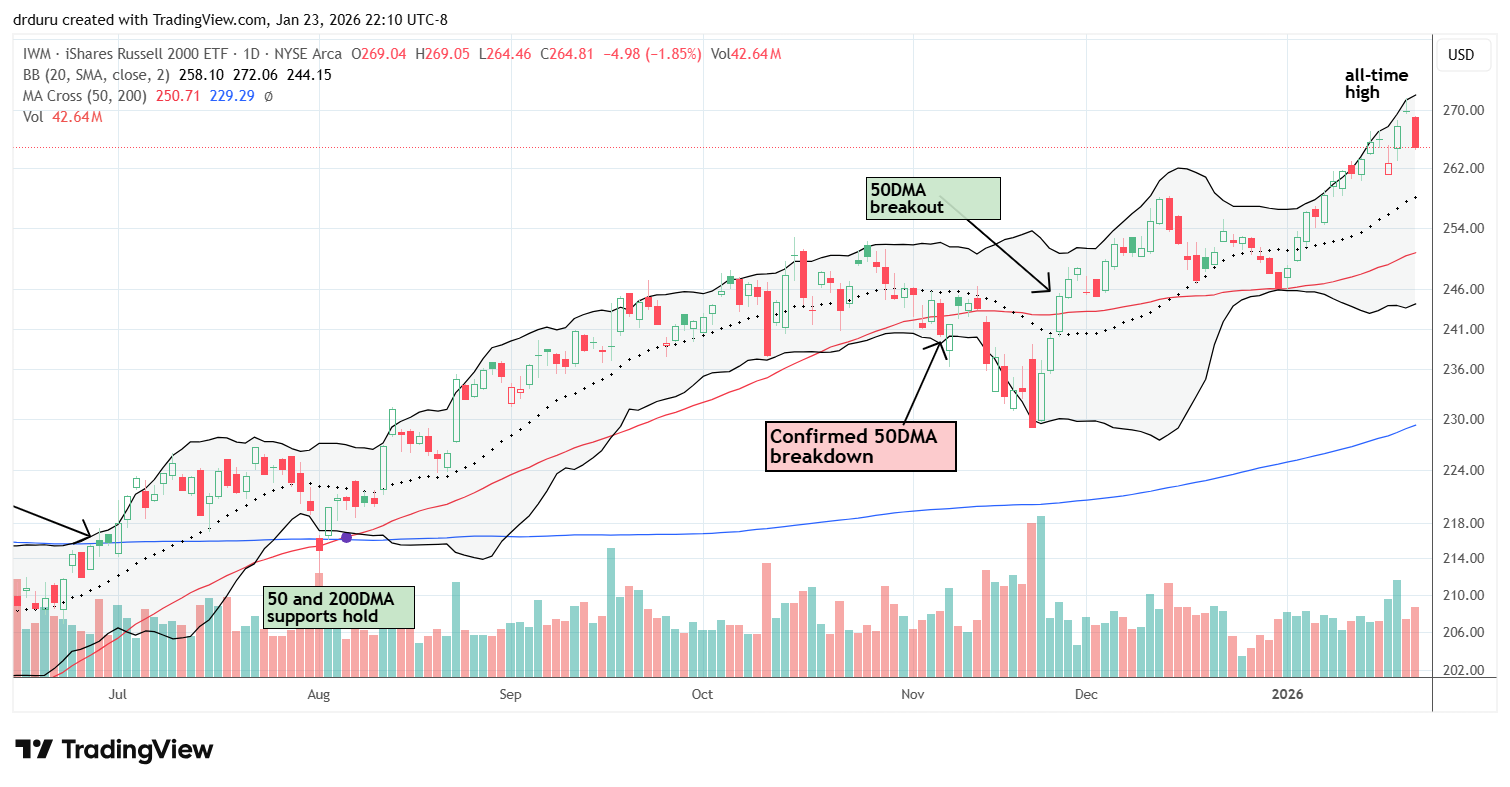
Small caps have been on a tear this year, and I have enjoyed the run-up given my large core position in IWM. That momentum finally ran into significant trouble with a 1.9% pullback on Friday. IWM greatly underperformed the more serene indices. I used this pullback to add to my first IWM call option trade of the year. This trade is more in case my risk off posture turns out premature; I am not optimistic on this trade and will be quick to close it out on a bounce from here.
The Short-Term Trading Call With Risk Off
- AT50 (MMFI) = 66.3% of stocks are trading above their respective 50-day moving averages
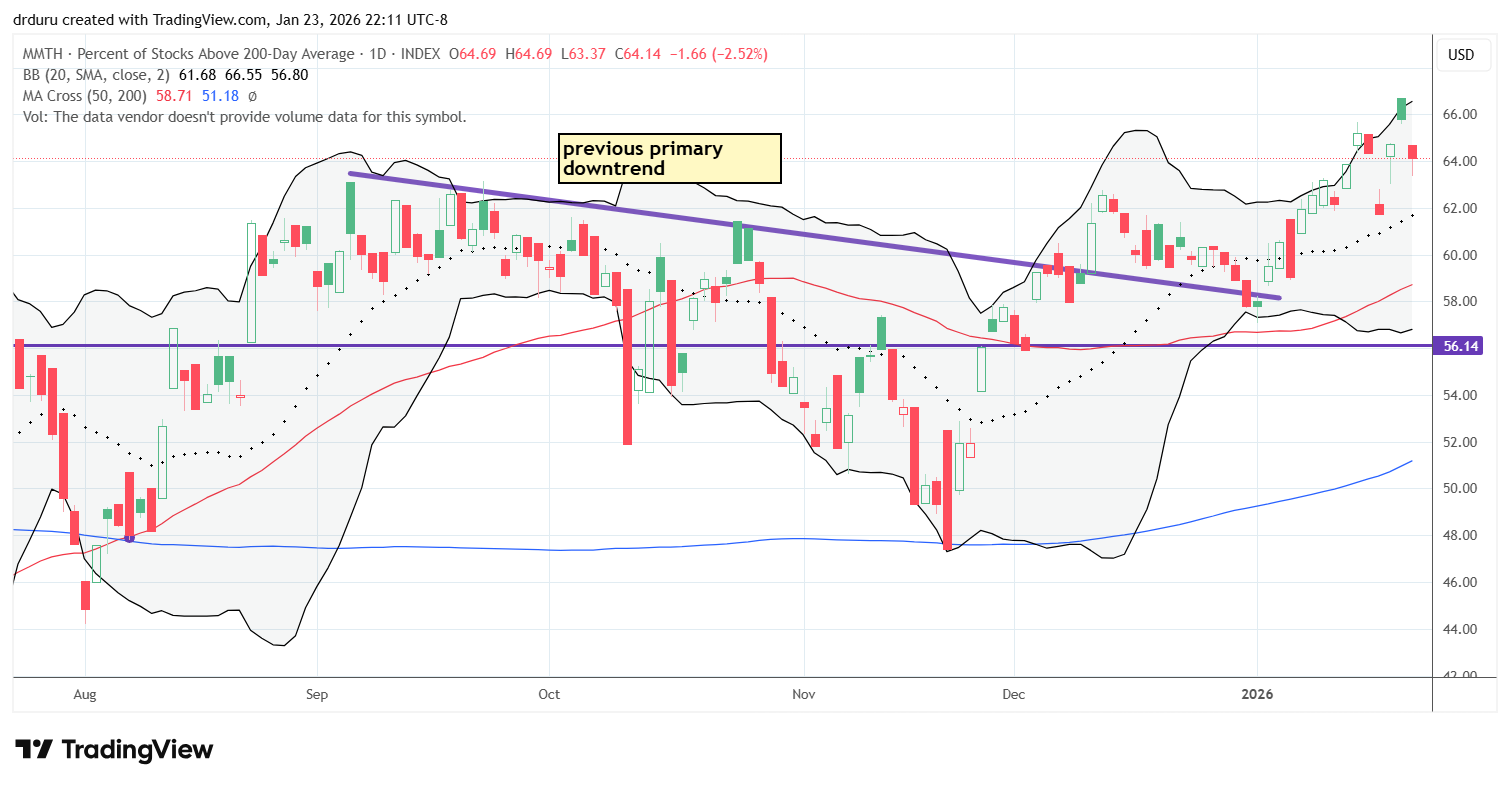
- AT200 (MMTH) = 64.1% of stocks are trading above their respective 200-day moving averages
- Short-term Trading Call: cautiously bearish
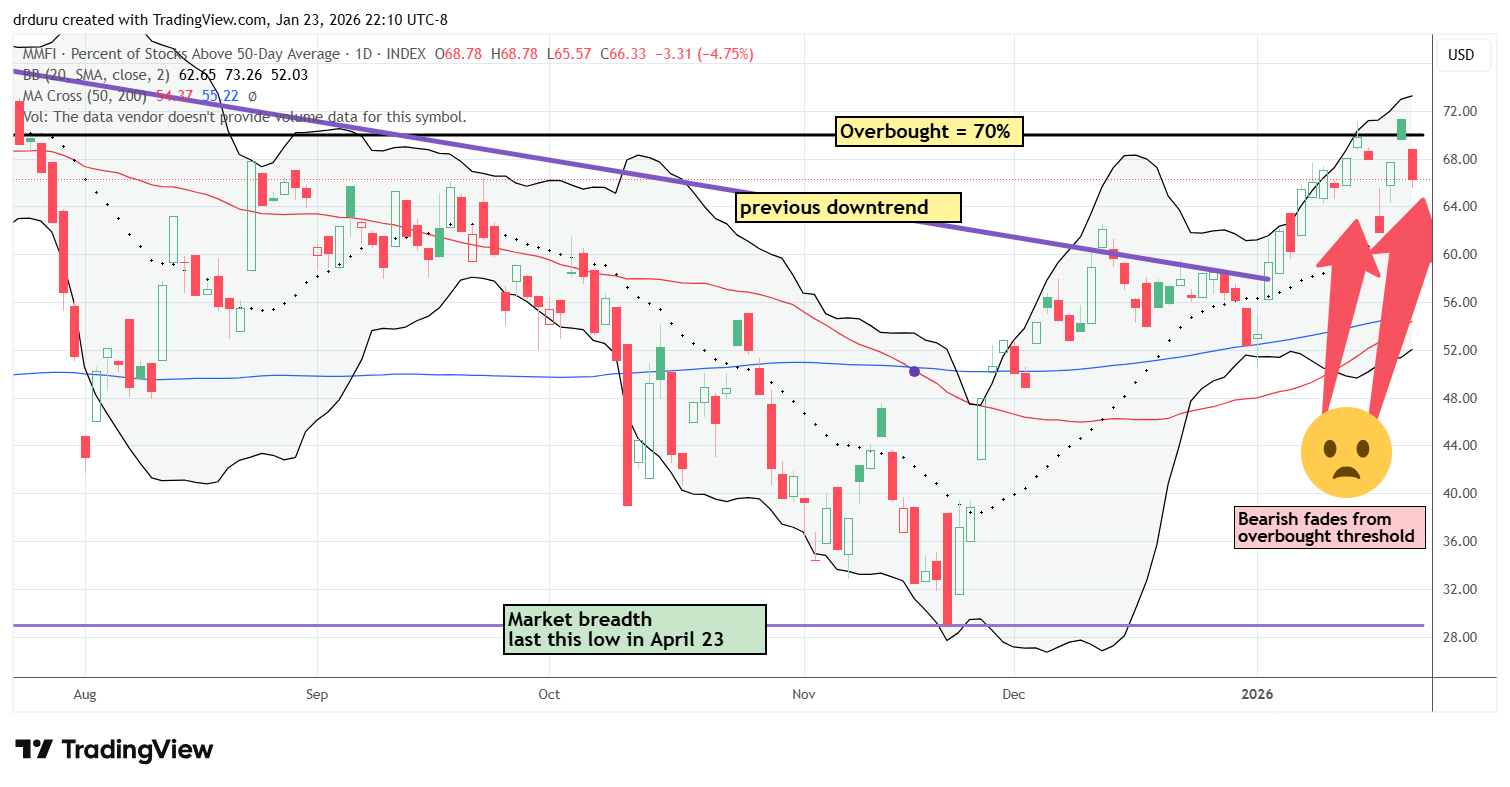
AT50 (MMFI), the percentage of stocks trading above their respective 50DMAs, closed the week at 66.3%. My favorite technical indicator started the holiday shortened week with a drop all the way to 61.8% and a confirmation of market breadth’s bearish signal from the previous week. The subsequent rebound created a second failure and fade at the overbought threshold for AT50 (70%). According to the AT50 rules, a fade from the overbought threshold is bearish. It is rare to see such failures within a week, so I am doubly cautious and wary now.
My concern is high enough to finally motivate me to downgrade the short-term trading call from neutral to cautiously bearish. This call means I am biased toward fading stocks in downtrends that are challenging resistance levels. I may even find select stocks to bet against ahead of earnings. However, I couch this downgrade to cautiously bearish in the “risk off” label to clarify that I am not rushing to trim core portfolio holdings. I am definitely not expecting some kind of collapse or crash around the corner (not as a base case). I will be watching earnings results carefully for confirming or invalidating signals.
AT200, the percentage of stocks trading above their 200DMAs, mapped the same pattern as AT50, but this longer-term indicator of the health of market breadth remains higher than the highs of 2025. This relatively bullish positioning tempers my bearishness.
Finally, permabull Tom Lee also tempered my bearishness with his clarification on his market call for a significant pullback in the first half of the year. In a CNBC interview, he spoke of a mid-year correction from higher levels. I practically fell out my seat when I heard that projection. I cannot take such a projection seriously. From today’s standpoint, a future sell-off from higher levels is not a correction at all. After all, I can project a bear market at some point in the future, someday, and be technically correct without providing actionable information. Thus, with the vaporization of Tom Lee’s bearishness about the first half of the year, I have one less reason to get aggressively bearish on the stock market in the short-term.
The Equities: Risk Off
In case you missed it…
Last week I provided near real-time observations on the implications of the S&P 500’s 50DMA breakdown and market breadth’s parallel bearishness.
SPDR Gold Shares (GLD)
Description: SPDR Gold Shares is an exchange-traded fund designed to track the price of gold bullion.
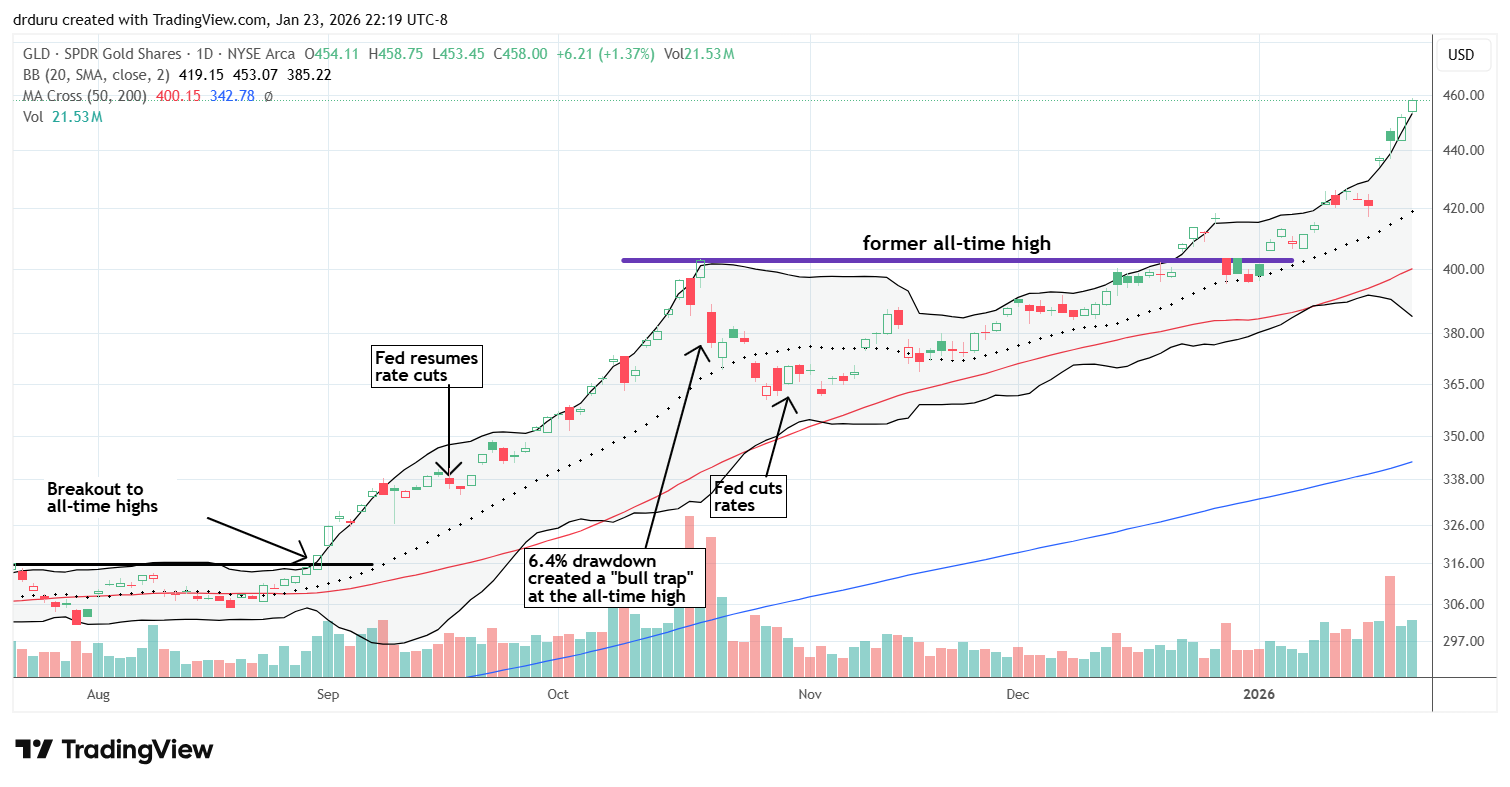
Technical status: SPDR Gold Trust (GLD) made a parabolic run alongside its upper Bollinger Band, setting new all-time highs.
Trade commentary: GLD has been on a tear since its 2023 breakout. This year has delivered another acceleration phase. This acceleration represents a parabolic move with GLD tagging its upper Bollinger Band (BB) (the black lines defining the expected volatility of price) all week. On Friday, GLD shot straight up from its upper Bollinger Band. Here I took profits on my latest GLD trade, a February $425/$440 call spread that, amazingly, turned out to be overly conservative. Even more amazing is the way financial market participants stare at gold’s relentless run-up as if it is a gold thing and not indicative of anything wrong in the financial system. One day we will find out who’s right. In the meantime, I am waiting for the next dip to buy.
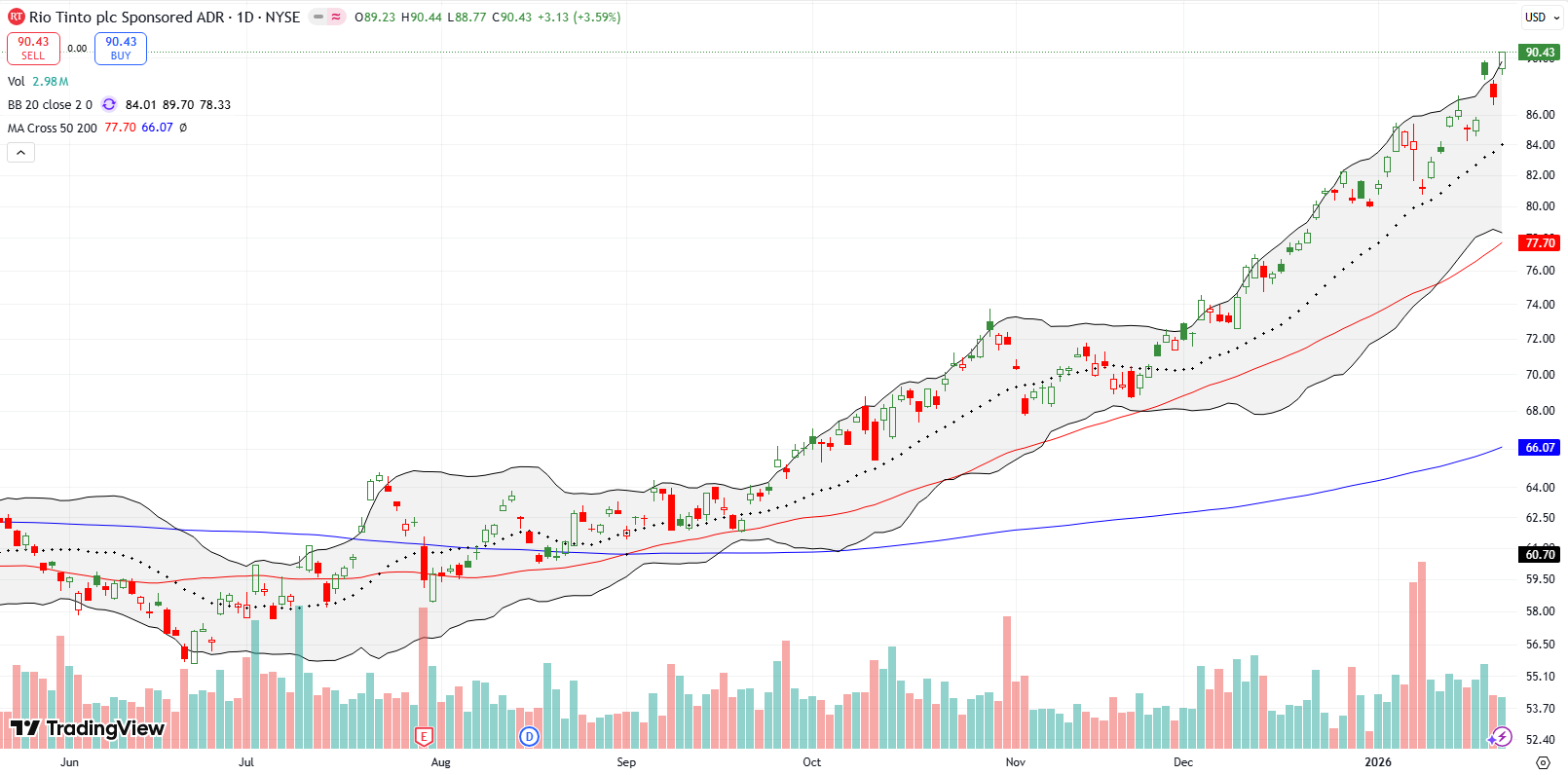
Rio Tinto (RIO)
Description: Rio Tinto (RIO) is a global mining and metals company that produces commodities including iron ore.
Technical status: Rio Tinto plc (RIO) hit a 5-year high as it climbed, firmly planted in its bullish run-up
Trade commentary: I am risk off but I have zero plans (so far) to sell any of my commodity plays running in parallel to precious metals. I see an American economy that will run hot and global governments and central banks which are likely to give in to more rounds of stimulus to assist economies burdened by new and old problems. I see a lot of investment going into infrastructure for AI, infrastructure for energy, and so on, and these activities will consume more and more commodities. A growing global battle for access to commodities says everything we need to know about investments in this sector.
Rio Tinto (RIO) has worked out particularly well as a part of my 2026 shopping list because Australia has had strong economic data. More on this topic coming in my Inflation Watch blog.
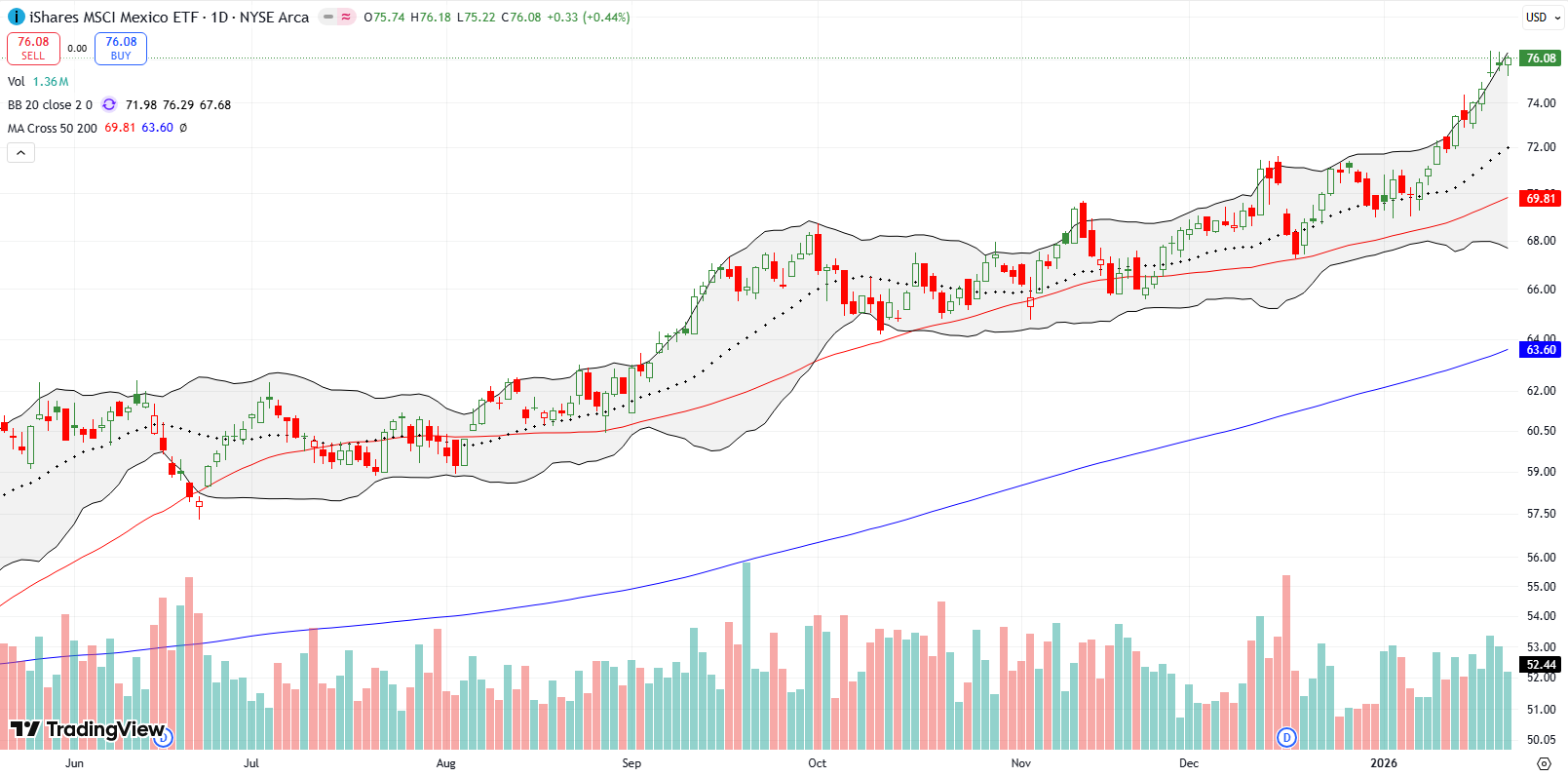
iShares MSCI Mexico ETF (EWW)
Description: iShares MSCI Mexico ETF (EWW) is an exchange-traded fund that seeks to track the performance of Mexican equities.
Technical status: iShares MSCI Mexico ETF (EWW) extended a strong rally that had been in place since spring of last year and added to gains early in the year.
Trade commentary: The iShares MSCI Mexico ETF (EWW) is another surprise winner of 2026’s early run-up plays. After gaining 48.1% last year, EWW is already up 9.7% this year. The S&P 500 is up 1.0% year-to-date. I really took my eye off the ball on Mexico even though I have traded the ever strengthening peso successfully. This miss is a big one. All I can do now is wait for the next pullback to the uptrending 50DMA (since I do not want to chase EWW higher).
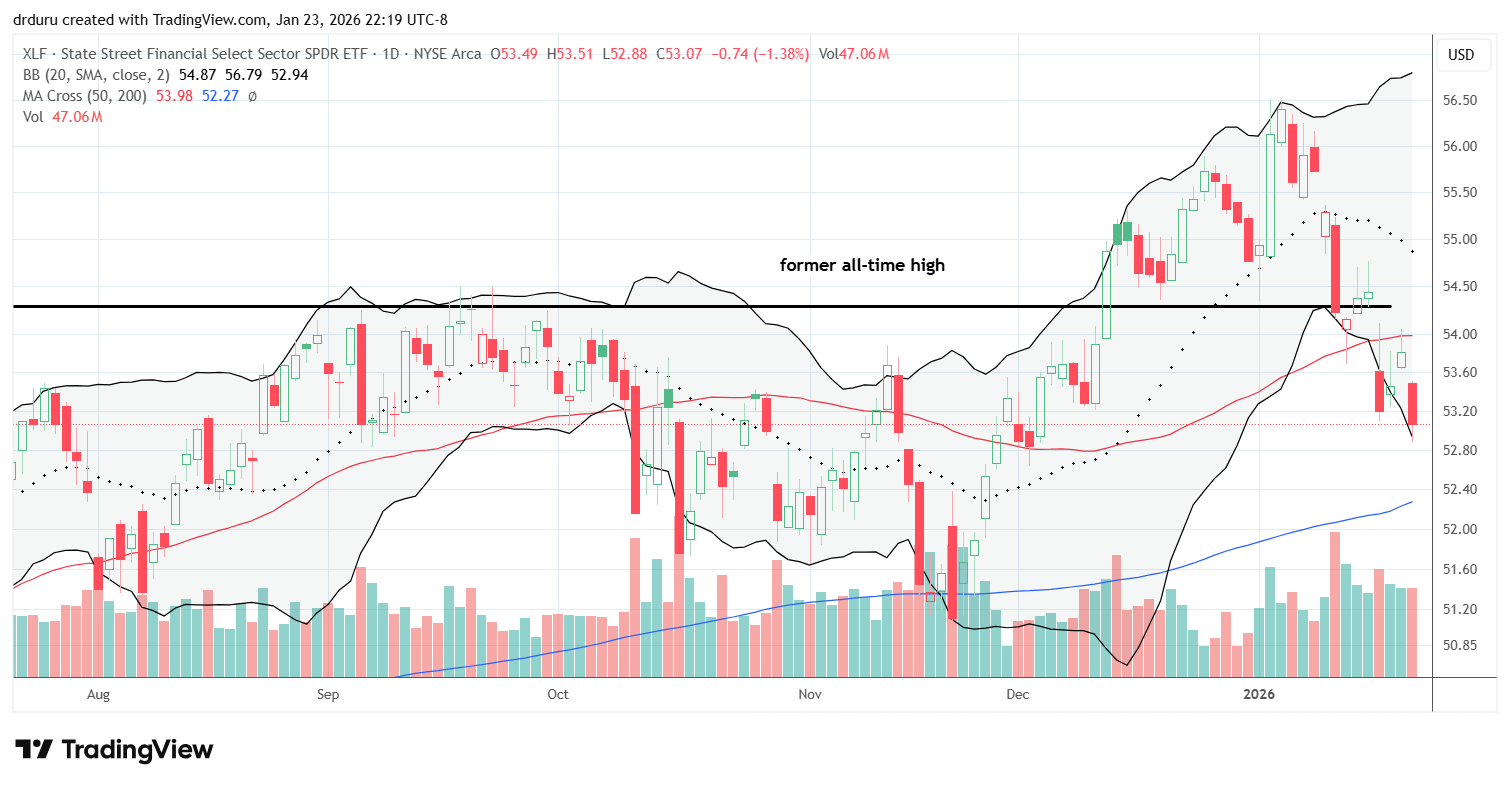
Financial Select Sector SPDR Fund (XLF)
Description: Financial Select Sector SPDR Fund (XLF) is an exchange-traded fund that tracks large U.S. financial sector companies.
Technical status: Financial Select Sector SPDR Fund (XLF) broke down through 50DMA support, weakly bounced into 50DMA resistance, and then sold off sharply, putting 200DMA support in focus.
Trade commentary: XLF followed through on its retreat from confirming the earlier bullishness in the stock market. I said two weeks ago that it is hard to be bearish when XLF is bullish. Now XLF is bearish after a confirmed 50DMA breakdown last week. Thus, the ETF of financials underlines my risk off stance. At this rate XLF will test 200DMA support in a week or two.
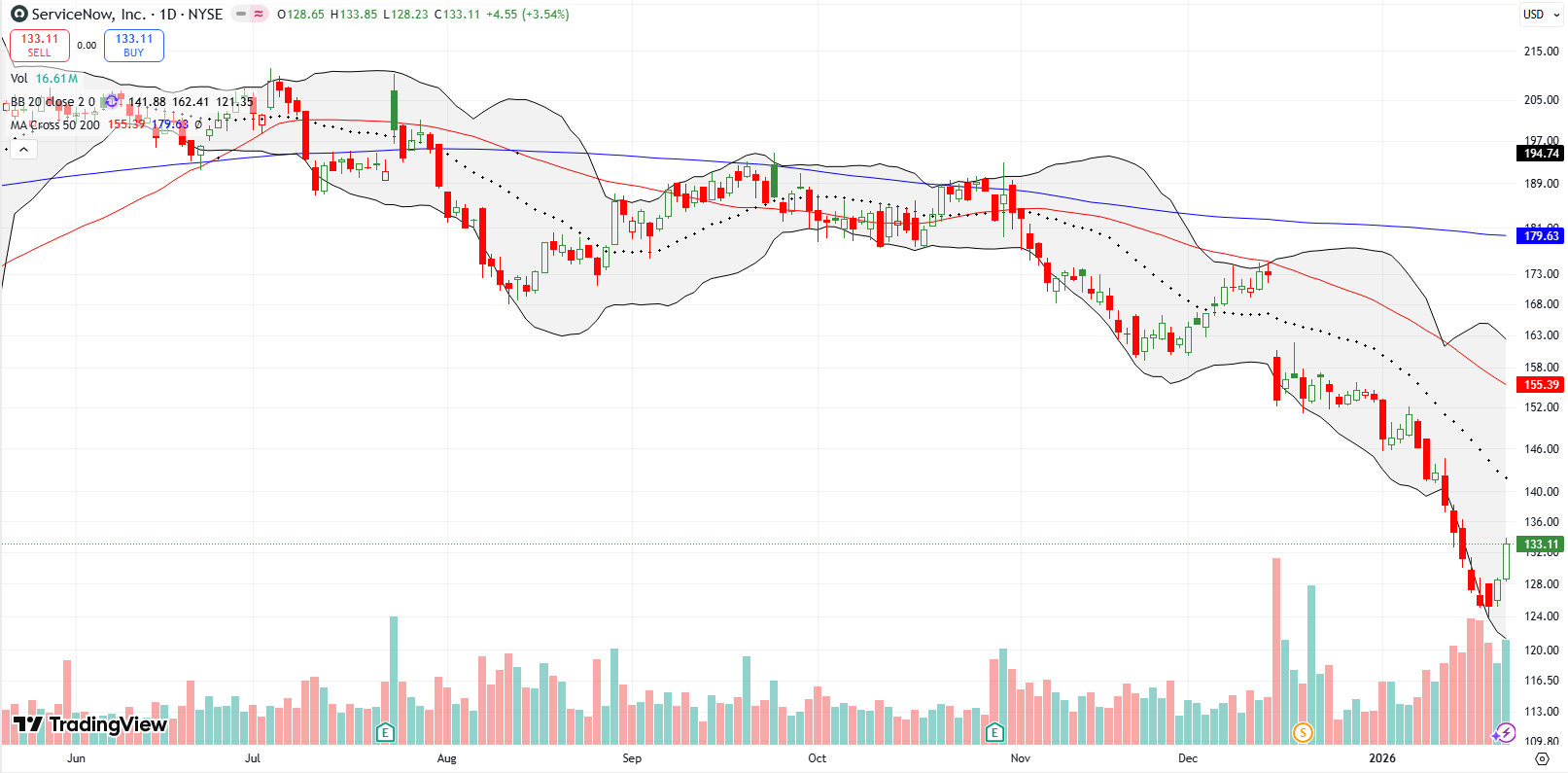
ServiceNow (NOW)
Description: ServiceNow (NOW) provides cloud-based software platforms for workflow automation and enterprise operations.
Technical status: ServiceNow Inc (NOW) began to make a turnaround amidst a steep and steady decline on AI-related fears.
Trade commentary: ServiceNow (NOW) has implemented some solidly strategic AI acquisitions. Its latest AI move is a partnership with OpenAI announced last week. ServiceNow has its eye on the ball, sees where the puck is going, and is ready for the AI-driven transformation in software. Investors have clearly panicked out of NOW and created a fantastic buying opportunity for measured contrarians like me. I bought NOW the day after this news. The market only reacted positively the day after that. While I traded in and out of other software plays during the week, I added NOW to my core list of contrarian software positions.
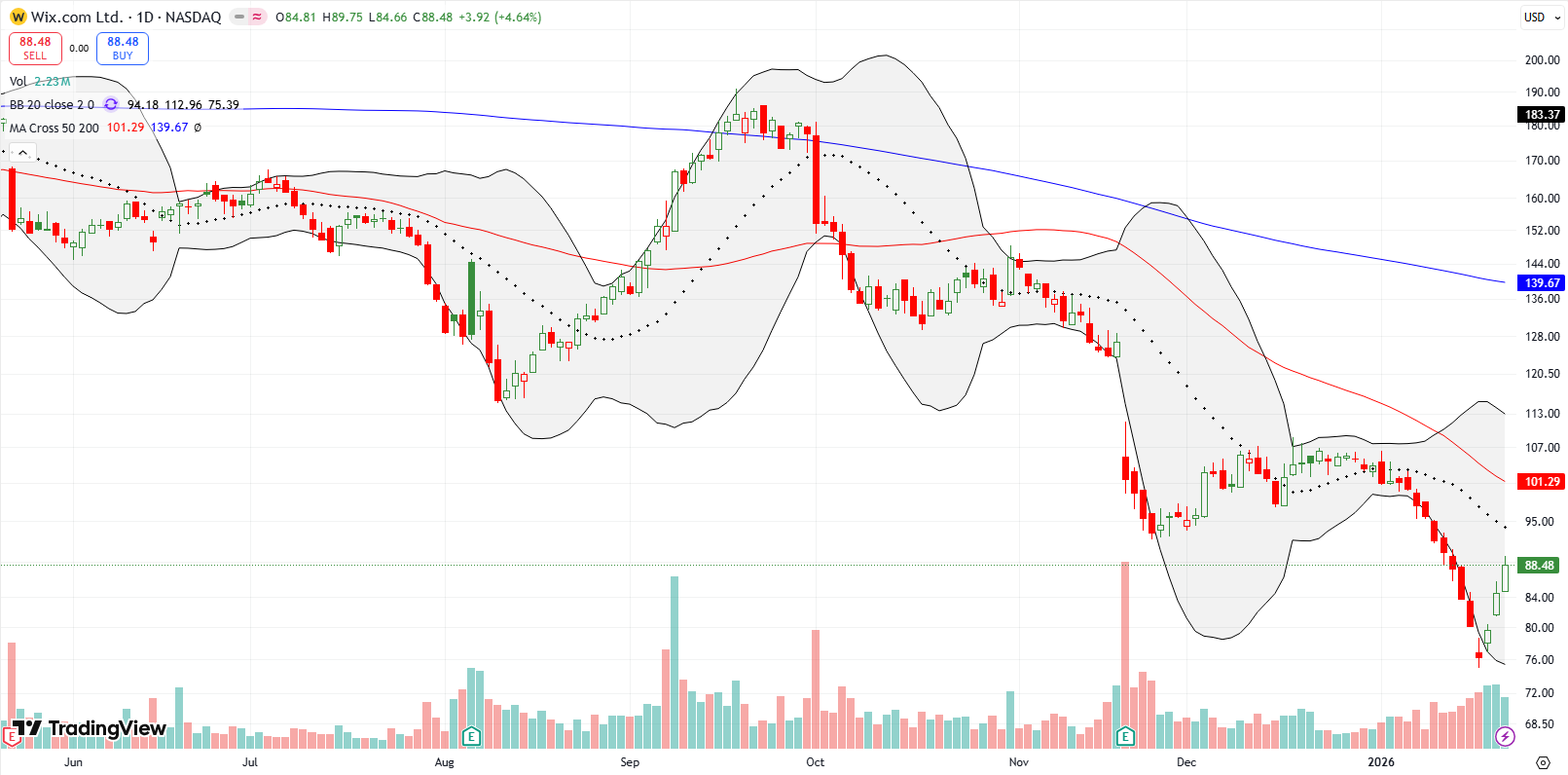
Wix.com (WIX)
Description: Wix.com (WIX) provides a web publishing platform for building and managing websites.
Technical status: Wix.Com Ltd (WIX) sold off in a heavy, accelerating decline and then flashed a morning star bottoming setup that was confirmed by a gap up and a 4.6% gain.
Trade commentary: WIX was a perfect bottom fishing play within the context of the software sell-off. The stock sold off day after day after day to start the year, with volume building into a crescendo of parabolic selling. Yet, fear and panic only lasts so long in the market. The classic bottoming signal was a morning star: a gap down, a “doji” that showed an intraday stalemate between buyers and sellers, and then a bullish resolution to the stalemate with a gap higher and a 4.6% on the day.
I bought a call spread on that confirmation and next took profits on Friday. While WIX is not a part of my core contrarian thesis on software stocks, I am using this chart and the trade as a classic and powerful example of trading the extremes of market behavior.
lululemon athletica inc (LULU)
Description: lululemon atheltica inc (LULU) designs and sells athletic apparel, footwear, and accessories.
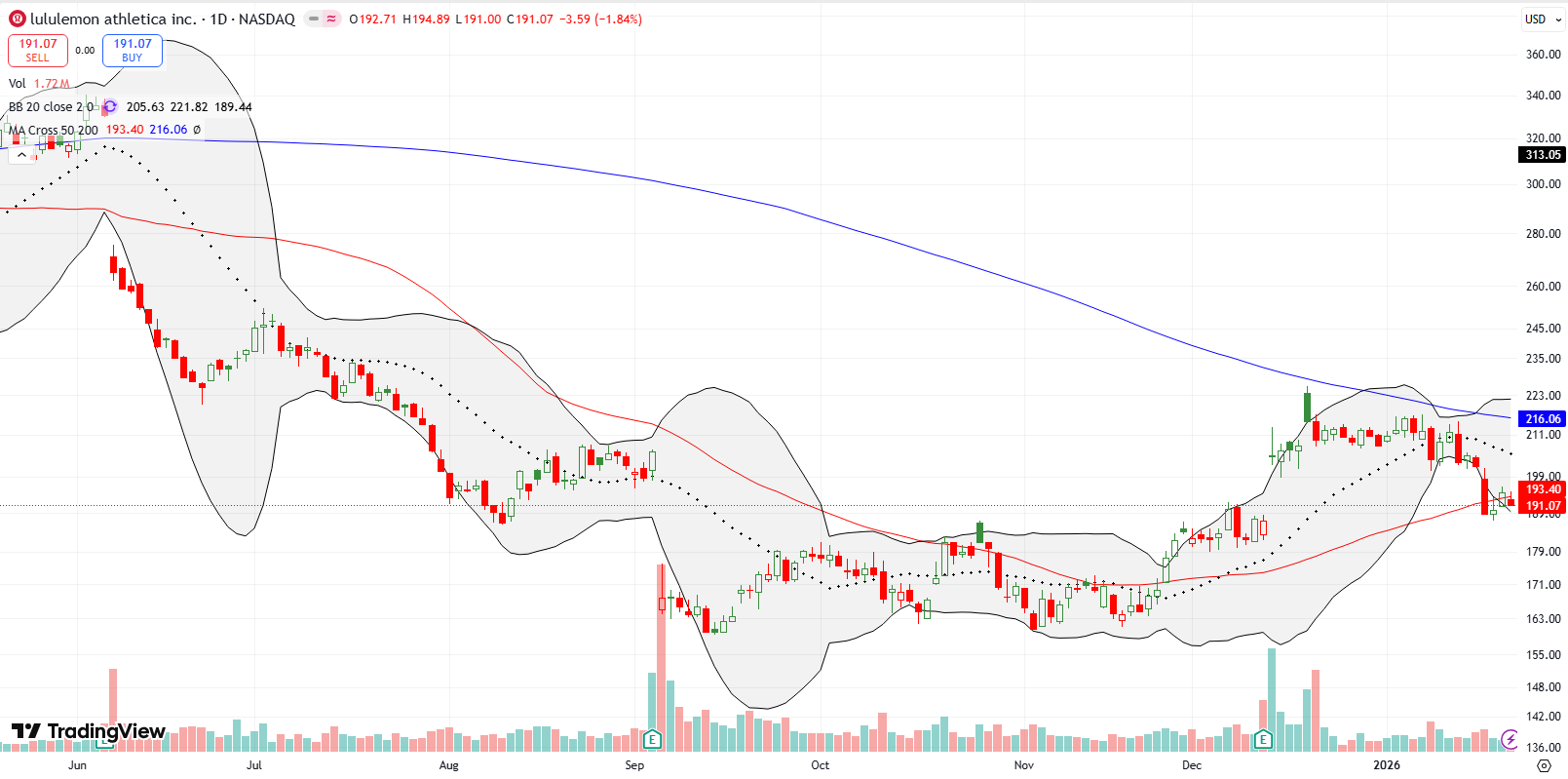
Technical status: lululemon athletica Inc (LULU) ran into 200DMA resistance with a gap and crap reversal and then broke down below its 50DMA, turning the stock bearish again.
Trade commentary: LULU looked like a turnaround stock until last month when it stalled post-earnings at 200DMA resistance. The subsequent month of a churn finally exhausted buyers and the stock drooped into a 50DMA breakdown. This return to bearishness ended the bearish to bullish reversal and brought the overall downtrend from the 2021 all-time high back into focus. Apparently, at least part of the pressure came from a “wardrobe malfunction” in the design of a newly launched “Get Low” athleisure line, a deja vu gaffe that first struck the company in 2013.
Reddit (RDDT)
Description: Reddit (RDDT) operates an online platform of communities and forums for user-generated discussions and content sharing.
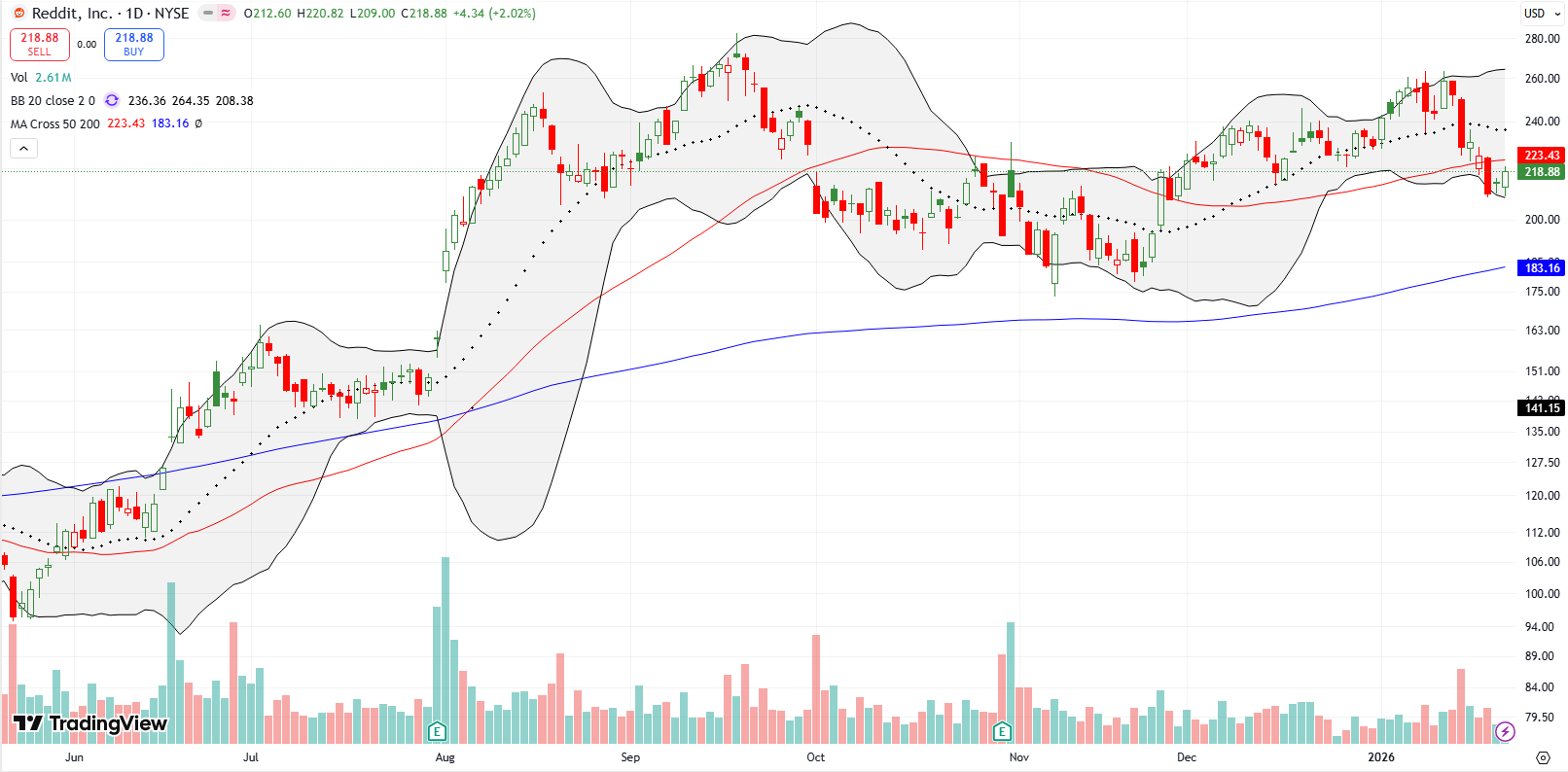
Technical status: Reddit Inc (RDDT) lost 6.8% in a 50DMA breakdown, leaving my very short-term long play on the ropes with tepid buying in a recovery effort.
Trade commentary: I tried to trade Reddit (RDDT) for a bounce off 50DMA support (before I turned risk off). The very next day RDDT fell 2.5% but still looked ready to hold support. A 6.8% drop the next day relieved me of my hopes. Overall, Reddit (RDDT) is neutral given the churn since last summer .
Apple Inc (AAPL)
Description: Apple Inc (AAPL) designs and sells consumer electronics, software, and digital services.
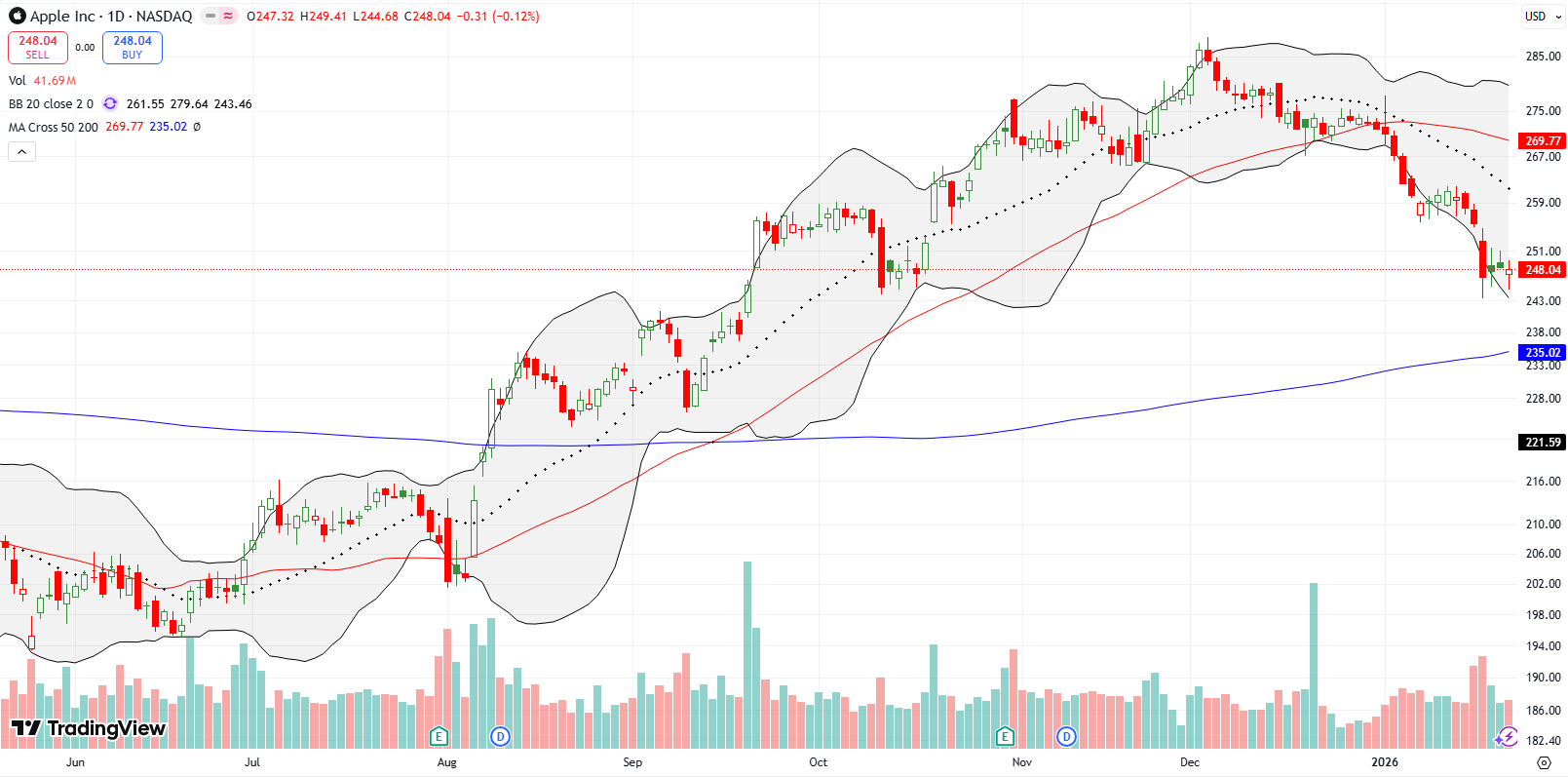
Technical status: AAPL confirmed a 50DMA breakdown and continued to decline, risking a 200DMA support test going into earnings.
Trade commentary: The year-to-date collective weakness of the “Magnificent 7” (the biggest tech stocks in the stock market) stands in sharp contrast to the exceptional strength in small caps, commodities, and consumer staples. AAPL’s weakness has been particularly persistent and notable. AAPL broke down below its 50DMA at the end of last year, confirmed the breakdown to start the year, and sellers pressed their bets from there.
I guessed AAPL was bottoming at the midpoint of this selling. I broke the rules of the ATM trade by buying call options on AAPL well below its 50DMA. I paid the price the following week when the stock looked like it was stabilizing only to resume selling in the final two days of the week. After a 3.5% plunge to start last week’s trading, AAPL did well to stabilize the rest of the way. Now, AAPL faces earnings in the coming week with a test of 200DMA support looming. If not for my risk off stance, I would be tempted to bet on AAPL holding support at the October lows.
Netflix (NFLX)
Description: Netflix (NFLX) operates a subscription streaming service that offers films and television programming.
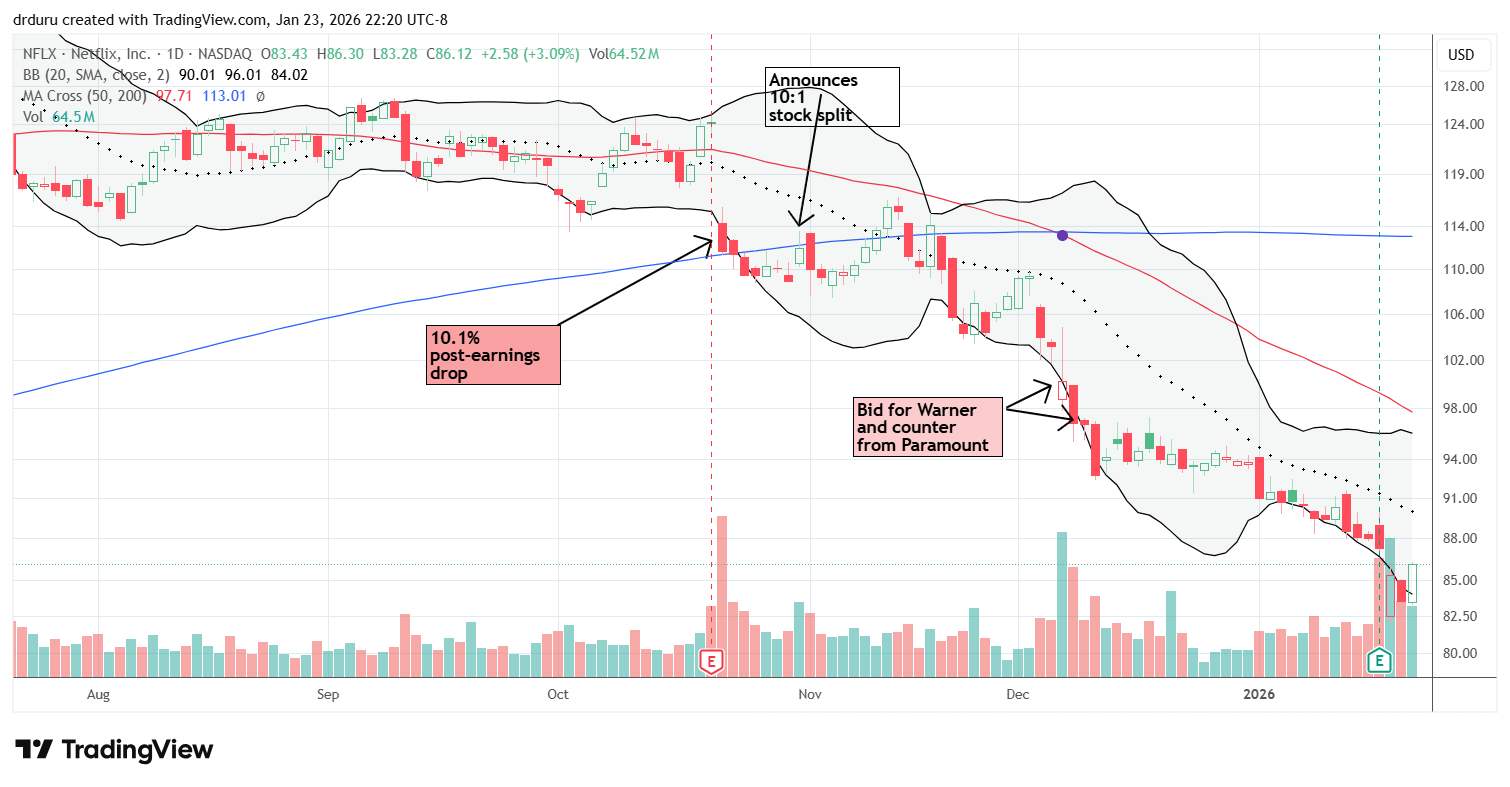
Technical status: Netflix Inc (NFLX) declined throughout the week, including a 2.2% post-earnings loss, reaching a level last seen at the start of 2025.
Trade commentary: I am targeting NFLX as a contrarian buy. The market has exhibited persistent negativity since a peak last summer, a weakness now amplified by the on-going drama over a bid to acquire Warner Brothers. NFLX popped 3.1% Friday after testing the lows from the April tariff trauma, drama and noise. Thus, the stock finally looks like it is finally trying to find a bottom, and I plan to make a first purchase in the coming week (despite my risk off trading call). Even if NFLX continues selling off from here, the stock looks like a great long-term hold from here. I will happily buy more at greater discounts.
My first contrarian attempt was a pre-earnings calendar call spread. I am left with a Feb $95 call that only has an outside chance of delivering a win. I went ahead and doubled down to reduce the basis (to $1.45) and slightly increase the odds of that win.
Intel (INTC)
Description: Intel (INTC) designs and manufactures semiconductor products and related computing technologies.
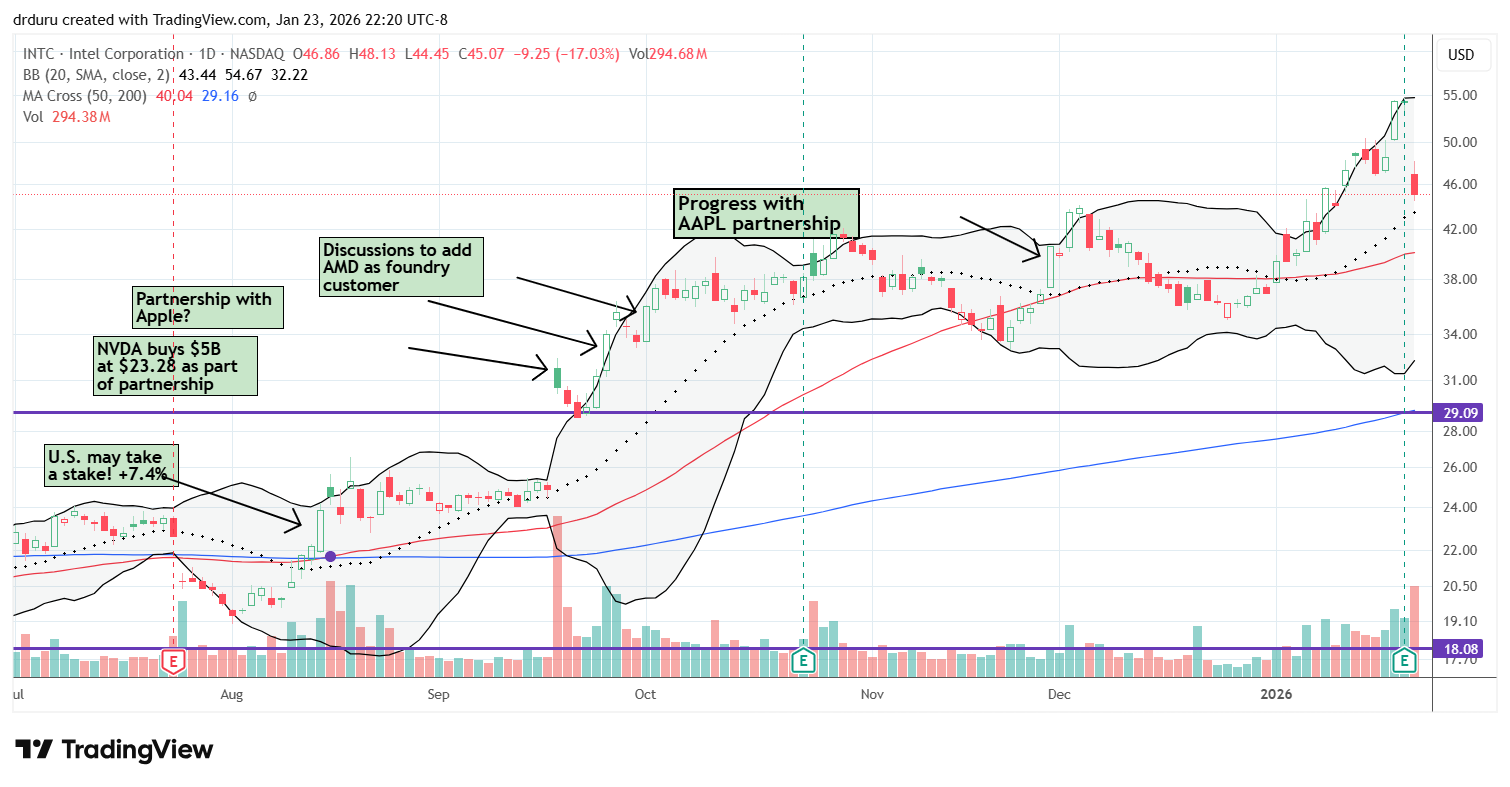
Technical status: Intel Corp (INTC) suffered a 17% post-earnings drop, falling away from new highs for the year.
Trade commentary: Intel (INTC) is my first setback from my 2026 shopping list. While I hold a substantial net profit from trading call options and selling calls against my shares, holding shares through a post-earnings collapse puts a dent in my thesis for INTC. I assumed the pre-earnings run-up carried some meaning. Fortunately, I bought shares at the beginning of the year, so the post-earnings collapse “only” erased about half the gains on my shares (mitigated by the obliteration of a call sold short against the position). This post-earnings loss reinforces my risk off stance for the rest of earnings season. Still, I will look to restart my “between earnings” trade in INTC by speculating on call options at key support levels. A test of 20DMA support looks imminent and a 50DMA test would nearly completely reverse my gains on shares. A test of 200DMA support would completely invalidate my reasons for including INTC on the 2026 shopping list.
In the meantime, I am looking to sell a call option against my position on the first bounce from current levels.
Booz Allen Hamilton Corporation (BAH)
Description: Booz Allen Hamilton provides management and technology consulting services, including work with government and commercial clients.
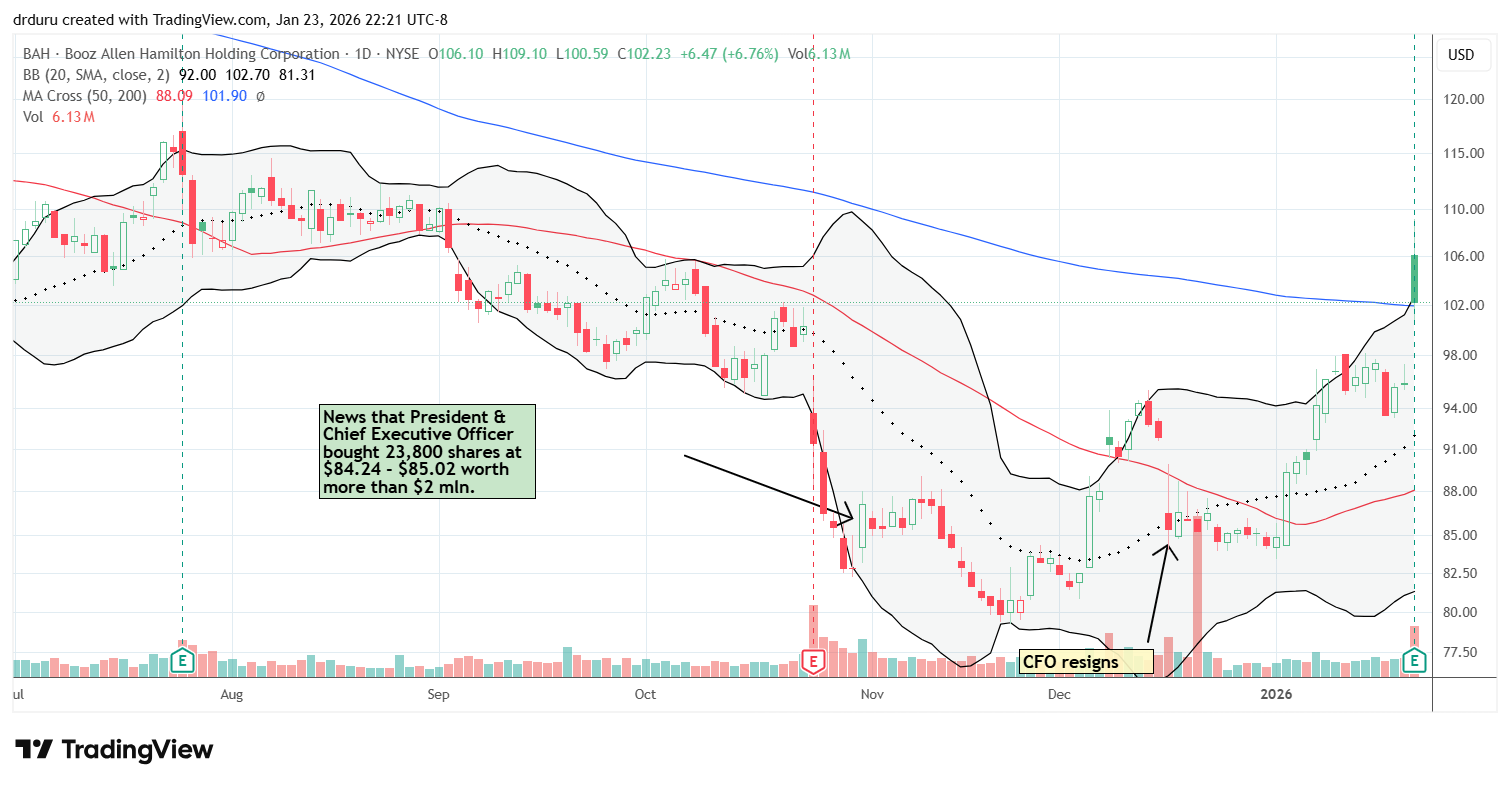
Technical status: Booz Allen Hamilton (BAH) surged 6.8% after earnings and held 200DMA support despite a gap and crap.
Trade commentary: When I lasted referenced BAH in December, I was stubbornly holding shares in the wake of a pullback following news of the CFO’s resignation. I rolled a covered call position to go short a January $90 call from a December $85 call. That target looked reasonably until BAH joined the group of stocks that has skyrocketed year-to-date. My shares were called away ahead of a post-earnings breakout above 200DMA resistance. Now, BAH looks like it is finally confirming a bottom. If 200DMA support holds, I will start scaling back in for a longer-term hold. Otherwise, I will look to trade the stock first on a complete reversal of post-earnings gains. As a reminder, I am interested in BAH as a contrarian play that follows a substantial investment by the CEO following October’s post-earnings sell-off to levels last seen in the summer of 2022. The subsequent post-earnings surge validates the trade strategy of following substantial purchases by insiders.
Be careful out there!
Footnotes
Subscribe for free to get email notifications of future posts!
“Above the 50” (AT50) uses the percentage of stocks trading above their respective 50-day moving averages (DMAs) to measure breadth in the stock market. Breadth defines the distribution of participation in a rally or sell-off. As a result, AT50 identifies extremes in market sentiment that are likely to reverse. Above the 50 is my alternative name for “MMFI” which is a symbol TradingView.com and other chart vendors use for this breadth indicator. Learn more about AT50 on my Market Breadth Resource Page. AT200, or MMTH, measures the percentage of stocks trading above their respective 200DMAs.
Active AT50 (MMFI) periods: Day #155 over 20%, Day #44 over 30%, Day #42 over 40%, Day #37 over 50%, Day #13 under 60% (overperiod), Day #128 under 70% (underperiod)
Source for charts unless otherwise noted: TradingView.com
Full disclosure: long IWM shares, long SPY put spread, long RIO, long XLF calls, long NOW, long RDDT call spread, long INTC
FOLLOW Dr. Duru’s commentary on financial markets via StockTwits, BlueSky, and even Instagram!
*Charting notes: Stock prices are not adjusted for dividends. Candlestick charts use hollow bodies: open candles indicate a close higher than the open, filled candles indicate an open higher than the close.
* Blog notes: this blog was written based on the heavily edited transcript of the following video that includes a live review of the stock charts featured in this post. I used ChatGPT to process the transcript.