

Stock Market Commentary
Inflation grabbed the headlines last week, but market breadth was just as important for the stock market. With financial markets initially feeling good about the CPI report, buyers rushed for laggard stocks and created a market breadth revival for two days. The abrupt sentiment shift nearly eliminated all my concerns about a bearish divergence between waning market breadth and an S&P 500 melting higher. A “surprising” surge in the Producer Price Index (PPI) deflated the CPI euphoria and stopped the market breadth surge in its tracks. The net result for the week was still fresh bullish momentum for the stock market as a whole.
The volatility index made a new low for the year as a way of confirming the fresh bullish momentum. The VIX was last this low the day before Christmas in 2024.
The Stock Market Indices
S&P 500 (SPY)
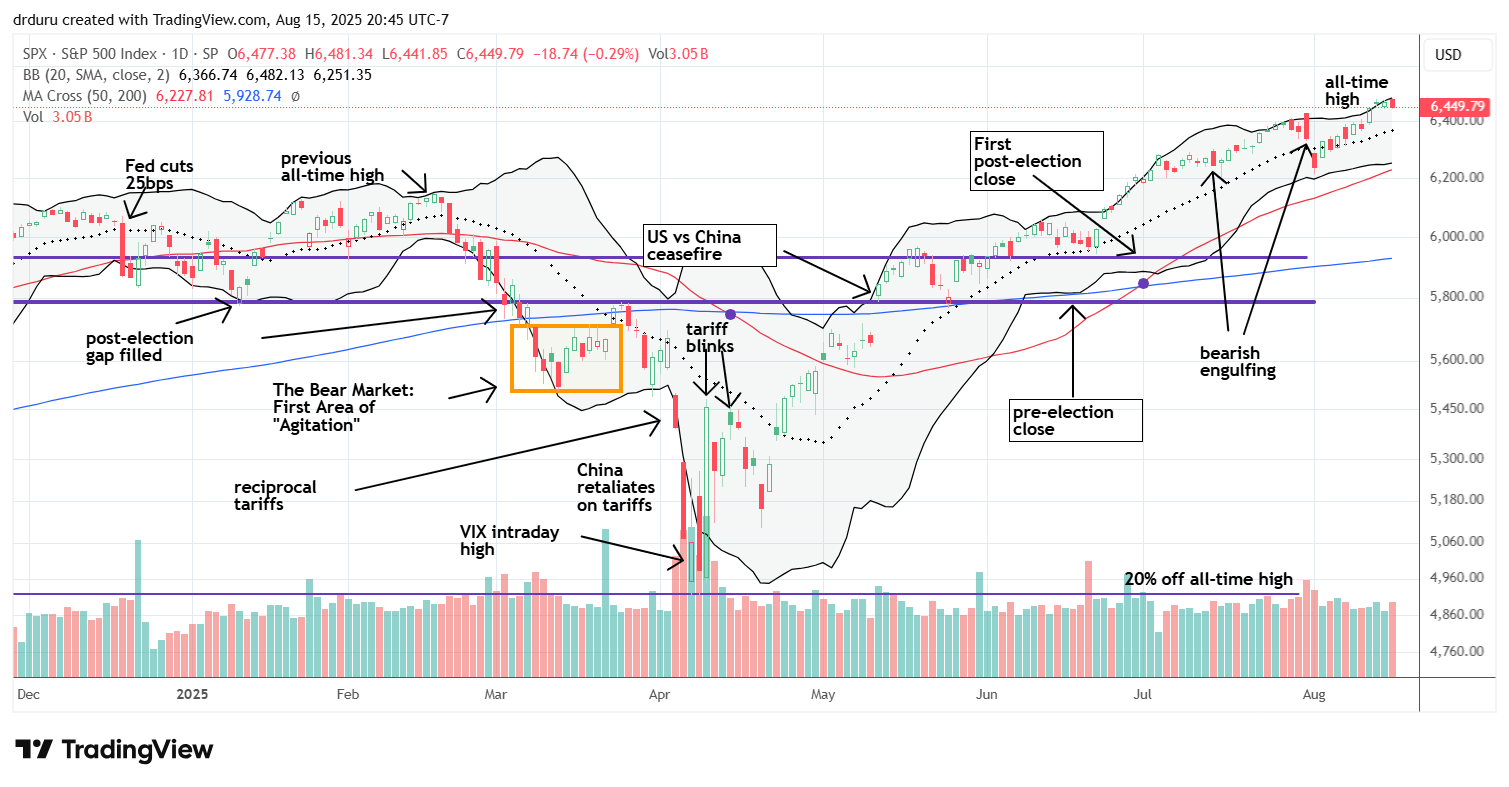
The S&P 500 (SPY) dropped 1.6% on August 1st, which had me anticipating a seasonal drawdown. Instead the buyers jumped right in and pushed the index into a steady march higher to fresh all-time highs. Even with market breadth pulling back a bit at the end of last week, the index closed higher on Thursday and dipped only 0.3% on Friday. The melt-up continues yet the S&P 500 does not even show the impact of the market breadth revival.
NASDAQ (COMPQ)
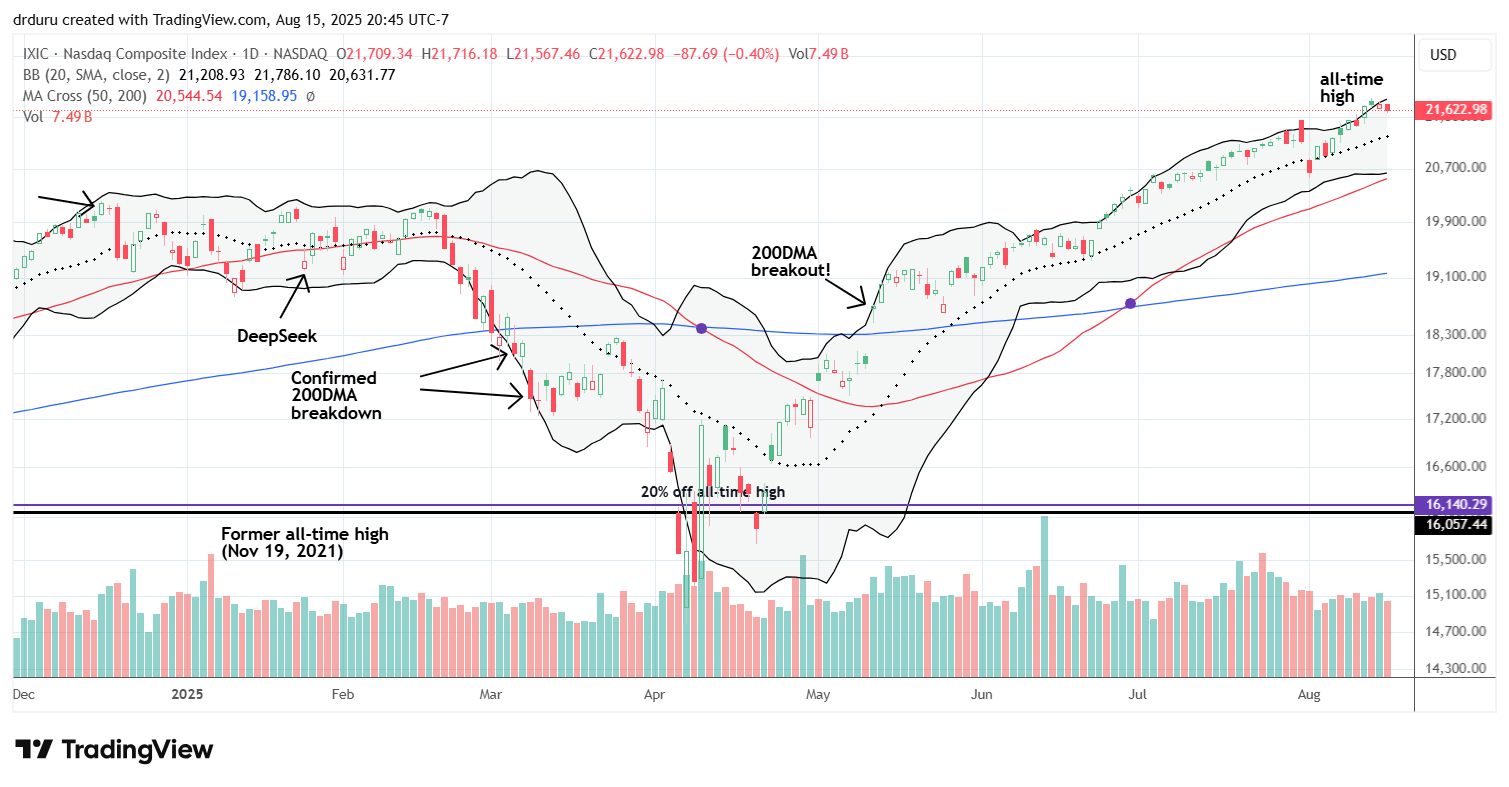
The NASDAQ (COMPQ) showed the same pattern as the S&P 500, sliding slightly on Thursday but otherwise continuing its melt-up trend. Right now, every dip to the 20DMA looks like a quick buying opportunity, as market sentiment is fully entrenched in buy-the-dip mode.
iShares Russell 2000 ETF (IWM)
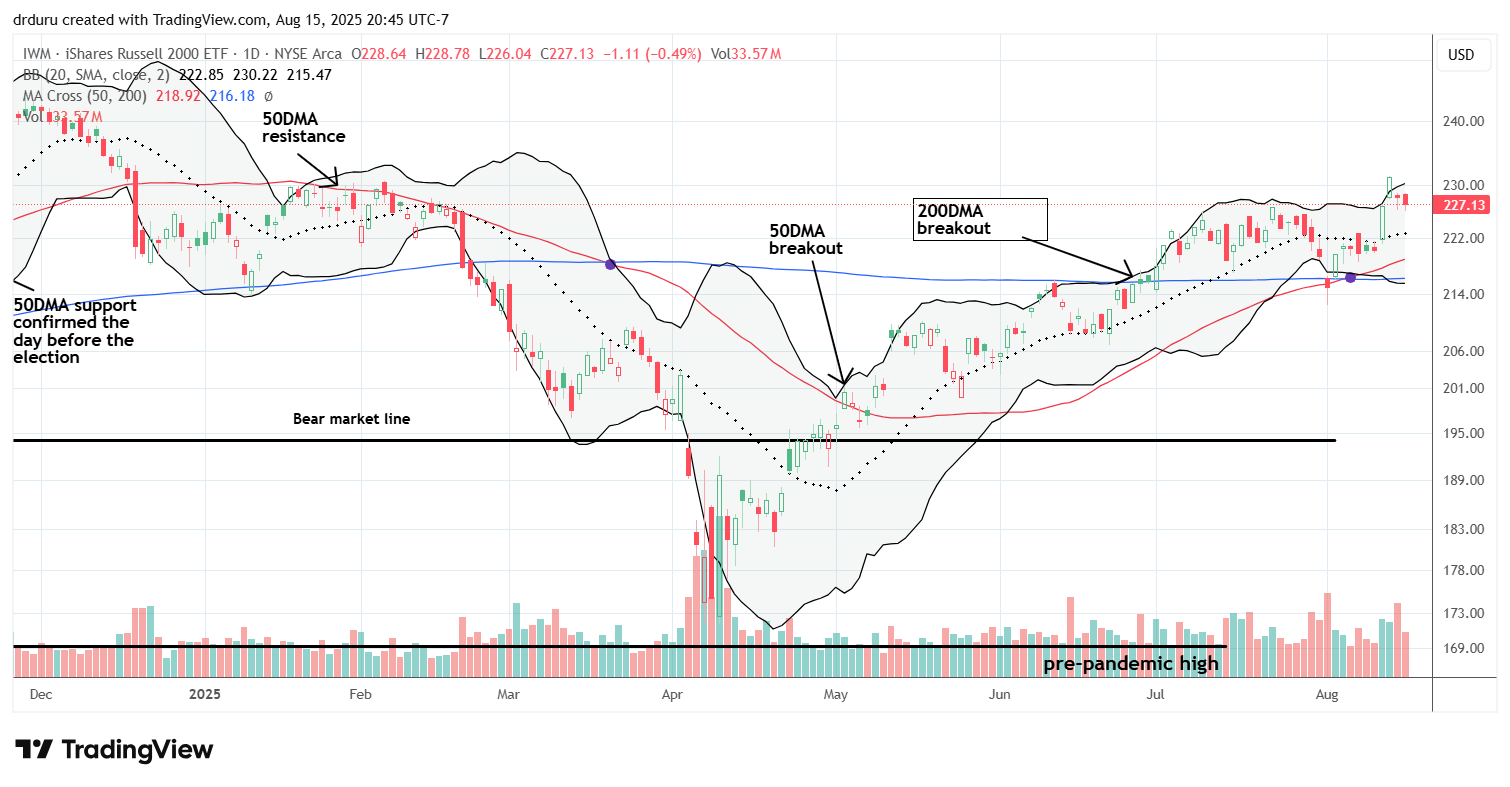
IWM was the biggest beneficiary of the breadth surge, breaking out to a new high for the year. Unfortunately, I was caught flat-footed. My regularly scheduled IWM calendar call spreads targeted the $225 strike, but IWM blew through the July highs and left me with only a fraction of the gains I could have had with straight calls. I adjusted with a new $230 strike calendar spread, and I am now carrying straight call options into next week after adding more on Friday. Of course, IWM is at risk now of a quick pullback to 20DMA support.
The Short-Term Trading Call With A Market Breadth Revival
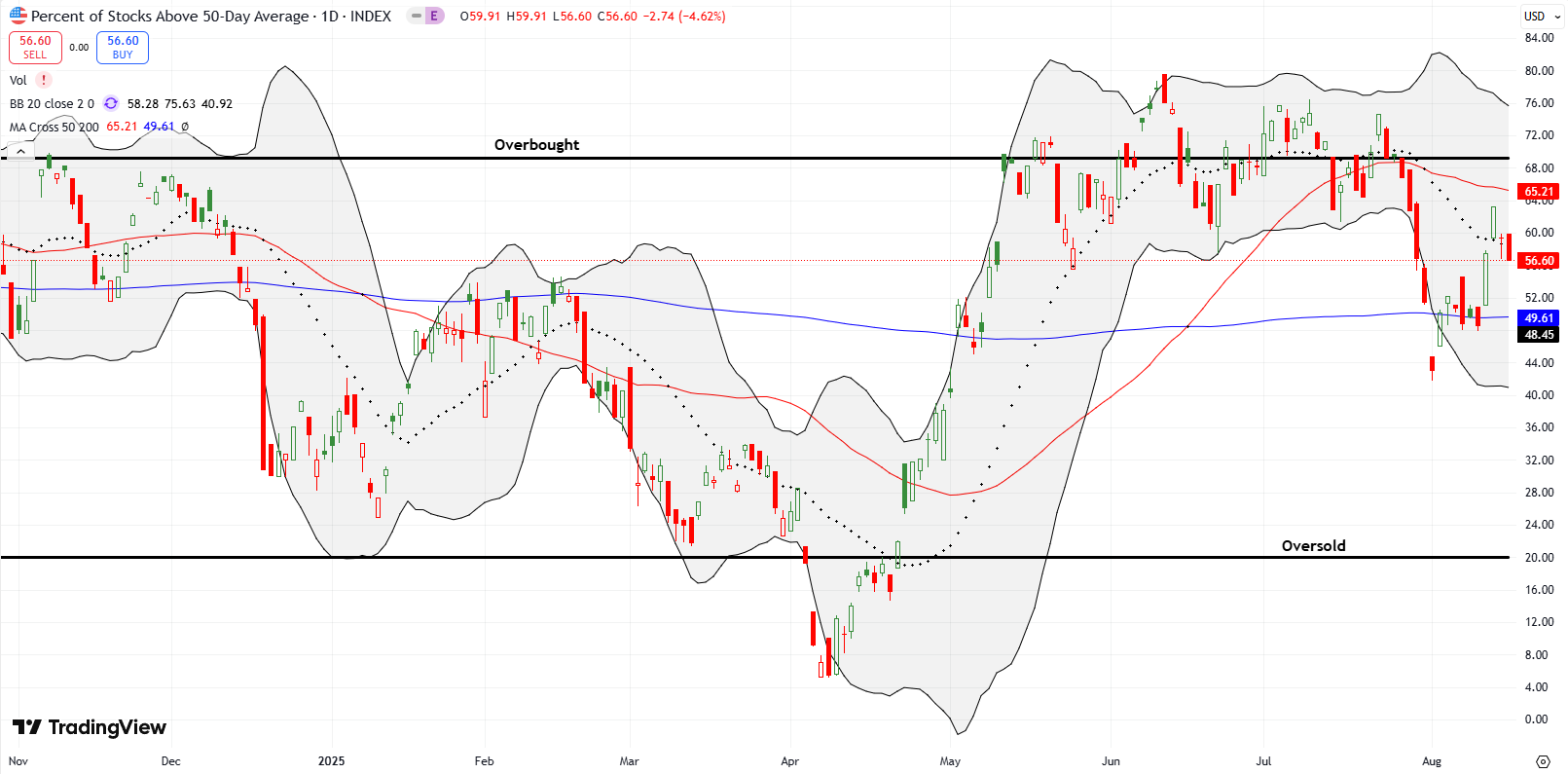
- AT50 (MMFI) = 56.6% of stocks are trading above their respective 50-day moving averages (first overbought day)
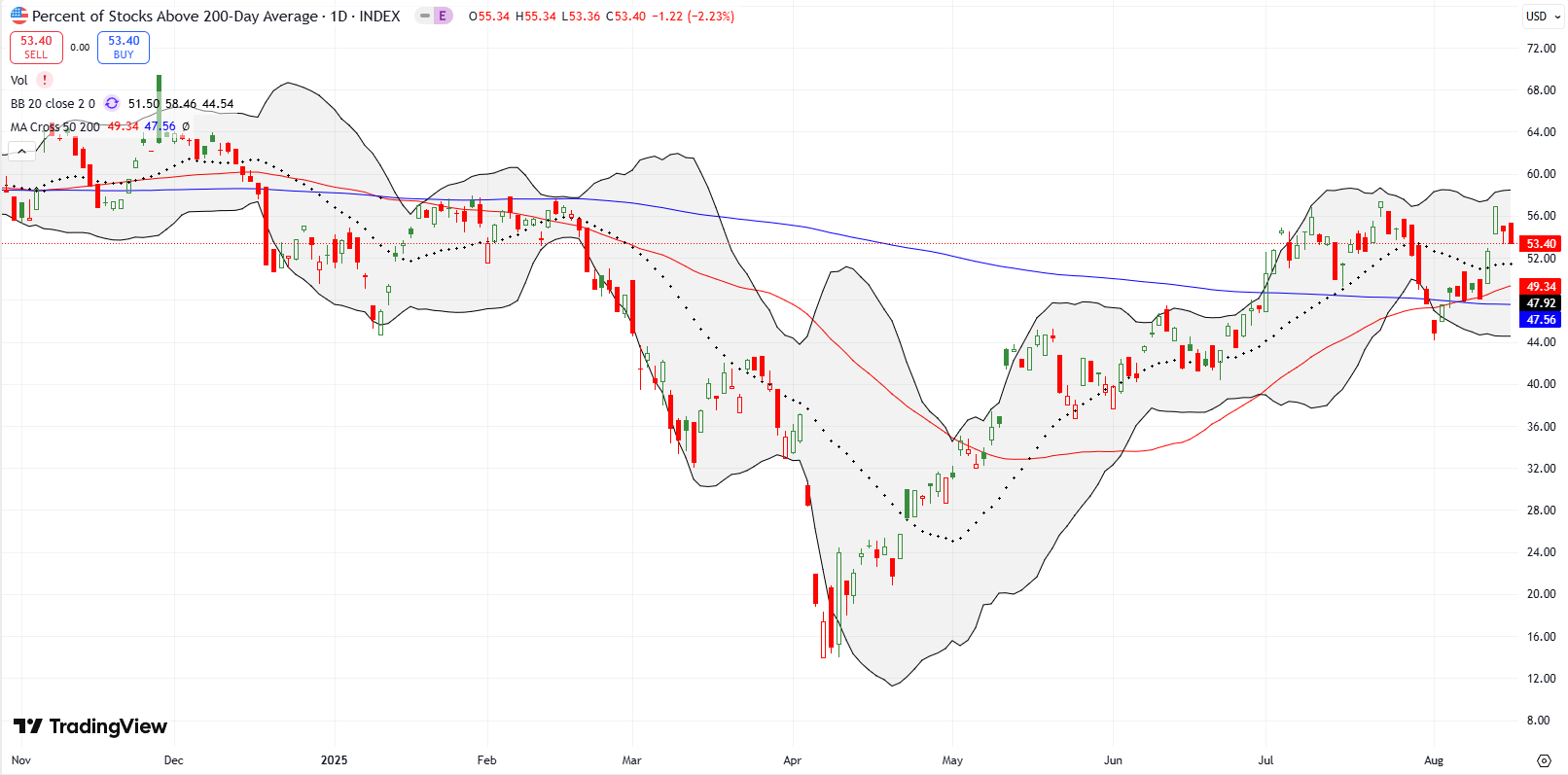
- AT200 (MMTH) = 53.4% of stocks are trading above their respective 200-day moving averages
- Short-term Trading Call: neutral
AT50 (MMFI), the percentage of stocks trading above their respective 50DMAs, closed the week at 56.6%. My favorite technical indicator surged 15 percentage points with the market breadth revival. AT200 (MMTH), the percentage of stocks trading above their respective 200DMAs, also jumped, briefly reclaiming levels from when the S&P 500 was last at all-time highs in February.
The significant improvement in market breadth broke my long-standing complaint that breadth was diverging bearishly from the major indices. Still, I am keeping the short-term trading call at neutral. This positioning will keep me mentally ready for any further drawdowns during these three months which are the most dangerous for the S&P 500. As a reminder I consider these drawdowns to be buying opportunities with October drawdowns offering the best risk/reward for such trades.
In the individual charts below, I show compelling cases of buy-every-dip mentality. I informally noticed a pattern this week of buyers stepping into stocks right at or just above 200DMA support on any drawdown. Where stocks managed to gap below 200DMA support, buy interest was not nearly as strong. In the coming weeks I will be looking for more evidence for the persistence of this buying pattern.
The Equities: Market Breadth Revival
Monday.com (MNDY)
Description: Monday.com (MNDY) is a cloud-based work operating system that helps organizations manage projects, workflows, and collaboration.
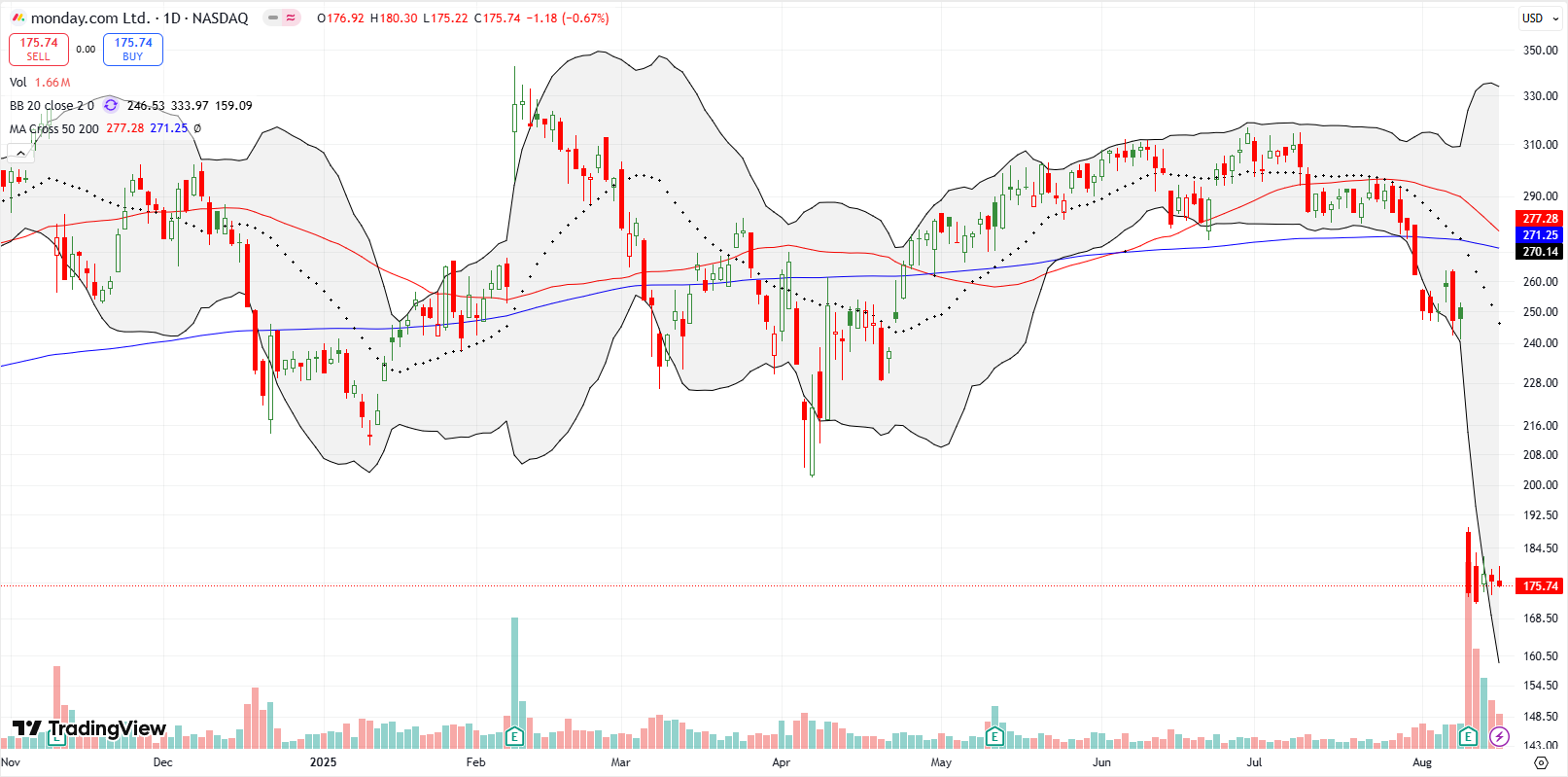
Technical status: MNDY plunged 30% after earnings, erasing gains for the year and returning to January 2024 levels. The stock is expensive, and the sharp move showed how easily bad news can take down expensive stocks even in the middle of a raging bull market.
Trade commentary: I’m not a buyer here, but I’ll watch in case buying interest picks up. For now, MNDY stays off my buy list. I definitely do not want to short since the stock could pop 10% on any given day that enough traders decide the stock is “cheap” down here.
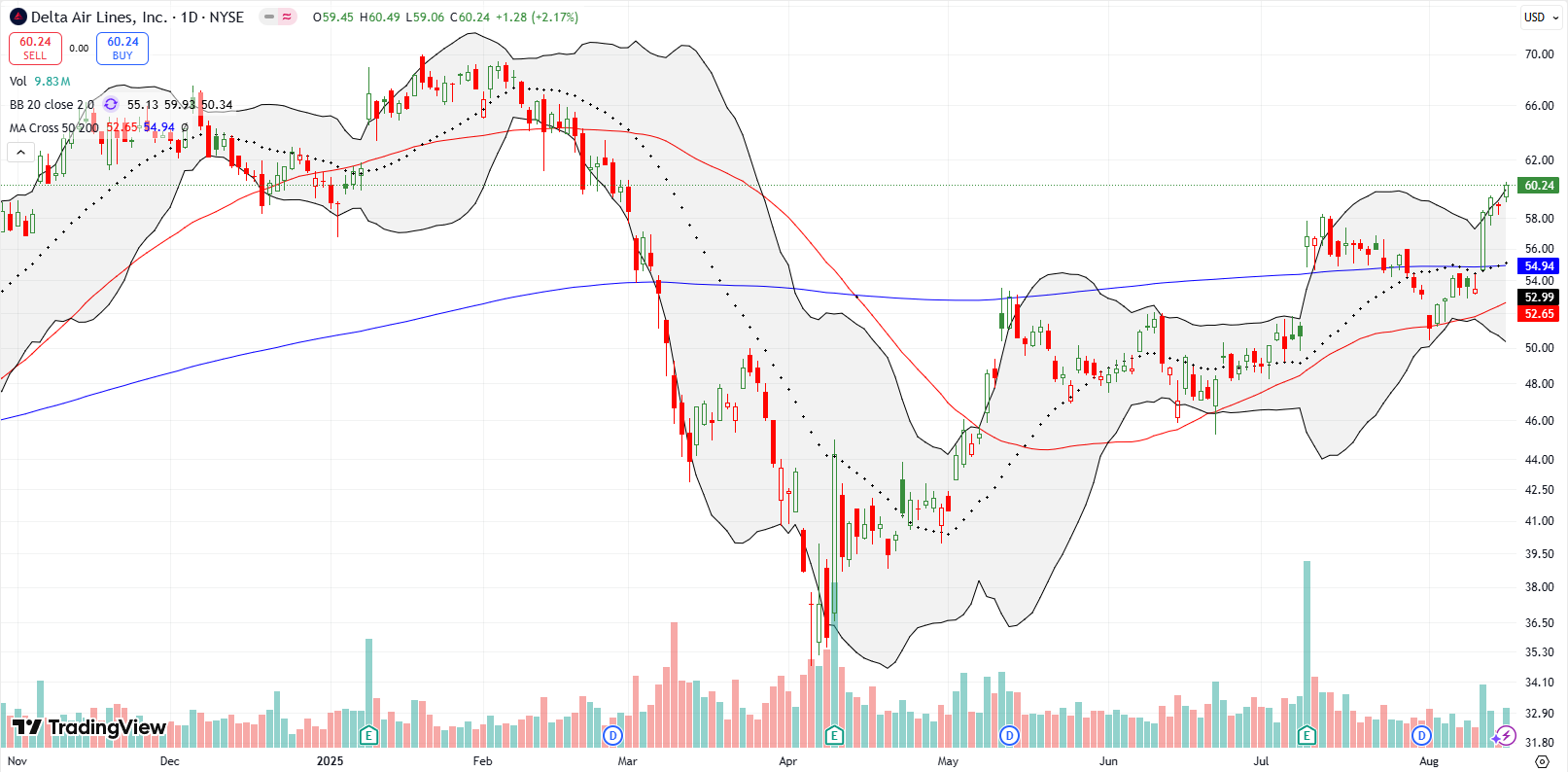
Delta Air Lines (DAL)
Description: Delta Air Lines (DAL) is a major U.S. airline providing domestic and international air travel services.
Technical status: DAL soared 9.2% after the CPI report showed strength in airline ticket prices. The stock held above its 200DMA, bouncing from support.
Trade commentary: I was caught flat-footed with a Sep/Jan $57.50 DAL calendar spread. I assumed DAL would largely stay in a trading range near or around its 200DMA (the blue line below). Still, I expect it to drift lower in due time as it is very possible the spike was one of those random things. Consumers may not be able to sustain higher and higher airline prices in the current economic environment.
Meta Platforms (META)
Description: Meta Platforms (META) is a technology company that owns and operates social media platforms including Facebook, Instagram, and WhatsApp.
Technical status: META bounced perfectly off 50DMA support and surged 11.3% post-earnings to an all-time high. Yet, the next day META gapped down for a 3.0% loss during the bears break-in on August 1st. Bullish momentum is back for META.
Trade commentary: I did not trade META even as the gap down after the earnings surge was a clear buying opportunity. I expect the stock to keep drifting higher with the 20DMA (the dashed line) racing to catch up.
Cardinal Health (CAH)
Description: Cardinal Health (CAH) is a healthcare services and products company specializing in pharmaceuticals and medical supplies distribution.
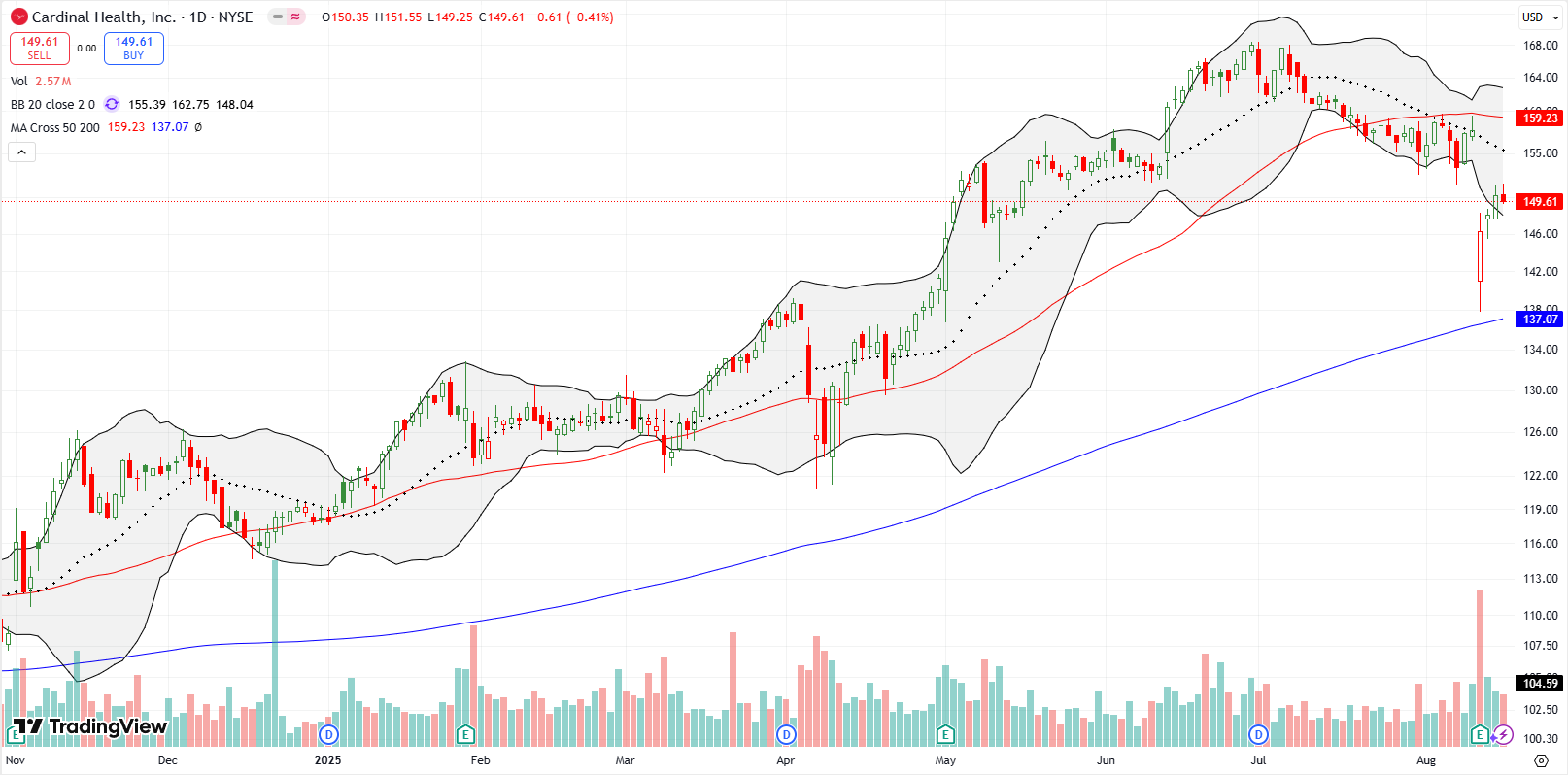
Technical status: CAH dropped 7.2% after earnings, nearly tagging 200DMA support at $137.75. Buyers stepped right in from there.
Trade commentary: If I had been paying closer attention, I would have bought at support. I am anecdotally noticing a pattern in this aggressively bullish environment where buyers are stepping in at 200DMA support almost no matter the cause of the pullback. CAH fits this mold. Moreover, the drop to 200DMA support created an extreme over-extension to the downside well below the lower Bollinger Band (BB).
UnitedHealth Group (UNH)
Description: UnitedHealth Group (UNH) is a diversified healthcare company offering health insurance and healthcare services.
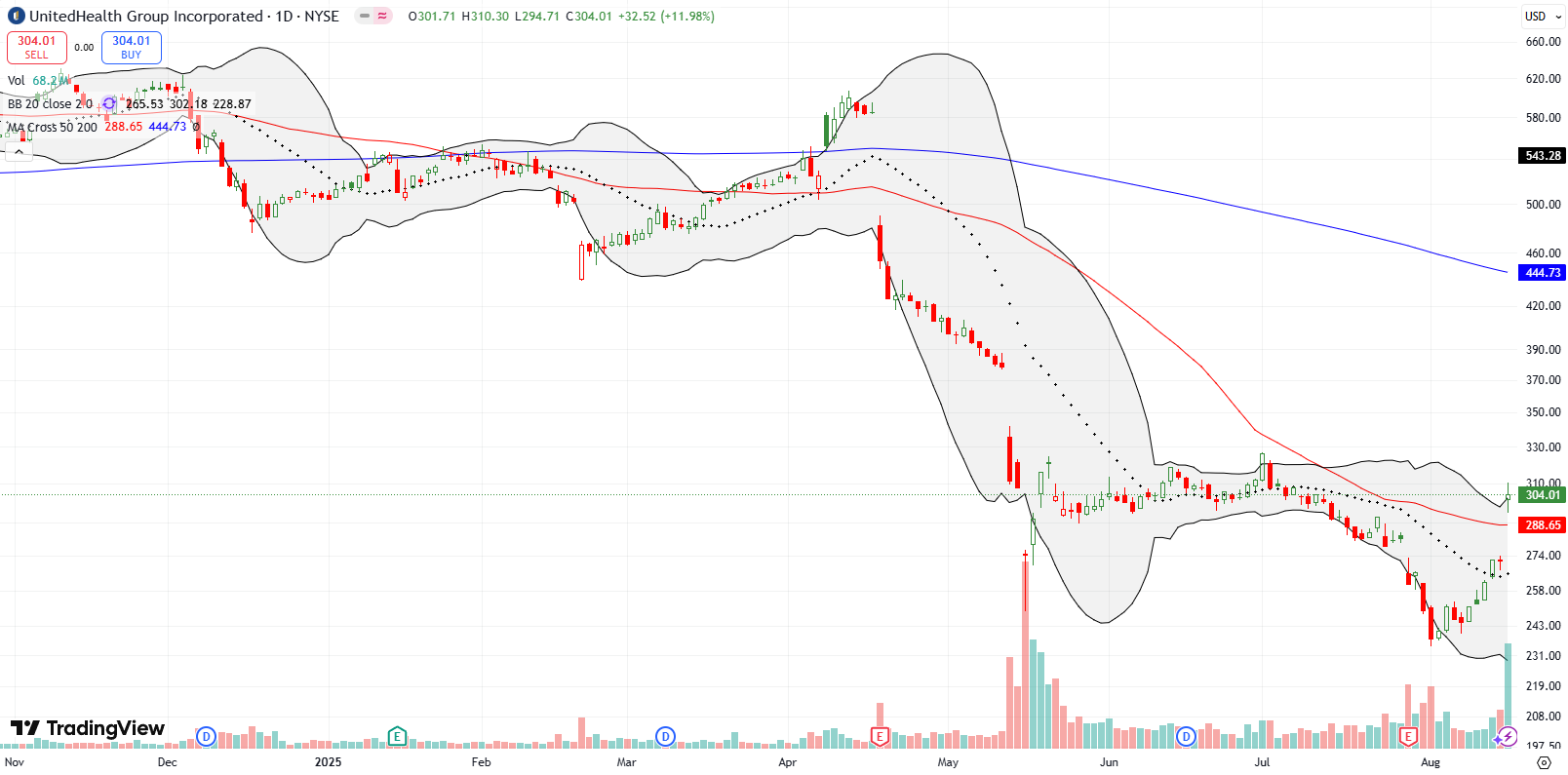
Technical status: UNH had been beaten down for months from scandal, investigations, and poor earnings, dropping as much as 45% this year. The stock hurdled 50DMA resistance with a 12% surge after Berkshire Hathaway and other big institutional money managers disclosed large stakes.
Trade commentary: I sold a September $280 put shortly after the open. I am assuming the 50DMA breakout is bullish with a low risk of reversal. Even if UNH trades below $280, I will be happy to own the stock there. I made this trading call after deciding buying a small amount of shares in the hopes for lower prices offered insufficient upside potential.
SmartRent (SMRT)
Description: SmartRent (SMRT) provides smart home automation and property management solutions for real estate operators.
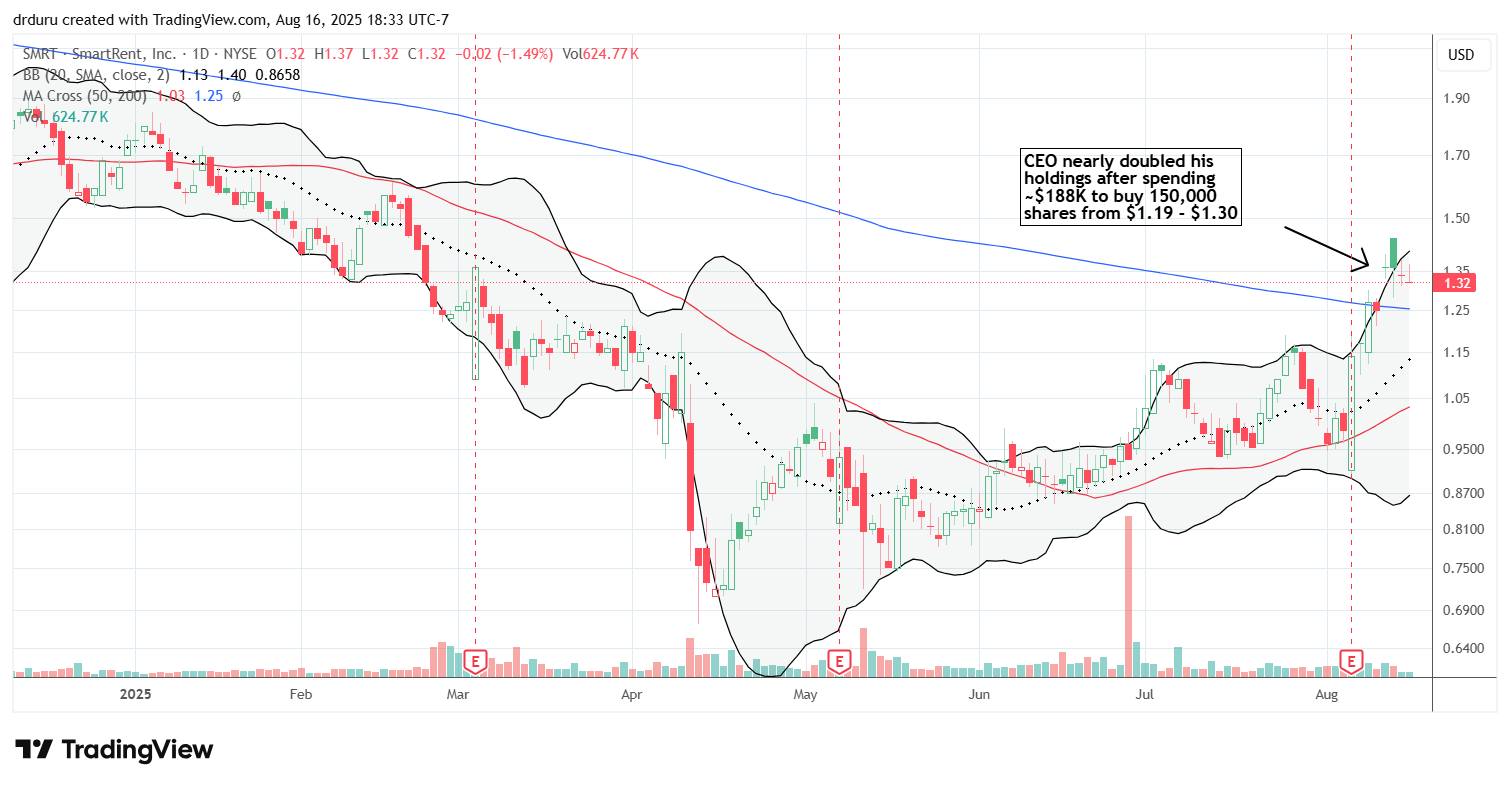
Technical status: SmartRent, Inc (SMRT) broke out above 200DMA resistance with an 8.8% gain on news of CEO buying. However, the stock has not yet confirmed the breakout with a higher close. Buyers were stymied by a fade in efforts to confirm the breakout on the next day.
Trade commentary: Once SMRT confirms the 200DMA breakout I am a buyer. Otherwise I will look to buy at 200DMA, 20DMA, and/or 50DMA support. I like the15.6% post-earnings gain earlier this month that formed a bullish engulfing pattern and seems to confirm an on-going recovery. I consider any trade in SMRT to be highly speculative and risky.
Tapestry (TPR)
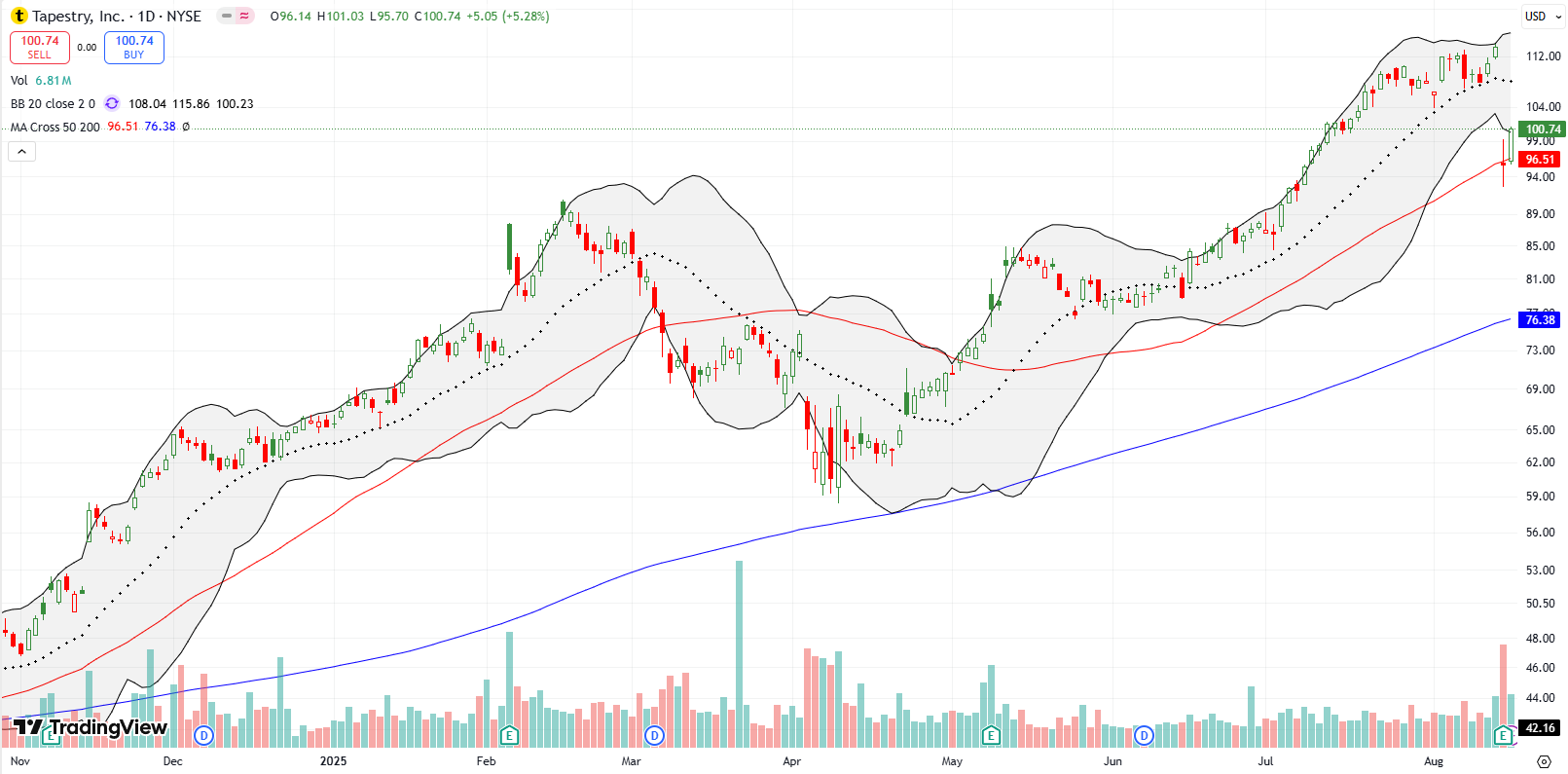
Description: Tapestry (TPR) is a luxury fashion holding company known for brands including Coach, Kate Spade, and Stuart Weitzman.
Technical status: TPR fell 15.7% post-earnings but held perfectly at 50DMA support. Buyers quickly followed up with a 5.3% rebound the next day.
Trade commentary: I missed the buy but will watch it closely next week for an entry. I love these setups because they offer a very clear stop loss point and a convenient upside target (a close of the gap down).
Maplebear Inc (CART)
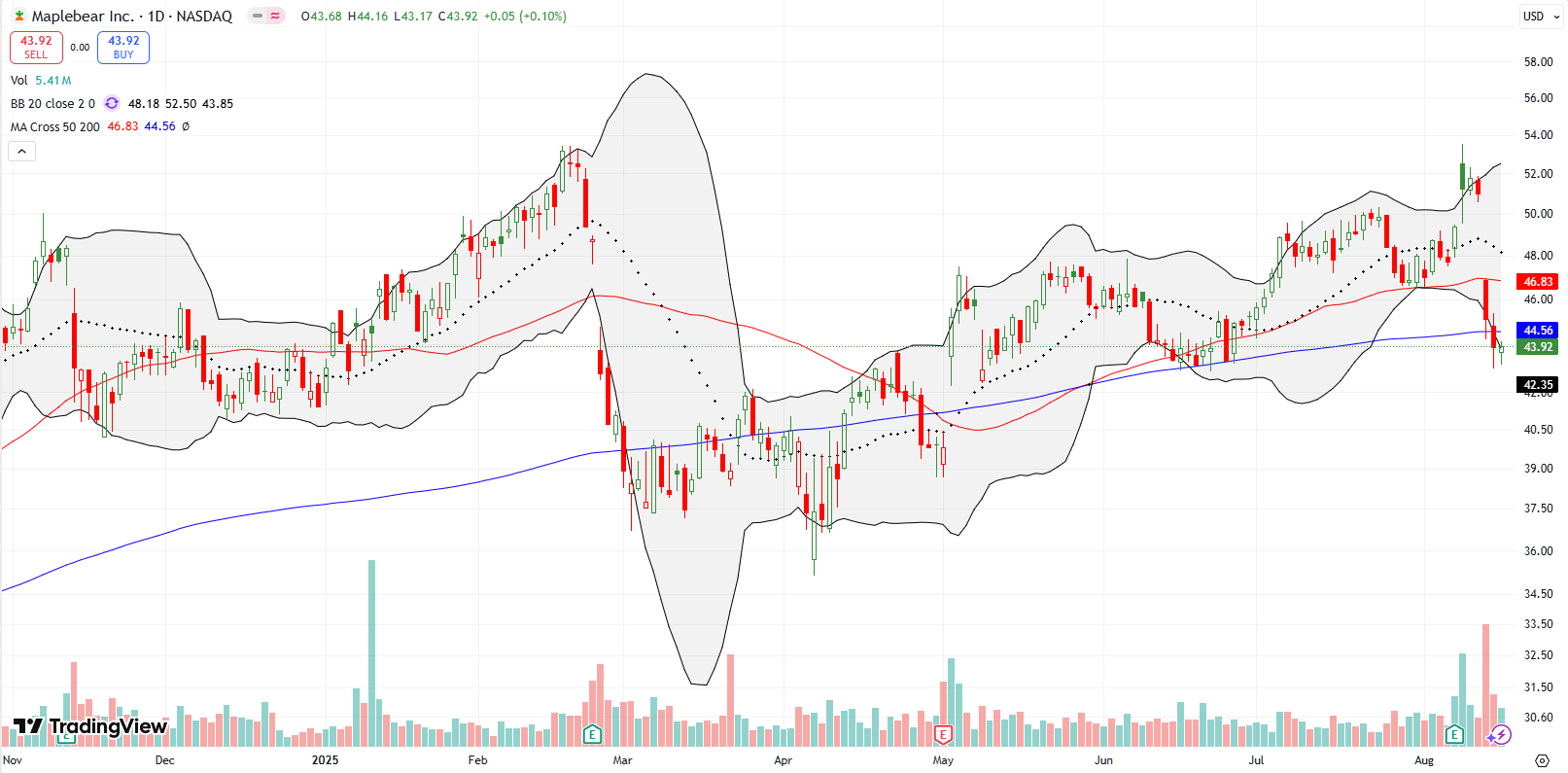
Description: Instacart (CART), officially MapleBear Inc., is an online grocery delivery and pick-up service platform.
Technical status: CART plunged 11.5% after Amazon.com (AMZN) announced same-day delivery of fresh produce. Stock broke down below 200DMA support but is already trying to stabilize.
Trade commentary: I bought stock and sold a call short at the $46 strike. After that call faded to near zero I rolled into a $45 strike call expiring Friday. I expect buyers to return once the Amazon panic fades. An Amazon panic has not happened in quite some time but I expect a similar recovery to past episodes.
Amazon (AMZN)
Description: Amazon.com (AMZN) is a global e-commerce and cloud computing company.
Technical status: AMZN filled most of its post-earnings gap after bouncing neatly off 50DMA support.
Trade commentary: Speaking of Amazon, my old rule of buying Amazon after earnings worked again. I took profits quickly as the stock hit my initial profit target within 1 week; the trade has a 2-week profit window. I missed the picture-perfect (re)entry on the test of 50DMA support.
Advanced Micro Devices (AMD)
Description: Advanced Micro Devices (AMD) designs and manufactures semiconductors for computing, graphics, and data center markets.
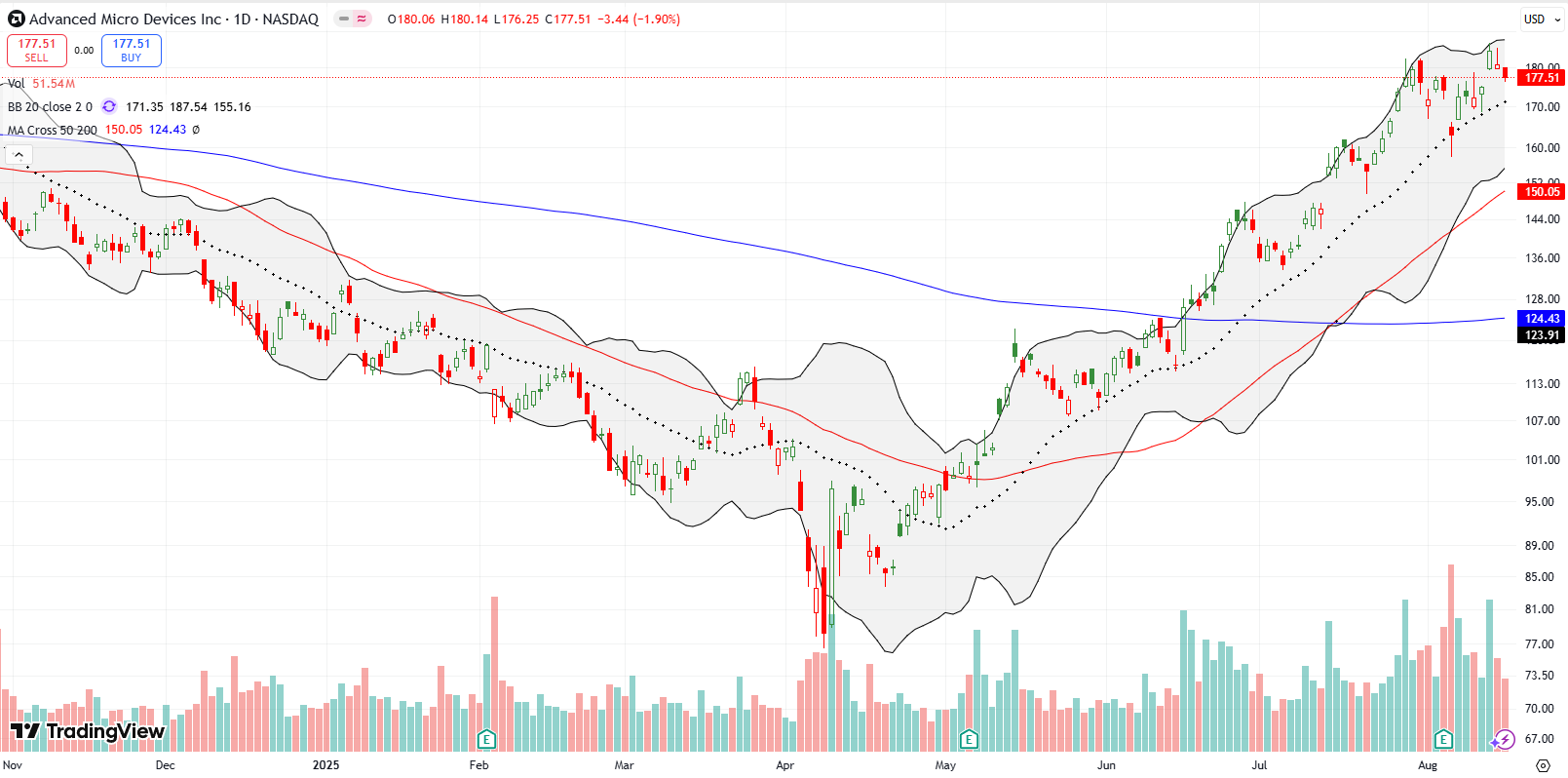
Technical status: AMD dropped 6.4% post-earnings but recovered quickly with a near perfect bounce off uptrending 20DMA support. Buyers brought it back to highs last seen last summer.
Trade commentary: I stayed patient and bought on dips. Still, I am now a little wary of the sustainability of this rebound from the April lows. AMD has gained 127% in just 4 months.
Etsy, Inc (ETSY)
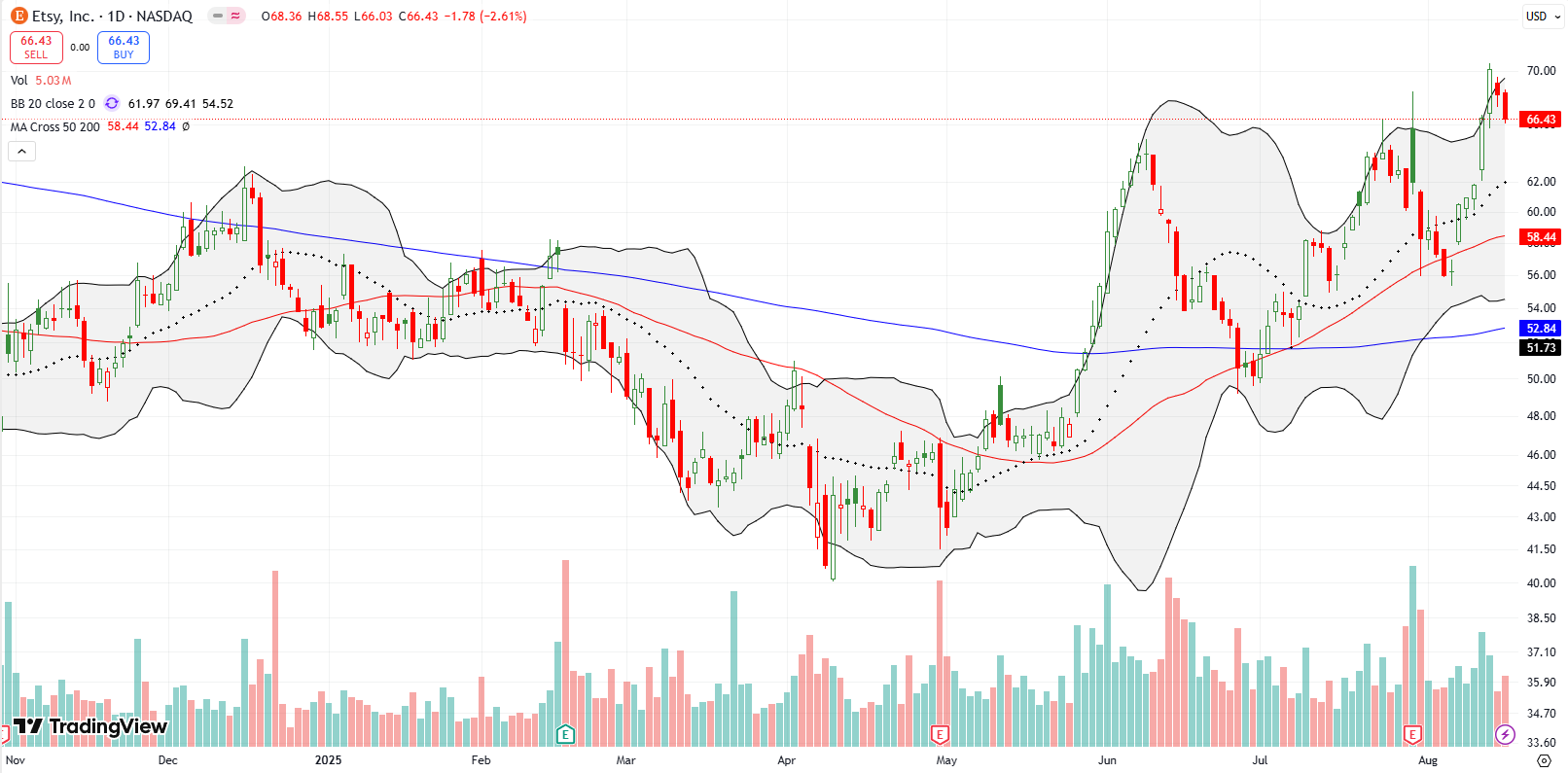
Description: Etsy (ETSY) operates a global online marketplace for handmade, vintage, and unique goods.
Technical status: ETSY sold off post-earnings but bounced away from 50DMA support. The rebound was almost as swift as the rally in May.
Trade commentary: I should have bought ETSY as soon as it gapped above its 50DMA and closed above its 20DMA. I remain bewildered by the rapid and abrupt change in sentiment in the stock.
First Solar (FSLR)
Description: First Solar (FSLR) develops and manufactures solar panels and provides utility-scale solar solutions.
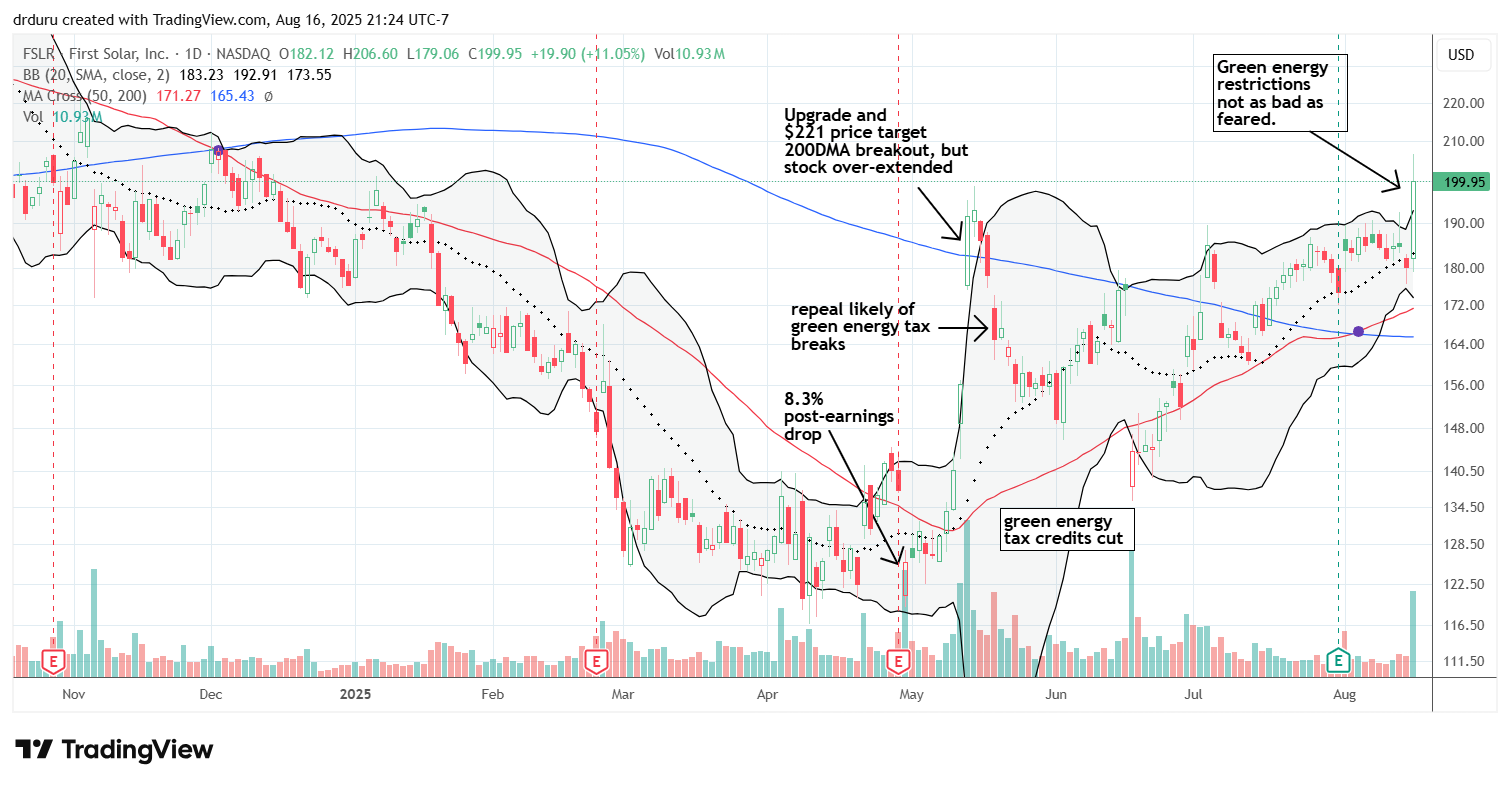
Technical status: FSLR soared 11% after anti green energy policies turned out less restrictive than feared. The stock closed at an 8-month high and confirmed on-going uptrends with the 20DMA and 50DMA.
Trade commentary: I like FSLR long-term and thought the current administration’s anti green energy stances would give me a chance to load up on FSLR at much cheaper prices. Instead, I may have to chase FSLR a bit as a contrarian buy looks less and less likely anytime soon. This is another lesson in buying sell-offs driven by Trump’s rhetoric and policies in anticipation of an eventual rebound or reversal – a type of Trump Trade.
Shopify Inc (SHOP)
Description: Shopify (SHOP) provides e-commerce software and services that enable businesses to sell online.
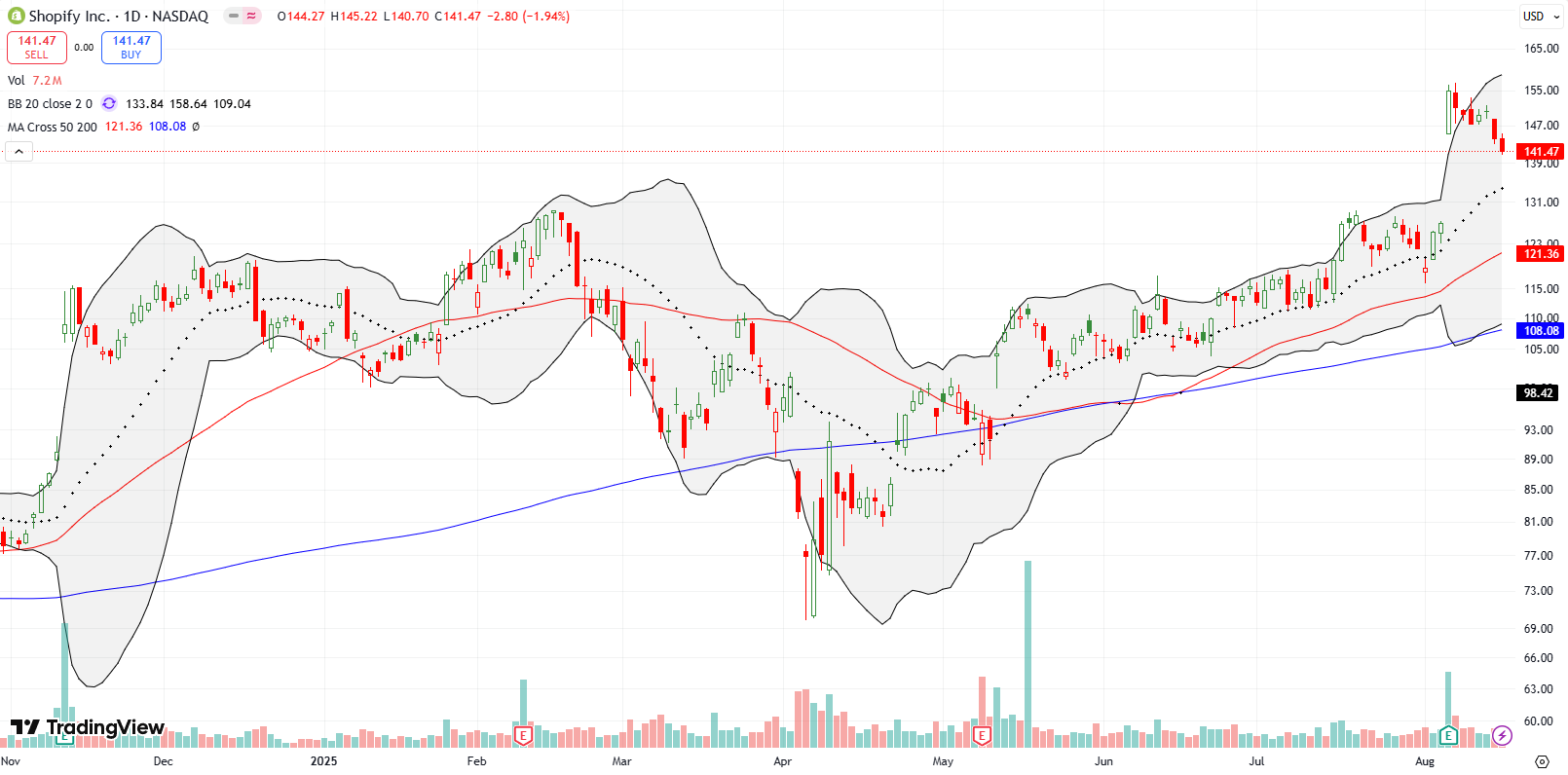
Technical status: SHOP soared 22% post-earnings but has been fading since. The 20DMA is the next key support to watch.
Trade commentary: I will look to buy SHOP if the stock bounces off 20DMA support.
Coherent (COHR)
Description: Coherent (COHR) designs and manufactures lasers, optics, and photonics solutions.
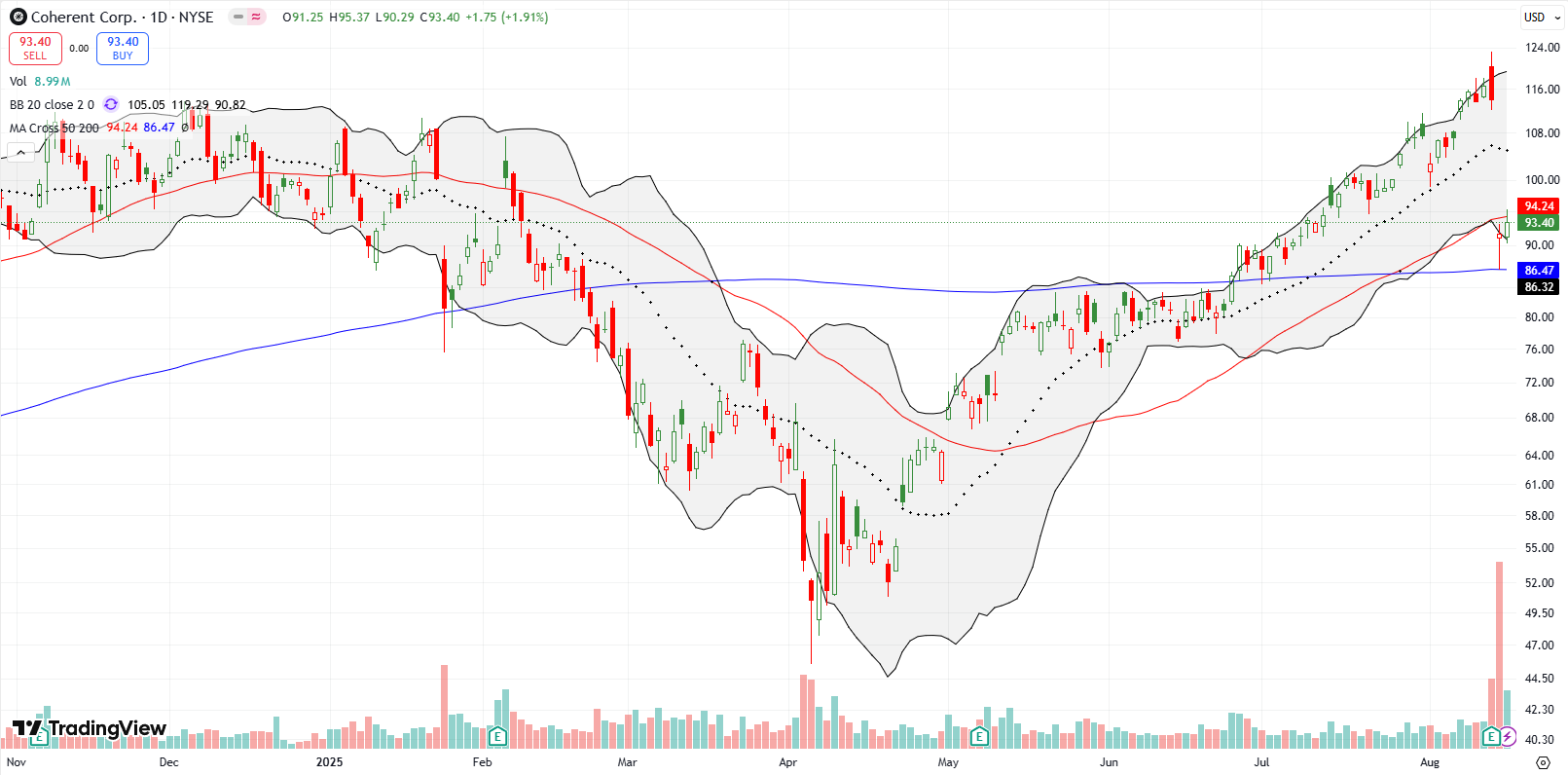
Technical status: COHR dropped 20% post-earnings but bounced from 200DMA support. It now faces resistance at the 50DMA after buyers stepped in right at the 200DMA.
Trade commentary: A year ago, I made a buy-the-dip case for COHR. I ended up instead first buying COHR on its 200DMA breakout. I took profits ahead of earnings and glad I steeped aside based on what I thought was slowing momentum (buying resumed shortly after). Now I am looking to get back in on a 50DMA breakout.
Deere & Company (DE)
Description: Deere & Company (DE) manufactures agricultural, construction, and forestry machinery and equipment.
Technical status: DE dropped 7% post-earnings but found support at the 200DMA before rebounding 2.1%.
Trade commentary: I am not buying DE here, but I am duly noting an on-going pattern of buyers stepping in on abrupt tests of 200DMA support.
Applied Materials (AMAT)
Description: Applied Materials (AMAT) provides semiconductor manufacturing equipment, services, and software.
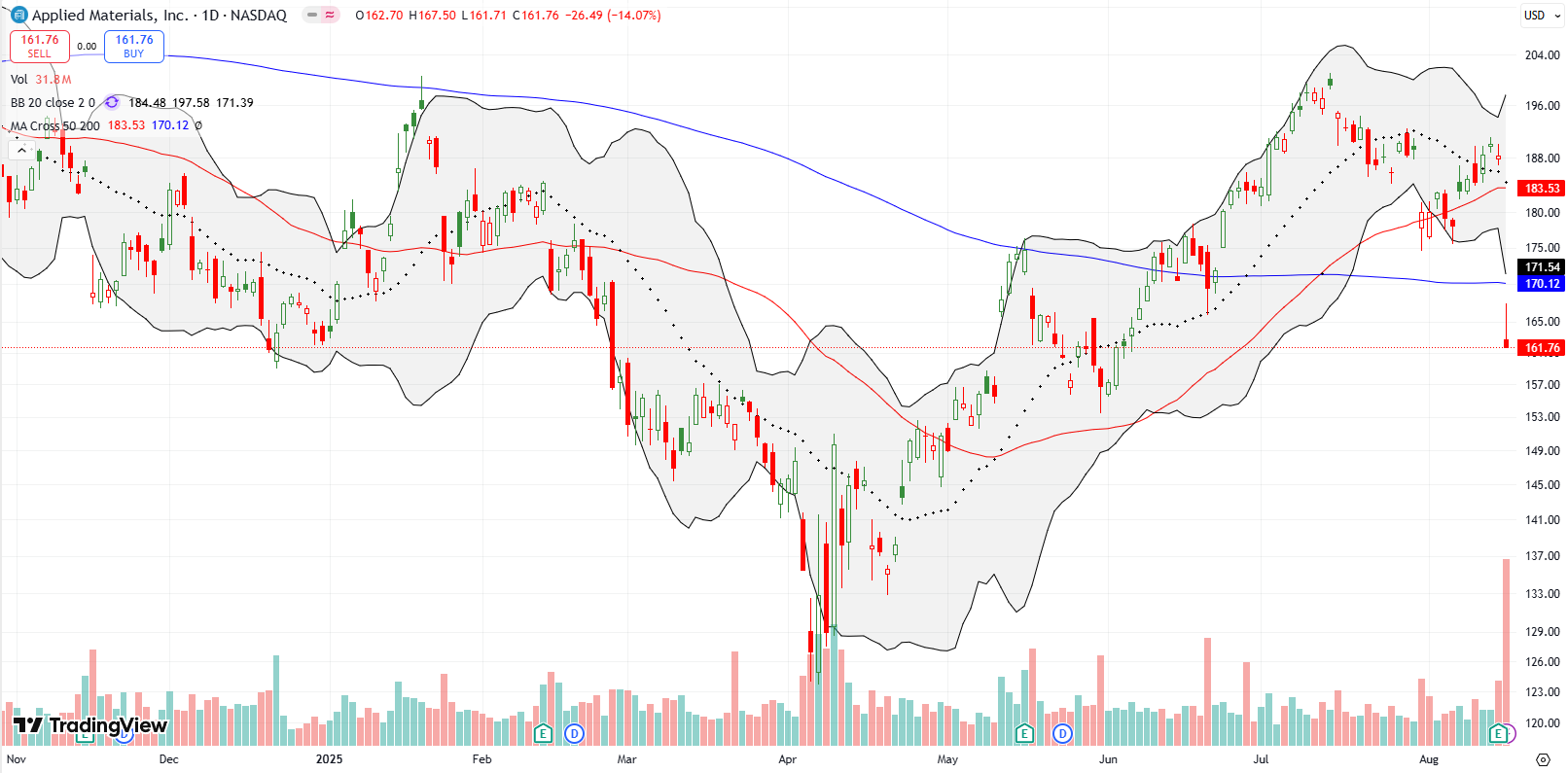
Technical status: AMAT fell 14.1% post-earnings, slicing below all the major trendlines. Semiconductor equipment names continue to look weak.
Trade commentary: I find it telling that AMAT closed at its lows of the day well below the lower Bollinger Band despite an intraday rally attempt. Given AMAT lowered guidance and analysts rushed to downgrade the stock, the stock is likely a short on a rally to 200DMA resistance.
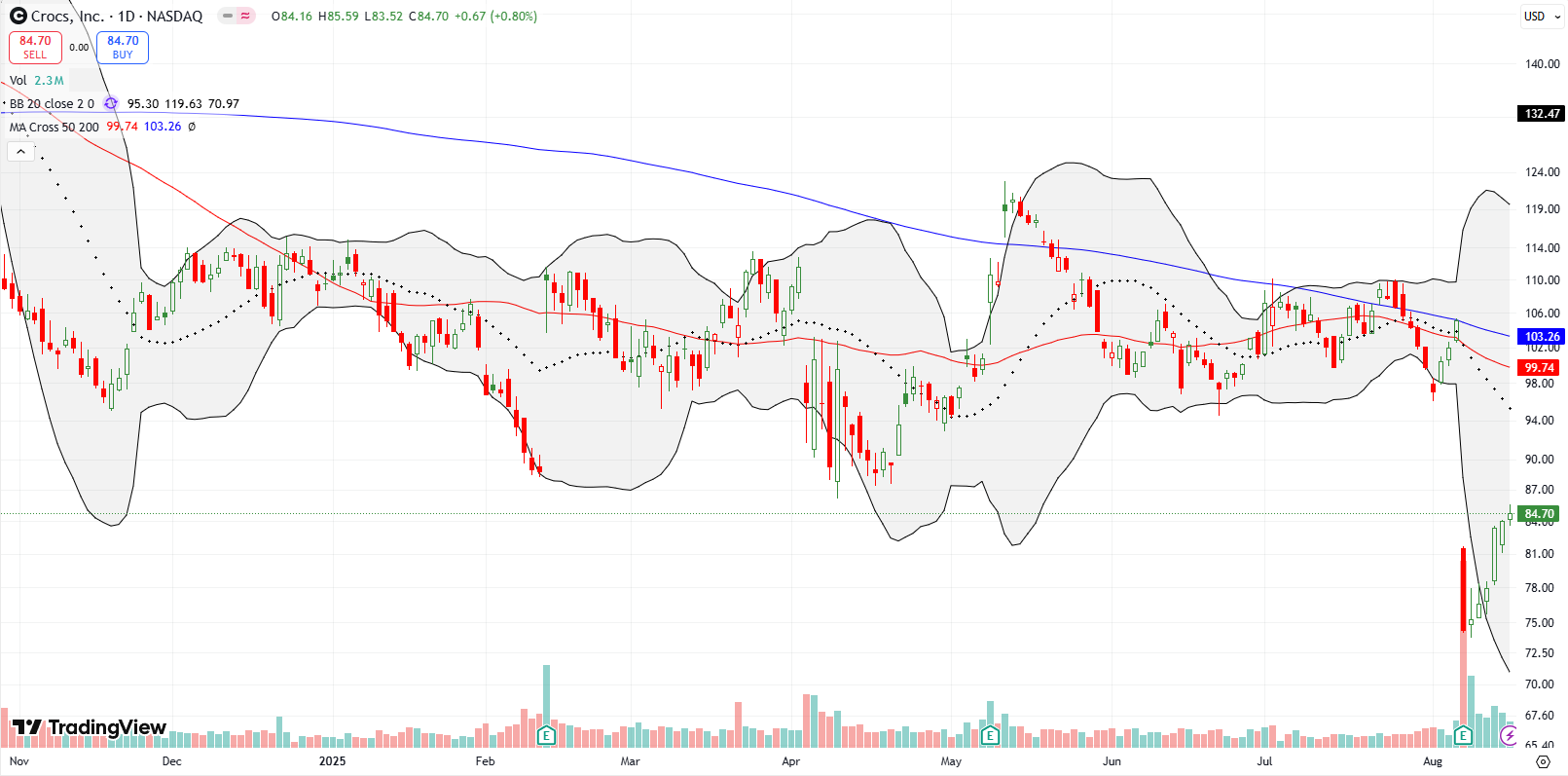
Crocs, Inc (CROX)
Description: Crocs, Inc (CROX) is a global footwear company known for its lightweight clog-style shoes.
Technical status: CROX dropped nearly 30% on earnings but quickly rebounded to post-earnings highs as buyers stepped in. The stock remains in a wide trading range dating back to 2021.
Trade commentary: I do not know what to make of CROX, but clearly traders are willing to buy the dips.
Sequans Communications (SQNS)
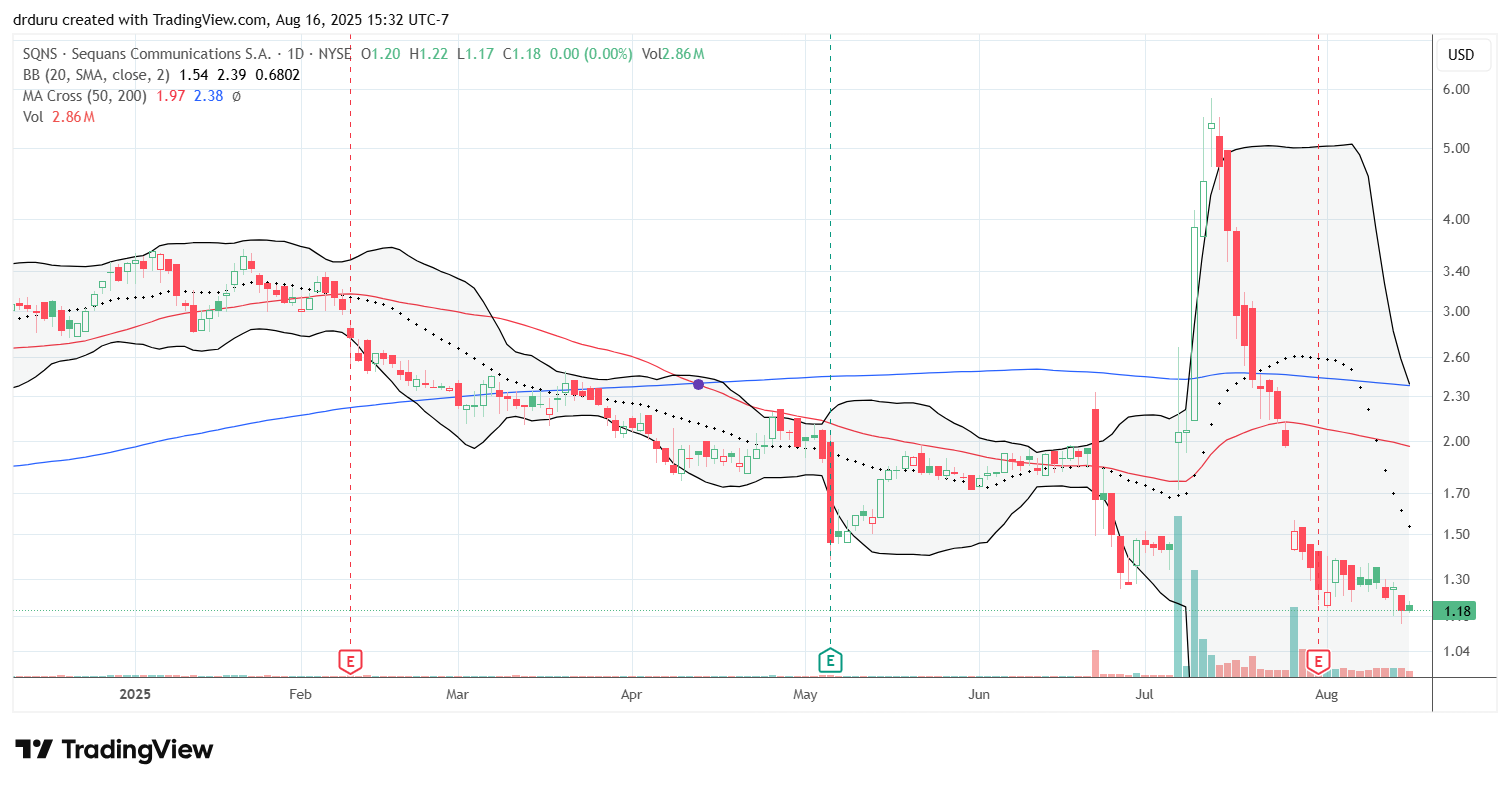
Description: Sequans Communications (SQNS) is a fabless semiconductor company based in Paris, France, founded in 2003 specializing in designing, developing, and supplying cellular semiconductor solutions—including chips, modules, software, IP, and design services—for 4G and 5G Internet of Things (IoT) applications.
Technical status: SQNS enjoyed an 88% gain the day it announced the launch of Bitcoin treasury operations. Presumably the gains going into the announcement came from rumors of the move. The quickly collapsed from there and is now DOWN almost 50% since the day of the announcement and trades at a 13-month low.
Trade commentary: I have zero interest in buying SQNS. I included here as another commentary on the speculative fervor coursing through the market that leaps from one gold mine to the next. I do not know how this company will continue to convince people to give it money to buy Bitcoin. Thursday’s announcement that the company plans to acquire 100,000 Bitcoin by 2030, from its current 3,141 Bitcoins, generated zero excitement. This hype looks like it is over before it really got started.The company’s funding plans tell me to just keep buying Bitcoin myself…and front-run plans like this one. SQNS Bitcoin is worth $373M, much more than the $317M enterprise value of the company. Thus to get more Bitcoin, the company will likely need to convince investors to help them leverage up the company. From the press release (emphasis mine):
- Throughout 2025, the company plans to continue building the first phase of its Bitcoin foundation by complementing the initial private placement by implementing public capital-raising tools.
- Next in 2026, Sequans aims to accelerate its treasury growth via strategic equity issuance, deployment of Bitcoin-backed credit instruments, and potential monetization of intellectual property assets.
- Toward 2030, the company targets to focus on continued optimization of its treasury strategy and capital structure by integrating a diversified mix of Bitcoin-backed financial products, aiming to enhance balance sheet resilience while minimizing reliance on common equity issuance.
Be careful out there!
Footnotes
Subscribe for free to get email notifications of future posts!
“Above the 50” (AT50) uses the percentage of stocks trading above their respective 50-day moving averages (DMAs) to measure breadth in the stock market. Breadth defines the distribution of participation in a rally or sell-off. As a result, AT50 identifies extremes in market sentiment that are likely to reverse. Above the 50 is my alternative name for “MMFI” which is a symbol TradingView.com and other chart vendors use for this breadth indicator. Learn more about AT50 on my Market Breadth Resource Page. AT200, or MMTH, measures the percentage of stocks trading above their respective 200DMAs.
Active AT50 (MMFI) periods: Day #43 over 20%, Day #41 over 30%, Day #36 over 40%, Day #4 over 50% (overperiod), Day #2 under 60% (underperiod), Day #16 under 70%
Source for charts unless otherwise noted: TradingView.com
Full disclosure: long IWM shares and calls, long BTC/USD, long IBIT calendar call spread, long DAL calendar call spread, short UNH put, long CART shares and short call, long AMD,
FOLLOW Dr. Duru’s commentary on financial markets via StockTwits, BlueSky, and even Instagram!
*Charting notes: Stock prices are not adjusted for dividends. Candlestick charts use hollow bodies: open candles indicate a close higher than the open, filled candles indicate an open higher than the close.
* Blog notes: this blog was written based on the heavily edited transcript of the following video that includes a live review of the stock charts featured in this post. I used ChatGPT to process the transcript.