
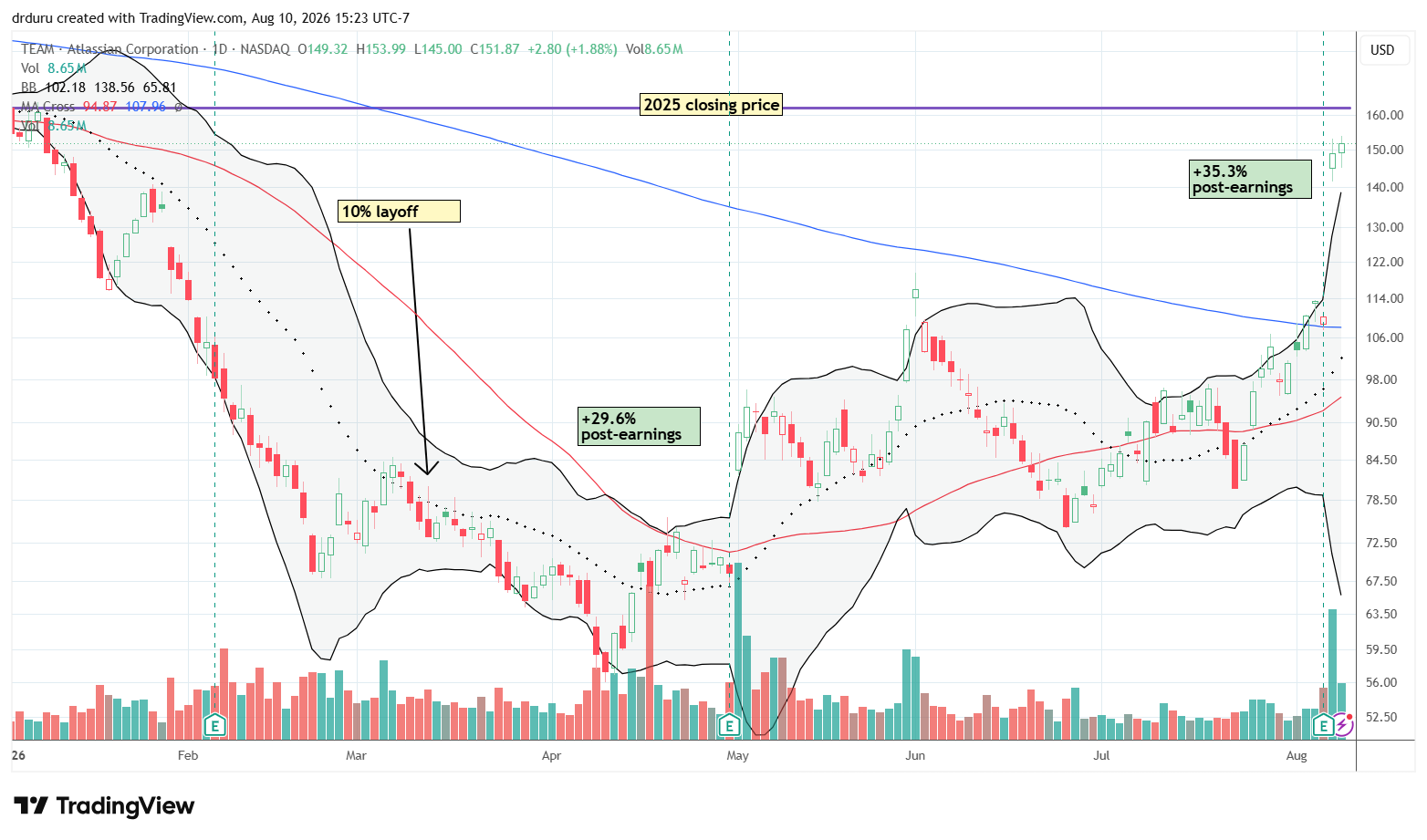
In April I launched PAIROS, the Panic AI Research On Software, to provide a structured approach for assessing my (contrarian) investment thesis in software companies heavily impacted by the SaaSpocalypse. Atlassian Corporation (TEAM) first emerged as a high conviction pick after the company’s release of its agentic AI platform called Rovo and next after a related PAIROS evaluation. Over the course of almost three months I accumulated stock and then periodically sold call options against that position. Last week’s 35.3% post-earnings surge was both a major validation of my investment thesis and a symbol of how I greatly underestimated the nearer term potential for PAIROS. After getting my TEAM shares called away and selling the remainder, I have updated the PAIROS analysis using Atlassian’s latest earnings report: the shareholder letter, the Q4 2026 earnings release, and the transcript from the earnings call. PAIROS upgraded TEAM across all categorial indices in alignment with the soaring stock.
{As a reminder, I use ChatGPT to execute the PAIROS framework and to generate a report. I edit the report as needed for accuracy and clarity. To-date, the model has proven sufficiently robust against ChatGPT’s expected errors when processing a large amount of content. References in brackets are indexed at the end of this post.}
PAIROS conclusion for TEAM: Great prospects
Atlassian’s strongest protection is the combination of persistent work systems, enterprise context, governed workflows, permissions, and agent-access interfaces. The company reported that agents increasingly consume Atlassian context and create new Atlassian records, while people continue to use the same platform. Over the PAIROS 0-2 year horizon, this dynamic is consistent with AI increasing Atlassian’s relevance.
TEAM scored strongly across all three PAIROS indices.
| Index | Score | Question answered | Explanation of Atlassian’s result |
|---|---|---|---|
| Viability Index (VI) | 4.1 | Does AI threaten the company’s viability over the next 0–2 years? | The evidence favors continued relevance because agents access Atlassian context through MCP, create durable records in Jira and Confluence, and operate within Jira’s governed workflows. The AI gateway separately provides direct evidence of multi-model operation. The score remains below the top of the range because many underlying tasks remain executable outside Atlassian and the report does not establish full portability across model providers. |
| Structural Condition Index (SCI) | 4.3 | If the company survives the AI challenge, what condition is it likely to be in? | This is Atlassian’s strongest index because its applications retain persistent workflow state, enterprise context, permissions, auditability, and orchestration. MCP strengthens interoperability by exposing this context to external agents, but it does not establish model independence. The score also reflects that Atlassian may be one of several enterprise knowledge graphs, does not control all underlying third-party data, and provides no direct evidence about patch velocity. |
| Economic Value Index (EVI) | 4.2 | Does AI make the company more or less economically valuable? | The earnings reports support value expansion through paid Collections, seat growth, cross-sell, higher average revenue per user, Rovo credits, and greater workflow activity among adopters. The score is constrained by undisclosed direct AI revenue and AI unit economics, non-causal adopter comparisons, early consumption pricing, and expected gross-margin pressure from higher Rovo usage and hosting costs. |
PAIROS upgraded TEAM across all three indices. The Viability Index (VI) increased from 3.9 to 4.1. The Structural Condition Index (SCI) increased from 4.2 to 4.3 (I also fixed a small error in the SCI scaling). The Economic Value Index (EVI) increased from 4.0 to 4.2. These indices can range from 1 to 5. In aggregate, TEAM received a “great prospects” rating.
PAIROS Earnings Summary
Atlassian’s Q4 FY2026 report demonstrated that Jira, Confluence, Jira Service Management, Rovo, and the Teamwork Graph are becoming a shared context, workflow, and control layer for work performed by people and AI agents. This evidence is relevant to PAIROS because it addresses whether agents use Atlassian or bypass it, whether Atlassian retains workflow and data control, whether AI expands demand, and whether the company captures economic value from agent activity.
Four distinct technical mechanisms are at work:
- The Teamwork Graph is Atlassian’s enterprise-context layer. It connects knowledge, work, communications, code, assets, and people across Atlassian and third-party applications. Atlassian reported more than 200 billion objects and connections, with agents both consuming the graph and contributing new Jira work items and Confluence pages to it. This supports the PAIROS analytic categories of Data Control and Context Ownership, Persistence Layer Role, and Barrier to Software Replication. However, it does not establish model-vendor independence. [S1, pp. 4-6]
- The MCP Server and Teamwork Graph CLI are access interfaces. They let agents running in external applications or agent systems securely access Atlassian and connected third-party context. Monthly active users exceeded 1 million, MCP calls rose more than 400% quarter over quarter, and MCP-generated Jira work items and Confluence pages increased nearly fourfold. These data support the PAIROS analytic categories of Agent Substitution Boundary, Human Interface Dependency, and AI Supply Chain Resilience. Atlassian’s selection among foundation models is an unknown. [S1, p. 6; S2, p. 3]
- Jira’s agent integrations are a governed orchestration mechanism. Jira can assign work to Rovo, Claude, Cursor, GitHub agents, and other agents while retaining goals, decisions, permissions, automation, audit trails, status, and human review. This capability supports the PAIROS analytic categories of System Layer Position, Workflow Embedding Depth, and Agent Enablement Function. External-agent availability does not itself reduce Atlassian’s dependency on a foundation-model vendor. [S1, p. 7; S2, p. 2]
- The AI gateway is Atlassian’s model-management layer. It optimizes AI workloads across multiple models for quality, cost, and speed. Management said Atlassian has blended multiple models for several years. This directly supports the PAIROS analytic category of Model Dependency Structure, but the earnings information does not disclose model allocation, switching constraints, fallback coverage, or whether every critical AI capability can operate across providers. [S1, p. 20; S3, Q&A with Karl Keirstead]
The shareholder letter provided additional data points relevant to PAIROS:
- Human and AI activity is complementary so far. Atlassian reported that 98% of MCP users were also active in the Jira user interface during the same month. This data demonstrates concurrent programmatic and human-interface usage, although it does not prove that MCP users depend on the Jira interface. [S1, p. 6]
- Adoption is associated with greater usage and commercial expansion. Rovo-assisted actions rose more than 50% quarter over quarter. Rovo adopters completed 20% more Jira work items, created or edited 25% more Confluence pages, and grew ARR more than twice as fast as non-adopters. Teamwork Collection customers used more than twice as many AI credits per user and deployed twice as many active agents as standalone customers. Agentic automations in Service Collection increased approximately threefold in six months. These are associations, not proof that Rovo caused the expansion. [S1, pp. 2-3, 6, 14]
- The business results support current demand, but not all growth was AI-driven. Cloud revenue grew 31%, Subscription ARR grew 23%, and RPO grew 44%. Cloud outperformance came from seat expansion and cross-sell rather than Data Center migrations. Data Center revenue benefited from greater upfront term-license recognition following the announced March 2029 end of life, so total revenue growth is not a clean measure of AI demand. [S1, pp. 13-20; S2, pp. 1-4; S3, Q&A with Ryan MacWilliams]
- Enterprise trust contributes to security. Atlassian launched Isolated Cloud, advanced AI administration controls, HIPAA availability for Rovo, permissioned agent access, and agent audit trails. These capabilities support enterprise adoption where isolation, compliance, and governance matter. [S2, pp. 2-3]
- Economic proof remains incomplete. Teamwork Collection and Service Collection are the current AI monetization vehicles, but direct AI revenue is undisclosed and consumption-based overages and Flex remain early. FY2027 guidance also explicitly includes gross-margin pressure from increasing Rovo usage and hosting costs. [S1, pp. 19-20; S3, Q&A with Robbie Owens]
Atlassian’s earnings report strengthened the near-term case that Atlassian can remain an agent-used system of record and orchestration layer. The report provided credible evidence of AI-linked paid expansion. The weakest parts of the evidence were direct AI revenue, incremental AI unit economics, the causal effect of Rovo on customer expansion, and the portability of critical AI capabilities across different model providers.
Conclusion: The Trade
I am now in the difficult (but not regrettable) position of owning zero shares in a high conviction investment narrative. TEAM trades well above its upper Bollinger Band (BB), so it is over-extended to the upside. Still, I do not foresee much of a pullback as last week’s post-earnings surge definitively flipped sentiment in TEAM from bearish or tepid to constructive and even bullish. Accordingly, analysts rushed to raise their price targets. Bank of America went from $105 to $175. Oppenheimer went from $110 to $200! Picking up the “rear” were Guggenheim who went from $115 to $165 and T.D. Cowen who hiked its price target, probably reluctantly, from $105 to $145. Wall Street rates TEAM a strong buy with an average price target of $188. Thus, TEAM is a stock with plenty of support.
Under these conditions, TEAM is a buy on the dips. If it does not dip from here, I will target a small purchase once the upper Bollinger Band catches up to the stock. That position will represent a no regrets trade so that I can collect some profit, if TEAM never meaningful dips before its next earnings report.
While I left some money on the table, I can still move forward knowing that PAIROS can continue to help me maintain high conviction in the software companies I think will survive the SaaSpocalypse intact and in good shape.
Appendix
See below for the detailed scoring for the PAIROS indices applied to the TEAM analysis. The news impact in this case refers to the Q4 earnings news.
Viability Index (VI)
| Dimension | Weight | Raw score |
Confidence level |
Weighted score |
News impact |
Evidence-based rationale |
|---|---|---|---|---|---|---|
| Agent Substitution Boundary | 15% | 4.4 | High | 0.1050 | + | Agents access Atlassian context through MCP, create Jira and Confluence records, and execute within Jira workflows; many underlying coding, content, and communication tasks remain possible outside Atlassian. [S1, pp. 6-7] |
| Capability Frontier Sensitivity (Dynamic) | 15% | 4.2 | Medium | 0.0630 | + | Stronger models can make Atlassian’s context and governed tools more useful when accessed through MCP or Jira, while also commoditizing interface-level and content-generation functions. [S1, pp. 4-7] |
| Recursive Improvement Exposure (Dynamic) | 15% | 3.8 | Medium | 0.0420 | + | Faster-improving agents can increase demand for context and coordination, but external agent platforms and competing enterprise graphs may capture part of that value. [S1, pp. 5-7; S3, Q&A with Koji Ikeda] |
| Barrier to Software Replication | 10% | 4.6 | High | 0.0800 | + | The accumulated workflow history, integrations, permissions, six context types, and more than 200 billion graph objects and connections are difficult to reproduce with code generation alone. [S1, pp. 4-6] |
| Tool Dependence of AI Systems (Task/Feature-Level) | 10% | 3.8 | Medium | 0.0280 | + | Agents need Atlassian tools for governed execution and persistence inside Atlassian workflows, but they do not need Atlassian for every underlying task. [S1, pp. 6-7] |
| AI Supply Chain Resilience | 10% | 4.5 | High | 0.0750 | + | MCP and the Teamwork Graph CLI let external agents operate against existing Atlassian context, permissions, and workflows without requiring wholesale reconstruction or relocation. [S1, p. 6; S2, p. 3] |
| Model Dependency Structure | 10% | 4.4 | High | 0.0700 | + | The AI gateway has blended multiple models for several years and optimizes workloads for quality, cost, and speed. The report does not disclose switching constraints, workload allocation, fallback coverage, or whether every critical AI capability is portable across providers. [S1, p. 20; S3, Q&A with Karl Keirstead] |
| Demand Expansion Under AI | 15% | 4.2 | Medium | 0.0630 | + | Seat expansion, Collection cross-sell, Rovo usage, and agentic automation support expanding demand, but the adopter comparisons are observational and do not isolate AI causality. [S1, pp. 2-3, 6, 14] |
Structural Condition Index (SCI)
| Dimension | Weight | Raw score |
Confidence level |
Weighted score |
News impact |
Evidence-based rationale |
|---|---|---|---|---|---|---|
| System Layer Position | 12% | 4.8 | High | 0.1080 | + | Jira, Confluence, and Jira Service Management store work, knowledge, service state, permissions, and workflow logic; Jira also governs agent assignments and review. [S1, pp. 4-7] |
| Data Control and Context Ownership | 13% | 4.6 | High | 0.1040 | + | The Teamwork Graph connects six forms of workflow-critical context and retains agent-created records. The score recognizes that some underlying data remains in third-party systems and that management expects enterprises to maintain three to five major knowledge graphs. [S1, pp. 4-6; S3, Q&A with Koji Ikeda] |
| Workflow Embedding Depth | 9% | 4.7 | High | 0.0765 | + | Jira keeps agent actions inside workflows with goals, permissions, automation, audit trails, status, and human review. [S1, p. 7] |
| Persistence Layer Role | 8% | 4.8 | High | 0.0720 | + | Atlassian persists tasks, pages, goals, decisions, service history, code context, and agent-created outputs as durable organizational records. [S1, pp. 4-7] |
| Information Processing Ownership | 6% | 4.2 | High | 0.0360 | + | The platform primarily stores, connects, validates, and exposes enterprise work information; Teamwork Graph inference and Rovo analysis add processing without displacing the source-of-truth role. [S1, pp. 4-6] |
| Human Interface Dependency | 4% | 3.8 | Medium | 0.0112 | + | More than 1 million users accessed the MCP Server or Teamwork Graph CLI, demonstrating meaningful programmatic consumption. The 98% overlap with Jira UI shows coexistence, not proof that programmatic use depends on the interface; the report does not disclose programmatic activity as a share of total use. [S1, p. 6] |
| Agent Enablement Function | 8% | 4.8 | High | 0.0720 | + | Atlassian supplies context, tools, permissions, workflow execution, monitoring, and governance for Rovo and external agents operating through Jira. [S1, pp. 6-7; S2, pp. 2-3] |
| Domain Complexity Requirement | 8% | 3.7 | Medium | 0.0196 | 0 | Software development, service management, compliance, and enterprise coordination require meaningful domain knowledge, while basic work-management functions remain broadly replicable. [S1, pp. 4-7; S2, pp. 2-3] |
| Tool Dependence of AI Systems (Task/Feature-Level) | 6% | 3.8 | Medium | 0.0168 | + | Atlassian tools are required for governed actions and persistence inside Atlassian workflows, but agents can perform many underlying tasks elsewhere. [S1, pp. 6-7] |
| AI Supply Chain Resilience | 8% | 4.5 | High | 0.0600 | + | MCP and the Teamwork Graph CLI expose existing context to agents deployed in other systems, while Jira integrates external agents without relocating the workflow or its system of record. [S1, pp. 6-7; S2, p. 3] |
| Security Trust Premium | 10% | 4.7 | High | 0.0850 | + | Isolated Cloud, AI administration controls, HIPAA availability, permission enforcement, and agent audit trails make trust and compliance part of the enterprise adoption case. [S1, p. 7; S2, pp. 2-3] |
| Patch Velocity Readiness | 8% | 3.0 | Low | 0.0000 | 0 | The supplied materials describe security architecture, governance controls, and compliance availability but provide no direct evidence about vulnerability-remediation speed, patch automation, or incident-response performance. [S2, pp. 2-3] |
Economic Value Index (EVI)
| Dimension | Weight | Raw score |
Confidence level |
Weighted score |
News impact |
Evidence-based rationale |
|---|---|---|---|---|---|---|
| Monetization Position | 15% | 3.9 | Medium | 0.0473 | +/- | Teamwork and Service Collections produce higher average revenue per user, additional credits, seat expansion, and cross-sell, but direct AI revenue is undisclosed, consumption pricing is early, and AI hosting costs pressure gross margin. [S1, pp. 3, 14, 19-20; S3, Q&A with Robbie Owens] |
| Value Capture Layer | 15% | 4.4 | High | 0.1050 | + | Atlassian captures value through subscriptions tied to persistent work state, workflow governance, and enterprise context, not only transient AI computation or presentation. [S1, pp. 4-7] |
| Commercial Defensibility Under Software Abundance | 15% | 4.3 | High | 0.0975 | + | Enterprise embedding, multiyear agreements, RPO growth, net retention above 120%, and Collection expansion indicate more than sales-driven demand, although enterprise sales investment remains important. [S1, pp. 13-14; S3, Q&A with Adam Wood and Alex Zukin] |
| Demand Expansion Under AI | 15% | 4.2 | Medium | 0.0630 | + | AI adoption is associated with more seats, work items, content, agents, service automations, and Collection usage; the supplied evidence does not isolate causation. [S1, pp. 2-3, 6, 14] |
| Barrier to Software Replication | 10% | 4.6 | High | 0.0800 | + | The Teamwork Graph, integrations, workflow history, permissions, and enterprise controls are difficult to recreate economically. [S1, pp. 4-7] |
| Human-AI Complementarity Potential | 10% | 4.6 | High | 0.0800 | + | Jira combines human intent, review, and governance with agent execution, while concurrent MCP and Jira-interface activity supports near-term complementarity. The overlap metric does not by itself prove productivity or causal economic benefit. [S1, pp. 6-7] |
| System Layer Position | 5% | 4.8 | High | 0.0450 | + | Atlassian owns persistent workflow and orchestration roles rather than only transient AI execution. [S1, pp. 4-7] |
| Data Control and Context Ownership | 5% | 4.6 | High | 0.0400 | + | The Teamwork Graph connects workflow-critical enterprise context and retains agent-created records, but Atlassian does not exclusively control all source data or enterprise knowledge graphs. [S1, pp. 4-6; S3, Q&A with Koji Ikeda] |
| Capability Frontier Sensitivity (Dynamic) | 5% | 4.2 | Medium | 0.0210 | + | Better models can make Atlassian’s context and tools more valuable when reached through MCP or Jira, while increasing substitution pressure on interface-level functions. [S1, pp. 4-7] |
| Tool Dependence of AI Systems (Task/Feature-Level) | 5% | 3.8 | Medium | 0.0140 | + | Agents use Atlassian for governed task execution and persistence, although many underlying actions can occur outside the platform. [S1, pp. 6-7] |
References
[S1] Primary source: Atlassian Corporation. TEAM Q4 FY2026 Shareholder Letter. August 6, 2026. Especially pp. 2-7 and 13-20.
[S2] Secondary source: Atlassian Corporation. Atlassian Announces Fourth Quarter and Fiscal Year 2026 Results. August 6, 2026. Especially pp. 1-4.
[S3] Tertiary source: Seeking Alpha. Atlassian Corporation (TEAM) Q4 2026 Earnings Call Transcript. August 6, 2026. Used only for incremental Q&A details, including responses to Adam Wood, Ryan MacWilliams, Karl Keirstead, David Hynes, Koji Ikeda, Alex Zukin, and Robbie Owens.