
Stock Market Commentary
The stock market last week was full of a nervous calm. Fed Chair Jerome Powell seemed to muffle the market’s mood after warning that meaningful inflation is yet to come as a result of tariffs. The expiration of the 90-day pause on reciprocal tariffs looms over the market with just one major deal on the books (the U.K. deal was recently confirmed but it seems incomplete) and a likely extension of the pause. Moreover, almost every week the news drops small trade war headlines that the market has learned to ignore given the sharp rebound from March and April’s tariff drama, trauma, and noise. For example, on Friday the U.S. reportedly may go after the semiconductor plants that its allies have in China. These reports and headlines now mean little unless and until something specific materializes…while the tariff pause remains in effect anyway.
More importantly, the week ended with the President announcing a 2-week pause on making a decision on bombing Iran’s nuclear facilities. That pause added to the nervous calm. The very next day, at the time of writing, the U.S. proceeded with a bombing run on Iran with plenty of weekend time for financial markets to avoid panicking. If Iran chooses the path of escalation instead of the “surrender” that the U.S. wants, all bets are off.
If the Iranian conflict escalates, I will place the war in the context of an expansion of what I still see as an unfolding World War Three. While the surface area of this war remains far more limited than the first two world wars, the participants are almost just as global in scope. Perhaps the perspective and hindsight of history will connect the dots and recognize the pouring of resources and weaponry from major powers to fight other major powers as a world war. Regardless, thank goodness the damage has not been global in scope.
The Stock Market Indices
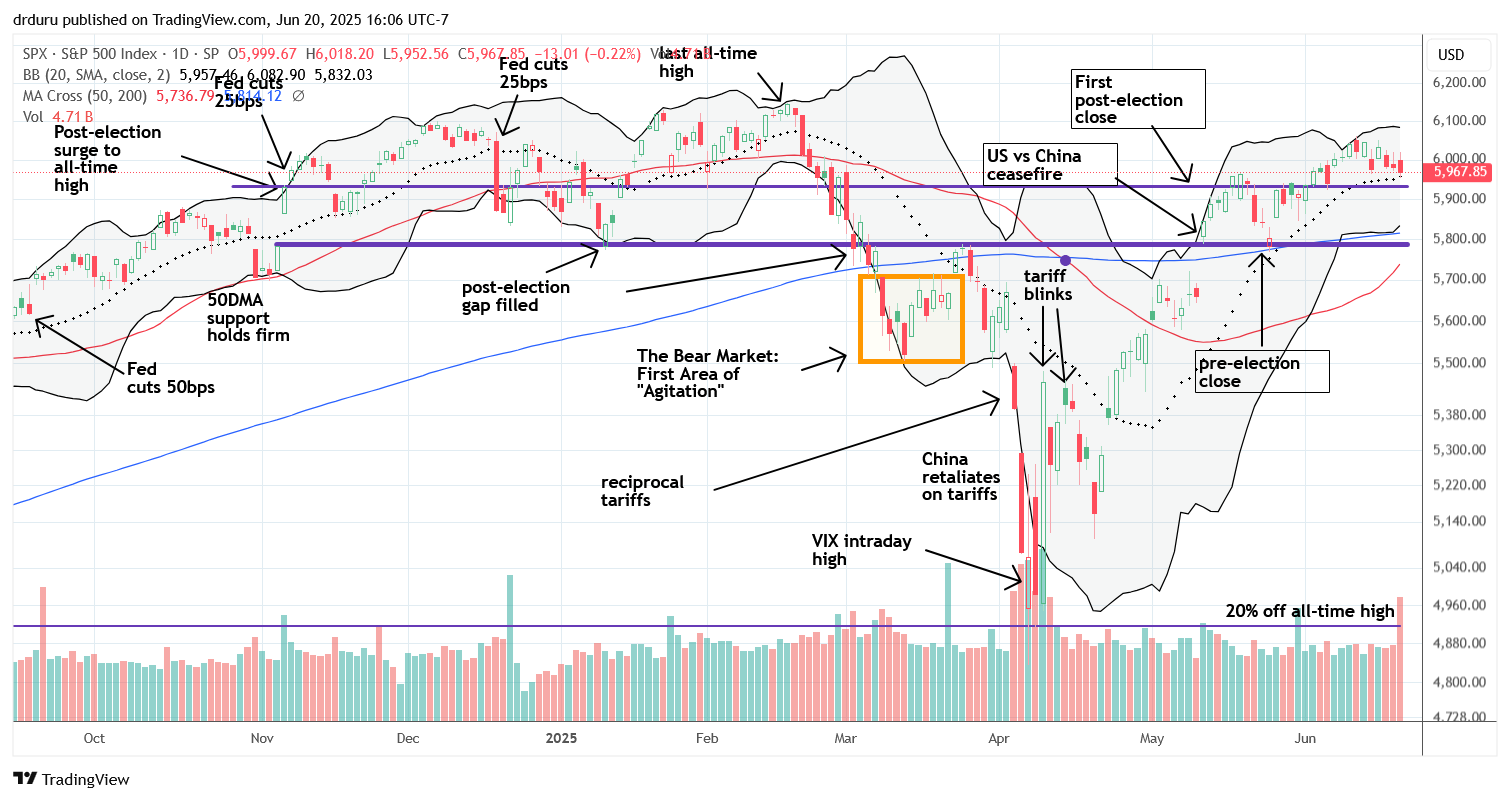
S&P 500 (SPY)
Despite bearish signals in market breadth (see below), SPY remains well supported. The index tested support at its 20-day moving average (DMA) (the dotted line), which also coincides with the first close after the November presidential election. A break below the first post-election close will flip me from cautiously bullish to neutral. A breakdown below the even firmer support from the convergence of the 50-day and 200-day moving averages (teh red and blue lines respectively), along with the post-election close, would finally force me to get bearish.
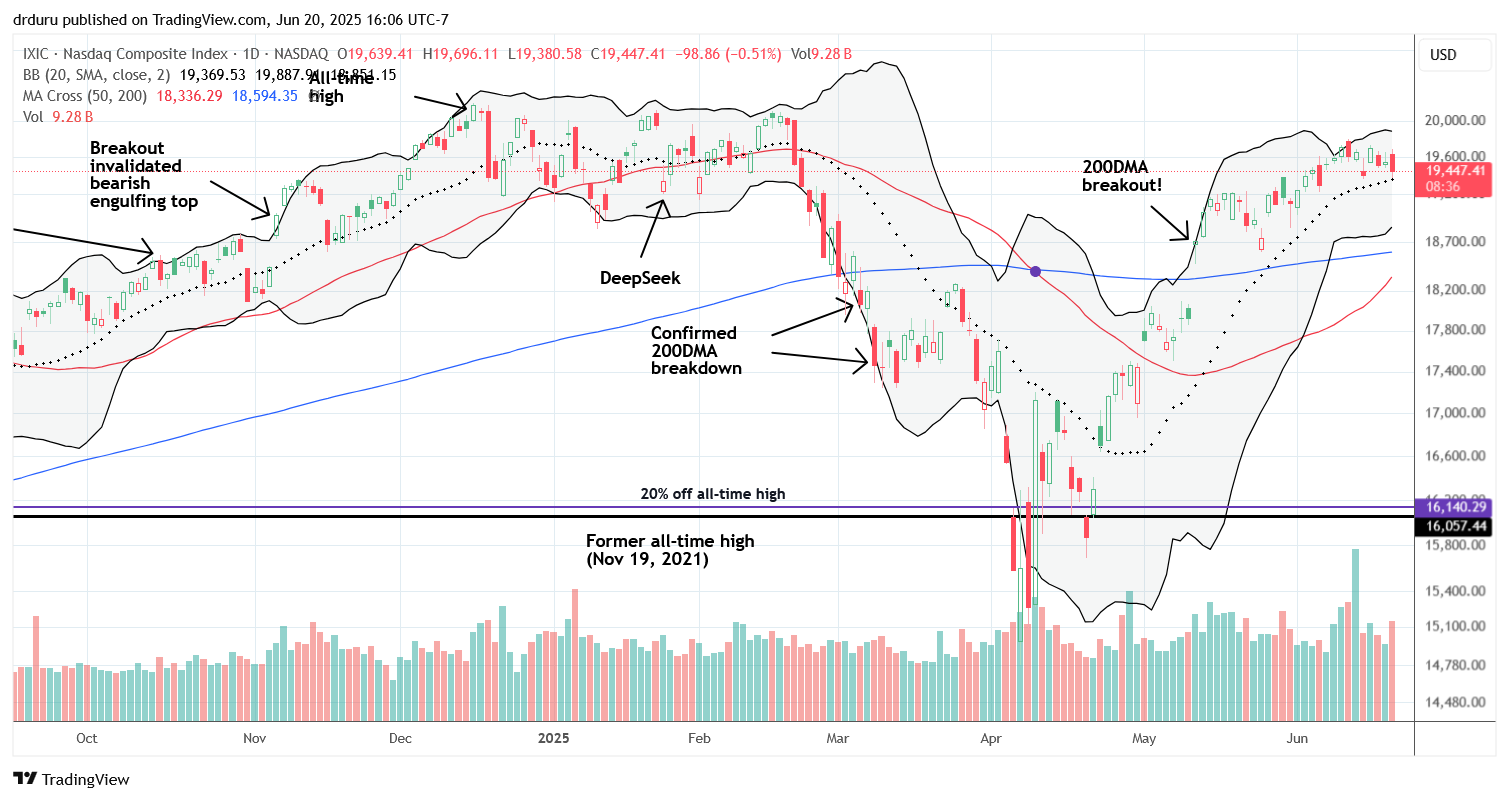
NASDAQ (COMPQ)
The NASDAQ mirrored the S&P 500 by testing its 20DMA support. Convergence between the 50-day and 200-day moving averages also creates a similar critical support zone. Also like the S&P 500, the tech laden index fell just short of testing all-time highs, adding to the importance of maintaining current support….as well as adding to the nervous calm given the weakening market breadth underlying the failed test.
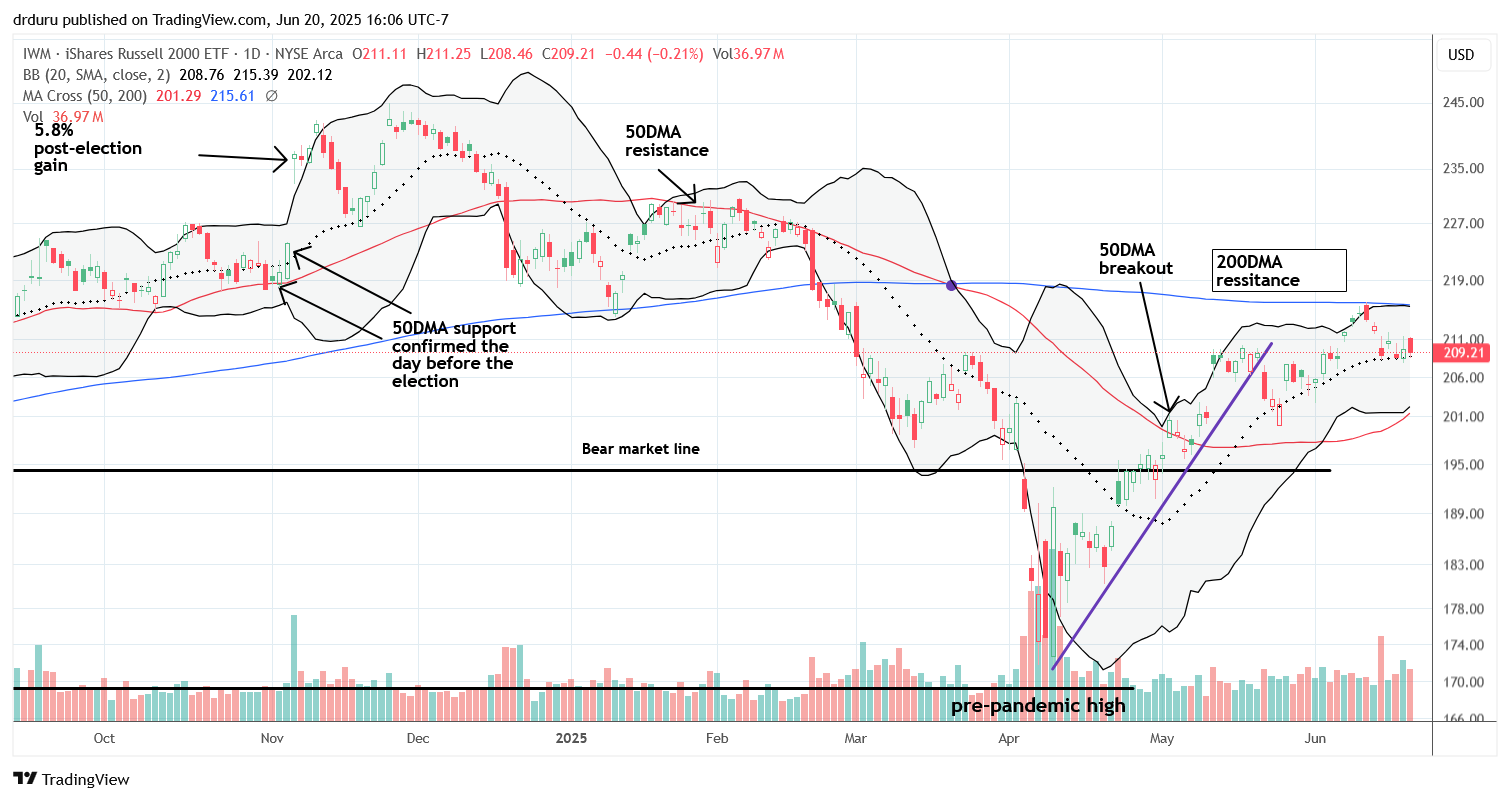
iShares Russell 2000 ETF (IWM)
I missed IWM’s test of its 20DMA last Friday, but I bought the third test on Wednesday with a $125 call option expiring in 2 weeks. The ETF of small caps is clinging to this support. A failure will setup an imminent test of 50DMA support.
The Short-Term Trading With A Nervous Calm
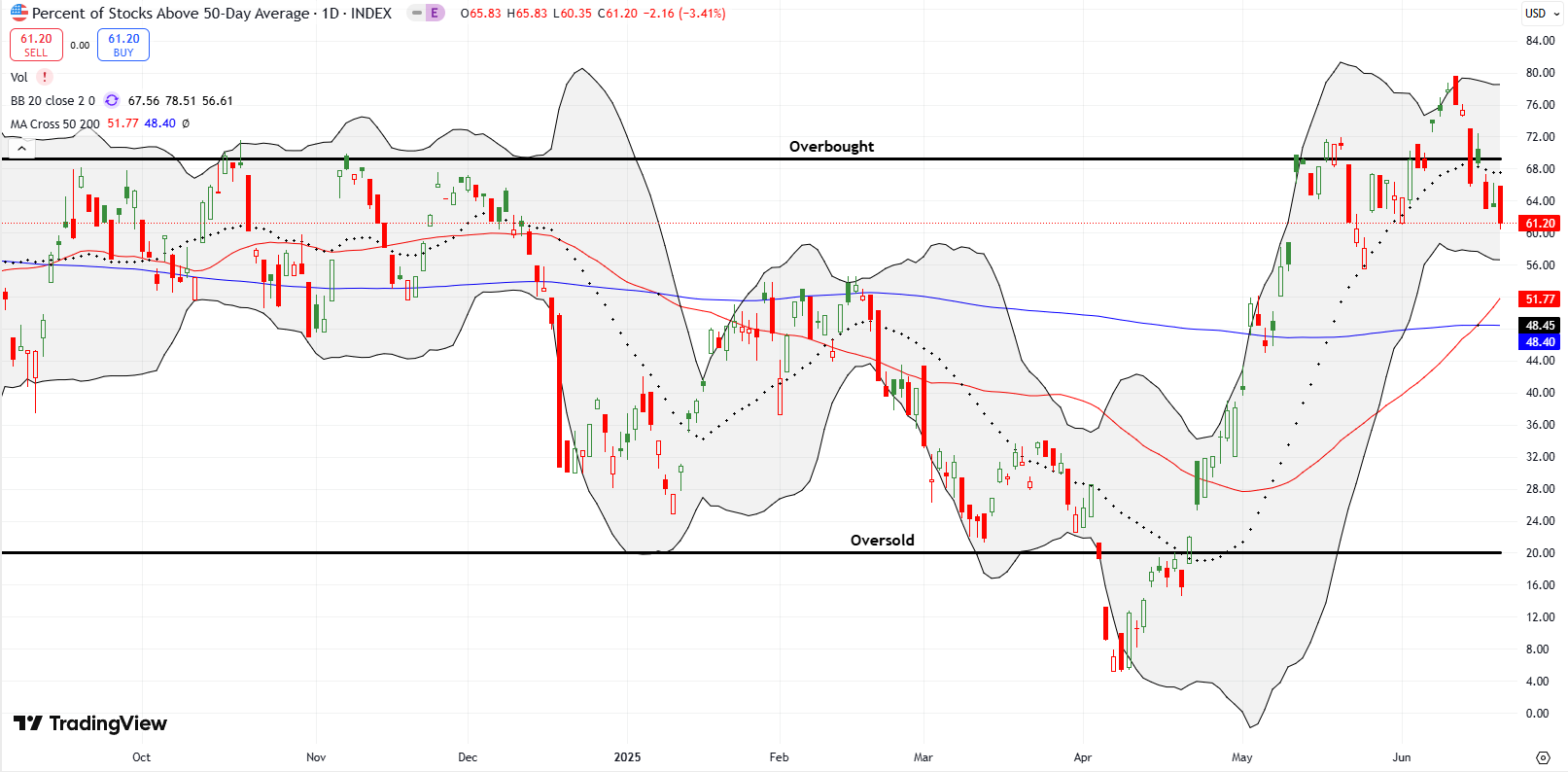
- AT50 (MMFI) = 61.2% of stocks are trading above their respective 50-day moving averages (first overbought day)
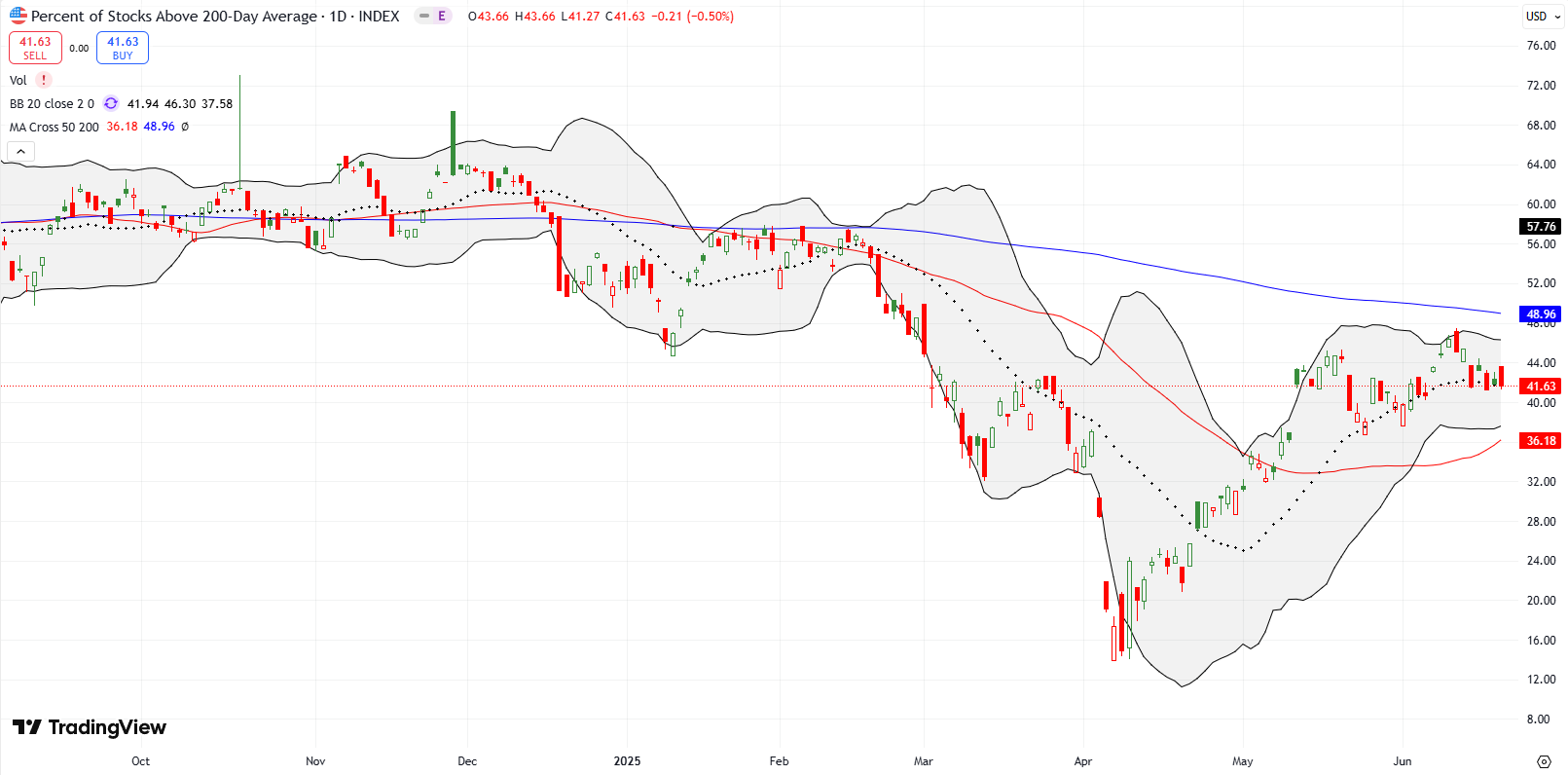
- AT200 (MMTH) = 41.6% of stocks are trading above their respective 200-day moving averages
- Short-term Trading Call: cautiously bullish
AT50 (MMFI), the percentage of stocks trading above their 50DMAs, closed the week at 61.2%. Since ending overbought conditions a week ago, my favorite technical indicator has fallen another 3 days out of 4 and sits at a one month low. According to the AT50 trading rules, the slip from overbought conditions puts the stock market in a bearish state. However, with the S&P 500 and the NASDAQ remaining well-supportive, I do not want to proactively or preemptively downgrade my short-term trading call from bullish. Instead, I need to see the breakdowns I described above before I change. Layering in economic and geopolitical warfare, all this tension puts ME in a state of nervous calm!
AT200 (MMTH), the percentage of stocks trading above their 200DMAs, held its ground during the week of nervous calm, a positive sign for longer-term market health. However, AT200 remains under a secondary downtrend. A breakout above that next downtrend would reaffirm and strengthen my bullishness.
The Volatility Index (VIX)
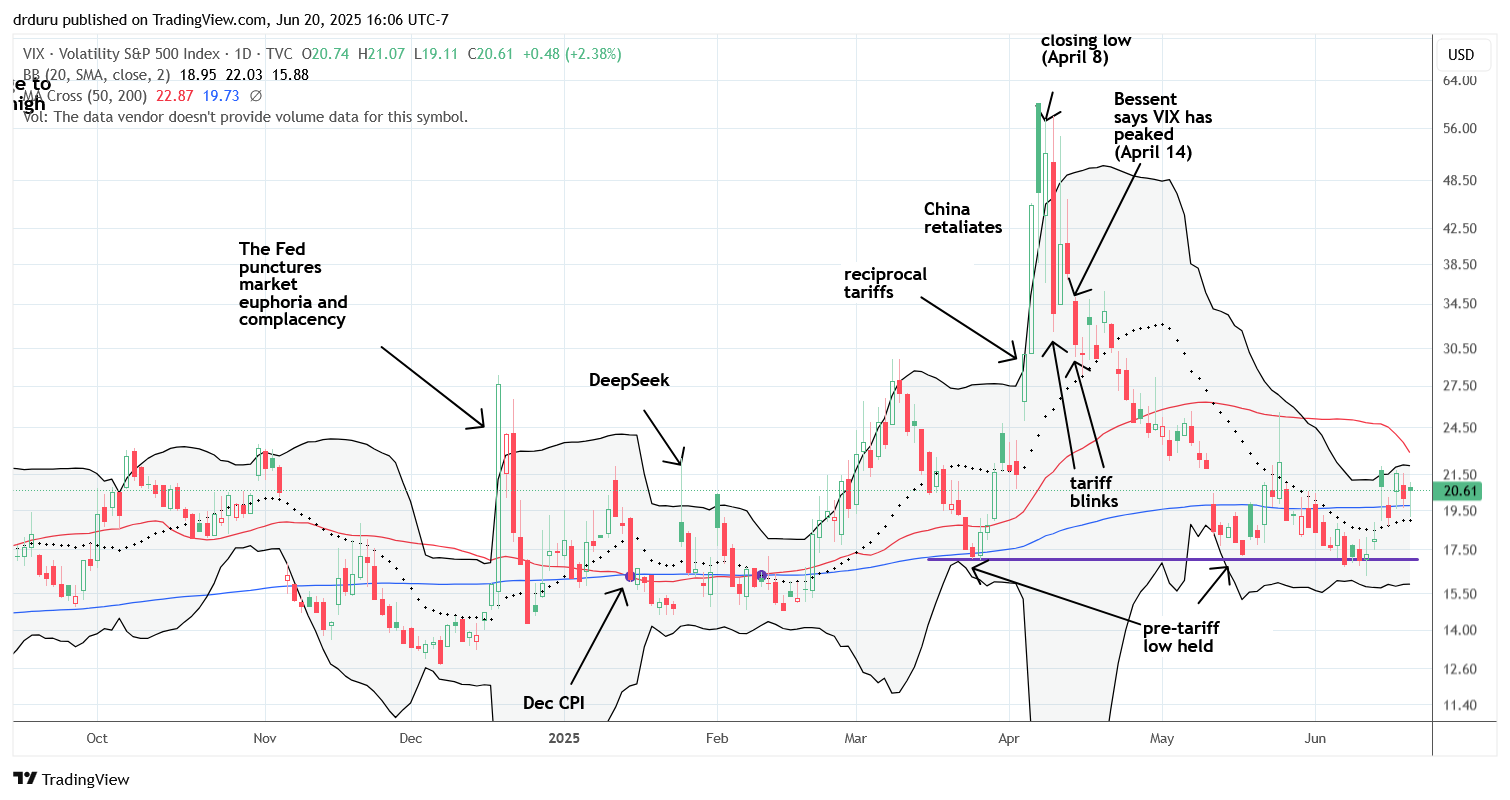
The VIX remained above 20, bouncing in place all week and adding to the week’s nervous overtones. The VIX behaved like a coiled spring, signaling the market’s nervousness. I bought a put spread on SPY for a partial hedge.
The Equities: Nervous Calm
United States Oil Fund (USO)
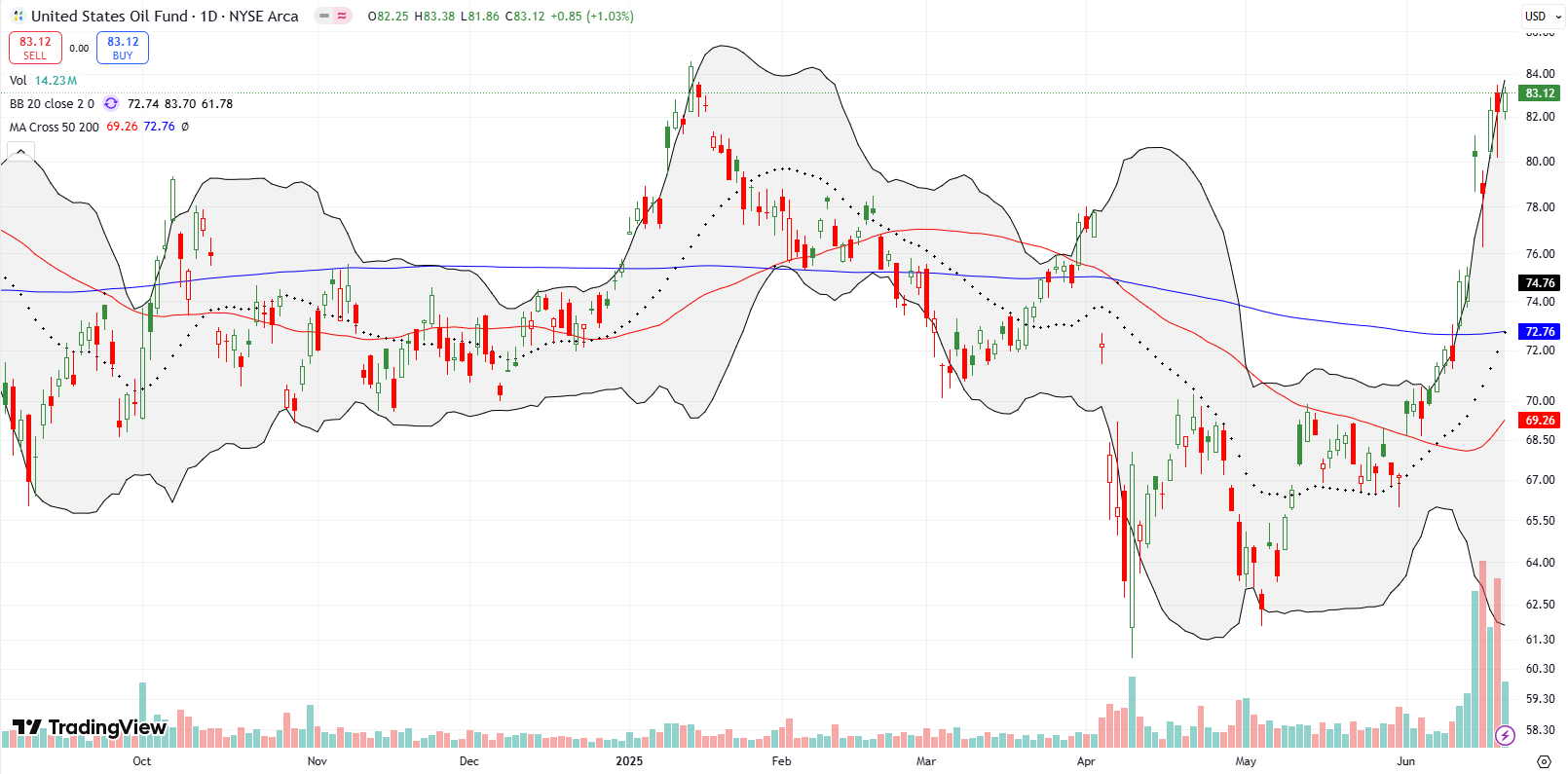
My bet against USO worked well on Monday but I decided to hold rather than take profits. Surprisingly, oil resumed its upward push. As a result, USO ended the week at its highest point since January. Now the bet against USO feel binary in this nervous calm. If the U.S.’s attack forces Iran to stand down, USO should collapse. If not, USO could soar all over again as Middle East oil gets ever riskier.
Accenture (ACN)
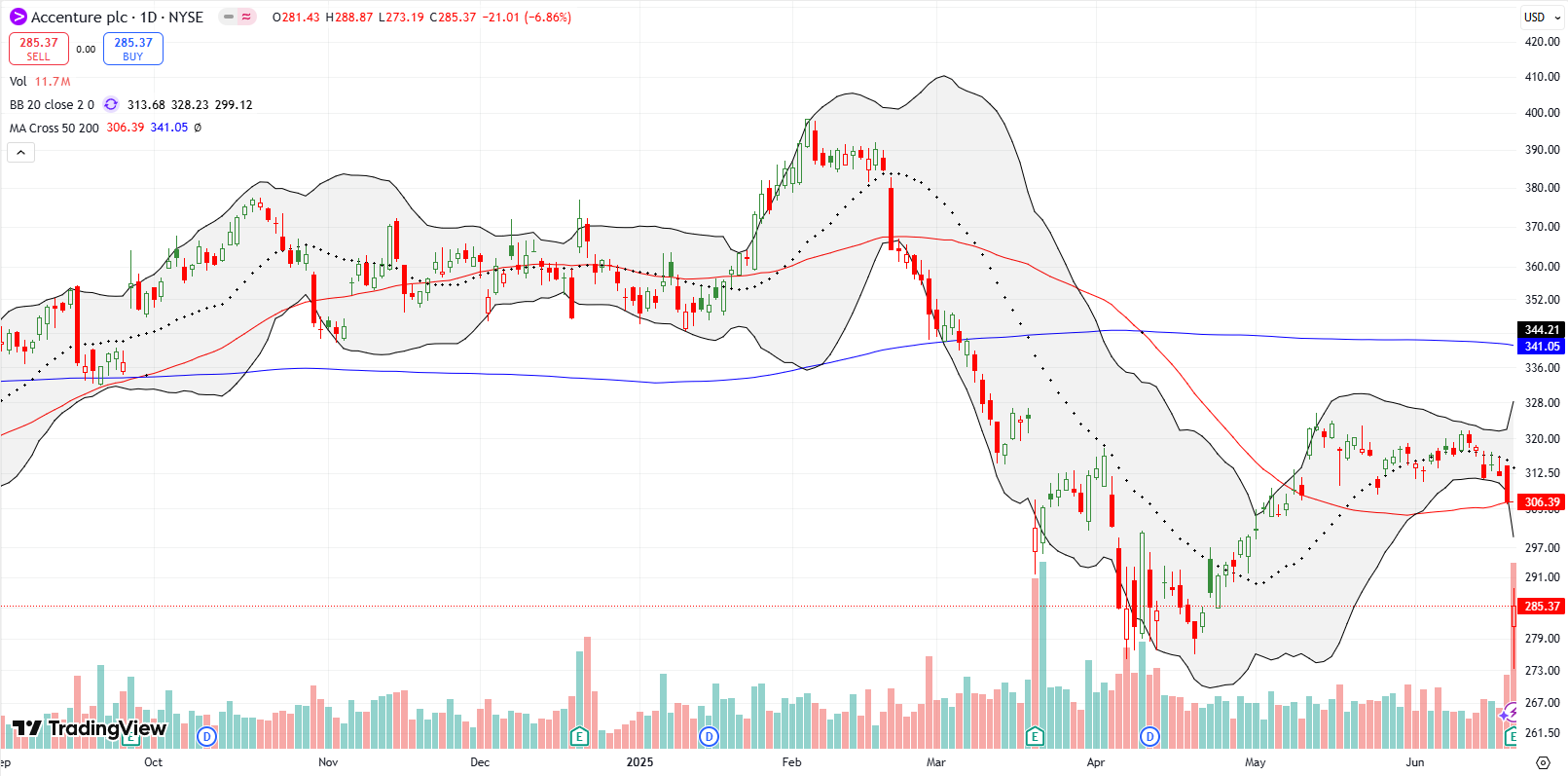
All the headlines for ACN earnings looked strong. Yet, ACN plunged 6.9% post-earnings. Underlying growth is slowing. I had hoped the firm’s private-sector focus would insulate it given the increasing success with generative AI business, but apparently that hope was misplaced. Now I hold on to see whether the April lows hold as support. If not, I have to take the lesson I just wrote about on laggard stocks and move on from ACN.
Circle Internet Group, Inc (CRCL)
Stablecoin company CRCL surged 20.4% and is up over 600% since its debut. All I can do is marvel at this run-up. I cannot even consider buying this rocket ship until it tests an important line of support. However, CRCL has run-up so fast that even a pullback to the 20DMA would mark a significant drawdown. For example, if CRCL stayed at the current $240.28 until its first 20DMA line appears, the stock would need to lose 24% to test 20DMA support around $184. The current average price is $137.
SPDR Gold Trust (GLD)
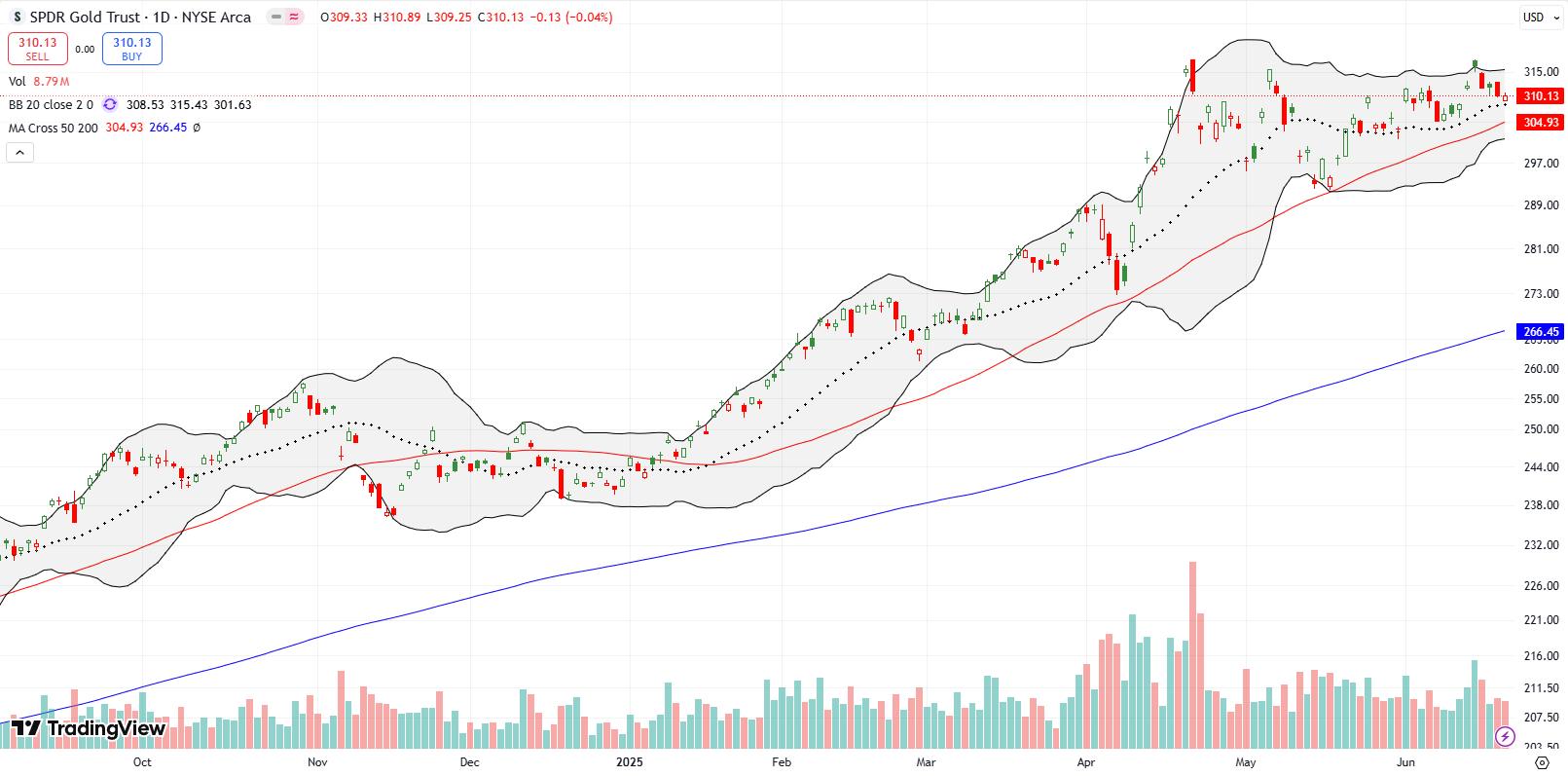
I wanted to go into the weekend with more hedges. GLD came to mind. With a light test of 20DMA support, I jumped on a July $320/$330 call spread. With 50DMA support holding up so well all year, I will happily add to my GLD position on a 50DMA test.
Carvana (CVNA)
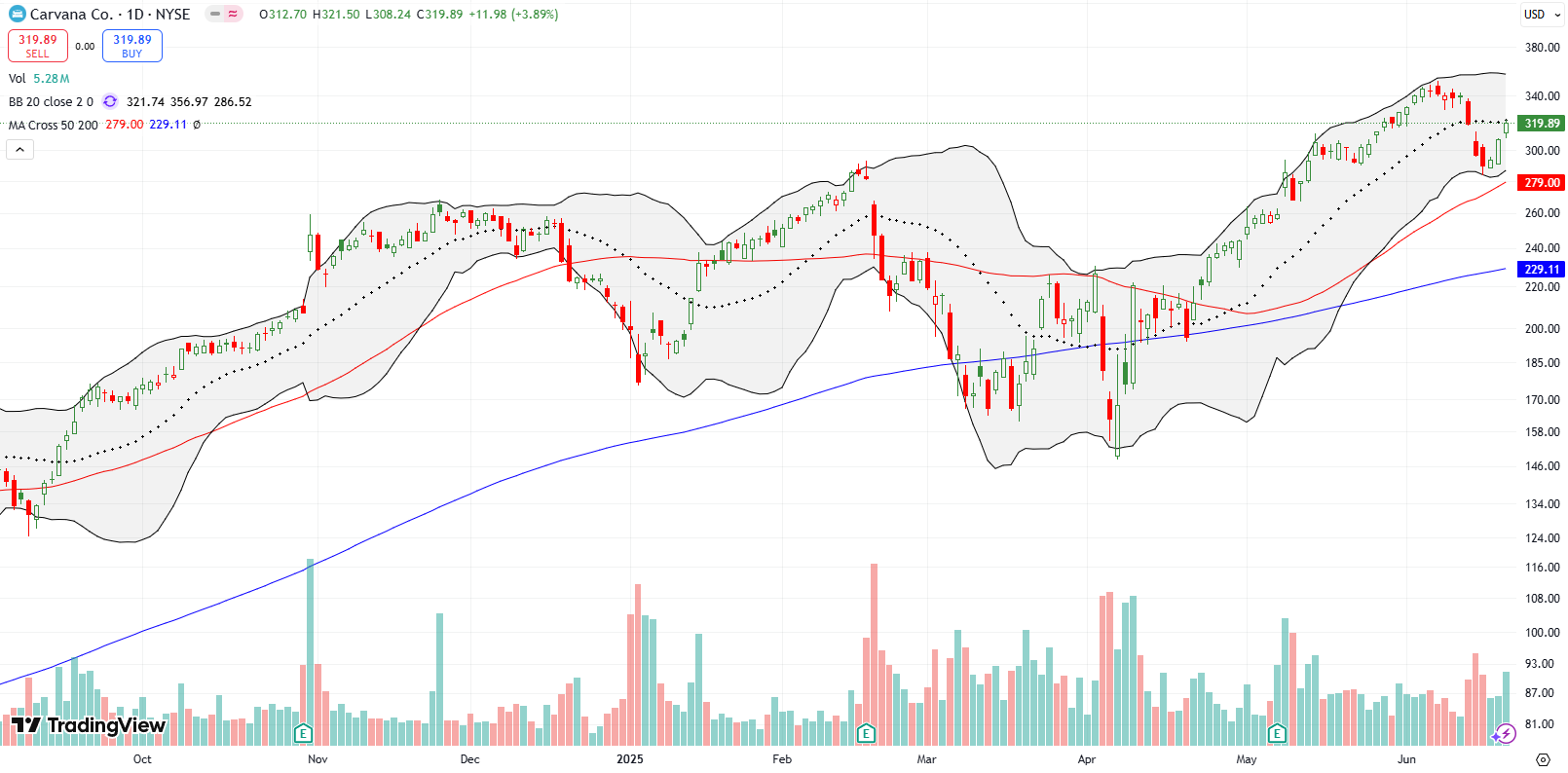
Incredibly, a little over two years ago, CVNA looked ready for bankruptcy as it collapsed 34% to $4.40/share.
Fast-forward to today and CVNA is freshly off a failed attempt to test its all-time high around $373. On June 11, Chanos revealed a new short position in CVNA (7:57 mark). The stock fell three straight days from there before rebounding sharply to 20DMA resistance. I decided to put CVNA on my short-list to act as a hedge against my trading bullishness. Clearly, as long as the market remains bullish, CVNA will continue levitating against the fundamentals that supposedly say it should trade a lot lower.
Apple (AAPL)
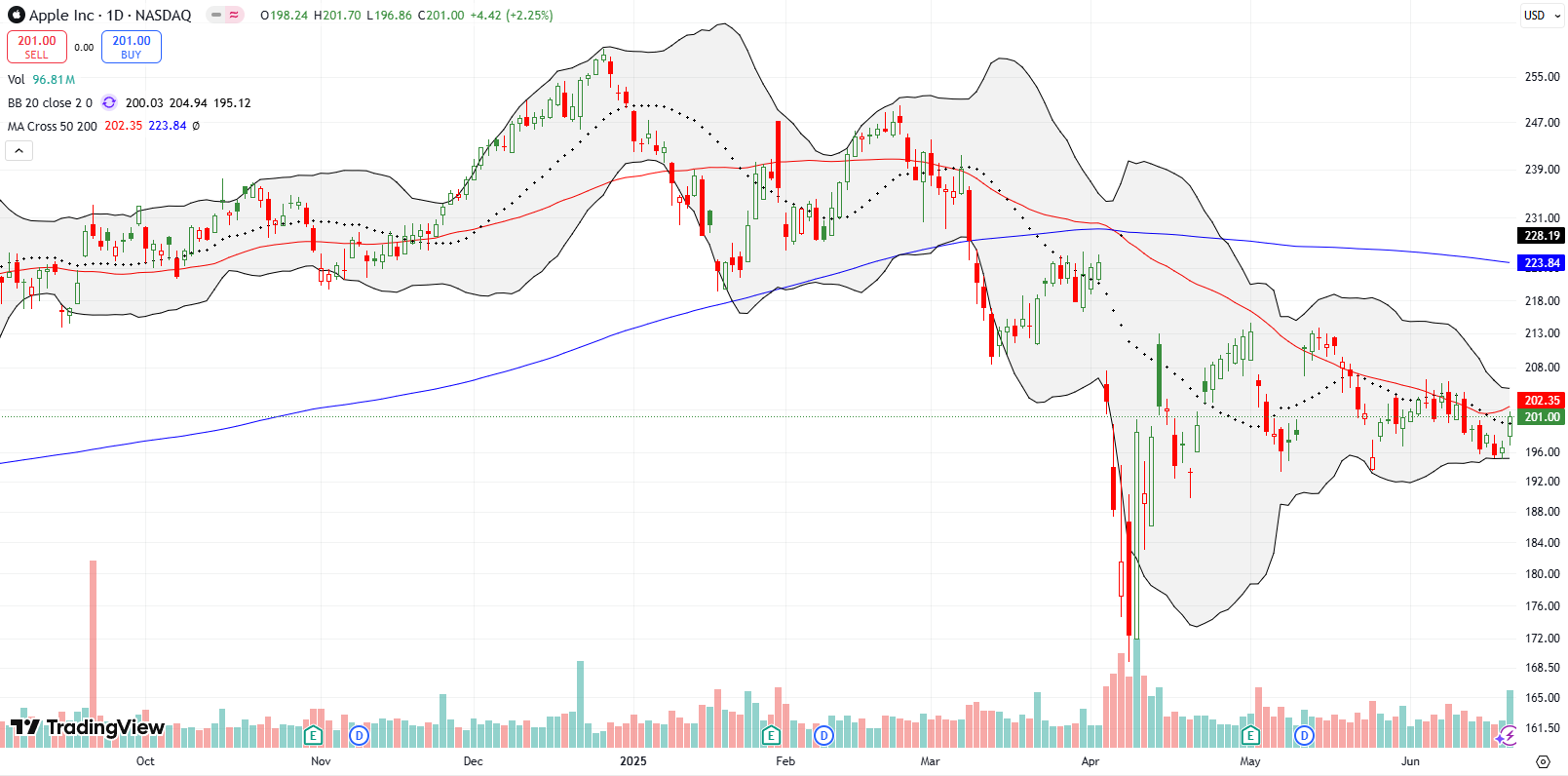
AAPL notably out-performed on Friday with a 2.3% gain. While the stock remains below its 50DMA, I noted how the downtrend line has now turned upward. High trading volume (on a triple witching day) suggests to me that AAPL could be close to ending my bearish position against the stock through shares in AAPD.
iShares US Home Construction ETF (ITB)
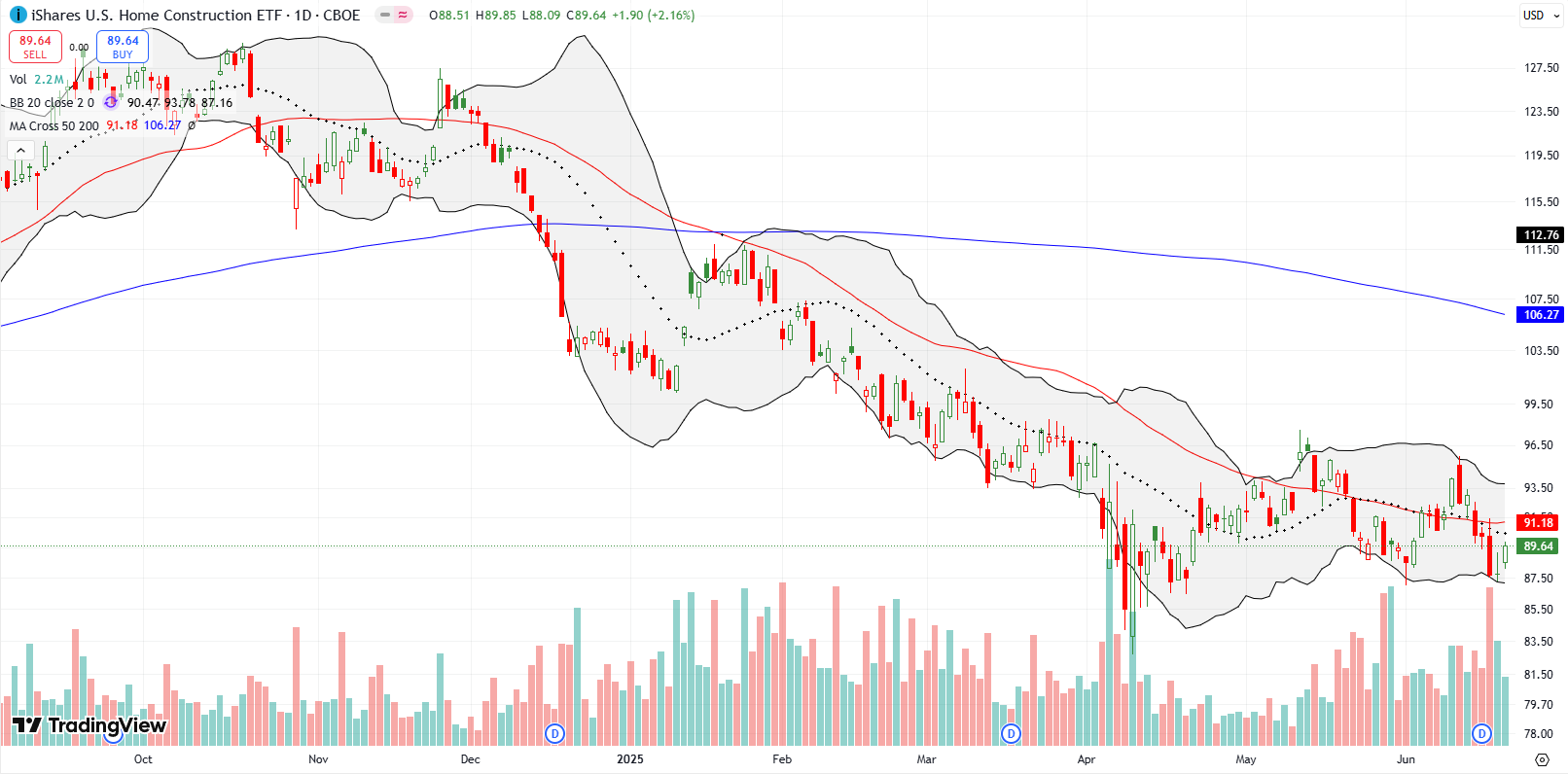
Rate sensitive stocks like home builders were boosted by a CNBC interview with Fed Governor Christopher Waller who insisted that the Fed should cut rates next month. He further claimed that tariffs look like they will have little impact on inflation, a direct contradiction to the narrative Powell just told on Wednesday. (Note well that Waller is supposedly on Trump’s short list to replace Powell next year – so benign commentary on tariffs is self-serving). ITB gained 2.2% in a rare day of out-performance. However, the downtrend defined by the 50DMA remains well intact.
Be careful out there!
Footnotes
Subscribe for free to get email notifications of future posts!
“Above the 50” (AT50) uses the percentage of stocks trading above their respective 50-day moving averages (DMAs) to measure breadth in the stock market. Breadth defines the distribution of participation in a rally or sell-off. As a result, AT50 identifies extremes in market sentiment that are likely to reverse. Above the 50 is my alternative name for “MMFI” which is a symbol TradingView.com and other chart vendors use for this breadth indicator. Learn more about AT50 on my Market Breadth Resource Page. AT200, or MMTH, measures the percentage of stocks trading above their respective 200DMAs.
Active AT50 (MMFI) periods: Day #33 over 20%, Day #31 over 30%, Day #26 over 40%, Day #21 over 50%, Day #19 over 60%, Day #5 under 70%
Source for charts unless otherwise noted: TradingView.com
Full disclosure: long IWM shares and calls, long USO put, long ACN, long GLD call spread, long CVNA put spread, long AAPD, long ITB
FOLLOW Dr. Duru’s commentary on financial markets via StockTwits, BlueSky, and even Instagram!
*Charting notes: Stock prices are not adjusted for dividends. Candlestick charts use hollow bodies: open candles indicate a close higher than the open, filled candles indicate an open higher than the close.
* Blog notes: this blog was written based on the heavily edited transcript of the following video that includes a live review of the stock charts featured in this post. I used ChatGPT to process the transcript.