

Earlier this month I launched PAIROS, the Panic AI Research On Software, to provide a structured approaching for assessing the (contrarian) investment thesis in software companies heavily impacted by the SaaSpocalypse. I ran a real-time test of PAIROS on Anthropic’s Mythos and developed a rationale for buying into Palo Alto Networks (PANW). So far, so good on that move even though the stock took a sharp dip on the way to higher prices (and I dutifully bought more stock on the dip). I have now turned the research focus on Atlassian Corporation (TEAM) which delivered a new release for AI-powered Rovo. This analysis is a follow-up to similar research on TEAM and Rovo two months ago.
The company recently released more features for its Rovo product which provides a large bundle of AI-driven features and services as a part of Atlassian’s “AI at Work” initiative. While I have only been able to use a small sample of Atlassian’s AI-enabled features, this latest Rovo release looks quite impressive. Thus, I am not surprised that this product release scored highly with PAIROS and confirmed my contrarian buy in TEAM.
This release supports the Levie/Jensen side of PAIROS: agents use tools, systems of record persist, and value moves toward platforms that own context, governance, and workflows. Rovo does not eliminate substitution risk, especially for generic project-management or documentation interfaces. However, Atlassian’s answer is credible because Rovo drives AI’s dependence on Atlassian’s work graph.
Rovo Gets High Marks from PAIROS
Final index scores were as follows:
- Viability Index (VI): 3.87
- Structural Condition Index (SCI): 4.16
- Economic Value Index (EVI): 3.99
Under the PAIROS framework, that combination qualifies as “great prospects” over the next 2 years.
Why the scores are positive
Viability: 3.87. Rovo strengthens Atlassian’s position against AI substitution risk. The key evidence is that Rovo Dev works from Jira items, gathers context, creates plans, runs code changes, and produces merge-ready pull requests in a controlled workflow. Developers still review and approve changes before shipping. This means AI is not bypassing Jira. AI is being routed through Jira.
Structural condition: 4.16. This is the strongest score. Jira and Confluence are acting as systems of record and workflow systems. Remix keeps the original Confluence page intact as the canonical source, while partner agents carry Confluence context into Lovable, Replit, and Gamma and link the output back to the source page through the Teamwork Graph. That is strong PAIROS evidence for context ownership, persistence, workflow embedding, and agent enablement.
Economic value: 3.99. Rovo creates a plausible path for Atlassian to capture AI-driven value inside its platform. Rovo Dev credits, Jira-based execution, partner agents, MCP skills, and Teamwork Graph context all point toward more usage around the Atlassian platform rather than less. The open question is monetization depth. The evidence shows product usage value clearly, but not yet the financial conversion rate.
The news matters because Atlassian is positioning Jira and Confluence as places where AI agents must work because those systems already hold the work, context, permissions, and source-of-truth records. PAIROS rewards this kind of positioning. PAIROS asks whether AI threatens viability, what structural condition the company is in, and whether AI makes the company more or less valuable.
What Atlassian Released
Atlassian’s recent announcements describe Rovo as AI that helps teams “move work forward.” The company is presenting AI as workflow execution embedded inside the tools where teams already operate.
The releases centered on three connected products.
Rovo Dev in Jira
Atlassian introduced Rovo Dev directly inside Jira. The company describes it as a context-aware AI teammate for software teams that can take Jira work items and move them toward merge-ready pull requests.
According to Atlassian, Rovo Dev can:
- gather context from Jira tickets
- review relevant code repositories
- propose implementation plans
- execute code changes
- run tests
- prepare pull requests for human review
Atlassian says developers remain in control, approving plans and reviewing code before anything ships.
The company also shared internal operating results. Atlassian said it cleaned up 12 stale feature flags in two days, improving cleanup velocity by about 85%. It also said 29 of 31 cleanup pull requests required no manual code changes. In a separate example, Atlassian stated its own teams use Rovo Dev to automatically resolve 51% of potential security vulnerabilities.
These claims are meaningful because the company is demonstrating measurable workflow outcomes.
Rovo Skills
Atlassian also highlighted Rovo Skills, which are repeatable AI workflows that take actions across enterprise apps.
Examples included:
- turning meeting transcripts into Jira work items
- writing status updates using work context across tools
- pulling marketing insights from connected data sources
- helping support teams analyze incidents faster
The company argues that AI becomes useful when it can do real work across systems rather than simply generate text.
Remix with Rovo in Confluence
Atlassian also launched Remix with Rovo and partner agents in Confluence.
This product allows teams to transform existing Confluence content into:
- charts
- diagrams
- infographics
- presentations
- prototypes
- starter apps through partners such as Replit, Gamma, and Lovable
Atlassian claims it has solved a “format problem.” Teams create lots of knowledge, but that knowledge often sits in documents people do not consume efficiently. Remix aims to turn existing knowledge into more useful formats without copy-pasting or losing context.
TEAM the Stock
Despite the big news, TEAM dropped 1.9% the day of the press release on April 8th. The stock sold off two more days before bottoming. During this period, software stocks across the industry were sold in the wake of fresh AI Panic from Anthropic’s Project Glasswing that introduced Mythos and revelations of substantial security flaws in enterprise software. The subsequent rebound from the panic took TEAM back to its downtrending 50-day moving average (DMA). Earnings are coming up this week on April 30th, so I expect the stock to stall at this critical resistance until then.
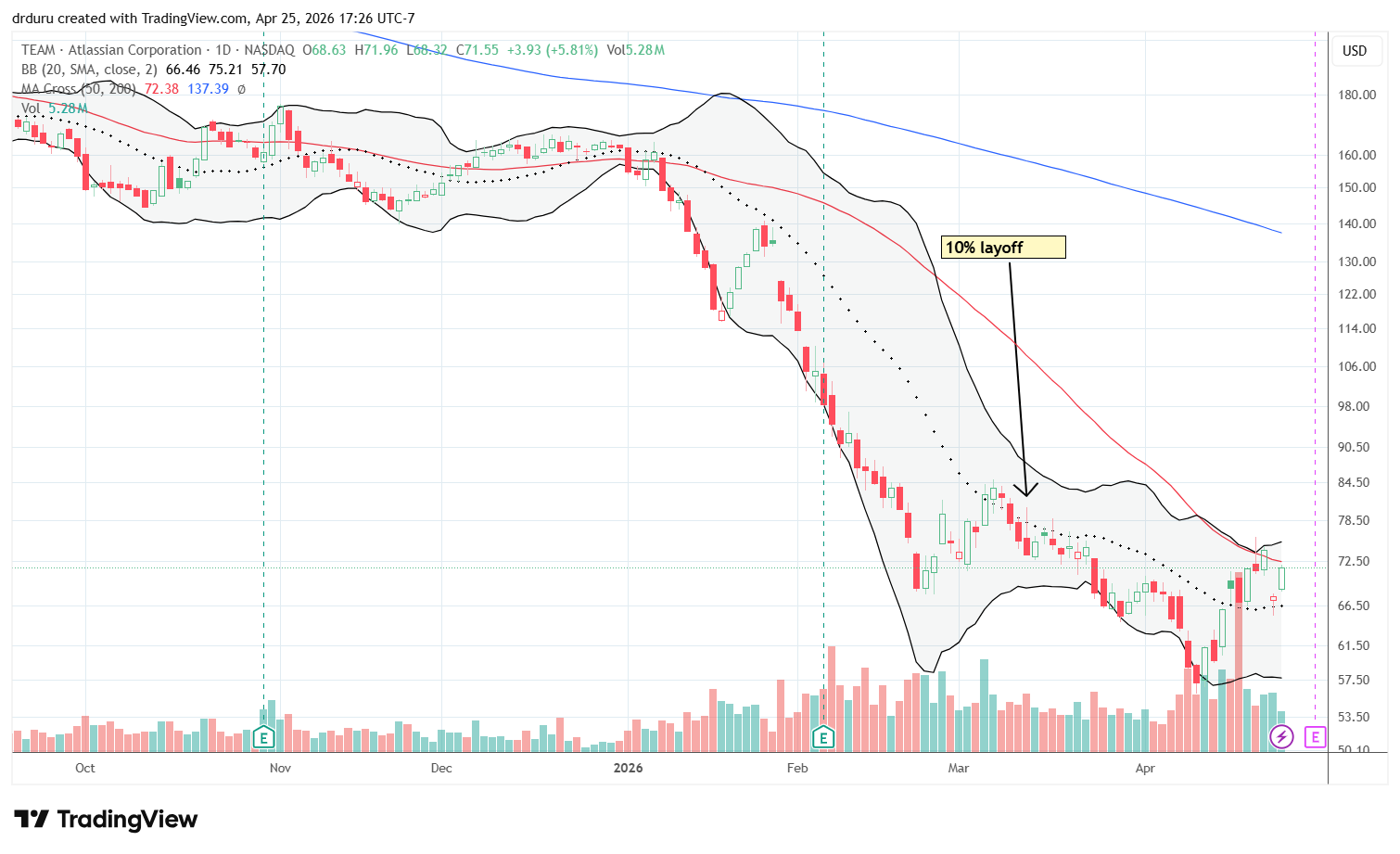
TEAM is attractively valued at a trailing price/sales of 3.3 and forward price/sales of 3.0. TEAM also trades a trailing price/earnings of 17 and forward P/E of 15. Its PEG ratio (P/E divided by expected growth rate) of 0.8 is attractive on an absolute basis and relatively cheap compared to the sector. Thus, TEAM’s valuation profile keeps me optimistic that investing through the short-term pain of the AI Panic offers a good risk/reward over the long-term.
Appendix: Full PAIROS Scoring Table for Atlassian Rovo Release
Scoring uses the PAIROS 1–5 scale where 3.0 = uncertain, above 3 is positive, below 3 is negative. Confidence weighting applied qualitatively.
1. Viability Index (VI)
| Dimension | Weight | Raw Score | Confidence | Adjusted Contribution | Rationale |
|---|---|---|---|---|---|
| Agent Substitution Boundary | 0.15 | 4.4 | High | 0.105 | AI agents use Jira/Confluence rather than bypass them |
| Capability Frontier Sensitivity | 0.15 | 4.0 | Medium | 0.053 | Better AI models likely improve Rovo usefulness |
| Recursive Improvement Exposure | 0.15 | 3.6 | Medium | 0.021 | Atlassian benefits, but must keep pace with frontier labs |
| Barrier to Software Replication | 0.10 | 4.1 | High | 0.055 | Workflow graph + installed base harder to copy |
| Tool Dependence of AI Systems | 0.10 | 4.3 | High | 0.065 | AI execution tied to Jira work items and Confluence docs |
| AI Supply Chain Resilience | 0.10 | 4.4 | High | 0.070 | Work remains inside Atlassian operating layer |
| Model Dependency Structure | 0.10 | 4.0 | Medium | 0.035 | Multi-model direction lowers single-vendor dependence |
| Demand Expansion Under AI | 0.15 | 4.1 | Medium | 0.058 | AI likely increases software coordination demand |
Final VI Score: 3.87
Interpretation: Atlassian appears more viable in an AI world because AI is reinforcing platform usage.
2. Structural Condition Index (SCI)
| Dimension | Weight | Raw Score | Confidence | Adjusted Contribution | Rationale |
|---|---|---|---|---|---|
| System Layer Position | 0.12 | 4.5 | High | 0.090 | Jira/Confluence remain core operating systems |
| Data Control & Context Ownership | 0.12 | 4.5 | High | 0.090 | Teamwork Graph owns valuable workflow context |
| Workflow Embedding Depth | 0.08 | 4.2 | High | 0.048 | Deeply embedded in daily work processes |
| Persistence Layer Role | 0.08 | 4.4 | High | 0.056 | Durable records of work, docs, tickets |
| Information Processing Ownership | 0.06 | 4.0 | Medium | 0.021 | Stores and validates work knowledge |
| Human Interface Dependency | 0.04 | 3.8 | Medium | 0.011 | Still UI heavy, but improving toward agent/API use |
| Agent Enablement Function | 0.08 | 4.5 | High | 0.060 | Platform enables governed AI execution |
| Domain Complexity Requirement | 0.08 | 4.0 | Medium | 0.028 | Enterprise workflow complexity is real moat |
| Tool Dependence of AI Systems | 0.04 | 4.3 | High | 0.026 | Agents need Jira/Confluence tools |
| AI Supply Chain Resilience | 0.08 | 4.4 | High | 0.056 | AI workflows remain anchored internally |
| Security Trust Premium | 0.10 | 4.3 | Medium | 0.046 | Governance/security important in enterprise AI |
| Patch Velocity Readiness | 0.10 | 3.9 | Medium | 0.032 | Large vendor with capability to iterate quickly |
Final SCI Score: 4.16
Interpretation: Atlassian is structurally well-positioned because it controls enterprise workflows, records, and context.
3. Economic Value Index (EVI)
| Dimension | Weight | Raw Score | Confidence | Adjusted Contribution | Rationale |
|---|---|---|---|---|---|
| Monetization Position | 0.15 | 4.0 | Medium | 0.053 | Rovo creates monetization opportunities |
| Value Capture Layer | 0.15 | 4.2 | High | 0.090 | Captures value near workflow source-of-truth layer |
| Commercial Defensibility | 0.15 | 4.0 | Medium | 0.053 | Embedded platform less commoditized than point tools |
| Demand Expansion Under AI | 0.15 | 4.1 | Medium | 0.058 | More AI may mean more managed work volume |
| Barrier to Software Replication | 0.10 | 4.1 | High | 0.055 | Hard to copy enterprise installed base + graph |
| Human-AI Complementarity | 0.10 | 4.4 | High | 0.070 | Humans supervise, approve, orchestrate |
| System Layer Position | 0.05 | 4.5 | High | 0.038 | Strong platform layer |
| Data Control & Context | 0.05 | 4.5 | High | 0.038 | Valuable proprietary workflow data |
| Capability Frontier Sensitivity | 0.05 | 4.0 | Medium | 0.018 | Better models help product utility |
| Tool Dependence of AI Systems | 0.05 | 4.3 | High | 0.033 | AI depends on Atlassian workflow tools |
Final EVI Score: 3.99
Interpretation: AI likely increases Atlassian’s value capture potential, though monetization proof still matters.
Final PAIROS Summary
| Index | Score | Meaning |
|---|---|---|
| Viability Index | 3.87 | Strong survival prospects |
| Structural Condition Index | 4.16 | Strong strategic structure |
| Economic Value Index | 3.99 | Positive value creation outlook |
Two important notes:
- Best score = SCI because Atlassian owns workflow systems and context.
- Lowest score = VI only because AI competition remains intense and fast-moving.
Be careful out there!
Full disclosure: long TEAM, long PANW