

ServiceNow puts AI in the core of its mission and software platform. From the company’s about page:
“ServiceNow is the AI control tower for business reinvention—and it all begins with workflows. We are a single platform that brings together any AI, any data, and any workflow, so you can completely reinvent how people work across every corner of your business….Like a single pane of glass where you can see and manage everything securely.”
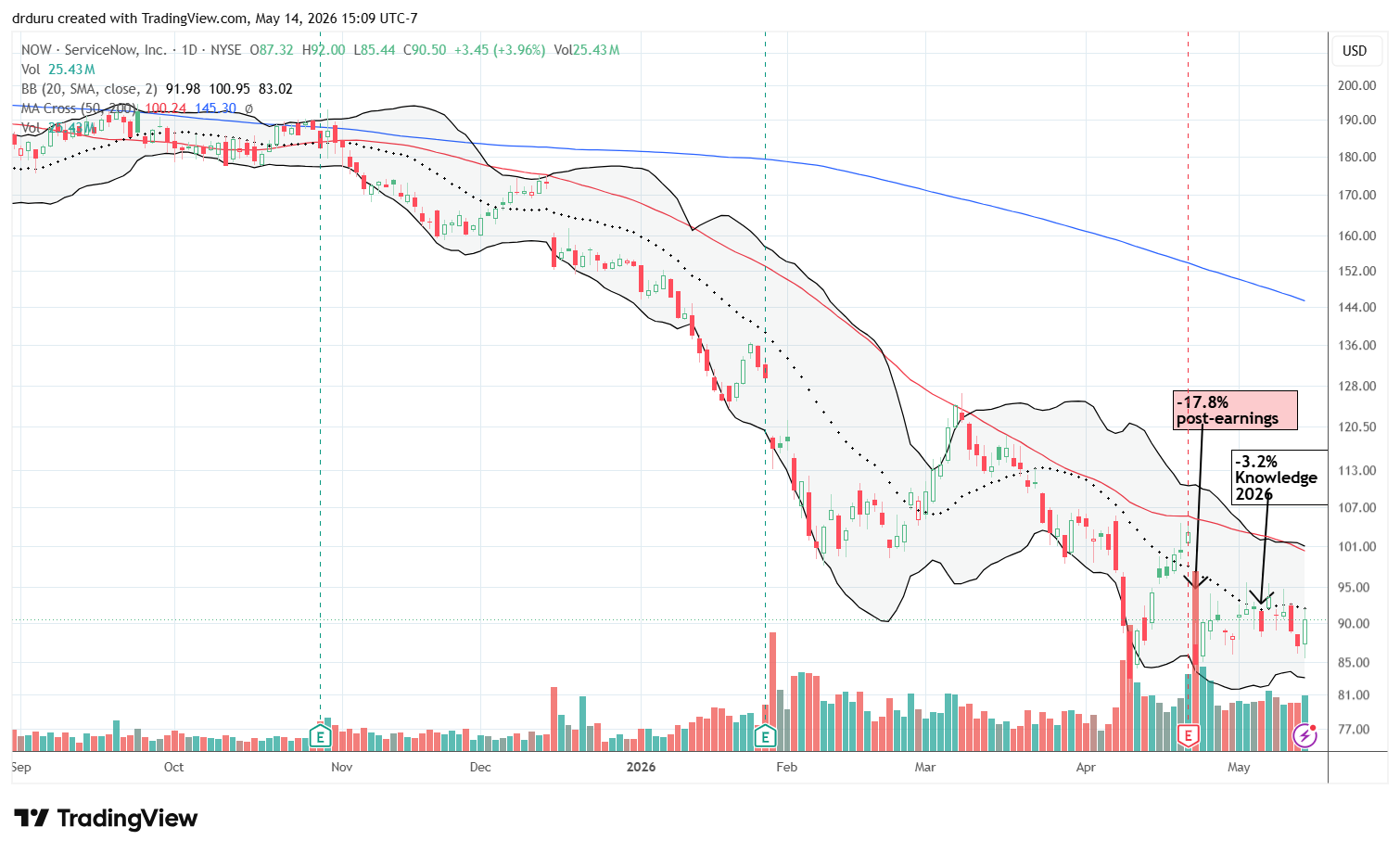
Yet, despite the company’s persistent and core AI-driven messaging, NOW has been crushed by the AI Panic driving the SaaSpocalypse. The stock is down 41% year-to-date, off 61% from its all-time high set in January, 2025, and it collapsed an historic 18% after reporting Q1 2026 earnings. At its bottom for the year, NOW traded at a 3-year low. Investors could not be more bearish…and the contrarian opportunity could not be more attractive even given the ongoing risks.
The strong AI-driven pronouncements continued in the company’s investor conference called Knowledge 2026. Flamboyant CEO Bill McDermott was as colorful as ever while positioning NOW as a company built for the AI-age: “We manage everyone else’s agents too. They can’t manage our agents because they don’t do what we do the way we do it.” Thus, I am not surprised that a PAIROS analysis of ServiceNow generated high scores.
I fed my PAIROS model (Panic AI Research on Software) one of ServiceNow’s AI blueprints titled “ServiceNow turns enterprise AI chaos into control with the platform for governed, autonomous work.” I supplemented the input with several key press releases from Knowledge 2026 including “ServiceNow Build Agent now works inside every major AI coding tool, governed by default.” The PAIROS model also used other Knowledge 2026 announcements on AI Control Tower, Autonomous Workforce, ServiceNow Otto, Action Fabric, Build Agent, AI Agent Studio, and App Engine Management Center.
AI-Driven
ServiceNow has positioned its platform as the governed execution layer for enterprise AI agents. The company is opening its platform as a system of action for agents, while tying agent activity to governance, enterprise context, workflows, permissions, auditability, and data controls. Last week, ServiceNow emphasized capabilities to sense across enterprise data, devices, and identities, decide with business context, act through AI specialists and workflows, and secure each step with governance that supports auditability.
On the developer side, Build Agent facilitates AI-generated apps and agents built from major coding tools that run and govern on ServiceNow with audit trails, security checks, compliance, scalability, performance, deployment approvals, release management, lifecycle governance, and quality gates.
Just this small sample of ServiceNow’s AI-driven capabilities should push PAIROS to high scores.
Great AI prospects for ServiceNow
ServiceNow indeed rated highly across each PAIROS index. In aggregate, this scoring amounts to a “great prospects” rating and a sharp contrast to the extremely bearish trading action in the stock.
| Index | Final score | Interpretation |
|---|---|---|
| Viability Index | 4.19 | Positive |
| Structural Condition Index | 4.48 | Positive, near very positive |
| Economic Value Index | 4.22 | Positive |
| Overall PAIROS description | Great prospects | All three indices are above 3.8 |
(See the Appendix below for a breakdown of the indices)
ServiceNow scores strongly because the company is addressing the layer where AI needs help: enterprise context, governed execution, permissions, auditability, workflow state, and cross-system action. ServiceNow integrates with external agents while governing them, making the company a potential beneficiary of agent proliferation.
The Build Agent announcement reframes vibe coding as a demand driver for ServiceNow. If AI-generated applications create shadow IT, compliance risk, poor maintainability, and technical debt, then ServiceNow’s governed runtime becomes even more valuable. One risk is that the market may not pay as much for this governance layer as ServiceNow expects, but the structural position is strong.
What Knowledge 2026 Reinforced for ServiceNow
Highlights:
- Tool Dependence of AI Systems: Action Fabric, MCP Server, and Build Agent increase the chance that agents route through ServiceNow instead of bypassing it.
- Agent Enablement Function: AI Agent Studio and Autonomous Workforce make ServiceNow a place where agents are built, deployed, and governed.
- Security Trust Premium: AI Control Tower directly addresses enterprise anxiety about agent sprawl, access control, hallucination, auditability, and AI spend.
- Demand Expansion Under AI: More agents create more need for control, observability, workflow execution, identity governance, and lifecycle management.
Still uncertain:
- Monetization Position: ServiceNow has a plausible path to capture value, but the 2030 ACV target is still a management target, not realized evidence.
- Patch Velocity Readiness: The company is moving toward faster AI-native delivery, but platform complexity remains a constraint.
- Human Interface Dependency: Otto may become a powerful AI front door, but agent-first consumption will matter more than UI strength under PAIROS.
The high PAIROS rating raises the question about NOW’s disastrous earnings report. So, with the PAIROS analysis in the context, I fed ChatGPT the transcript from the Q1 earnings call and asked the basic question: “what went wrong?” (The following commentary is highly edited output from ChatGPT)
An impatient market
The market rejected the near-term financial translation of ServiceNow’s AI-driven strategy.
The earnings conference call delivered a strong strategic argument but a weaker near-term earnings argument. ServiceNow said AI is a major tailwind, raised its AI commitment target from $1B to $1.5B, and described its “AI control tower” architecture as proof positive. However, the earnings included three problems: organic guidance did not clearly move higher, lowered margins from the Armis acquisition, and management repeatedly asked the market to trust future AI acceleration that has not yet fully appeared in reported numbers.
ServiceNow beat Q1 guidance, but it did not deliver the kind of clean organic acceleration investors demand from an AI winner.
The company raised full-year subscription revenue guidance by $205M at the midpoint, but that increase included a 125 basis point contribution from Armis. Q2 subscription revenue and cRPO (Current Remaining Performance Obligation) guidance also included a 125 basis point Armis contribution. At the same time, Armis created a 75 basis point full-year operating margin headwind, a 200 basis point free cash flow margin headwind, and a 125 basis point Q2 operating margin headwind.
So while AI is supposed to accelerate revenue, guidance only increased with an acquisition that included some margin dilution. In coming quarters, ServiceNow needs to shift from positioning to definitive and compelling results.
Where’s the AI in the Earnings Results?
During Q&A, analysts attempted to assess whether the AI story is already in the company’s guidance.
One analyst noted that the stock was already down 12% after-hours and said “something is not getting through to investors.” He then framed two concerns: uncertainty about inorganic contribution to Q1, and the fact that the full-year number did not really move outside of Armis and currency. He also compared ServiceNow’s $1.5B Now Assist target to the much larger ARR gains being reported by AI labs and asked when ServiceNow would get organic positive revisions from generative AI.
President and CFO Gina Mastantuono responded. She said the Veza and Pyramid acquisitions were tiny contributors, that ServiceNow would have beaten regardless, that some on-prem deals slipped to Q2, and that the company held the guide excluding Armis despite conflict-related uncertainty. She defended the quarter while also confirming the market’s concern: excluding Armis, the full-year subscription guide was not raised.
ServiceNow is asking investors to believe in an AI flywheel. Yet the earnings conference call showed the flywheel more through anecdotes, targets, and future Knowledge 2026 promises than through a raised organic full-year guide.
Not Enough Performance With the Confidence
McDermott gave a highly aggressive strategic defense. Much of it was directionally consistent with the PAIROS conclusion: ServiceNow is arguing that AI increases the need for workflow control, context, security, and governed execution. The company said it has more than 95B annual workflows and more than 7T transactions feeding context, and it positioned Context Engine as the difference between ServiceNow AI and foundation models.
The highly confident tone may have worked against the company. Statements like “there has never been a tailwind for ServiceNow like AI,” “there’s a perfect correlation between enterprise AI from any source and ServiceNow’s expansion,” “that’s a guarantee,” and “Armis is going to be our Instagram” are big and bold. They raise the evidentiary bar and burden of proof. When the financial guide does not show a clean organic raise, investors can hear those claims as over-promotion rather than disciplined forecasting. These kinds of boasts also pair poorly with a contrarian trade!
The market looked for a bridge from AI product traction to revenue, cRPO, margins, and free cash flow. The company delivered pieces of that bridge, but not enough. It said AI commitments may reach $1.5B, Now Assist is outperforming, AI Control Tower deal sizes more than doubled quarter-over-quarter, RaptorDB Pro deal volume grew 80%, and EmployeeWorks already closed 6 deals above $1 million in net new ACV. Those data points are real positives. But the company did not fully resolve how fast those metrics convert into organic subscription revenue acceleration.
Here is a summary and explanation of analyst concerns:
| Investor concern | Evidence from the call | Why it hurt |
|---|---|---|
| Organic acceleration was not obvious | Full-year guide was raised, but Armis contributed 125 bps | Investors wanted AI to lift the core guide, not just acquisition-adjusted revenue |
| Margin quality weakened | Armis lowered full-year operating margin, free cash flow margin, and Q2 operating margin | Growth stocks need clean growth and margin durability |
| AI monetization is still being proven | AI commitment target rose to $1.5B, but management promised more detail later | Investors wanted proof now, not at Knowledge 2026 |
| M&A clouded the story | Analysts asked about Veza, Pyramid, Moveworks, and Armis | The market questioned whether growth is organic, acquired, or both |
| Macro/geopolitical noise complicated the quarter | Middle East on-prem deals slipped and affected revenue timing | Even if temporary, it reduced the cleanliness of the print |
| Competitive AI anxiety remains unresolved | Analysts asked about AI labs, agentic orchestration, pricing, and core discount risk | The market still fears value leakage to AI-native players |
PAIROS conclusion is forward-looking
Given the disconnect between current guidance and the bullish AI positioning, the “great prospects” rating from PAIROS from NOW is more forward-looking than the typical assessment. The company came to the earnings conference call with a structurally compelling PAIROS story: agents need context, identity, workflow, governance, security, and execution. ServiceNow has those assets. But investors came to earnings asking a more immediate question: where is the organic upside in the numbers?
The answer remains in the future. The monetization bridge was deferred to Knowledge 2026 and that day still did not assuage skeptical investors since NOW fell 3.2% that day. The stock is still struggling to recover from the selling on that day. While PAIROS favors the AI-strategy, investors need cleaner proof. I am betting that this divergence represents the upside opportunity in coming quarters.
Epilogue
In a Bloomberg Television interview, McDermott explained the company’s workforce adjustments and justified the company’s internal use of AI. My alarm bells rang when he sang the familiar refrain highlighting the advantage of robots over humans: “They work hard 24 by7 [sic]. You don’t have to pay them, and they don’t eat any lunch and they don’t have any health care benefits. So they’re very affordable and that really complements our workforce.” Even though he claimed the company is still hiring, I have a strong bias against companies that extol the virtues of firing employees and replacing full-time workers with cheaper substitutes. So while I remain bullish on the stock, I am quite ready to exit the trade if the company fails to pivot more strongly toward AI as value-creation and revenue generation.
Appendix
Viability Index scoring
| Dimension | Weight | Score | Confidence | Adjusted score | Rationale |
|---|---|---|---|---|---|
| Agent Substitution Boundary | 0.15 | 4.6 | High | 0.80 | ServiceNow is explicitly trying to become the platform agents use, not a workflow system agents bypass. |
| Capability Frontier Sensitivity | 0.15 | 4.2 | Medium | 0.42 | Stronger models should increase the value of governed execution, but some application-level functions still face model-driven compression. |
| Recursive Improvement Exposure | 0.15 | 4.0 | Medium | 0.35 | The platform benefits from AI progress, but recursive coding improvements also pressure app-building and workflow customization economics. |
| Barrier to Software Replication | 0.10 | 4.5 | High | 0.75 | ServiceNow’s embedded workflows, data models, permissions, governance, and enterprise integrations are difficult to replicate quickly. |
| Tool Dependence of AI Systems | 0.10 | 4.4 | Medium | 0.49 | Action Fabric, MCP Server, Build Agent, and governed app deployment make ServiceNow more useful to agents, but not every enterprise action must route through ServiceNow. |
| AI Supply Chain Resilience | 0.10 | 4.6 | High | 0.80 | ServiceNow’s claim is that agents can act inside the workflow and governance layer without rebuilding enterprise processes externally. |
| Model Dependency Structure | 0.10 | 4.7 | High | 0.85 | ServiceNow emphasizes any model, any cloud, and any data source, reducing dependence on one AI provider. |
| Demand Expansion Under AI | 0.15 | 4.3 | Medium | 0.45 | AI increases demand for governed agent execution, but adoption and budget conversion still need proof beyond early customer examples and targets. |
VI = 4.19
Structural Condition Index scoring
| Dimension | Weight | Score | Confidence | Adjusted score | Rationale |
|---|---|---|---|---|---|
| System Layer Position | 0.12 | 4.8 | High | 0.90 | ServiceNow is a system of action, orchestration layer, and workflow governance platform. |
| Data Control & Context | 0.12 | 4.7 | High | 0.85 | Context Engine, data catalog, identity, assets, workflows, and transaction history support workflow-critical context. |
| Workflow Embedding Depth | 0.08 | 4.8 | High | 0.90 | ServiceNow’s core product is deterministic workflow execution with permissions, approvals, and policy controls. |
| Persistence Layer Role | 0.08 | 4.6 | High | 0.80 | ServiceNow persists workflow state, audit trails, agent actions, operational history, and configuration context. |
| Information Processing Ownership | 0.06 | 4.2 | High | 0.60 | The company is more than analysis or presentation; it stores, validates, routes, and governs operational information. |
| Human Interface Dependency | 0.04 | 4.2 | Medium | 0.42 | Otto is a human-facing front door, but ServiceNow is also moving toward headless and agent-consumable execution through Action Fabric and MCP. |
| Agent Enablement Function | 0.08 | 4.7 | High | 0.85 | ServiceNow provides governed capabilities for agents to work on data, workflows, and system functions. |
| Domain Complexity Requirement | 0.08 | 4.4 | High | 0.70 | IT, HR, security, risk, CRM, employee workflows, identity, compliance, and regulated execution require domain depth. |
| Tool Dependence of AI Systems | 0.04 | 4.3 | Medium | 0.45 | Agents can use ServiceNow as a governed action layer, but tool dependence will vary by customer architecture. |
| AI Supply Chain Resilience | 0.08 | 4.6 | High | 0.80 | The pitch is built around avoiding external workflow reconstruction and external governance drift. |
| Security Trust Premium | 0.10 | 4.7 | High | 0.85 | ServiceNow’s AI Control Tower, identity governance, agent observability, audit controls, and security stack directly map to rising trust requirements. |
| Patch Velocity Readiness | 0.10 | 4.0 | Medium | 0.35 | Monthly release ambition and quality gates help, but the evidence is less direct than for governance and orchestration. |
SCI = 4.48
Economic Value Index scoring
| Dimension | Weight | Score | Confidence | Adjusted score | Rationale |
|---|---|---|---|---|---|
| Monetization Position | 0.15 | 4.2 | Medium | 0.42 | ServiceNow says AI should become a large share of ACV, but this remains partly forward-looking. |
| Value Capture Layer | 0.15 | 4.1 | High | 0.55 | ServiceNow captures value through workflow state, execution, governance, and source-of-action position. |
| Commercial Defensibility Under Software Abundance | 0.15 | 4.5 | High | 0.75 | AI makes app generation easier, but ServiceNow is defending the harder layer: governed enterprise runtime. |
| Demand Expansion Under AI | 0.15 | 4.3 | Medium | 0.45 | More agents should increase need for control, monitoring, workflow execution, and governance. |
| Barrier to Software Replication | 0.10 | 4.5 | High | 0.75 | AI coding tools can recreate interfaces and simple apps; they cannot easily recreate ServiceNow’s process capital and governance layer. |
| Human-AI Complementarity Potential | 0.10 | 4.5 | High | 0.75 | ServiceNow’s model is explicitly human-governed autonomous work, not pure human replacement. |
| System Layer Position | 0.05 | 4.8 | High | 0.90 | Strong system-layer position improves monetization potential. |
| Data Control & Context | 0.05 | 4.7 | High | 0.85 | Workflow-critical context supports differentiated economic value. |
| Capability Frontier Sensitivity | 0.05 | 4.2 | Medium | 0.42 | Better models make the platform more useful, but also reduce the cost of building competing features. |
| Tool Dependence of AI Systems | 0.05 | 4.3 | Medium | 0.45 | ServiceNow is making itself more agent-consumable, though dependence is not universal. |
EVI = 4.22
Full disclosure: long NOW