

Introduction
I have been working on a framework to make sense of AI’s impact on the enterprise software industry. The ongoing SaaSpocalypse caused by an AI Panic has given this research extra urgency because I suspect the sell-off has created contrarian opportunities to buy impacted stocks for significant upside gains in coming years. I created a structured, analytical approached backed by the multifaceted insights of various experts. The resulting model is called Panic AI Research On Software, or PAIROS.
I used a “beta” version of PAIROS to conclude that Atlassian (TEAM) will survive the SaaSpocalypse. The model also kept me in the stock despite the company’s recent layoffs do not alter the thesis. Yet PAIROS produced results that were difficult to interpret and did not enforce normalized measurements. ChatGPT did most of the heavy lifting of model building. I recently upgraded PAIROS to make the model more robust and easy to understand. I took over the model building, but I did use ChatGPT to help me break down the logic and the scoring system into small, digestible modules. The process was iterative and thorough.
PAIROS is not a prediction tool. It does not provide buy and sell recommendations on software stocks. PAIROS does not try to collapse the data into a single conclusion. Instead, this model uses a set of consistent rules to measure the impact of AI on software companies. The interpretation of the results currently occurs on a case-by-case basis. Hopefully over time, I will see enough patterns in these results to upgrade PAIROS with a decision engine.
How PAIROS Operates
Core Questions
PAIROS answers three questions as scored indices:
- Viability Index (VI): Does AI threaten the software company’s viability?
- Structural Condition Index (SCI): If the company survives the AI challenge, what condition is it likely to be in?
- Economic Value Index (EVI): Does AI make this company more valuable or less valuable?
PAIROS also answers these questions relative to categories of software companies.
Competing Frameworks
PAIROS answers the core questions by scoring a company (or a software category) across 20 dimensions. These 20 dimensions came from studying competing frameworks from six experts:
- Aaron Levie, CEO of Box, Inc
- In a CNBC interview, Levie described how AI redistributes value toward software that agents depend on.
- Doug O’Laughlin, semiconductor analyst
- O’Laughlin popularized the term SaaSpocalypse. He described the AI-driven death of software in “The Death of Software 2.0 (A Better Analogy!)” and in “AI is Creating Peak Software, Media is the Best Analogy” arguing that AI abstracts away software. The release of Claude Code confirmed for him his argument.
- Steven Sinofsky, seed investor and author of “Hardcore Software: Inside the Rise and Fall of the PC Revolution”
- In “Software Dead? Nah“, Sinofsky argues that “AI changes what we build and who builds it, but not how much needs to be built. We need vastly more software, not less.” The demand for software is far from satiated according to Sinofsky.
- Sinofsky references the doom and gloom during earlier industry transitions as points of comparison. He also points out how people rush to make predictions during transitions, the majority of which fail to materialize.
- Matt Shumer, CEO of HyperWriteAI and OthersideAI
- In “Something Big Is Happening“, Shumer marvels at how much coding he has delegated to AI and warns that a major wipeout is coming for software companies and software development work.
- The compounding of coding capabilities is compressing timelines of innovation.
- Connor Boyack, President of Libertas, Kids Markets, and Praxis
- Boyack responds to Shumer’s alarm in “AI isn’t coming for your future. Fear is” and argues that the concerns over what is seen overwhelms the unseen positives including new demand, new workflows, and new monetization enabled by AI-driven cost reductions. Boyack’s insights build on the ideas of economist Frédéric Bastiat from 1850.
- Jensen Huang, CEO of NVIDIA (NVDA)
- In a CNBC interview, Huang clarifies that agents use tools (software) rather than simply replacing them and can even increase the use of tools.
- Humans move up the abstraction “stack.”
Scoring
I synthesize these competing frameworks by scoring each of the twenty dimensions distilled from them. Those scores are in turn aggregated into the three indices introduced earlier:
- Viability Index (VI)
- Structural Condition Index (SCI)
- Economic Value Index (EVI)
Each index is a weighted sum of a unique subset of the dimensions which are in turn further adjusted by ChatGPT’s level of confidence in scoring the dimension. I have instructed ChatGPT to be a critical thinker that is allowed uncertainty. Every score must be justified, backed by references from authoritative sources.
I do not force a further aggregation or conclusion. Instead, I create a general interpretation of the indices with the following classification ranges using case logic:
- VI >= 3.8 AND EVI >= 3.8 AND SCI >= 3.8 → “great prospects”
- Only two indices above 3.0 → “good potential”
- VI >= 3.8 AND EVI <= 2.2 → “survives but loses value”
- VI <= 2.2 AND SCI >= 3.8 → “structurally strong but at risk of disruption”
- SCI >= 3.8 AND EVI <= 2.2 → “durable but economically pressured”
- Otherwise → “mixed prospects”
Note that there are many more permutations possible. These classifications are only starting points. I did not include a classification of a company or category of software that scores poorly across two or three indices.
Continuous Learning
Finally, the weekly scans also search for new insights to update PAIROS. With 20 dimensions already incorporated into the model, I expect updates to happen infrequently, at least in the near future.
Anthropic provided a timely use case for testing the validity of PAIROS.
Applying PAIROS: Anthropic’s Project Glasswing
Anthropic announced Project Glasswing on April 7, 2026 as a partnership with several big tech companies and cybersecurity software companies to use AI for cybersecurity. AI models can now autonomously discover and exploit software vulnerabilities at scale. Anthropic explained that in testing, Claude Mythos Preview identified thousands of vulnerabilities across operating systems, browsers, and critical infrastructure software. Some of these vulnerabilities had existed for decades.
AI dramatically lowers the cost of attacking software. Yet, AI also dramatically improves the ability to defend software. The question for PAIROS is whether Anthropic’s solution will threaten the business of existing cybersecurity software companies even though the partnership includes cybersecurity software companies Palo Alto Networks (PANW) and Crowdstrike (CRWD).
PAIROS Measurement: Cybersecurity Software
I used ChatGPT to help summarize the PAIROS output for publishing.
Unit of analysis: Cybersecurity software (category)
Time horizon: 0–2 years
Viability Index (VI): 2.94
Glasswing replaces parts of what security professionals do today. Vulnerability discovery, exploit generation, and analysis can now be automated. At the same time, security systems are still needed. AI is just changing how the work gets done.
PAIROS identified a mixed result for VI. Viability is not collapsing, but it is under pressure.
Structural Condition Index (SCI): 3.78
Cybersecurity remains deeply embedded in systems and workflows. It sits across infrastructure, endpoints, networks, and software development pipelines. The structure holds.
Even as AI takes over more of the work, the need for systems of record, monitoring, and orchestration does not go away. If anything, these systems become more important.
Economic Value Index (EVI): 3.62
AI increases the number of vulnerabilities discovered while it also compresses attack timelines. AI raises the stakes and thus drives demand for cybersecurity software.
Security becomes more necessary, not less. Companies will spend more to protect systems.
Final Classification
Using the characterization ranges, PAIROS evaluated Project Glasswing as having “good potential” on the cybersecurity industry.
The stock market’s positive, initial reaction across cybersecurity stocks confirmed the conclusion from PAIROS.
The Market Reaction
The 15-minute chart below shows the immediate impact of Anthropic’s press release for Project Glasswing. The pattern fits a narrative of hesitation and then realization.
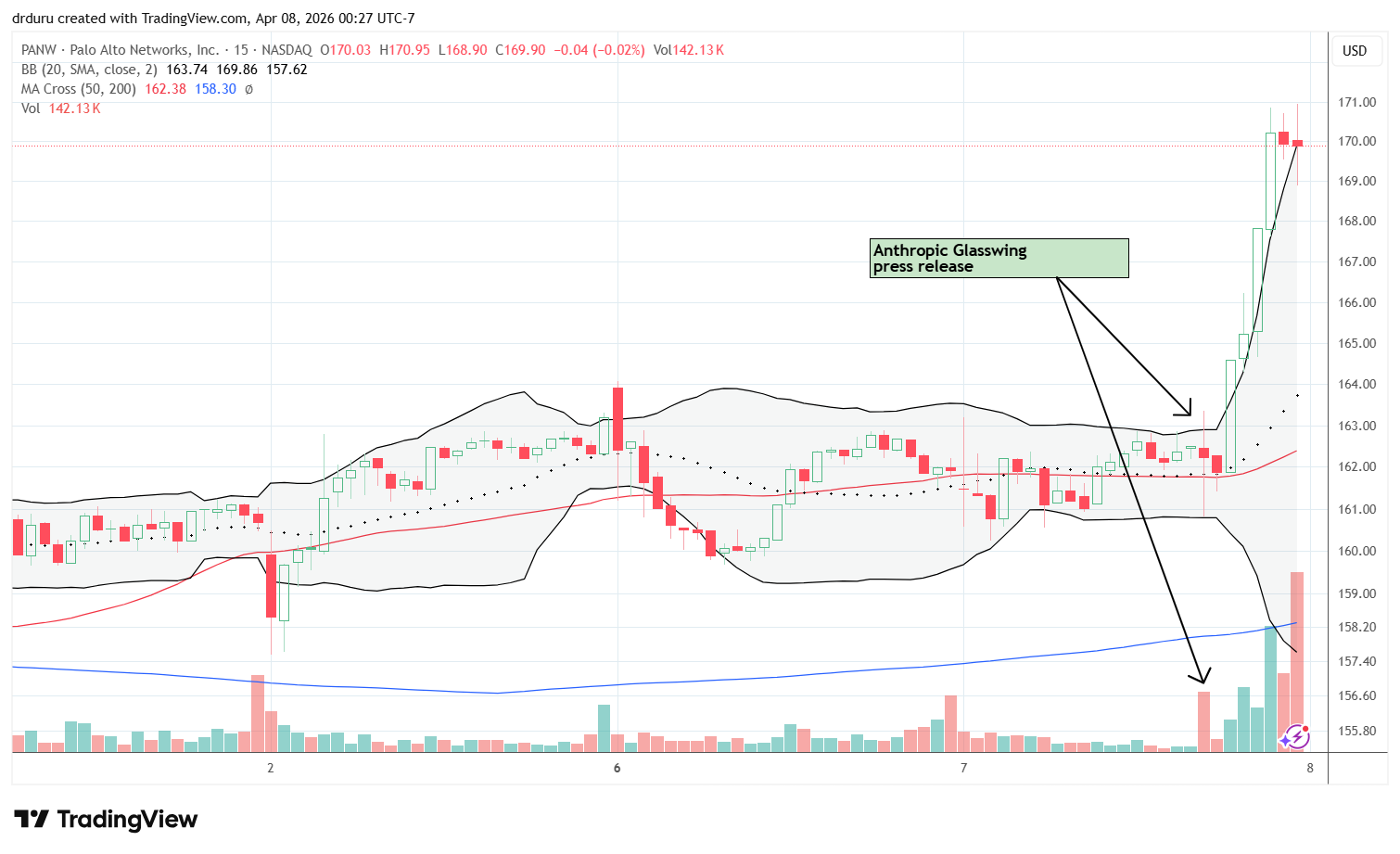
Trading volume (the bars at the bottom of the chart) instantly rose with buyers and sellers swinging the stock wildly (see the highs and lows of the single 15-minute candle), likely aided by trading algorithms coming to instant conclusions about the news. Volume plunged back to normal in the next 15 minutes as the markets took some time to absorb the news. Presumably more humans took over the decision-making. Volume surged again in the next 15 minutes and buyers sent the stock into an intraday breakout. The final rush to buy was aided by a strong close in the last 45 minutes of trading across the stock market (in anticipation of a cease fire in Israel and the U.S.’s war against Iran).
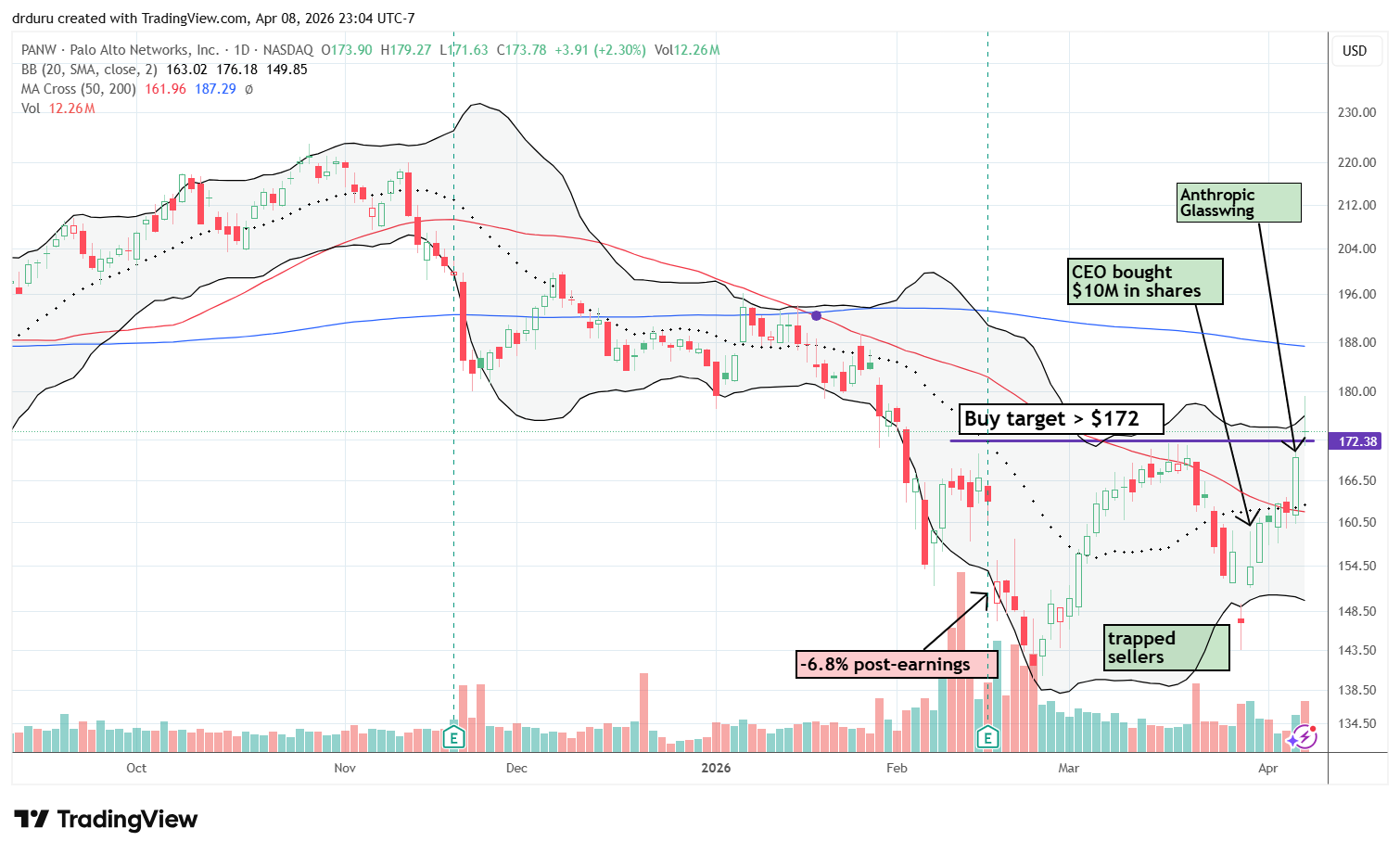
PANW closed up 4.9% for the day. The stock even crossed the $172 buy threshold I set up the previous week as a condition for piggybacking on the CEO’s $10M purchase in shares.
So far, Project Glasswing looks like an example of how AI can both disrupt and strengthen a software sector. (Of course, it is anyone’s guess what happens to the next from here!)
What to Expect Next from PAIROS
Every Friday morning, my ChatGPT will run PAIROS as a scan of AI-related software news.
Each week will include:
- a focused analysis of one key development
- full scoring across all dimensions
- computed VI, SCI, and EVI
- a classification based on the PAIROS framework
PAIROS also works for ad hoc analyses of the news and even for earnings reports from software companies. I will report significant findings and updates here on One-Twenty Two.
I am encouraged by the upgrade in PAIROS. This improvement required a systematic and methodical review of each competing framework and a collaborative synthesis with ChatGPT. The process taught me how to guide ChatGPT toward creating robust analytical models. There will be more to come!
Contact me if you are interested in a complete copy of the PAIROS model.
Full disclosure: long PANW, CRWD, BOX
Great write up. A lot of it is definitely going over my head, but I’m trying to absorb as much as I can from you. Your information has definitely prevented some impulsive decision making on my end. What are you thoughts on ADBE ? I know AI has servicenow down badly, But i guess TEAM could be the rotation.
I’d love to know how I can make things clearer. At some point, I want to release this model for general use.
I thought ADBE would be my obvious software buy this year. But the stock has consistently trended down and never “tricked” me into a buy. From a technical standpoint, it is one of the worst of the bunch given the 20021 peak and the constant selling from there. So, I took ADBE off my list. I still check it from time to time.
NOW and TEAM SHOULD be eventual winners but the market clearly doesn’t think so. I wrote in detail about TEAM in an earlier post. The hard part about being contrarian is that the market can be wrong for as long as it wants to be. 🙂
Last week was a great example of just how panicked the market is. PANW was first deemed a winner when I wrote this piece. The very next two trading days, PANW suddenly looks like a loser as all cybersecurity stocks were sold off hard. The sheer force of this panic is awesome to behold.